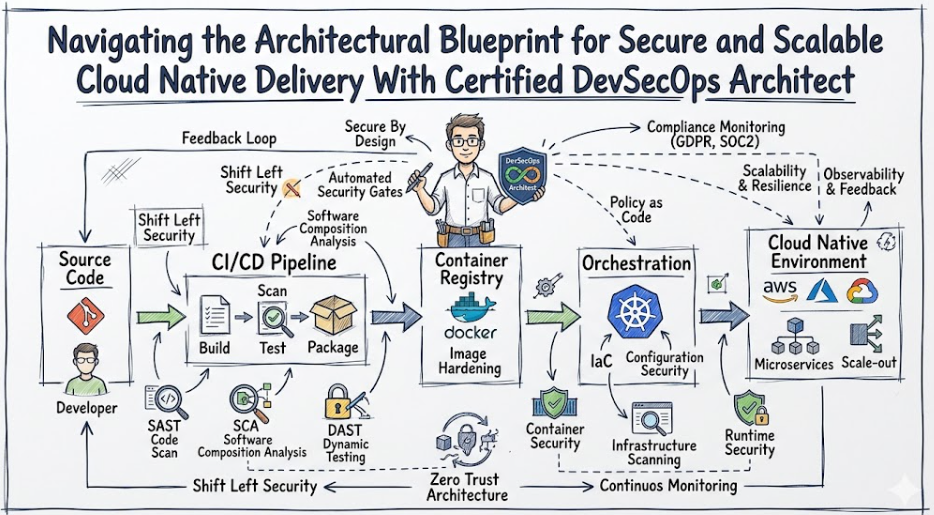
A significant change from old security silos to a unified, automated approach is now required by cloud-native ecosystems.. This Certified DevSecOps Architect roadmap provides DevSecOpsSchool professionals and SREs with the necessary framework to lead this transition. Because legacy manual checks cannot keep pace with modern release cycles, this guide clarifies how architectural expertise secures your career trajectory. You will learn to design resilient platforms that bake protection directly into the delivery pipeline, ensuring compliance without sacrificing development speed.
What is the Certified DevSecOps Architect?
The Certified DevSecOps Architect credential serves as the definitive standard for leaders who want to automate security across the entire software development lifecycle. It replaces outdated reactive models with a proactive, code-driven methodology that spans from local development to production clusters. This program prioritizes real-world, production-focused learning, moving beyond basic tool syntax to focus on high-level system design. It aligns with enterprise needs by treating security as a scalable infrastructure component that enhances, rather than hinders, the engineering workflow.
Who Should Pursue Certified DevSecOps Architect?
Senior engineers, platform architects, and security leads who manage large-scale cloud deployments will find this path exceptionally rewarding. While it offers a structured learning path for newcomers, it specifically empowers veterans to take command of an organization’s security posture. Technical managers also benefit significantly by gaining the depth required to steer digital transformation projects securely. In competitive regions like India and major global tech hubs, these skills differentiate top-tier architects from general practitioners.
Why Certified DevSecOps Architect is Valuable and Beyond
Enterprises worldwide now view the software supply chain as a critical vulnerability, making skilled architects more valuable than ever. This certification helps you maintain relevance by focusing on core architectural principles that outlast specific software versions or temporary trends. Since most companies now rely on microservices and Kubernetes, the ability to secure these complex environments ensures long-term job security. You effectively transform yourself into a strategic asset capable of protecting the organization’s most valuable digital assets.
Certified DevSecOps Architect Certification Overview
The program delivers its curriculum through a dedicated training portal and hosts all assessments on devsecopsschool.com. This certification uses a rigorous, hands-on methodology to verify that you can solve actual production challenges under realistic conditions. It structures the learning journey into logical phases, allowing you to master each component of the security lifecycle individually. This practical approach ensures you gain the confidence to implement automated threat modeling and runtime defense in any corporate environment.
Certified DevSecOps Architect Certification Tracks & Levels
The framework guides you through three distinct stages of professional growth: foundation, professional, and advanced. The foundation level introduces the essential mechanics of integrating security scanners into automated pipelines. At the professional level, you dive into complex tasks like policy-as-code and advanced secrets management across multi-cloud setups. Finally, the advanced architect level prepares you for executive-level technical leadership, where you align security engineering with global business risk strategies.
Complete Certified DevSecOps Architect Certification Table
| Track | Level | Who it’s for | Prerequisites | Skills Covered | Recommended Order |
| Security Operations | Foundation | Junior DevOps/QA | Git & Linux Basics | SAST, DAST, SCA | 1 |
| Infrastructure | Professional | Senior SRE/Devs | CI/CD Proficiency | IaC & Vault | 2 |
| Global Strategy | Advanced | Tech Leads/Principals | 5+ Years Experience | Governance & Risk | 3 |
Detailed Guide for Each Certified DevSecOps Architect Certification
Certified DevSecOps Architect – [Foundation Level]
What it is
This certification validates your ability to insert critical security checkpoints into a standard deployment pipeline. It serves as the primary entry point for engineers who want to “shift left” without creating bottlenecks for the development team.
Who should take it
Junior DevOps engineers and system administrators should start here to build a solid technical base. It suits anyone responsible for the daily operation of build servers and basic container registries.
Skills you’ll gain
- Implementing automated Static Application Security Testing (SAST) in CI.
- Executing Software Composition Analysis (SCA) to manage third-party risks.
- Performing basic vulnerability scans on Docker images and Kubernetes manifests.
Real-world projects you should be able to do
- Configure a Jenkins or GitLab pipeline to fail automatically when it detects high-severity bugs.
- Build a dashboard that tracks dependency vulnerabilities across multiple project repositories.
Preparation plan
- 7–14 Days: Learn the core philosophy of DevSecOps and basic pipeline automation.
- 30 Days: Practice installing and configuring three major open-source security scanners.
- 60 Days: Deploy a complete secure pipeline that covers code, libraries, and containers.
Common mistakes
- Ignoring the feedback loop and overwhelming developers with too many low-priority alerts.
- Treating security as a one-time step rather than a continuous process.
Best next certification after this
- Same-track option: Certified DevSecOps Professional.
- Cross-track option: Kubernetes Administrator.
- Leadership option: DevOps Team Lead.
Certified DevSecOps Architect – [Professional Level]
What it is
This level confirms your expertise in managing security-as-code within highly dynamic, production-grade environments. It demonstrates your capacity to handle sensitive credentials and infrastructure policies using industrial-strength automation.
Who should take it
Senior SREs and cloud engineers who oversee production infrastructure will find this level most applicable. It targets professionals who must ensure that every cloud resource remains compliant with corporate security standards.
Skills you’ll gain
- Writing and enforcing Policy-as-Code using tools like Open Policy Agent.
- Deploying centralized secrets management with dynamic credential rotation.
- Monitoring runtime environments for security drifts and unauthorized changes.
Real-world projects you should be able to do
- Design an automated system that blocks the deployment of insecure Terraform templates.
- Implement a zero-trust network policy for a complex microservices application.
Preparation plan
- 7–14 Days: Review advanced cloud networking, IAM roles, and encryption standards.
- 30 Days: Build and test a secure Kubernetes cluster with integrated logging and alerting.
- 60 Days: Create a full-scale automated compliance audit for a multi-account cloud environment.
Common mistakes
- Creating overly restrictive policies that prevent the system from scaling or recovering.
- Failing to document the automated security workflows for the rest of the team.
Best next certification after this
- Same-track option: Advanced DevSecOps Architect.
- Cross-track option: FinOps Practitioner.
- Leadership option: Engineering Manager.
Choose Your Learning Path
DevOps Path
The DevOps path prioritizes the seamless flow of code from a developer’s machine to the end-user. You focus on building fast, reliable pipelines that allow for frequent releases while maintaining high system stability. This journey requires a deep understanding of automation, containerization, and the collaborative culture needed to bridge the gap between development and operations.
DevSecOps Path
Choosing the DevSecOps path makes you the primary defender of the software delivery process. You spend your time turning security requirements into automated code that runs every time someone commits a change. This path is the most direct route to senior architect roles, as it combines deep technical knowledge with a high-value specialization in protection.
SRE Path
The SRE path views operations through the lens of software engineering, focusing on reliability and performance. You integrate security into the observability stack to ensure that every potential threat is visible and manageable. This route suits engineers who enjoy solving complex architectural puzzles and building systems that can survive massive traffic and sophisticated attacks.
AIOps Path
AIOps uses machine learning to sift through massive amounts of operational data and identify security anomalies. On this path, you learn how to use AI to reduce alert noise and predict failures before they impact the business. It represents the future of security monitoring, where automated systems handle the “heavy lifting” of data analysis.
MLOps Path
The MLOps path focuses on the specialized requirements of securing machine learning lifecycles. You learn how to protect data pipelines, ensure model integrity, and defend against adversarial attacks on AI endpoints. This niche is growing rapidly as more enterprises integrate machine learning into their core product offerings.
DataOps Path
DataOps applies agile principles to data management to ensure it remains fast, accurate, and secure. You focus on masking sensitive information and encrypting data as it moves through various processing stages. This path is essential for architects working in finance or healthcare, where data privacy is a legal requirement.
FinOps Path
The FinOps path introduces financial intelligence to the cloud engineering world, helping you balance security costs with performance. You learn how to identify expensive, insecure resources and optimize the cloud footprint for both safety and savings. This path attracts engineers who want to understand the business impact of their technical decisions.
Role → Recommended Certified DevSecOps Architect Certifications
| Role | Recommended Certifications |
| DevOps Engineer | Certified DevSecOps Foundation, Jenkins Specialist |
| SRE | SRE Professional, Certified DevSecOps Architect |
| Platform Engineer | Kubernetes Expert, Certified DevSecOps Architect |
| Cloud Engineer | Cloud Solutions Architect, Certified DevSecOps Architect |
| Security Engineer | Advanced Security Practitioner, DevSecOps Professional |
| Data Engineer | DataOps Specialist, Data Security Architect |
| FinOps Practitioner | FinOps Certified Associate, Cloud Cost Architect |
| Engineering Manager | Technical Leadership, Strategic DevSecOps Management |
Next Certifications to Take After Certified DevSecOps Architect
Same Track Progression
After reaching the architect level, you should focus on deep specializations like Supply Chain Security. This involves mastering the tools and processes that verify the origin and integrity of every code snippet used in your builds. You can also pursue expert-level cloud security certifications to refine your skills on specific platforms like AWS, Azure, or GCP.
Cross-Track Expansion
Broadening your expertise into AIOps or DataOps makes you a more versatile and valuable professional. By understanding how to apply AI to security or how to secure big data pipelines, you solve a wider range of enterprise problems. This cross-training prepares you for high-level consulting or senior architectural roles in diverse industries.
Leadership & Management Track
Moving into leadership requires you to shift your focus from writing code to managing risk and strategy. You should look for certifications that cover IT governance, project management, and people leadership. This track prepares you for executive roles where you define the security vision for the entire company.
Training & Certification Support Providers for Certified DevSecOps Architect
DevOpsSchool
This organization provides industry-leading training specifically designed for working professionals. They offer extensive lab environments where you can practice real-world scenarios under the guidance of expert mentors. Their courses focus on the practical application of tools to solve complex architectural problems.
Cotocus
Cotocus specializes in helping enterprises and individuals master cloud-native technologies through deep-dive technical sessions. They provide hands-on training for Kubernetes, Terraform, and advanced security suites. Their approach ensures you understand the underlying mechanics of every tool you use.
Scmgalaxy
Scmgalaxy serves as a massive knowledge hub, offering thousands of free tutorials and community-driven guides. It is an excellent resource for staying updated on the latest DevSecOps trends and troubleshooting technical issues. Many candidates use their resources as a primary study aid for certification exams.
BestDevOps
BestDevOps offers curated learning paths that simplify the complex world of modern engineering. They focus on providing clear, concise training materials that help you master the most relevant tools in the market. Their programs are highly regarded for their technical accuracy and practical focus.
devsecopsschool.com
This site serves as the official host for the architect certification, providing all the necessary study materials and exam details. It offers a structured path to mastery, ensuring you meet all the requirements for each certification level. It is the most reliable source for the latest exam updates and official curriculum changes.
sreschool.com
Sreschool focuses on the reliability and stability of large-scale systems. Their training programs complement the DevSecOps path by teaching you how to build secure infrastructures that are also highly available. It is ideal for engineers who want to specialize in the operational side of security.
aiopsschool.com
Aiopsschool provides cutting-edge training on the intersection of artificial intelligence and IT operations. You will learn how to build automated systems that use ML to protect and manage modern infrastructures. This is the go-to resource for architects looking to stay ahead of the AI curve.
dataopsschool.com
Dataopsschool specializes in the secure orchestration of data pipelines. Their curriculum covers everything from data masking to automated compliance in big data environments. It is a vital resource for anyone working in data-heavy industries like fintech or e-commerce.
finopsschool.com
Finopsschool teaches you how to manage the financial side of cloud engineering without compromising on security. Their programs show you how to design cost-efficient architectures that meet all safety standards. This training is perfect for managers who need to align their technical goals with the company’s budget.
Frequently Asked Questions (General)
- How challenging is the Certified DevSecOps Architect exam?The exam tests your ability to design complex systems, so it requires significant technical knowledge and hands-on experience.
- What is the typical preparation time for this certification?Most candidates spend between two to three months studying, depending on their previous experience with automation and security tools.
- Are there any mandatory prerequisites?You generally need a few years of experience in DevOps or security and a basic understanding of cloud infrastructure and scripting.
- Does this certification offer a good return on investment?Yes, architects in this field are among the highest-paid professionals in the tech industry due to the critical nature of their work.
- Should I take the foundation level if I already have experience?While possible, taking the foundation level ensures you have a comprehensive understanding of the entire DevSecOps lifecycle as defined by the program.
- How long does the certification remain valid?The certification is typically valid for two years, after which you can renew it by completing updated training or passing a new exam.
- Is the training focused on specific tools?While you will use many popular tools, the training emphasizes the architectural principles that apply across different toolsets and platforms.
- Is an online exam option available?Yes, you can take the exam from anywhere in the world through a proctored online testing platform.
- What kind of support is available during the training?Most providers offer access to mentors, community forums, and dedicated technical support to help you through the lab exercises.
- How does this certification differ from a standard security degree?This program is much more practical and focuses specifically on the automated delivery pipelines used in modern software companies.
- Are the labs hosted in the cloud?Yes, you will have access to real cloud environments where you can build and secure actual infrastructures during your training.
- Will this certification help me find work abroad?Absolutely, as the demand for secure infrastructure architects is a global phenomenon with opportunities in every major tech market.
FAQs on Certified DevSecOps Architect
- Does the exam include Kubernetes security scenarios?Yes, mastering Kubernetes security is a major component of the professional and advanced tracks. You will learn to secure the control plane, the network, and the individual workloads.
- How does the training address multi-cloud security?The curriculum teaches you how to build a unified security layer that works across AWS, Azure, and Google Cloud. This ensures your designs remain effective regardless of where the application is hosted.
- Do I need to be a programmer to pass the exam?You don’t need to be a full-stack developer, but you must be comfortable reading code and writing scripts for automation and configuration.
- Is automated compliance a major part of the curriculum?Yes, you will learn how to turn complex legal requirements into automated tests that run every time you update your infrastructure.
- What framework does the program use for threat modeling?The training often utilizes the STRIDE framework to help you systematically identify and mitigate potential threats during the design phase.
- Can I apply these skills to traditional on-premise data centers?While the focus is on the cloud, the principles of automation and “shifting left” are highly effective in traditional environments as well.
- Does the certification cover the cultural aspects of DevSecOps?Yes, the program teaches you how to build collaboration between different teams and foster a culture where everyone takes responsibility for security.
- How often does the provider update the course material?The curriculum undergoes regular updates to include the latest security threats, new tools, and evolving industry best practices.
Final Thoughts: Evaluating if a Career as a DevSecOps Architect is Right for You
Purchasing this certification shows that you are dedicated to security, which is the most important component of contemporary technology. By grasping these architectural concepts, you establish yourself as a leader capable of producing high-caliber software in a safe and efficient manner. Although it takes a lot of work, the benefits in terms of professional advancement and technical authority are unmatched. Join the exclusive ranks of architects who are influencing the future of secure software delivery by taking the first step now and concentrating on the practical labs.
It is impressive how this blueprint simplifies secure cloud delivery, making the architect journey feel manageable and clear.