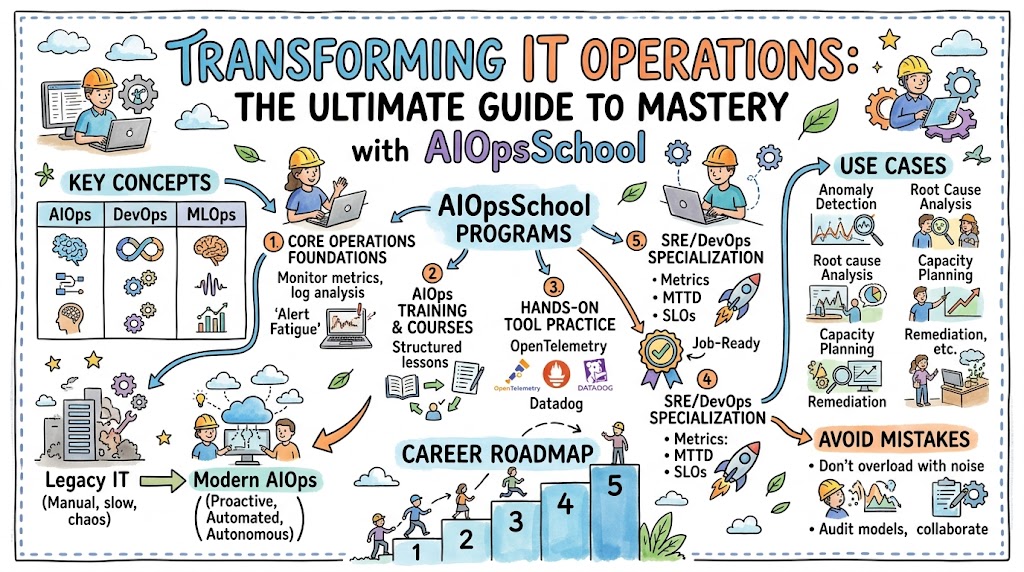
Introduction
Modern enterprise IT environments are growing incredibly complex, pushing traditional monitoring systems past their absolute limits. Engineering teams deal with a relentless flood of alerts every single day, which makes it nearly impossible to separate critical system failures from harmless operational background noise. When a primary service goes down, engineers usually spend hours digging through disconnected dashboards, while engineering leads struggle to pinpoint the actual source of the failure. This overwhelming alert fatigue damages team morale and directly threatens business revenue through extended system downtime. To resolve these challenges, modern organizations are shifting away from reactive monitoring and adopting intelligent, proactive platforms like AiOpsSchool.
By embedding artificial intelligence and machine learning directly into your operational workflows, you can easily transform chaotic log data into actionable system insights. Navigating this massive technological shift requires a structured approach to learning and a clear path toward professional skill development. Enrolling in comprehensive AIOps Training gives you the precise framework needed to master automated incident response and anomaly detection. Embracing these advanced methodologies ensures your technical teams can maintain high system availability and confidently build self-healing infrastructure.
Navigating the Shift to Artificial Intelligence for IT Operations
Artificial Intelligence for IT Operations represents the natural fusion of big data, machine learning, and traditional infrastructure management. At its core, this practice uses advanced algorithms to analyze massive volumes of operational data collected from various enterprise environments. Instead of relying on manual oversight, it automatically uncovers hidden data patterns, detects anomalies, and pinpoints the root causes of infrastructure issues. It serves as an intelligent operational brain that continuously observes, learns, and optimizes your entire digital ecosystem.
This methodology eliminates the traditional silos that separate development, operations, and security teams by providing a unified view of system health. It continuously ingests metrics, logs, and traces to build a deep, contextual understanding of standard system behavior. Consequently, when an unexpected performance deviation occurs, the platform identifies the anomaly in real time and triggers automated workflows before users experience any service degradation. Moving to this automated model changes the fundamental nature of IT management from a chaotic, reactive struggle into a highly predictable, automated process.
Key Operational Concepts You Must Know
To successfully deploy AIOps in IT operations, professionals must first master the core building blocks of modern telemetry and data science. Understanding these foundational elements allows you to transform raw data streams into intelligent operational decisions.
- Full-Stack Observability: The continuous practice of measuring the internal states of a system by thoroughly analyzing its external outputs, ensuring deep visibility across distributed cloud infrastructure.
- Unified Telemetry Data: The structured collection of metrics (numerical data points), logs (timestamped event records), and traces (the end-to-end journey of a request) into a single analytical repository.
- Intelligent Event Correlation: Advanced algorithmic clustering that automatically groups thousands of isolated network alerts into a single, cohesive incident context.
- Dynamic Baseline vs. Anomaly: The process of establishing a fluid, mathematically accurate model of normal performance that adjusts for seasonal traffic variations, allowing for precise anomaly detection.
- Automated Remediation: The deployment of self-healing scripts and automated workflows that resolve verified system incidents without requiring human intervention.
The Perfect Starting Point for Beginners
Entering the world of automated operations might seem intimidating at first, but AIOps for beginners offers an incredibly accessible and rewarding career path. The industry is changing quickly, making now the absolute best time to develop these highly valuable skills.
- Exponential Data Growth: Enterprise infrastructure generates massive amounts of telemetry data that humans can no longer analyze manually, creating an urgent demand for automated solutions.
- Rapid Multi-Cloud Adoption: As organizations scale across hybrid and multi-cloud environments, they need intelligent platforms to manage the underlying operational complexity.
- The Industry Shift to Automation: Companies are actively moving away from manual troubleshooting, prioritizing engineers who know how to build self-healing environments.
Analyzing Operational Frameworks
Understanding how different operational methodologies interact is essential for building a modern infrastructure strategy. The table below outlines the distinct roles and focuses of each primary framework.
| Concept | Primary Focus | Core Question It Answers |
|---|---|---|
| AIOps vs DevOps | Applying machine learning to automate and optimize enterprise infrastructure operations. | How can we use artificial intelligence to automate incident response and maximize system availability? |
| AIOps vs MLOps | Streamlining the deployment, lifecycle management, and monitoring of machine learning models in production. | How can we build reliable pipelines to deploy, test, and retrain our data science models? |
| DevOps | Improving collaboration between development and operations teams through continuous integration and delivery. | How can we accelerate software feature delivery while maintaining strict code quality and stability? |
Platform Implementation vs. Culture — What’s the Real Difference?
A very common industry mistake is viewing automated operations as merely a software platform you can install and instantly forget. True operational excellence requires a deliberate balance between advanced software deployment and a fundamental cultural shift in how your teams operate.
| Operational Focus | Platform Implementation | Cultural Transformation |
|---|---|---|
| Primary Objective | Deploying software agents and configuring cloud architecture. | Building organizational trust in automated decision-making. |
| Core Activities | Connecting API endpoints and setting up telemetry data pipelines. | Redefining team roles and eliminating institutional data silos. |
| Major Challenge | Managing massive data ingestion and integrating legacy systems. | Overcoming team resistance to automated system remediation. |
Investing heavily in advanced platforms while completely ignoring your team culture leads directly to underutilized tools and broken workflows. True success comes when your engineers confidently trust automated insights and actively adapt their daily habits to support a self-healing infrastructure.
Core Operational Use Cases
Implementing intelligent automation solves a wide variety of persistent operational challenges. Organizations achieve consistent system reliability by focusing on these essential use cases:
- Dynamic Anomaly Detection: Evaluating live system metrics against mathematical baselines to flag unusual performance deviations before they cause downtime.
- Automated Event Correlation: Consolidating millions of separate log entries and network alerts into a small number of actionable incident reports.
- Advanced AIOps root cause analysis: Automatically tracing complex system dependencies across distributed microservices to find the exact origin of a failure.
- Predictive Capacity Planning: Using long-term historical data trends to accurately forecast future storage, memory, and compute requirements.
- Instant Automated Remediation: Triggering self-healing scripts to automatically restart failed processes or scale cloud infrastructure in response to load spikes.
- Optimizing AIOps in IT operations: Streamlining daily workflows to help operations teams move from chaotic firefighting to proactive system optimization.
Real-World Use Cases of Modern Operations
In the competitive world of e-commerce, unexpected microservice latency can quickly stall user checkouts and cause immediate revenue loss. By deploying intelligent AIOps use cases, an online retailer can automatically correlate database connection spikes with localized container failures, instantly routing traffic to healthy nodes. This rapid automated response eliminates manual troubleshooting and protects customer sales.
Modern banking institutions handle millions of digital transactions every minute while facing sophisticated security threats and strict compliance rules. Utilizing advanced machine learning allows these financial institutions to optimize AIOps in IT operations by continuously scanning network logs for subtle data anomalies. When the system detects an unusual data export pattern, it isolates the affected virtual machines within seconds, preventing data breaches before human security teams even receive an alert.
Global Software-as-a-Service providers must manage highly volatile application workloads while controlling cloud infrastructure costs. By applying predictive analytics to long-term usage data, a SaaS platform can anticipate user traffic surges hours before they actually happen. This proactive approach ensures seamless system scaling, maintaining application performance while avoiding expensive over-provisioning.
Selecting the Right Tools
Building a powerful operational ecosystem requires choosing the right software tools for your specific infrastructure needs. The following categorized list highlights the leading technologies currently used in the enterprise industry:
Full-Stack Monitoring and Observability Platforms
- Dynatrace: Offers advanced, AI-driven observability with automated root-cause analysis for enterprise-scale environments.
- Datadog: Provides comprehensive, cloud-scale monitoring that seamlessly unifies metrics, traces, and logs into single dashboards.
- New Relic: Delivers deep, full-stack data analytics to help engineering teams visualize and optimize application performance.
- ScienceLogic: Specializes in hybrid-cloud infrastructure monitoring and automated IT workflow orchestration.
Intelligent Event Correlation and ITSM Tools
- BigPanda: Excel in automating alert correlation and noise reduction across highly fragmented enterprise tools.
- PagerDuty: Combines digital operations management with automated incident response to speed up resolution times.
- Moogsoft: Uses specialized machine learning algorithms to ingest, de-duplicate, and correlate massive alert volumes.
Open-Source Telemetry Stacks
- Prometheus & Grafana: The industry-standard open-source pairing for time-series metric collection and data visualization.
- OpenTelemetry: A powerful, vendor-neutral observability framework designed to standardize telemetry collection.
Cloud-Native Operational Services
- AWS CloudWatch Anomaly Detection: Uses machine learning models to continuously monitor and analyze cloud infrastructure metrics.
Reviewing a comprehensive AIOps Tutorial is the perfect next step to learn how to integrate these distinct technologies into a unified operational platform.
Common Mistakes in Operations Engineering
Deploying intelligent operations systems comes with specific pitfalls that can easily stall your team’s progress. Recognizing these common mistakes early helps you keep your automation strategy on track.
- Ignoring Alert Noise Reduction: Failing to tune initial alert thresholds fills dashboards with meaningless notifications, causing engineers to ignore critical warnings. Teams must use correlation engines to filter out background noise.
- Treating Automation as “Set and Forget”: Assuming machine learning models stay perfect forever without maintenance causes systems to miss new failure patterns. Engineers must routinely retrain models using fresh data.
- Skipping Telemetry Data Quality: Feeding unformatted, low-quality logs into an AI engine produces inaccurate insights and false alarms. Organizations must prioritize strict data normalization.
- Automating Remediation Too Early: Implementing self-healing scripts before validating your baseline models can trigger destructive, unintended automated actions. Teams must thoroughly test workflows in staging environments first.
- Lack of Cross-Team Buy-In: Deploying new automation tools without training your core operations teams leads to tool abandonment and fragmented workflows. You must secure early team buy-in through hands-on education.
Empowering Site Reliability Engineering
Modern Site Reliability Engineering focuses on maintaining excellent system availability while accelerating software delivery. Integrating AIOps for SRE provides teams with the predictive insights needed to meet strict Service Level Objectives.
+--------------------------------------------------------------+
|                  Intelligent SRE Workflow                    |
+--------------------------------------------------------------+
|                                                              |
|   Telemetry Ingestion ---> Machine Learning Analytics        |
|   (Logs/Metrics/Traces)      (Dynamic Baselining)            |
|                                         |                    |
|                                         v                    |
|   Automated Remediation <--- Root Cause Identified           |
|   (Self-Healing Scripts)     (MTTD/MTTR Drastically Reduced) |
|                                                              |
+--------------------------------------------------------------+
By automatically tracking performance trends, machine learning algorithms can predict Service Level Indicator breaches before they occur. This gives SRE teams plenty of time to optimize infrastructure, significantly reducing Mean Time to Detection and Mean Time to Resolution. Moving away from manual firefighting allows engineers to focus their energy on building resilient, long-term architecture.
Seeing AIOps in Action
To understand the practical value of automated operations, let’s examine a common enterprise incident scenario. This breakdown contrasts traditional manual troubleshooting with an automated, intelligent response.
The Production Crisis
During a busy Friday afternoon traffic peak, an enterprise banking application experiences a sudden, severe latency spike. The legacy monitoring system fires hundreds of disconnected alerts, creating immediate confusion across the on-call engineering teams.
The Automated Response Workflow
- Ingestion: The centralized data platform ingests live telemetry data across the entire infrastructure.
- Correlation: The AI engine filters out minor background alerts and groups the remaining notifications into a single incident ticket.
- Root Cause Identification: Using advanced AIOps root cause analysis, the platform traces the latency spike to an unindexed database query deployed in a recent microservice update.
- Remediation: The system automatically runs a pre-approved script that routes traffic away from the struggling database node while alerting the development team.
The Measurable Business Result
By optimizing AIOps in IT operations, the company reduces its Mean Time to Resolution from several hours down to less than four minutes. This rapid response saves thousands of dollars in potential downtime penalties and protects the user experience.
How to Become an Operations Expert — Career Roadmap
Building a successful career in AI-driven operations requires a structured approach to mastering both engineering principles and data science concepts. Following a clear educational path ensures you develop the practical, hands-on skills needed for modern enterprise environments.
- Master Systems and Monitoring Basics: Build a solid foundation by managing Linux systems, configuring cloud networks, and using traditional monitoring tools.
- Learn Core Automation Principles: Gain deep experience with infrastructure-as-code tools and container orchestration platforms like Kubernetes.
- Complete Advanced AIOps Training: Enroll in dedicated educational programs to master automated incident response and anomaly detection models.
- Gain Hands-On Tool Experience: Build real-world projects using open-source telemetry frameworks and enterprise event correlation software.
- Earn an Official AIOps Course Certificate: Validate your practical skills by earning industry-recognized certifications that prove your technical expertise.
Why Get an AIOps Certification?
As companies quickly move away from legacy monitoring, demand for highly skilled operations engineers is growing faster than ever. Earning an official AIOps Certification gives you a clear competitive advantage in the modern technology job market.
- Immediate Resume Credibility: Holding a verified credential proves you can successfully manage complex, AI-driven enterprise infrastructure.
- Structured Professional Learning: Completing an official curriculum ensures you master everything from data ingestion to automated system remediation.
- Greater Career Leverage: Certified professionals are well-positioned for senior roles in SRE, DevOps, and platform engineering, commanding higher salaries.
Earning your AIOps Foundation Certification confirms you have a strong grasp of the essential data science and automation concepts needed to lead modern IT teams.
Frequently Asked Questions
- What is the primary difference between traditional monitoring and AIOps?Traditional monitoring tools simply alert teams when systems cross static performance thresholds, requiring engineers to manually investigate issues. In contrast, AIOps uses machine learning to automatically correlate data, detect anomalies, and identify root causes in real time.
- How does an AIOps Certification help my engineering career?Earning an AIOps Certification validates your ability to manage complex, automated cloud environments. This specialized credential makes your resume stand out to top employers and opens doors to high-paying roles in SRE and DevOps engineering.
- What topics are covered in an introductory AIOps Course?A comprehensive AIOps Course covers foundational telemetry data collection, machine learning anomaly detection, automated event correlation, and self-healing remediation workflows. Students get hands-on practice using industry-standard tools and platforms.
- Can professionals take an AIOps Online Training program while working full-time?Yes, modern training programs offer flexible, self-paced online schedules designed specifically for working engineers. This allows you to build advanced automation skills without interrupting your daily job responsibilities.
- Why should an experienced engineer get an AIOps Foundation Certification?An AIOps Foundation Certification proves you thoroughly understand how big data and machine learning apply to modern IT operations. It establishes your conceptual expertise before you move on to advanced platform implementations.
- What specific benefits does an AIOps Consulting service provide to enterprises?Consulting services help organizations assess their operational maturity, select the right automation tools, and design scalable observability strategies. This guidance reduces implementation risks and accelerates your team’s return on investment.
- How do AIOps Implementation Services speed up company automation goals?These professional services handle the heavy lifting of deployment, from configuring data pipelines to setting up automated remediation workflows. This hands-on support allows your internal teams to focus entirely on core business priorities.
- What makes AI Observability Training different from standard monitoring education?This advanced training focuses on monitoring highly complex, non-deterministic AI models and LLM pipelines in production. Engineers learn how to track model drift, measure prompt latency, and ensure data quality across intelligent applications.
Where to Learn AIOps
Building the expertise required to manage modern, AI-driven infrastructure requires a structured and practical educational framework. Aspiring engineers and technology leaders can access a comprehensive suite of learning programs tailored to every stage of their professional development.
- AIOps Training: Immersive, hands-on learning paths designed to teach you how to deploy machine learning models and build automated workflows across enterprise cloud infrastructure.
- AIOps Course: Focused, structured modules that cover core operational principles, telemetry data normalization, and intelligent alert correlation strategies.
- AIOps Certification: Globally recognized professional credentials that validate your technical skills, helping you secure senior engineering and platform leadership roles.
- AIOps Tutorial: Step-by-step technical guides that provide immediate, practical experience configuring open-source telemetry stacks and automated remediation scripts.
Final Thoughts
The rapid growth of distributed cloud systems and microservices means organizations can no longer rely on manual infrastructure monitoring. To stay competitive, companies must adopt automated, intelligent operational frameworks that predict and resolve incidents before they impact customers. Developing these highly sought-after skills requires a commitment to continuous professional education. Investing in structured AIOps Training gives you the practical tools and knowledge needed to excel in this changing field. Earning an official AIOps Certification confidently demonstrates your ability to build and manage resilient, self-healing enterprise platforms. Explore the comprehensive educational resources and professional development paths available at AiOpsSchool.com to accelerate your journey toward operational mastery.
A practical gap in most AIOps discussions is model reliability itself. Alert correlation and anomaly detection can drift as traffic patterns, deployments, and infrastructure change, so teams need feedback loops, retraining policies, and human review paths to avoid automation quietly making the wrong operational decisions.