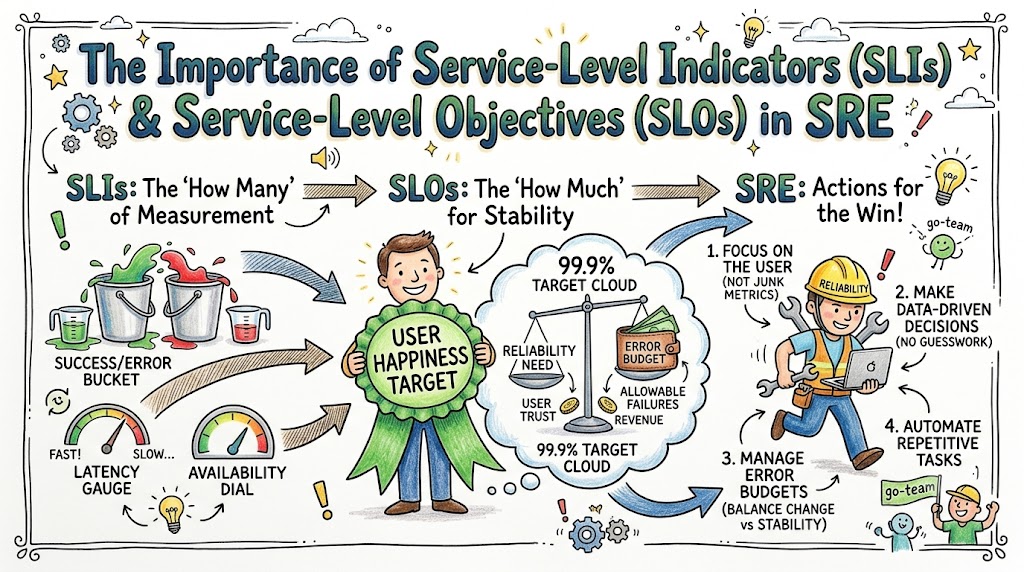
Have you ever wondered how top tech companies keep their massive platforms running smoothly without constantly putting out fires? The secret lies in shifting from reactive firefighting to proactive measurement. This is exactly where Service-Level Indicators and Service-Level Objectives come into play. At its core, SRE is about balancing reliability with innovation, and you simply cannot achieve that balance without concrete metrics. If you want to master these essential concepts, Sreschool provides the exact blueprint you need to succeed.
Service-Level Indicators are the specific, quantitative measurements of a service’s behavior. Think of them as the raw data points that tell you exactly what is happening at any given moment. On the other hand, Service-Level Objectives are the target values you set for those indicators. They represent the goal you are trying to achieve, such as ensuring a web page loads within a certain timeframe. Together, they form the foundation of modern reliability engineering.
Without these two elements, engineering teams are essentially flying blind. They rely on gut feelings or vague notions of system health rather than hard data. By implementing SLIs and SLOs, organizations can clearly define what “good” looks like. This clarity transforms how teams build, deploy, and maintain software, leading to happier users and less stressed engineers.
Understanding Service-Level Indicators (SLIs)
To truly grasp the power of SLIs, you have to look at them as the vital signs of your software systems. Just as a doctor measures your heart rate, blood pressure, and temperature to assess your physical health, SREs measure SLIs to assess system health. These indicators are carefully chosen metrics that directly reflect the user’s experience. If an SLI drops, it means the user is feeling the pain, even if the underlying servers are technically still running.
Choosing the right SLIs is a critical step that requires deep empathy for the end user. You must ask yourself what truly matters to the person clicking the button or loading the page. Is it the speed at which the page renders? Is it the guarantee that once they submit a form, the data is permanently saved? Or is it the ability to access the service at any hour of the day?
Common examples of SLIs include availability, which measures the proportion of valid requests successfully served. Another crucial SLI is latency, measuring the time it takes to serve a request. Throughput, which measures how many requests can be handled per second, is also a vital indicator. Additionally, error rate, tracking the percentage of failed requests, rounds out the core set of reliability indicators that most teams monitor.
It is important to remember that not all SLIs are created equal. A poorly chosen SLI can lead to a false sense of security. For instance, measuring CPU usage is not an SLI because high CPU does not always mean a bad user experience. An SLI must be a direct reflection of customer happiness. Therefore, the process of defining SLIs should always start and end with the user’s perspective in mind.
Defining Service-Level Objectives (SLOs)
Once you have your raw measurements in the form of SLIs, you need a target to aim for. This is where Service-Level Objectives enter the picture. An SLO is a specific, numerical threshold applied to an SLI over a defined window of time. It is the contract you make with your users, even if they never explicitly see it. It acts as an internal compass guiding your engineering efforts and resource allocation.
Setting an SLO requires a delicate balancing act. If you set the bar too high, like aiming for one hundred percent uptime, you will paralyze your development team. They will spend all their time hardening the system and zero time building new features. Conversely, if you set the bar too low, your users will experience constant outages and frustrations, eventually leaving for a competitor. The sweet spot lies somewhere in the middle, where reliability enables business growth rather than stifling it.
SLOs are typically expressed as a percentage over a rolling time window. For example, you might set an SLO stating that ninety-nine point nine percent of requests will complete in under two hundred milliseconds over a rolling thirty-day period. This specific language removes all ambiguity. Everyone in the organization knows exactly what the target is, how it is measured, and the timeframe involved.
Furthermore, SLOs introduce a powerful concept known as the error budget. This is the inverse of your SLO, representing the acceptable amount of unreliability. If your SLO is ninety-nine percent, your error budget is one percent. This budget empowers product teams to make risk-based decisions. If they have plenty of budget left, they can deploy risky features. If the budget is exhausted, they must pivot to reliability work.
Why Traditional Uptime Monitoring Falls Short
For decades, the standard metric for system reliability was simply uptime. Organizations would proudly boast about their “five nines” of availability, implying their systems were virtually never down. However, this metric is dangerously misleading in the modern era of distributed computing. A system can be technically up and running, returning green lights on a monitoring dashboard, while simultaneously providing a horrendous experience to every single user.
Consider a scenario where a database query starts taking ten seconds instead of ten milliseconds. The server is still awake and responding to health checks. The traditional uptime monitor proudly flashes green, declaring one hundred percent availability. But the user staring at a blank, spinning screen is experiencing a complete outage. Uptime monitoring fails to capture performance degradation, which is often far more damaging to a business than a hard crash.
Another flaw in traditional monitoring is its focus on infrastructure rather than outcomes. Operations teams would monitor CPU, memory, disk space, and network interfaces. While these metrics are useful for debugging, they do not tell you if the service is actually doing its job. A server can have plenty of free memory and low CPU, yet be completely unable to process a customer’s shopping cart due to a logic error.
SLIs and SLOs solve this by shifting the focus from the machinery to the customer. They force us to ask if the system is achieving its business purpose, not just if the hardware is powered on. This paradigm shift is fundamental to modern operations. It aligns engineering metrics directly with business success, ensuring that technical health accurately reflects customer satisfaction.
The Symbiotic Relationship Between SLIs and SLOs
You cannot have a meaningful SLO without a well-defined SLI, and an SLI without an SLO is just useless noise. They exist in a perfect symbiotic relationship that drives continuous improvement. The SLI provides the objective reality of your system’s current state, while the SLO provides the subjective goal of where you want to be. Together, they create a feedback loop that constantly pushes the system toward optimal performance.
When an SLI misses its corresponding SLO, it triggers a specific, calculated response. Because you know exactly what metric failed and by how much, you can route the alert to the exact right team. There is no war room full of confused engineers guessing what broke. The SLI tells you what is broken, the SLO tells you how badly it is broken, and the error budget tells you how urgently it needs to be fixed.
This relationship also fundamentally changes how teams communicate with business stakeholders. Instead of saying “the latency is high,” which means nothing to a non-technical executive, you can say “we are currently missing our checkout latency SLO, which means we are burning through our error budget faster than anticipated.” This translates technical reality into business risk, allowing leadership to make informed decisions about feature freezes or emergency patches.
Ultimately, this symbiosis creates a culture of shared responsibility. Product managers, developers, and SREs all look at the same SLO dashboard. They all understand the error budget. They all share the consequences of missing the target and the rewards of staying within budget. This unified vision is what separates high-performing tech organizations from those stuck in chaotic, reactive cycles.
Key Operational Concepts You Must Know
To truly navigate the world of site reliability engineering, you need to be fluent in several foundational concepts that surround SLIs and SLOs. These are the tools and mental models that allow you to put your metrics into action. Without understanding these supporting concepts, your SLOs will just be numbers on a screen rather than dynamic drivers of engineering behavior. Let us break down the absolute must-know concepts.
Error Budgets An error budget is the allowable amount of system unreliability, calculated as one hundred percent minus your SLO. If your SLO is ninety-nine point nine percent, your error budget is zero point one percent. This concept is revolutionary because it turns reliability into a quantifiable resource. Product managers can treat this budget like a financial budget, choosing to spend it on new, risky features or save it by doing stability work. When the budget hits zero, all feature work stops, and the focus shifts entirely to fixing reliability.
Service-Level Agreements (SLAs) People often confuse SLOs with SLAs, but they serve entirely different purposes. An SLO is an internal target, a promise you make to yourself and your engineering team. An SLA is an external contract, a promise you make to your customers, often with financial penalties attached if you fail. You should never base an SLA directly on an SLO. Instead, your SLO should be significantly stricter than your SLA, giving you a safe buffer so that internal failures do not result in paying out customer refunds.
Alerting on Symptoms, Not Causes Traditional monitoring alerts you when a server’s CPU spikes. Modern SRE practices dictate that you should only alert when an SLO is breached. This is alerting on symptoms. If the CPU spikes but the SLI remains healthy, the user is fine, and you do not need to wake up an engineer at midnight. By tying alerts directly to SLO violations, you drastically reduce alert fatigue and ensure that every page actually requires human intervention to protect the user experience.
Toil Reduction Toil is the repetitive, manual, and automatable work that scales linearly with your service growth. If you have to manually restart a server every time a specific memory leak occurs, that is toil. SREs aim to keep toil below fifty percent of their total operational work. By clearly defining SLOs and automating the responses to common SLO breaches, you systematically eliminate toil, freeing up engineers to focus on building scalable architectures rather than acting as high-paid button pushers.
Incident Management When an SLO is breached and the error budget is impacted, it is classified as an incident. Modern incident management is not about blaming individuals; it is about understanding system failures. Because you have precise SLIs, the post-incident review becomes highly objective. You can trace exactly when the SLI dropped, which deployment correlated with the drop, and how much error budget was consumed. This data-driven approach removes the emotion from post-mortems and accelerates genuine solutions.
Platform Implementation vs. Culture — What’s the Real Difference?
A common trap that organizations fall into is believing that buying an expensive monitoring tool automatically makes them proficient in SRE. They install the software, configure a few dashboards, and expect reliability to magically improve. This highlights the critical distinction between platform implementation and cultural adoption. The tool is just the vehicle; the culture is the fuel. Without the right fuel, the vehicle goes nowhere.
Platform implementation is the mechanical act of instrumenting your code to emit SLI data, storing that data in a time-series database, and visualizing it on a dashboard. It involves writing Prometheus queries, setting up Grafana panels, and configuring PagerDuty escalation policies. This is a purely technical exercise. It requires software engineering skills, but it does not require a shift in mindset. You can implement a platform in a few weeks if you have the right engineering talent.
Culture, on the other hand, is how your organization actually responds to the data that platform generates. A healthy SRE culture is one where developers proactively check the error budget before deploying a risky change. It is a culture where leadership does not demand one hundred percent uptime, understanding that some failures are the cost of innovation. It is a culture where missing an SLO is treated as a learning opportunity, not a reason to fire someone.
- Platform Focus: Dashboard creation, alert routing, log aggregation, and metric storage.
- Cultural Focus: Risk tolerance, blameless post-mortems, cross-team collaboration, and product-owner alignment.
- Platform Outcome: You know exactly when your system is broken.
- Cultural Outcome: Your teams actively work together to prevent the system from breaking.
Consider a scenario where a new feature deployment causes a slight latency increase, eating up ten percent of the monthly error budget in one day. In an organization with only platform implementation, the dashboard turns red, an alert goes off, and an SRE begrudgingly rolls back the deployment while complaining about the developers. In an organization with a strong culture, the product manager sees the budget burn rate, pauses the rollout, collaborates with the developers to optimize the feature, and confidently redeploys it later.
The real difference boils down to autonomy and trust. Platform implementation is often driven top-down by operations teams trying to maintain control. Cultural adoption is driven bottom-up and laterally, integrating reliability directly into the software development lifecycle. You can achieve one hundred percent platform implementation and zero cultural adoption, resulting in a beautiful dashboard that nobody looks at until the entire company is on fire. True operational excellence requires both, but culture will always be the harder and more valuable mountain to climb.
Real-World Use Cases of Modern Operations
Understanding the theory behind SLIs and SLOs is important, but seeing how they are applied in the real world makes the concepts truly click. Different industries and service types require entirely different approaches to defining what “good” looks like. Let us explore several distinct use cases that demonstrate the versatility and power of modern operational practices in diverse environments.
E-commerce Checkout Systems In an e-commerce platform, the most critical user journey is the checkout process. If a user can browse products but cannot pay, the business loses revenue directly. Here, the primary SLI is the success rate of checkout requests. The SLO might be set at ninety-nine point nine nine percent availability for the checkout API over a thirty-day window. Because the business impact is so high, the error budget is incredibly small. A single breach triggers an immediate, high-severity incident response, as every minute of downtime translates directly to lost sales.
Video Streaming Platforms For a service like a video streaming platform, availability is less critical than playback quality. If a video buffers for five seconds, the user perceives this as a major failure, even though the API is technically up. The primary SLI here is playback latency or rebuffering rate. The SLO might state that ninety-nine percent of video streams will experience less than two seconds of total rebuffering time per hour. This shifts the engineering focus away from keeping servers online toward optimizing content delivery networks and adaptive bitrate streaming algorithms.
Software-as-a-Service (SaaS) APIs If your business sells an API to other developers, your SLIs must reflect the contractual expectations of your clients. Latency and error rates are paramount. An SLO might guarantee that ninety-nine point five percent of API requests will return a successful response in under one hundred milliseconds. In this use case, SLOs are heavily tied to business reputation. Developers talk to each other, and a sluggish API will quickly be abandoned in favor of a competitor, making strict adherence to the SLO a matter of business survival.
Database-as-a-Service (DBaaS) When providing a managed database service, the SLIs must capture the nuanced performance of data persistence. While read latency is important, write acknowledgment latency is critical. An SLO might dictate that ninety-nine point nine nine percent of write operations are durably acknowledged to the client within fifty milliseconds. Furthermore, backup and restore SLIs are crucial, guaranteeing that a point-in-time recovery can be achieved within a specific timeframe, as data loss is the ultimate failure for a database provider.
Internal Microservices Architecture Not all SLOs are customer-facing. In a complex microservices architecture, teams rely on each other’s services. An internal authentication service might have an SLO of ninety-nine point nine percent latency under ten milliseconds. Even though end users do not see this metric directly, if the authentication service slows down, it cascades and causes the frontend SLOs to breach. These internal SLOs create a chain of accountability, ensuring that upstream teams do not inadvertently take down downstream teams through negligence.
Common Mistakes in Operations Engineering
Even with the best intentions, organizations frequently stumble when implementing SLIs and SLOs. These mistakes can lead to wasted engineering effort, false confidence, or even worse, a degraded user experience. Recognizing these common pitfalls is the first step toward avoiding them and building a truly resilient operational practice. Let us examine the most prevalent errors that plague modern operations teams.
Setting Too Many SLOs When teams first learn about SLOs, they often go overboard, creating an objective for every single metric they can possibly measure. This leads to SLO sprawl, where nobody can actually keep track of what matters. If everything is a priority, nothing is a priority. A good rule of thumb is to identify one or two critical SLIs per service that truly represent the user experience. Focus your energy on guarding those core metrics rather than spreading your attention thin across dozens of trivial ones.
Aiming for One Hundred Percent Reliability This is arguably the most destructive mistake in the industry. Demanding one hundred percent uptime eliminates the error budget entirely. Without an error budget, you cannot take any risks. You cannot deploy new code, you cannot upgrade infrastructure, and you cannot innovate. The system becomes frozen in time. Accepting that failures will happen, and planning for them through a calculated error budget, is the only way to sustain long-term velocity and reliability simultaneously.
Using Proxy Metrics Instead of Real SLIs As mentioned earlier, using CPU or memory as an SLI is a massive mistake. These are proxy metrics. A team might set an SLO that CPU utilization stays below eighty percent, assuming this keeps latency low. However, a garbage collection pause in a specific programming language might spike latency to seconds while CPU sits comfortably at thirty percent. Always measure the output, not the internal mechanics of the system. The user does not care about your CPU; they care about their request.
Ignoring the Time Window An SLO is meaningless without a clearly defined time window. Saying “ninety-nine percent availability” is incredibly vague. Does that mean ninety-nine percent over a minute, a day, or a year? A one-minute window is far too volatile and will trigger constant alerts. A one-year window is far too slow, meaning you might not realize you are breaching your SLO until it is far too late to fix it. Most mature organizations rely on rolling thirty-day windows to smooth out anomalies while remaining responsive.
Treating SLOs as a Punishment Tool If leadership uses SLO breaches to penalize engineers or deny promotions, the system will immediately collapse. Engineers will begin gaming the metrics, ignoring real problems, or hiding incidents to protect their careers. SLOs must be treated as a tool for system improvement and resource negotiation. When an SLO misses its target, the question should never be “who messed up?” but rather “what weakness in our system allowed this to happen, and how do we fix it?”
How to Become an Operations Expert — Career Roadmap
Transitioning into a site reliability engineering role or leveling up your operations expertise requires a strategic blend of software engineering skills, systems thinking, and deep operational knowledge. It is not a career path you can stumble into accidentally; it requires deliberate cultivation of specific technical and soft skills. Here is a comprehensive roadmap to guide you from a curious beginner to a highly sought-after operations expert.
Phase 1: Master the Fundamentals of Linux and Networking Before you can manage distributed systems, you must intimately understand a single system. Dive deep into the Linux operating system. Learn how the kernel manages memory, how process scheduling works, and how to interpret system logs. Simultaneously, build a rock-solid foundation in networking. Understand the OSI model, TCP/IP handshakes, DNS resolution, and HTTP protocols. You cannot debug a distributed system failure if you do not understand how packets move across a wire.
Phase 2: Learn a High-Level Programming Language SRE is fundamentally a software engineering discipline. You must be able to write production-quality code, not just bash scripts. Python and Go are the dominant languages in the SRE ecosystem. Python is excellent for automation, data manipulation, and building internal tooling. Go is unparalleled for writing high-performance, concurrent services and CLI tools that interact with cloud APIs. Focus on writing clean, testable, and maintainable code.
Phase 3: Deep Dive into Cloud Platforms and Infrastructure as Code (IaC) Modern operations exist entirely in the cloud. Choose a major cloud provider and learn its core services thoroughly, focusing on compute, networking, and storage. More importantly, stop clicking through web consoles. Master Infrastructure as Code tools like Terraform or Pulumi. You must be able to provision entire environments deterministically using code, ensuring that infrastructure is version-controlled, peer-reviewed, and easily reproducible.
Phase 4: Instrumentation and Observability Engineering This is where SLIs and SLOs become your bread and butter. Learn how to instrument applications using OpenTelemetry to emit traces, metrics, and logs. Understand how to use time-series databases like Prometheus to store this data. Master visualization tools like Grafana to build SLO dashboards. You need to become the person who can look at a scattered mess of telemetry data and distill it into a handful of meaningful Service-Level Indicators.
Phase 5: Advanced System Design and Chaos Engineering An expert does not just react to failures; they design systems that anticipate them. Study distributed systems theory, understanding concepts like the CAP theorem, consensus algorithms, and eventual consistency. Then, put your systems to the test by practicing Chaos Engineering. Use tools to intentionally inject failures into your infrastructure, such as shutting down random nodes or simulating network latency, to verify that your SLOs hold up under extreme stress.
FAQ Section
What is the main difference between an SLI and an SLO?
An SLI is the actual measurement or quantitative data point of your service’s performance, like current latency in milliseconds. An SLO is the target goal you set for that measurement over a specific time period, like aiming for that latency to be under two hundred milliseconds ninety-nine percent of the time.
Can a service have multiple SLIs?
Yes, a service can and usually should have multiple SLIs, but you must be careful not to create too many. Typically, you should identify one primary SLI that best represents the user experience, and perhaps one or two secondary SLIs to provide additional context, such as measuring both availability and latency for a single API endpoint.
What happens when an error budget is exhausted?
When an error budget hits zero, it means you have used up your allowed allowance for unreliability. Best practices dictate that all new feature deployments should be paused immediately. The engineering team must pivot entirely to reliability work, such as fixing bugs, refactoring fragile code, or improving scaling mechanisms, until the budget naturally recovers over the rolling window.
Do internal services need SLOs?
Absolutely. Internal services are the building blocks of your external user experience. If an internal authentication service is slow, it will cause your frontend SLOs to breach. Defining SLOs for internal services creates clear boundaries and accountability between different engineering teams, preventing one team’s negligence from causing a cascading failure for another.
How do I choose the right time window for an SLO?
The right time window balances responsiveness with stability. A one-hour window is too sensitive and will cause alert fatigue from minor blips. A one-year window is too slow, meaning you might not detect a chronic problem for months. A rolling thirty-day window is the industry standard, offering a good balance of smoothing out short-term noise while reacting quickly enough to protect the user experience.
Final Summary
Mastering Service-Level Indicators and Service-Level Objectives is not just a technical exercise; it is a fundamental shift in how engineering organizations operate. By defining exactly what good looks like through SLIs and setting ambitious but realistic targets through SLOs, teams can finally escape the reactive trap of constant firefighting. These metrics provide a shared language that bridges the gap between technical operations and business objectives, ensuring that every engineering effort directly contributes to customer satisfaction.
The journey requires moving beyond outdated concepts like simple uptime monitoring and embracing a holistic view of system health. It demands a strong cultural foundation built on trust, error budgets, and blameless post-mortems, rather than merely purchasing new monitoring tools. When implemented correctly, SLIs and SLOs empower developers to move fast, give product managers the confidence to take calculated risks, and provide SREs with the precise data needed to keep complex systems stable.
As you continue to develop your skills in modern operations, remember that reliability is a feature, and like any feature, it must be measured, prioritized, and continuously improved. By internalizing the concepts discussed in this guide, you will be well-equipped to build resilient systems that scale gracefully, withstand chaos, and deliver exceptional value to your users, no matter how complex the technological landscape becomes.