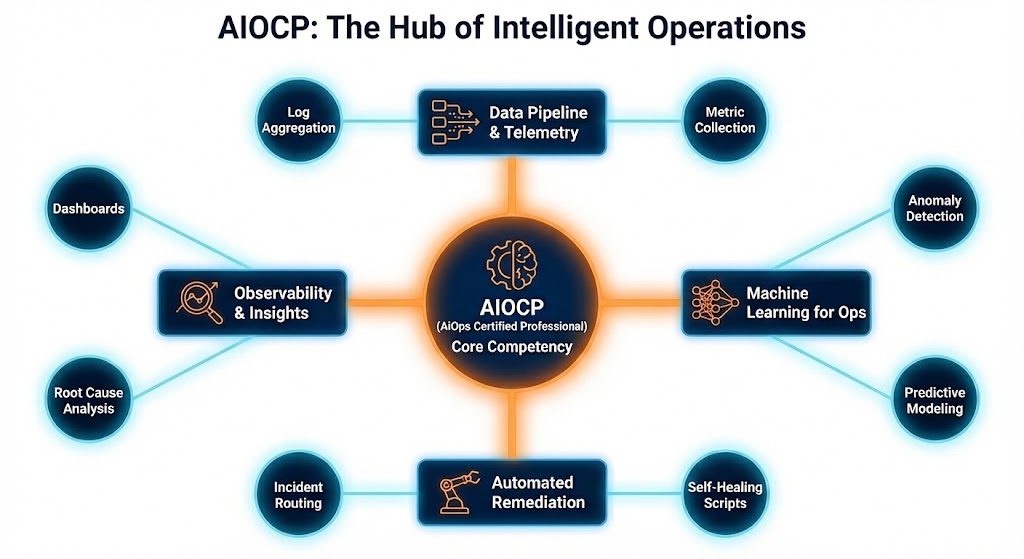
Introduction
Systems complexity now grows at a pace that outstrips human capability. The AiOps Certified Professional (AIOCP) stands as the premier credential for those ready to lead the shift toward autonomous, data-driven infrastructure. This guide details how you can master machine learning for IT operations to stay ahead in a competitive market. By enrolling through DevOpsSchool, you gain direct access to industry-standard practices that eliminate manual toil and reduce incident noise. Whether you specialize in site reliability or cloud architecture, this path ensures you possess the technical depth to manage the most demanding enterprise environments.
What is the AiOps Certified Professional (AIOCP)?
The AiOps Certified Professional (AIOCP) provides a comprehensive framework for applying artificial intelligence to modern IT workflows. It exists to transform how organizations handle massive volumes of telemetry, transitioning from reactive alerting to proactive prediction. This certification focuses on the practical application of machine learning algorithms to logs, metrics, and traces. Engineers who earn this title demonstrate their ability to build self-monitoring and self-healing systems that meet the needs of high-velocity digital enterprises.
Who Should Pursue AiOps Certified Professional (AIOCP)?
DevOps engineers, Site Reliability Engineers (SREs), and Platform Architects benefit most from this specialized training. Security professionals and Data Engineers also use this certification to enhance their ability to detect anomalies and optimize data flows. This program serves a diverse global audience, including the fast-growing tech sector in India and enterprise teams worldwide. Even technical leaders who need to oversee digital transformation find the AIOCP curriculum vital for making informed architectural decisions.
Why AiOps Certified Professional (AIOCP) is Valuable in 2026 and Beyond
Enterprises increasingly struggle with “alert fatigue” and the high costs of manual incident management. The AiOps Certified Professional (AIOCP) remains valuable because it teaches logic-based automation that survives tool-specific trends. This knowledge allows you to bridge the gap between legacy operations and modern, AI-first platforms. By becoming an expert in intelligent operations, you offer companies a way to maintain uptime while significantly reducing their operational overhead.
AiOps Certified Professional (AIOCP) Certification Overview
The program delivers high-impact learning via the official course site and hosts all training on the primary platform. It utilizes a rigorous assessment model that forces candidates to prove their skills through production-grade scenarios. The certification owners maintain a curriculum that evolves alongside the latest advancements in deep learning and automated root cause analysis. This ensures that every graduate brings immediate, actionable value to any technical organization they join.
AiOps Certified Professional (AIOCP) Certification Tracks & Levels
The AIOCP program offers three distinct progression tiers: Foundation, Professional, and Advanced. The Foundation level provides the essential knowledge of data ingestion and basic analytics. The Professional level dives into model deployment and the automation of operational tasks. The Advanced level prepares you for strategic leadership and the design of complex, cross-functional AI systems. This structure allows you to build your expertise in a logical sequence that aligns with your professional growth.
Complete AiOps Certified Professional (AIOCP) Certification Table
| Track | Level | Who it’s for | Prerequisites | Skills Covered | Recommended Order |
| Operations | Foundation | Junior Engineers | Basic Linux | Monitoring Basics, Data Prep | 1 |
| Engineering | Professional | SREs & DevOps | Python & Cloud | ML Integration, Auto-scaling | 2 |
| Strategy | Advanced | Tech Leads | 5+ Years Exp | AI Governance, Enterprise ROI | 3 |
| Intelligence | Security AI | SecOps | InfoSec Basics | Pattern Recognition, Defense | 4 |
Detailed Guide for Each AiOps Certified Professional (AIOCP) Certification
AiOps Certified Professional (AIOCP) – Foundation
What it is
This certification validates your understanding of the core pillars of intelligent operations. It confirms that you can navigate the modern observability landscape and identify the data needed for AI analysis.
Who should take it
Aspiring cloud engineers and recent graduates find this an ideal starting point. It also helps project managers who need to understand the technical requirements of AIOps projects.
Skills you’ll gain
- Understanding structured vs. unstructured operational data.
- Basic log aggregation and filtering techniques.
- Identifying KPIs for intelligent monitoring.
- Fundamentals of automated reporting.
Real-world projects you should be able to do
- Design a centralized dashboard that highlights performance anomalies.
- Script a basic data cleaning process for infrastructure logs.
Preparation plan
- 7–14 days: Review the conceptual shift from DevOps to AIOps.
- 30 days: Learn the basics of data visualization and statistical monitoring.
- 60 days: Complete all lab modules and take the foundation exam.
Common mistakes
- Neglecting the importance of data quality at the source.
- Focusing on specific tools instead of universal data principles.
Best next certification after this
- Same-track: AIOCP Professional.
- Cross-track: Cloud Associate certifications.
- Leadership: Agile Practitioner.
AiOps Certified Professional (AIOCP) – Professional
What it is
This professional credential proves your ability to engineer and deploy machine learning models within a live DevOps environment. It focuses on the bridge between data science and operational uptime.
Who should take it
Active DevOps engineers and SREs with several years of experience who want to lead automation initiatives using advanced AI techniques.
Skills you’ll gain
- Building predictive models for capacity planning.
- Automating incident triage and root cause analysis.
- Deploying self-healing scripts into production.
- Managing the lifecycle of operational algorithms.
Real-world projects you should be able to do
- Create an automated system that predicts and prevents service outages.
- Deploy a model that identifies security breaches through behavioral analysis.
Preparation plan
- 7–14 days: Study specific ML libraries used for time-series forecasting.
- 30 days: Build end-to-end automation pipelines in a test environment.
- 60 days: Complete the final project and pass the professional assessment.
Common mistakes
- Over-fitting models to historical data, leading to poor live performance.
- Failing to integrate AI results into existing incident management tools.
Best next certification after this
- Same-track: AIOCP Advanced.
- Cross-track: Certified Kubernetes Security Specialist (CKS).
- Leadership: IT Management certifications.
Choose Your Learning Path
DevOps Path
The DevOps path focuses on making software delivery smarter and more resilient. You will learn to use AI to predict deployment risks and optimize CI/CD pipelines automatically. This track targets engineers who want to eliminate bottlenecks in the release cycle through intelligent analysis. It ensures that every code change benefits from data-driven safety checks before reaching the user.
DevSecOps Path
This path prioritizes the use of AI for proactive security and threat management. You will learn to build systems that recognize malicious patterns in network traffic faster than manual rules ever could. This track focuses on automated compliance and the rapid remediation of vulnerabilities. It is the perfect choice for security specialists who want to stay ahead of automated cyber threats.
SRE Path
The SRE path targets the ultimate goal of zero-touch reliability. You focus on building intelligent systems that maintain high availability by predicting and fixing issues before they impact SLOs. This track covers the automation of error budget management and complex system failovers. It serves professionals who prioritize absolute system stability in large-scale distributed environments.
AIOps / MLOps Path
This specialized track teaches you how to manage the models that manage your systems. You focus on the health, accuracy, and deployment of machine learning models within the infrastructure stack. This path bridges the gap between pure data science and systems engineering. It is ideal for those who want to oversee the technical health of the AI engines themselves.
DataOps Path
The DataOps path ensures that the data flowing into your AI systems remains clean, timely, and relevant. You learn to build robust data pipelines that handle the massive scale of modern enterprise telemetry. This track focuses on monitoring the data lifecycle and preventing “data drift” from ruining your AI insights. It suits engineers who love the architecture of large-scale data systems.
FinOps Path
The FinOps path uses AI to solve the challenge of cloud cost optimization. You learn to apply machine learning to forecast cloud spending and identify wasted resources with high precision. This track turns operational efficiency into direct financial savings for the organization. It is essential for anyone responsible for the economic health of a cloud-native business.
Role → Recommended (Topic name) Certifications
| Role | Recommended Certifications |
| DevOps Engineer | AIOCP Foundation + Professional |
| SRE | AIOCP Professional + Advanced |
| Platform Engineer | AIOCP Professional |
| Cloud Engineer | AIOCP Foundation |
| Security Engineer | AIOCP Security Intelligence Track |
| Data Engineer | AIOCP DataOps Track |
| FinOps Practitioner | AIOCP FinOps Track |
| Engineering Manager | AIOCP Advanced |
Next Certifications to Take After AiOps Certified Professional (AIOCP)
Same Track Progression
After reaching the professional tier, you should pursue the Advanced Architect certification. This allows you to design high-level AI strategies that span multiple departments and cloud providers. You will focus on enterprise-wide governance and the ethical implementation of autonomous systems.
Cross-Track Expansion
Expand your technical reach by mastering container orchestration or advanced cloud networking. Certifications like the CKA (Certified Kubernetes Administrator) complement your AIOps skills perfectly. Understanding the underlying infrastructure allows you to build more effective AI models for those specific platforms.
Leadership & Management Track
For those aiming for executive positions, combine your technical AI expertise with management credentials. Focus on programs that teach digital transformation and the financial management of tech teams. This path prepares you for roles like CTO or Head of Infrastructure.
Training & Certification Support Providers for AiOps Certified Professional (AIOCP)
DevOpsSchool
This provider leads the way by offering comprehensive training specifically built for the AIOCP curriculum. They focus on practical, lab-based learning that forces students to solve real-world production challenges. Their mentors bring decades of industry experience, ensuring that every student understands how to apply AI principles in actual enterprise environments.
Cotocus
This organization helps corporate teams transition to intelligent operations through tailored training programs. They focus on the specific tools and platforms that your organization already uses, making the learning process highly relevant. Their training ensures that teams can immediately implement AIOps strategies to improve system reliability and performance.
Scmgalaxy
This platform serves as a massive community resource for anyone pursuing the AIOCP certification. They offer a wealth of scripts, tutorials, and community support to help self-motivated learners succeed. Their approach blends formal education with peer-to-peer knowledge sharing, providing a well-rounded learning experience for engineers at all levels.
BestDevOps
This provider emphasizes the engineering rigor required to build professional-grade AI systems. Their courses dive deep into the algorithms and data structures that power modern observability tools. They cater to engineers who want a thorough, technical understanding of how AI transforms the world of DevOps and SRE.
devsecopsschool.com
This site focuses on the critical intersection of security and artificial intelligence. They offer specialized training for the AIOCP security track, teaching students how to use AI to hunt for threats and automate defense. Their labs use real-world attack scenarios to ensure students can handle the pressure of modern cybersecurity operations.
sreschool.com
This provider focuses exclusively on the needs of Site Reliability Engineers in the age of AI. Their training covers the use of machine learning to maintain SLOs and manage incident response at scale. They provide the practical skills needed to turn traditional SRE practices into intelligent, autonomous operations.
aiopsschool.com
As a dedicated institution for AIOps, this provider offers the most direct path to the AIOCP credential. They cover everything from the basics of telemetry to the design of complex, self-healing architectures. Their curriculum remains at the absolute forefront of the industry, reflecting the latest shifts in AI-driven operations.
dataopsschool.com
This organization teaches the vital data engineering skills required to power any AIOps initiative. They focus on the design and maintenance of data pipelines that feed AI engines with high-quality information. Their training ensures that your AI insights are always based on accurate and timely telemetry data.
finopsschool.com
This provider helps you master the economic impact of your technical work through AI-driven FinOps. They teach you how to use machine learning to identify hidden costs and optimize cloud resources automatically. This is a critical skill for any engineer who wants to prove the ROI of their AIOps projects to senior management.
Frequently Asked Questions (General)
- How does this certification differ from others?AIOCP focuses specifically on the operational side of AI, making it more relevant for SREs and DevOps than a generic data science cert.
- Is Python necessary for the exam?Yes, you will need a working knowledge of Python to complete the Professional and Advanced level practical assessments.
- How long should I study?Most professionals find that 3 to 4 months of dedicated study provides enough time to master the Professional level materials.
- Can I take the exam from home?Yes, the certification providers offer proctored online exams that you can complete from your home or office.
- Does the certification expire?Yes, the certificate usually remains valid for three years, after which you must renew to prove your knowledge of updated technologies.
- What is the pass rate?The pass rate remains competitive, as the exam requires a strong performance in the practical lab portions.
- Are there any hidden costs?The exam fee typically covers the assessment, but you may need to pay separately for lab access or study materials depending on the provider.
- Is this recognized in the US and Europe?Yes, global enterprises recognize AIOCP as a standard for high-level operational excellence in the AI era.
- Can a beginner take this?Beginners should start with the Foundation level, which provides the necessary context before moving into complex engineering.
- Does it cover generative AI?Modern updates to the curriculum include the use of LLMs for log summarization and automated documentation tasks.
- How much math is involved?You need to understand basic statistics and probability, but the focus remains on the operational application rather than pure theory.
- Is there a retake policy?Yes, most providers allow at least one retake, though you may need to wait a certain period between attempts.
FAQs on AiOps Certified Professional (AIOCP)
- Which level should I start with?Unless you have extensive experience in both AI and DevOps, you should begin with the Foundation level to ensure a solid grasp of the basics.
- How does this help with alert fatigue?AIOCP teaches you how to use clustering and pattern recognition to group thousands of related alerts into a single, actionable incident.
- Is it available in India?Yes, all the listed providers offer training and certification services across India, including major tech hubs like Bangalore and Pune.
- Does the course include real-world tools?Yes, you will work with popular open-source and enterprise tools like ELK, Prometheus, and various Python-based ML frameworks.
- How does this certification impact my salary?Certified AIOCP professionals typically earn a premium compared to traditional DevOps engineers because of their specialized skill set.
- Can I use this for cloud-native apps?Absolutely; the certification focuses heavily on managing microservices and containerized environments using intelligent automation.
- Is there a community for students?Yes, providers like Scmgalaxy offer active forums where you can discuss technical challenges with other candidates.
- How does AIOCP handle data privacy?The curriculum includes modules on managing operational data securely and complying with global privacy standards like GDPR.
Final Thoughts: Is AiOps Certified Professional (AIOCP) Worth It?
Investing in the AIOCP certification represents a commitment to the future of high-scale engineering. As an industry veteran, I have watched the burden on operations teams grow to unsustainable levels. This certification offers the only viable way forward by teaching you how to let the machines handle the data while you focus on the architecture. It is not just about learning new tools; it is about adopting a mindset where data dictates operational decisions. If you want to move into the highest tiers of engineering and command the respect of your peers, the AIOCP is your roadmap to success. Start today, and secure your place at the forefront of the intelligent operations revolution.