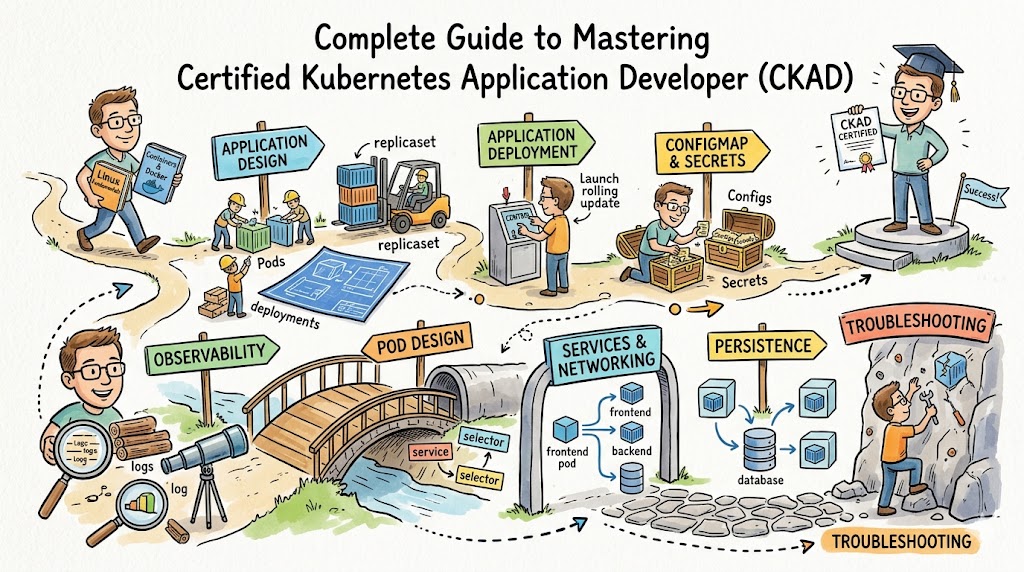
Modern software delivery relies heavily on container orchestration, and the Certified Kubernetes Application Developer (CKAD) credential serves as the gold standard for professionals in this space. This roadmap provides a technical deep dive for engineers who want to validate their ability to design and deploy cloud-native applications. By utilizing resources from DevOpsSchool, you can bridge the gap between basic container knowledge and professional-grade cluster management. This guide ensures you make informed career decisions while navigating the shift toward platform engineering and microservices.
What is the Certified Kubernetes Application Developer (CKAD)?
The Certified Kubernetes Application Developer (CKAD) represents a performance-based certification that tests your hands-on proficiency in a live CLI environment. Unlike standard exams that rely on memory, this assessment requires you to solve real-world architectural problems under a strict time limit. It focuses on the day-to-day tasks of an application developer, ensuring you can manage pods, services, and storage without constant supervision.
This program exists because enterprises need engineers who can handle production-focused learning over pure theory. It aligns perfectly with the current industry demand for developers who take ownership of the entire application lifecycle. When you earn this certification, you prove to global employers that you possess the skills to maintain high-availability systems in a cloud-native ecosystem.
Who Should Pursue Certified Kubernetes Application Developer (CKAD)?
Backend developers, full-stack engineers, and SREs gain the most immediate benefit from this certification. It also provides immense value to cloud professionals and security engineers who must ensure that workloads remain isolated and efficient within a shared cluster. Even engineering managers find this track useful for understanding the technical constraints their teams face during digital transformations.
Professional growth in the Indian and global tech markets often depends on verifying your skills through recognized industry benchmarks. Beginners with a foundation in Linux and Docker will find this a challenging but achievable milestone. Experienced engineers use it to formalize their knowledge, while managers use it to lead their departments toward more mature DevOps practices.
Why Certified Kubernetes Application Developer (CKAD) is Valuable and Beyond
Enterprise adoption of Kubernetes continues to grow, ensuring that CKAD skills remain relevant despite the rapid turnover of other tools. This certification offers a high return on investment because it focuses on the universal principles of distributed systems rather than a single cloud provider’s proprietary tools. You can apply these skills to AWS, Azure, Google Cloud, or on-premises environments with equal effectiveness.
Longevity in a technical career requires constant adaptation to cloud-native workflows. The CKAD validates that you can navigate these changes and deliver value in a containerized world. It shields your career against obsolescence by focusing on the fundamental orchestration patterns that define modern infrastructure and application design.
Certified Kubernetes Application Developer (CKAD) Certification Overview
The Linux Foundation delivers this program through Certified Kubernetes Application Developer (CKAD) and hosts it on https://www.devopsschool.com. It utilizes a practical, proctored assessment where you interact with multiple Kubernetes clusters to complete specific technical tasks. This structure ensures that every certificate holder has actually performed the work required in a production environment.
The ownership of the environment rests entirely on the candidate during the exam. You must configure networking, manage persistent volumes, and troubleshoot failing pods within a two-hour window. This rigorous approach makes the CKAD one of the most respected credentials in the DevOps and SRE communities worldwide.
Certified Kubernetes Application Developer (CKAD) Certification Tracks & Levels
The certification path moves from foundational concepts to advanced specializations like security and administration. While the CKAD focuses on the application layer, the CKA (Administrator) and CKS (Security) tracks allow you to broaden your infrastructure expertise. This tiered approach helps you align your learning with your specific career goals and daily project requirements.
Specialization tracks in FinOps and SRE offer additional ways to differentiate your profile in a crowded job market. By following these levels, you demonstrate a clear progression from a basic practitioner to a master of cloud-native architecture. This progression is essential for engineers who want to move into senior, principal, or architectural roles within their organizations.
Complete Certified Kubernetes Application Developer (CKAD) Certification Table
| Track | Level | Who it’s for | Prerequisites | Skills Covered | Recommended Order |
| Application | Professional | Developers | Linux, Docker | Pods, YAML, Services | First |
| Admin | Professional | Ops / SRE | CKAD Experience | Cluster Ops, Nodes | Second |
| Security | Advanced | Security Pros | CKA/CKAD | Network Policies, RBAC | Third |
| Observability | Advanced | SRE / Platform | CKAD | Logging, Monitoring | Fourth |
Detailed Guide for Each Certified Kubernetes Application Developer (CKAD) Certification
Certified Kubernetes Application Developer (CKAD) – Professional Level
What it is
This certification validates your ability to build, configure, and expose cloud-native applications on Kubernetes. It confirms that you can use standard primitives to design and troubleshoot scalable tools in a live environment.
Who should take it
Software engineers and cloud practitioners who manage containerized workloads should pursue this. It requires about 6–12 months of experience with Linux and basic container concepts.
Skills you’ll gain
- Building and scaling deployments with high availability.
- Configuring applications via ConfigMaps and Secrets.
- Implementing multi-container pod patterns like Sidecars.
- Managing persistent storage using PVs and PVCs.
- Directing traffic through Services and Ingress.
Real-world projects you should be able to do
- Migrating a monolithic service to a Kubernetes-based microservice.
- Setting up a self-healing deployment with readiness and liveness probes.
- Managing application state with Persistent Volumes.
- Creating secure network policies to isolate sensitive workloads.
Preparation plan
- 7–14 days: Learn imperative kubectl commands to save time during the exam.
- 30 days: Practice every domain in a local lab environment using Minikube or Kind.
- 60 days: Solve multiple mock exams to improve speed and accuracy under pressure.
Common mistakes
- Spending too long on a single question worth low points.
- Neglecting to check the cluster context before running commands.
- Writing YAML files manually instead of using imperative generators.
- Forgetting to verify that a resource successfully reached a “Running” state.
Best next certification after this
- Same-track option: Certified Kubernetes Administrator (CKA).
- Cross-track option: Certified Kubernetes Security Specialist (CKS).
- Leadership option: Cloud Strategy Professional.
Choose Your Learning Path
DevOps Path
This path focuses on automating the software delivery pipeline. You will learn how to integrate Kubernetes into your CI/CD workflows to ensure fast, reliable application updates. By mastering these tools, you help your organization reduce deployment friction and improve overall engineering velocity.
DevSecOps Path
Security takes priority in this specialized learning track. You will learn to implement zero-trust networking, scan images for vulnerabilities, and manage secrets securely within your clusters. This path is vital for engineers who work in highly regulated industries like finance or healthcare.
SRE Path
The Site Reliability Engineering path emphasizes the stability and performance of your production systems. You will master observability, self-healing mechanisms, and resource optimization to maintain high uptime. The goal is to build resilient applications that automatically adapt to changing traffic patterns.
AIOps Path
You will explore how machine learning and AI can automate complex IT operations. This path covers the use of intelligent tools to predict system failures and manage cluster capacity. It is ideal for engineers who want to manage large-scale infrastructure with minimal manual intervention.
MLOps Path
This track bridges the gap between data science and production engineering. You will learn to deploy machine learning models at scale using Kubernetes-native tools like Kubeflow. This ensures that your AI models remain reproducible, scalable, and easy to monitor in production.
DataOps Path
You will focus on managing data-intensive applications and persistent storage within containers. This path addresses the challenges of running databases and data pipelines on Kubernetes. It is essential for data engineers who are moving stateful workloads to cloud-native platforms.
FinOps Path
The FinOps path teaches you how to optimize the costs of your cloud infrastructure. You will learn to track resource usage by labels and namespaces to ensure financial accountability. This expertise is highly valued by organizations looking to maximize the ROI of their cloud investments.
Role → Recommended Certified Kubernetes Application Developer (CKAD) Certifications
| Role | Recommended Certifications |
| DevOps Engineer | CKAD, CKA, Terraform |
| SRE | CKAD, CKA, Prometheus |
| Platform Engineer | CKAD, CKA, CKS |
| Cloud Engineer | CKAD, Solutions Architect |
| Security Engineer | CKAD, CKS |
| Data Engineer | CKAD, DataOps Professional |
| FinOps Practitioner | CKAD, FinOps Certified |
| Engineering Manager | CKAD, PMP |
Next Certifications to Take After Certified Kubernetes Application Developer (CKAD)
Same Track Progression
Advancing to the Certified Kubernetes Administrator (CKA) represents the most common next step. While CKAD covers application deployment, CKA teaches you how to build and maintain the actual clusters. This combination makes you a versatile professional capable of handling the entire stack.
Cross-Track Expansion
Broadening your skills into security with the CKS or cloud-specific architecture adds significant market value. Understanding how Kubernetes interacts with managed services like AWS EKS or Google GKE makes your expertise more practical. You can also explore Infrastructure as Code (IaC) to automate your environment provisioning.
Leadership & Management Track
Transitioning into leadership requires a blend of technical depth and management frameworks. Combining your CKAD knowledge with a PMP or MBA allows you to lead high-level digital strategy. You will be able to bridge the communication gap between executive stakeholders and technical teams.
Training & Certification Support Providers for Certified Kubernetes Application Developer (CKAD)
DevOpsSchool
This platform provides instructor-led bootcamps that focus on the practical requirements of the CKAD exam. They offer access to real-world labs where you can practice every domain under the guidance of experienced mentors. Their curriculum ensures you build the speed and accuracy needed for success.
Cotocus
You can access high-level technical consulting and training through Cotocus. They emphasize production-grade Kubernetes scenarios, helping you master the tools used by global tech giants. Their training programs are designed for professionals who want to move beyond the basics of orchestration.
Scmgalaxy
This community-focused provider offers a wide range of study materials and mock exams for CKAD aspirants. They help you build a strong foundation in configuration management before you dive into complex Kubernetes tasks. Their resources are excellent for self-paced learners who need reliable study guides.
BestDevOps
This provider specializes in curated learning paths that simplify the journey to becoming a certified developer. They offer targeted modules on the most difficult exam topics, such as network policies and persistent volumes. Their goal is to ensure you pass the certification on your first attempt.
devsecopsschool.com
You will find specialized training here for integrating security into your Kubernetes development process. This site provides the knowledge needed to build secure application images and harden your cluster configurations. It is an essential resource for aspiring DevSecOps professionals.
sreschool.com
This site focuses on the principles of Site Reliability Engineering within the Kubernetes ecosystem. You will learn how to implement monitoring, logging, and self-healing systems that keep applications healthy. Their courses are perfect for those who want to specialize in high-availability systems.
aiopsschool.com
Engineers interested in the future of automated operations should explore the courses offered here. You will learn how to use AI-driven tools to manage Kubernetes clusters and predict potential outages. This training prepares you for the next wave of intelligent infrastructure management.
dataopsschool.com
This platform offers specialized training for managing data pipelines and stateful applications in containers. You will learn the best practices for database orchestration and data consistency on Kubernetes. It is the go-to resource for data engineers working in cloud-native environments.
finopsschool.com
You will learn how to control cloud spending and optimize resource allocation through this specialized provider. They offer frameworks for tracking costs within Kubernetes and implementing saving strategies. This knowledge is crucial for any technical leader managing a cloud budget.
Frequently Asked Questions (General)
- Is the CKAD exam harder than multiple-choice certifications?
Most candidates find the CKAD more difficult because it requires practical implementation rather than just recognizing correct answers. You must demonstrate that you can actually configure a cluster under time pressure.
- How much time should I spend studying?
You should dedicate at least 40 to 60 hours of hands-on practice if you already know Docker and Linux. If you are new to these technologies, expect to spend 3 to 4 months building your foundational skills.
- Can I use the documentation during the test?
The exam allows you to access the official Kubernetes documentation website in one browser tab. You must learn to search this site quickly to find YAML examples and command syntax during the exam.
- What is the format of the questions?
The test consists of 15 to 20 performance-based tasks that you must complete in a terminal window. You are graded on the final state of the cluster and the resources you created.
- Do I need to know a programming language?
You do not need to write complex code, but you must be comfortable editing YAML files. A basic understanding of how applications run in a Linux environment is also essential for success.
- How long does the certification last?
The CKAD certification remains valid for three years from the date you pass the exam. You must retake the test after this period to keep your status active and up to date.
- What happens if I fail the exam?
Most exam purchases include one free retake, allowing you to try again if you don’t succeed the first time. This takes the pressure off and lets you learn from the initial experience.
- Is the exam proctored?
Yes, a live proctor monitors your webcam and screen throughout the entire session. You must follow strict rules regarding your environment and the websites you access.
- What are the most important topics to study?
You should focus heavily on Pod Design, Network Policies, and Persistent Volumes. These domains carry significant weight and often cause the most trouble for candidates during the test.
- Can I take the exam on my own laptop?
You can use your own computer as long as it meets the technical requirements for the proctoring software. A stable internet connection and a working webcam are mandatory.
- How do I get my certificate?
The Linux Foundation will email your results within 24 hours of the exam. If you pass, you can download your certificate and claim your digital badge through their portal.
- Does CKAD help with job hunting?
Yes, many recruiters specifically search for CKAD-certified candidates for DevOps and SRE roles. It provides immediate proof that you have the hands-on skills required for the job.
FAQs on Certified Kubernetes Application Developer (CKAD)
- Does the exam version match the latest Kubernetes release?
The exam usually tracks a version that is one or two releases behind the latest stable upstream version. You should check the official handbook to ensure your practice environment matches the exam’s Kubernetes version.
- Should I use aliases for the kubectl command?
Setting up aliases like “k” for “kubectl” and exporting common variables will save you several minutes during the exam. Most successful candidates use these shortcuts to improve their speed and efficiency.
- Are there any specific hardware requirements for the webcam?
You need a webcam that can clearly show your face and your ID during the check-in process. The proctor will also ask you to scan the room with the camera to ensure no unauthorized materials are present.
- How do I manage time between difficult and easy questions?
You should immediately skip any question that feels too complex and move to the easier tasks. Secure the points for the simple questions first, then use your remaining time to tackle the more difficult architectural problems.
- Does the exam cover Helm or service meshes?
The current CKAD curriculum focuses on core Kubernetes objects and does not include third-party tools like Helm or Istio. However, mastering the core objects is a prerequisite for using those advanced tools in production.
- Can I use a second monitor during the test?
No, the proctoring rules usually restrict you to a single monitor. This makes it easier for the proctor to monitor your activity and ensures a fair testing environment for everyone.
- What kind of terminal is used in the exam?
The exam environment provides a standard Linux terminal in your browser. You will have access to common text editors like Vim and Nano for modifying YAML files and configuration scripts.
- How does the grading work for partially completed tasks?
The grading system checks the final state of the cluster for each task. If you complete most of a task but fail on a final step, you might receive partial credit, but full points require complete accuracy.
Final Thoughts: Is Certified Kubernetes Application Developer (CKAD) Worth It?
Practical mastery of Kubernetes defines the modern engineering landscape, and the CKAD provides the most reliable way to prove your expertise. After years of mentoring professionals, I have seen how this certification builds the technical confidence needed to handle high-stakes production environments. It forces you to move beyond the surface level of containers and truly understand how distributed systems function at scale.
Investing the time to earn this credential pays off in both immediate salary gains and long-term career stability. You gain a deep, functional understanding of orchestration that remains applicable regardless of the specific tools your company uses. If you want to elevate your career and join the ranks of elite cloud-native engineers, starting your CKAD journey is the smartest move you can make today.