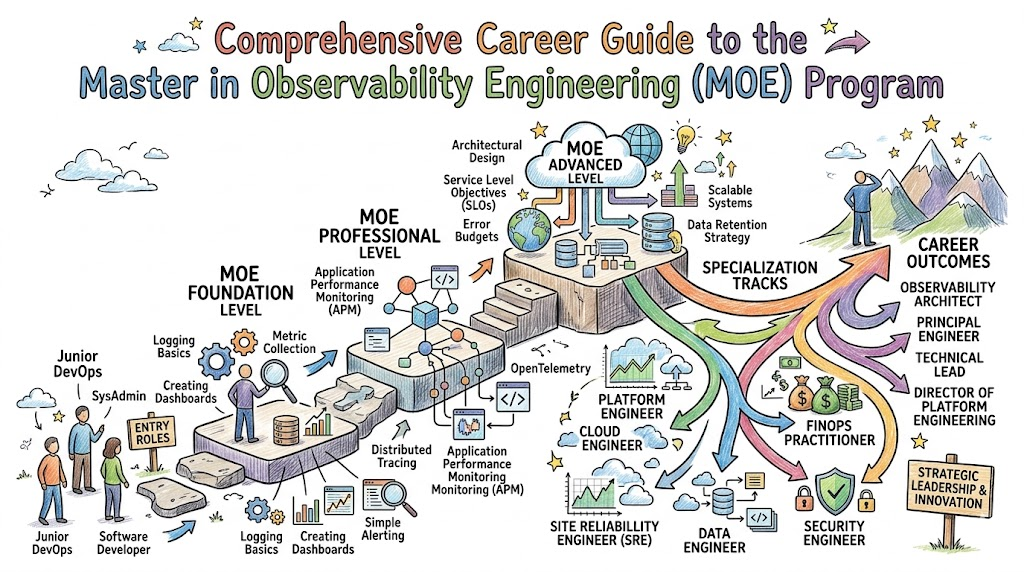
Navigating the complexities of modern cloud-native environments requires more than just standard monitoring tools. Enrolling in the Master in Observability Engineering (MOE) provides DevOpsschool students and veteran engineers with the precise technical framework needed to decode distributed system behaviors. This guide serves as a roadmap for professionals who want to transition from reactive firefighting to proactive system reliability. By mastering the core pillars of telemetry, you ensure that your infrastructure remains transparent, scalable, and resilient against the “unknown-unknowns” of production traffic.
What is the Master in Observability Engineering (MOE)?
The Master in Observability Engineering (MOE) represents an advanced educational standard for engineers managing high-scale distributed systems. It exists to solve the visibility gap created by microservices and ephemeral containerized workloads. Unlike traditional monitoring that only tracks pre-defined failures, this program teaches you how to ask new questions of your system without shipping new code. It aligns perfectly with enterprise-grade requirements for deep forensic analysis and real-time performance tuning. Most organizations now prioritize this certification because it moves the focus from “is it up?” to “why is it slow?”
Who Should Pursue Master in Observability Engineering (MOE)?
Site Reliability Engineers (SREs), DevOps leads, and Cloud Architects gain the most significant edge by completing this certification. It also benefits security analysts who need to correlate audit logs with system traces for rapid threat detection. Developers who want to own their code in production find that these skills reduce the friction between writing features and maintaining stability. Whether you work in a startup in India or a global tech giant, this certification validates your ability to manage the technical debt of complex software stacks.
Why Master in Observability Engineering (MOE) is Valuable and Beyond
Industry leaders consistently rank observability as a top priority because it directly impacts the bottom line by reducing downtime. The MOE certification offers long-term career value because it focuses on open-source standards like OpenTelemetry rather than proprietary vendor lock-in. As enterprises migrate more workloads to the cloud, the demand for professionals who can architect high-cardinality data systems continues to grow. Investing in this program ensures you remain a high-value asset capable of steering organizations through complex digital transformations.
Master in Observability Engineering (MOE) Certification Overview
The primary training occurs through the official course link and stays hosted on the website mentioned in the opening section. The program uses a practical, hands-on methodology to verify that candidates can actually implement what they learn in a live environment. It utilizes a structured approach to telemetry, covering metrics, logs, and distributed traces in a unified curriculum. Ownership of this program rests with industry veterans who constantly update the modules to reflect the latest shifts in the CNCF (Cloud Native Computing Foundation) landscape.
Master in Observability Engineering (MOE) Certification Tracks & Levels
The certification features a progressive ladder consisting of Foundation, Professional, and Advanced tiers. The Foundation level establishes a baseline for system health, while the Professional level dives deep into service mesh observability and distributed tracing. The Advanced tier focuses on the business of reliability, including SLO management and large-scale data governance. This clear progression allows you to tailor your learning journey to your specific career goals and current job responsibilities.
Complete Master in Observability Engineering (MOE) Certification Table
| Track | Level | Who it’s for | Prerequisites | Skills Covered | Recommended Order |
| Telemetry Core | Foundation | Aspiring DevOps | Basic Linux | Dashboards & Logs | 1 |
| Distributed Ops | Professional | Active SREs | Foundation Level | Tracing & OTel | 2 |
| Strategy & Scale | Advanced | System Architects | Professional Level | Governance & Cost | 3 |
| Intelligent Ops | Expert | AI/ML Engineers | Advanced Level | Predictive Analysis | 4 |
Detailed Guide for Each Master in Observability Engineering (MOE) Certification
Master in Observability Engineering (MOE) – Foundation
What it is
This certification validates an engineer’s ability to set up basic infrastructure monitoring and centralized logging. It acts as the gateway to advanced reliability engineering.
Who should take it
Junior system administrators and developers who need to understand how to visualize the health of their applications.
Skills you’ll gain
- Deploying Prometheus exporters on various operating systems.
- Designing functional Grafana dashboards for real-time monitoring.
- Configuring log collectors like Fluentd or Promtail.
- Implementing basic alerting rules to prevent outages.
Real-world projects you should be able to do
- Build a monitoring stack for a basic three-tier web application.
- Aggregate logs from multiple Docker containers into a searchable interface.
Preparation plan
- 7-14 Days: Learn the basics of PromQL and log query languages.
- 30 Days: Set up a local monitoring environment using Docker Compose.
- 60 Days: Document a mock incident and how your dashboards helped identify the cause.
Common mistakes
- Creating too many alerts that lead to notification fatigue.
- Monitoring resource usage without monitoring actual user experience.
Best next certification after this
- Same-track option: MOE Professional.
- Cross-track option: AWS or Azure Practitioner.
- Leadership option: Certified Scrum Master.
Master in Observability Engineering (MOE) – Professional
What it is
The Professional level focuses on the intricate world of distributed tracing and microservices. It confirms your ability to track a single request across dozens of internal services.
Who should take it
Intermediate DevOps and SRE professionals who manage high-traffic Kubernetes environments.
Skills you’ll gain
- Instrumenting code using OpenTelemetry SDKs.
- Visualizing request spans and identifying latency bottlenecks.
- Setting up Service Level Indicators (SLIs) that reflect user pain.
- Managing the overhead and cost of high-volume trace data.
Real-world projects you should be able to do
- Identify the specific microservice causing a 500ms delay in a request chain.
- Implement head-based or tail-based sampling to save on storage costs.
Preparation plan
- 7-14 Days: Deeply research the W3C Trace Context and span attributes.
- 30 Days: Set up Jaeger or Tempo in a Kubernetes cluster.
- 60 Days: Correlate specific log errors with trace IDs automatically.
Common mistakes
- Forgetting to propagate trace headers across service boundaries.
- Sampling too aggressively and losing critical error data.
Best next certification after this
- Same-track option: MOE Advanced.
- Cross-track option: CKA (Certified Kubernetes Administrator).
- Leadership option: Engineering Manager Foundations.
Choose Your Learning Path
DevOps Path
This path focuses on shifting observability “left” into the development phase. You learn how to use telemetry to validate deployments and automate rollbacks when metrics deviate from the norm. It ensures that developers have the data they need to debug their own code in production. This approach dramatically increases the velocity of feature releases while maintaining safety.
DevSecOps Path
Professionals on this track use observability as a powerful lens for security forensics. You learn to detect lateral movement and unauthorized API calls by analyzing trace patterns and log anomalies. This path bridges the gap between traditional security monitoring and modern cloud-native defense. It allows you to build a more secure infrastructure through continuous visibility.
SRE Path
The SRE path prioritizes the “Golden Signals” of latency, traffic, errors, and saturation. You focus on building automated systems that respond to observability data to keep the site running. This track teaches you the art of managing Error Budgets and balancing feature velocity with system stability. It is the most technical path for those managing mission-critical platforms.
AIOps Path
This track utilizes machine learning to make sense of the massive scale of modern telemetry data. You learn how to implement automated root cause analysis and noise reduction algorithms. It prepares you to handle environments where the volume of data exceeds human capacity for manual analysis. This path is the future of large-scale enterprise operations.
MLOps Path
MLOps specialists focus on the observability of the machine learning lifecycle. You learn to monitor model drift and data quality alongside traditional infrastructure metrics. This path ensures that AI models remain accurate and provide value long after their initial deployment. It is a vital specialization for companies relying on automated decision-making.
DataOps Path
The DataOps path applies observability principles to data movement and transformation pipelines. You learn how to monitor data freshness and schema integrity in real-time. This ensures that the data driving your business intelligence remains accurate and timely. It is a critical track for data engineers who manage complex ETL workflows.
FinOps Path
This track links technical performance directly to cloud expenditure. You learn how to use observability data to find “orphaned” resources and optimize your cloud bill. This path enables you to have data-driven conversations about the cost of reliability. It is an essential skill for engineering leaders who need to justify their infrastructure budget.
Role → Recommended Master in Observability Engineering (MOE) Certifications
| Role | Recommended Certifications |
| DevOps Engineer | MOE Foundation, MOE Professional |
| SRE | MOE Professional, MOE Advanced |
| Platform Engineer | MOE Advanced, Cloud Native Expert |
| Cloud Engineer | MOE Professional, FinOps Track |
| Security Engineer | MOE DevSecOps Specialist |
| Data Engineer | MOE DataOps Track |
| FinOps Practitioner | MOE FinOps Specialist |
| Engineering Manager | MOE Advanced Strategy |
Next Certifications to Take After Master in Observability Engineering (MOE)
Same Track Progression
Once you master the MOE curriculum, you should seek out deep-dive certifications in specific open-source tools like Prometheus or Grafana. Staying specialized ensures you remain the primary authority for observability architecture within your company. This progression keeps you ahead of new features and shifts in the telemetry landscape.
Cross-Track Expansion
Broadening your expertise into Kubernetes Security (CKS) or Advanced Network Engineering provides a more holistic view of the systems you observe. These skills help you understand the “why” behind the metrics you see on your dashboards. Cross-training makes you a more versatile engineer who can solve problems across the entire stack.
Leadership & Management Track
If you plan to move into people management, look for certifications in Strategic Leadership or IT Business Management. These programs help you translate technical SLOs into business-level KPIs that executives understand. Transitioning to leadership allows you to build and mentor high-performing observability teams.
Training & Certification Support Providers for Master in Observability Engineering (MOE)
DevOpsSchool
This provider offers world-class instructor-led training that focuses on the practical application of observability principles. They guide students through complex labs that mirror real-world production challenges. Their certification is widely respected by enterprises looking for hands-on technical proficiency in MOE.
Cotocus
This organization specializes in technical consulting and high-end engineering workshops. They help teams master the nuances of distributed tracing and service mesh monitoring through tailored sessions. Their approach ensures that engineers can immediately apply their new skills to their current projects.
Scmgalaxy
This community-driven platform provides a vast library of tutorials and resources for DevOps enthusiasts. They excel at breaking down complex observability concepts into easy-to-understand modules. It is an excellent place for continuous learning and keeping up with the latest tool updates.
BestDevOps
This training center focuses on career-ready skills, helping professionals bridge the gap between theory and practice. Their MOE tracks emphasize the creation of production-grade monitoring and logging systems. They offer excellent mentorship for those looking to reach senior-level engineering roles.
devsecopsschool.com
This platform focuses exclusively on the intersection of security and modern operations. They provide specialized tracks that teach how to use observability data for advanced threat hunting and compliance. Their training is essential for anyone working in a security-conscious environment.
sreschool.com
Dedicated to the principles of Site Reliability Engineering, this provider places observability at the heart of its training. They teach the math behind SLOs and the logic of error budgets. Their courses prepare you for the rigors of managing global-scale infrastructure.
aiopsschool.com
This provider leads the way in teaching artificial intelligence for IT operations. They show you how to apply machine learning to your observability data to automate incident response. Their training is perfect for engineers looking to build self-healing systems.
dataopsschool.com
This platform focuses on the unique observability challenges within data engineering and analytics pipelines. They teach you how to monitor data flows and ensure high-quality outputs for business users. It is the go-to provider for data-focused professionals.
finopsschool.com
Focusing on the financial side of the cloud, this provider teaches you how to link observability to the bottom line. You learn to monitor and manage cloud spend through technical metrics. Their training is vital for modern cost-conscious engineering teams.
Frequently Asked Questions (General)
- How does MOE differ from standard DevOps certifications?
Standard DevOps courses cover a broad range of tools, while MOE goes deep into the specific science of system visibility and forensic data analysis.
- Can I earn this certification if I don’t use Kubernetes?
Yes, the principles of observability apply to any system, including virtual machines and serverless functions, though many labs use Kubernetes for scale.
- What programming languages should I know?
You should have a basic understanding of a language like Python, Go, or Java to understand how to add instrumentation libraries to your applications.
- Is there a practical component to the exam?
Most authorized providers require you to complete a series of hands-on labs that prove your ability to configure real observability stacks.
- How long does the certification remain valid?
Providers generally recommend a two-year renewal cycle to ensure you stay current with the rapidly evolving ecosystem of cloud-native tools.
- Will this certification help me get a job at a top-tier tech firm?
Yes, companies like Google, Meta, and Amazon value observability skills highly as they are central to their internal engineering cultures.
- Do I need an expensive cloud subscription to practice?
Most labs can be performed using local tools like Minikube or free-tier cloud accounts, making the training accessible to everyone.
- Is the MOE Foundation level enough to get started?
The Foundation level provides the essential skills to begin working as a monitoring engineer or junior SRE, though advanced roles require higher levels.
- Can teams take this certification together?
Many providers offer corporate training packages that allow entire engineering teams to standardize their observability practices at once.
- What is the focus of the Advanced level?
The Advanced level shifts from “how to monitor” to “how to manage a reliability strategy” across a large, complex organization.
- Are there any prerequisites for the MOE Professional exam?
Typically, you should either complete the Foundation level or have significant documented experience in DevOps or system administration.
- Does the program cover open-source or proprietary tools?
The curriculum prioritizes open-source standards like OpenTelemetry, Prometheus, and Grafana to ensure your skills are portable across any company.
FAQs on Master in Observability Engineering (MOE)
- What are the three pillars of observability covered in MOE?
The program focuses heavily on metrics (numerical data), logging (event records), and distributed tracing (request journeys) to provide a 360-degree view of a system.
- Does MOE help in reducing Mean Time to Resolution (MTTR)?
By providing deeper insights into system behavior, MOE allows engineers to find the root cause of an issue in minutes rather than hours, directly lowering MTTR.
- How does the program handle data sampling?
You will learn various sampling strategies (head-based, tail-based, and adaptive) to ensure you collect high-value data without overwhelming your storage budget.
- Can observability help with capacity planning?
Yes, the metrics and trends you learn to collect are essential for predicting future resource needs and avoiding “out of memory” crashes during traffic spikes.
- Is eBPF included in the MOE curriculum?
The advanced modules often introduce eBPF as a cutting-edge way to get deep system visibility without the need for manual code instrumentation.
- Does the certification teach me how to build dashboards?
The program goes beyond simple dashboarding to teach you how to create meaningful visualizations that tell a story about system health and performance.
- How does MOE support service level management?
You learn the technical requirements for defining, tracking, and reporting on Service Level Indicators (SLIs) and Service Level Objectives (SLOs).
- Will I learn about OpenTelemetry collectors?
Implementing and configuring OpenTelemetry collectors is a core part of the Professional and Advanced tracks, as they are central to modern telemetry pipelines.
Final Thoughts: Is Master in Observability Engineering (MOE) Worth It?
Spending time in the MOE program is a calculated move toward the most important set of skills in contemporary engineering. Few people can design a system that uses deep, correlated data to show its underlying state, even though many can set up a basic alarm. With this qualification, you become someone who creates dependable, self-aware infrastructure instead of just managing tools. The MOE path is the greatest option if you want to future-proof your career and confidently tackle the most difficult technological problems in the world. The clarity you acquire from these abilities will make all other aspects of your work simpler and more fulfilling.