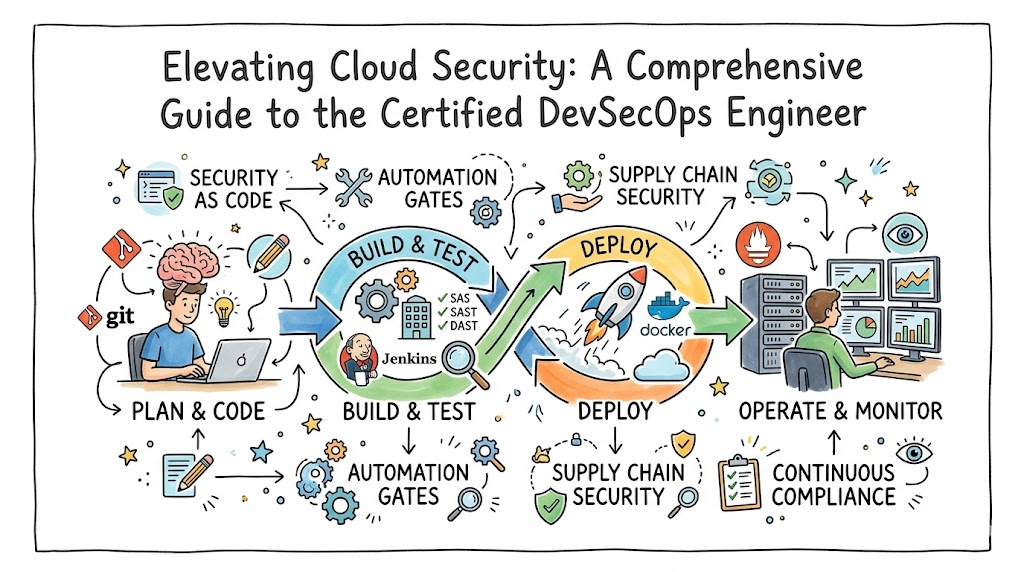
Security integration within modern software delivery pipelines represents the single most important shift for engineering teams today. This detailed guide explores the Certified DevSecOps Engineer program, a roadmap specifically built for professionals who want to merge security seamlessly into their development and operations workflows. By leveraging the resources at DevSecOpsschool, engineers gain the practical mastery required to protect cloud-native environments while maintaining high deployment speeds. Whether you are a senior architect or a growing developer, this certification provides the technical edge needed to thrive in an industry that now demands “security-first” engineering excellence.
What is the Certified DevSecOps Engineer?
The Certified DevSecOps Engineer credential signifies an individual’s ability to automate security across the entire software development lifecycle. It exists to eliminate the friction between rapid releases and rigorous protection requirements by transforming security into a programmable and repeatable process. Unlike certifications that rely on abstract theory, this program prioritizes production-grade implementation and real-world infrastructure hardening. It aligns perfectly with modern enterprise practices by treating security as a collective responsibility rather than a siloed department.
Who Should Pursue Certified DevSecOps Engineer?
Cloud architects, SREs, and software developers find immense value in this certification as they navigate complex, distributed systems. Newcomers use it to build a foundational career in security automation, while senior leads leverage the curriculum to drive organizational change. The program carries significant weight in global markets and the Indian tech sector, where companies increasingly seek “security-aware” engineering talent. Managers also benefit by gaining the technical context to oversee DevSecOps transitions and lead high-performing, compliant teams.
Why Certified DevSecOps Engineer is Valuable Today and Beyond
As cyber threats evolve, organizations prioritize engineers who can build self-healing, secure pipelines that stand up to constant scrutiny. This certification ensures long-term career relevance by focusing on core principles like “Policy as Code” and automated compliance. It offers a massive return on time investment because the skills apply to any cloud provider or modern toolchain. Professionals holding this title remain highly sought after because they drastically reduce the risk of costly data breaches and system downtime.
Certified DevSecOps Engineer Certification Overview
Candidates access the learning modules through the official DevSecOpsschool portal, while the DevSecOpsschool website hosts the entire certification journey. The program utilizes a performance-based assessment model, requiring students to solve actual security challenges in a live sandbox environment. Industry experts maintain the certification structure, ensuring it reflects the latest vulnerabilities and defense strategies. This hands-on approach ensures that every certified professional possesses the competence to secure enterprise-scale workloads immediately.
Certified DevSecOps Engineer Certification Tracks & Levels
The program offers a clear progression through foundation, professional, and advanced tiers to support continuous professional growth. Foundation levels introduce the basics of scanning and “shifting left,” while professional and advanced tracks tackle complex topics like secret management and Kubernetes hardening. Specialization tracks allow engineers to align their learning with specific roles in SRE, DevOps, or FinOps. This structured path ensures that your credentials grow alongside your career responsibilities.
Complete Certified DevSecOps Engineer Certification Table
| Track | Level | Who it’s for | Prerequisites | Skills Covered | Recommended Order |
| Security Ops | Foundation | New Grads / Jrs | Linux Basics | SAST, SCA, Linting | 1 |
| Pipeline Security | Professional | DevOps / SRE | 2+ Years Exp | DAST, Vault, CI/CD | 2 |
| Platform Hardening | Advanced | Lead Engineers | Professional Cert | K8s Security, IaC | 3 |
| Strategic Security | Expert | Managers / Architects | 5+ Years Exp | Risk, Governance | 4 |
Detailed Guide for Each Certified DevSecOps Engineer Certification
Certified DevSecOps Engineer – Foundation Level
What it is
This introductory level confirms your ability to integrate basic security checks into a developer’s daily workflow. It proves you understand how to identify vulnerabilities before the code even leaves the workstation.
Who should take it
Aspiring DevOps engineers and junior developers should start here to build a “security-first” mindset. It requires a basic understanding of Git and the ability to navigate a terminal environment.
Skills you’ll gain
- Automated code linting for security flaws.
- Running Static Application Security Testing (SAST).
- Managing Software Composition Analysis (SCA) to find vulnerable libraries.
- Using Git hooks to prevent credential leaks.
Real-world projects you should be able to do
- Integrate a security scanner into a GitHub Actions workflow.
- Create a report identifying high-risk dependencies in a Node.js project.
Preparation plan
Dedicate the first 14 days to mastering security terminology and tool installation. Spend the next 30 days running scans on open-source repositories. Complete your 60-day plan by automating these scans in a local Jenkins environment.
Common mistakes
Candidates often overlook the importance of basic Linux permissions during their labs. Others fail by trying to memorize tool commands instead of understanding the vulnerability types they are fixing.
Best next certification after this
- Same-track option: Certified DevSecOps Engineer – Professional.
- Cross-track option: Cloud Practitioner.
- Leadership option: Junior Team Lead.
Certified DevSecOps Engineer – Professional Level
What it is
This certification validates your skill in building and managing end-to-end secure delivery pipelines. It focuses on the technical orchestration required to keep production environments safe and compliant.
Who should take it
Mid-level engineers who currently manage CI/CD systems and want to specialize in security automation. You should have at least two years of hands-on experience in a cloud or operations role.
Skills you’ll gain
- Orchestrating Dynamic Application Security Testing (DAST).
- Deploying and managing HashiCorp Vault for secrets.
- Implementing container security and image signing.
- Automating cloud infrastructure compliance.
Real-world projects you should be able to do
- Build a pipeline that automatically fails if a DAST scan finds a critical SQL injection risk.
- Set up a production Kubernetes cluster with automated network policies.
Preparation plan
Focus on secret management and DAST configurations for the first 14 days. Use 30 days to integrate these into a multi-stage pipeline. Spend the final 60 days perfecting your troubleshooting skills for complex automated workflows.
Common mistakes
Many struggle with the networking requirements between the security tools and the application. Another common error involves failing to properly filter false positives, which causes friction with development teams.
Best next certification after this
- Same-track option: Certified DevSecOps Engineer – Advanced.
- Cross-track option: Certified Kubernetes Administrator (CKA).
- Leadership option: DevSecOps Architect.
Choose Your Learning Path
DevOps Path
This route focuses on cultural transformation and developer enablement. You learn to provide tools that help developers secure their own code without adding friction to their day. It prioritizes the “Shift Left” philosophy, moving security checks into the IDE and the build process. This path suits those who enjoy collaboration and want to improve the overall quality of software engineering.
DevSecOps Path
The core DevSecOps track prepares you for a dedicated role in security automation and architecture. You study the deep technical integrations of vulnerability scanners, secret managers, and compliance engines. This path transforms you into a specialist who can design a fortress around any software product. It represents the fastest route to becoming a high-value security engineer in modern tech companies.
SRE Path
Site Reliability Engineers follow this path to ensure that security supports system uptime and performance. You focus on runtime security, anomaly detection, and building resilient infrastructure that can withstand attacks. It bridges the gap between infrastructure stability and data protection. This track is perfect for engineers who manage large-scale, mission-critical production environments.
AIOps Path
Engineers in this track apply artificial intelligence to the massive volume of security data generated by modern systems. You learn to use machine learning to identify threats that traditional signature-based tools might miss. This path suits forward-thinking professionals who want to automate the detection and response to sophisticated cyberattacks. It combines data science with deep security operations knowledge.
MLOps Path
This specialized path addresses the unique security requirements of the machine learning lifecycle. You focus on securing data pipelines, protecting model weights, and ensuring the privacy of training datasets. It teaches you how to apply DevSecOps rigor to the experimental world of AI. This is a critical path for engineers working in AI-driven startups or research departments.
DataOps Path
Data security and privacy form the foundation of the DataOps track. You explore how to protect data as it moves from ingestion to analytics through masking and encryption. It ensures that your data pipelines comply with strict regulations like GDPR or SOC2. This path is essential for engineers in finance, healthcare, or any industry handling sensitive user information.
FinOps Path
This track links security investments with financial efficiency and cloud cost optimization. You learn to evaluate the cost-to-risk ratio of various security tools and infrastructure configurations. It prepares you to make business-focused decisions that keep the organization safe without overspending on the cloud bill. This is a highly strategic path for those looking to influence engineering budgets.
Role → Recommended Certified DevSecOps Engineer Certifications
| Role | Recommended Certifications |
| DevOps Engineer | Foundation + Professional levels |
| SRE | Professional + Advanced levels |
| Platform Engineer | Core + Infrastructure tracks |
| Cloud Engineer | Cloud Security focus |
| Security Engineer | All levels and tracks |
| Data Engineer | DataOps specialty |
| FinOps Practitioner | FinOps specialty |
| Engineering Manager | Expert / Leadership track |
Next Certifications to Take After Certified DevSecOps Engineer
Same Track Progression
Deepening your expertise means pursuing advanced certifications that focus on high-level architecture and policy design. You will move into the realm of “Security Governance as Code,” managing security across multiple cloud providers. This path leads to principal-level roles where you set the security standard for the entire organization.
Cross-Track Expansion
Broadening your skills into areas like Kubernetes administration or cloud architecture makes you a more versatile “T-shaped” professional. By combining security with platform engineering, you can build systems that are inherently secure from the ground up. This flexibility allows you to tackle a wider variety of engineering challenges.
Leadership & Management Track
Transitioning into leadership requires a shift toward risk management and team strategy. You will learn how to align security goals with business objectives and how to build a culture of security throughout the company. This track prepares you for high-level positions such as Director of DevSecOps or CISO.
Training & Certification Support Providers for Certified DevSecOps Engineer
DevOpsSchool
This organization provides industry-leading training with a heavy emphasis on hands-on labs and real-world scenarios. Their instructors bring decades of experience to help you master the complexities of security automation.
Cotocus
Cotocus specializes in cloud-native training and infrastructure-as-code security. They provide the practical skills needed to harden modern platforms and secure containerized workloads effectively.
Scmgalaxy
As a hub for configuration management and DevOps knowledge, Scmgalaxy offers tutorials and community support for security tool integration. Their resources help you stay current with the latest industry shifts.
BestDevOps
This provider delivers structured learning paths that simplify the most difficult security concepts for engineers. They focus on clear, step-by-step instruction to ensure you pass your certification with confidence.
devsecopsschool.com
As the official certification site, this platform provides the most accurate and up-to-date exam details and study materials. It serves as the primary resource for all aspiring DevSecOps professionals.
sreschool.com
This platform bridges the gap between reliability and security. They offer training that helps SREs build stable, secure, and highly available infrastructure for the modern enterprise.
aiopsschool.com
Engineers looking to leverage machine learning in security operations should turn to this resource. They provide cutting-edge training on the intersection of AI and operational security.
dataopsschool.com
Focusing on the data lifecycle, this provider helps engineers secure sensitive information across complex data pipelines. Their courses are vital for anyone in data-heavy industries.
finopsschool.com
This resource teaches you how to balance security requirements with cloud spending. It is the leading platform for professionals who need to manage the financial impact of their security decisions.
Frequently Asked Questions (General)
- Does the exam require extensive coding knowledge?
You need to be comfortable reading code and writing basic scripts in languages like Python or Bash. The exam focuses more on configuring security tools and interpreting their output than on building complex applications.
- Can I finish the preparation in 30 days?
Many professionals with a background in DevOps complete the training and pass the exam within a month. A dedicated daily study routine makes this goal very achievable.
- Are the certification exams proctored?
The exams are proctored online to maintain the integrity and value of the credential. You will need a reliable computer and a quiet space to take the test.
- Will this certification help me get a job in India?
The Indian tech market has a massive demand for DevSecOps skills as companies migrate to the cloud. This credential serves as a strong signal of your technical competence to recruiters.
- Is the foundation level mandatory for everyone?
No, if you already have several years of experience in security automation, you may choose to start at the professional level. However, the foundation level ensures you have no gaps in your core knowledge.
- What tools do I need to install for the labs?
Most training providers offer a cloud-based lab environment, so you won’t need to install anything locally. You just need a modern web browser to access the tools and infrastructure.
- How often does the curriculum change?
The program updates its content regularly to include new tools and reflect the current threat landscape. This ensures that your skills remain relevant in a fast-paced industry.
- Is there a discount for bulk corporate training?
Many of the support providers offer corporate packages for teams looking to certify multiple engineers at once. You should contact the providers directly for specific pricing.
- What is the passing score for the exam?
While the exact score can vary by level, most exams require at least 70% to pass. The focus is on demonstrating that you can successfully complete the practical tasks.
- Can I use the certification logo on my LinkedIn profile?
Yes, once you pass the exam, you receive a digital badge and logo that you can use to showcase your achievement. This helps you stand out to potential employers and peers.
- Do I need to be a security expert to start?
The program is designed to take engineers with operational or development backgrounds and turn them into security experts. You only need a willingness to learn and a basic technical foundation.
- What happens if my internet disconnects during the exam?
Most proctoring services have protocols for technical issues. You should immediately contact the support team to resolve the problem and resume your session if possible.
FAQs on Certified DevSecOps Engineer
- How does this program handle the security of Docker containers?
The course includes deep dives into image scanning, container breakout prevention, and runtime security. You will learn how to build a secure container supply chain from start to finish.
- Does the certification cover “Policy as Code” concepts?
You will learn to use tools like Open Policy Agent (OPA) to enforce security rules across your infrastructure automatically. This ensures that no non-compliant resources ever reach production.
- Is threat modeling part of the professional track?
You will learn how to identify potential attack vectors early in the design phase. This proactive approach saves time and prevents major security flaws in the final product.
- How does the exam test hands-on skills?
The exam places you in a live environment where you must fix vulnerabilities or configure security tools to meet specific requirements. It is a true test of your practical abilities.
- Does the course address security for serverless architectures?
The curriculum covers the unique challenges of serverless security, including function permissions and event-source protection. It ensures you are prepared for the latest cloud trends.
- Will I learn about secrets management in a multi-cloud setup?
The professional and advanced levels cover centralized secret management that works across AWS, Azure, and GCP. You will learn to eliminate “secret sprawl” across your organization.
- Does the program teach how to secure a CI/CD pipeline itself?
Securing the “keys to the kingdom” remains a major focus. You will learn how to protect your build servers and ensure that only authorized changes reach production.
- How does the certification help with regulatory audits?
By teaching you “Compliance as Code,” the program helps you generate automated reports that satisfy auditors. This reduces the manual effort required for SOC2, HIPAA, or GDPR compliance.
Final Thoughts: Is Certified DevSecOps Engineer Worth It?
Professionals who want to lead in a cloud-first world should view this certification as a career accelerator. It replaces vague security concepts with precise, automated actions that provide immediate value to any employer. I strongly encourage you to embrace this path, as the demand for engineers who can “secure the pipeline” far exceeds the current supply. Taking this step today ensures you stay ahead of the curve and become a key architect of the secure digital future.