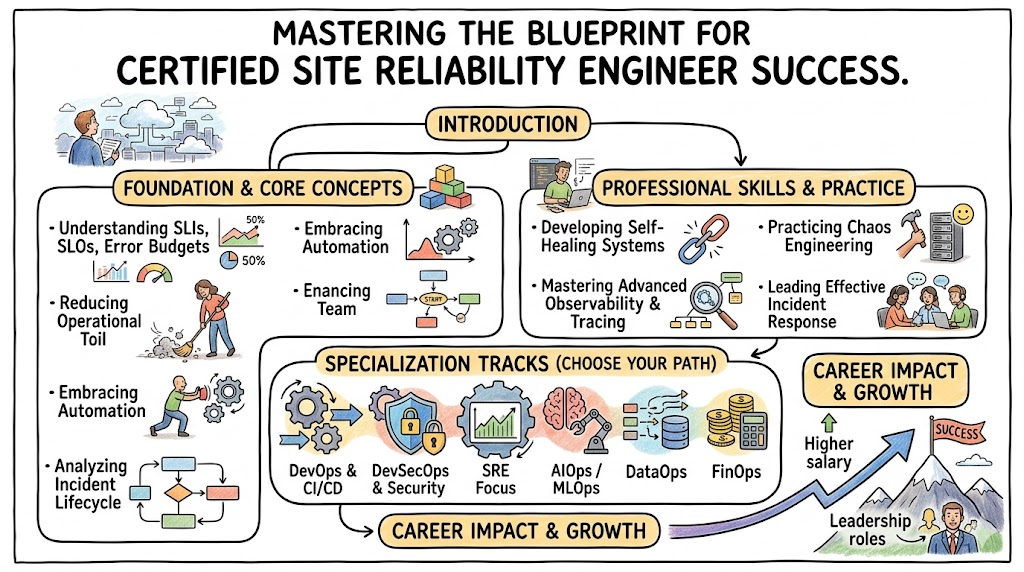
Engineering teams now face the massive challenge of maintaining uptime while deploying features at lightning speed. This comprehensive guide explores the Certified Site Reliability Engineer pathway, a critical framework for anyone navigating the intersection of development and operations. By focusing on automation and data-driven reliability, Sreschool helps professionals transition from manual firefighting to high-level platform engineering. You will discover how this certification transforms your technical approach and secures your position in the modern cloud-native ecosystem.
What is the Certified Site Reliability Engineer?
The Certified Site Reliability Engineer designation acts as a gold standard for professionals who manage mission-critical production environments. It replaces traditional, manual administration with an engineering-first mindset that prioritizes long-term system health. Organizations utilize this framework to ensure their services remain scalable, resilient, and highly available under extreme traffic loads. By mastering these principles, you learn to treat operations as a software problem, utilizing code to manage infrastructure and eliminate repetitive manual tasks.
Who Should Pursue Certified Site Reliability Engineer?
Ambitious software developers, system administrators, and cloud architects will find immense value in this certification track. It specifically targets those who want to move beyond basic deployment and take full ownership of service reliability and performance. Engineering managers also benefit significantly by learning how to implement culture-shifting practices like error budgets and blameless post-mortems. Whether you operate in the Indian tech hub or a global enterprise, these skills define the next generation of infrastructure experts.
Why Certified Site Reliability Engineer is Valuable and Beyond
Enterprises across every sector are migrating to distributed systems, creating an urgent need for engineers who understand reliability at scale. Holding this credential proves your ability to navigate complex microservices architectures and maintain stability during rapid changes. Since the core principles rely on engineering logic rather than specific vendor tools, your expertise remains relevant even as the technology stack evolves. You gain a competitive edge that translates directly into higher-tier roles and increased earning potential in the global market.
Certified Site Reliability Engineer Certification Overview
Candidates access the full program through the official portal hosted on Sreschool, ensuring a streamlined and professional learning journey. The curriculum combines deep theoretical knowledge with rigorous, hands-on practical assessments to validate real-world readiness. This dual approach ensures that every certified professional can walk into a production environment and contribute immediately to system stability. The program structure follows a logical progression, starting with core concepts and advancing toward complex architectural decision-making.
Certified Site Reliability Engineer Certification Tracks & Levels
The program offers three distinct tiers—foundation, professional, and advanced—to match your current experience and career goals. Specialized tracks also exist for related fields such as DevOps, FinOps, and AIOps, allowing for a tailored professional development path. As you move through these levels, you demonstrate a growing mastery of the tools and philosophies that drive modern site reliability. Each stage aligns with specific job responsibilities, helping you climb the career ladder from an individual contributor to a strategic leader.
Complete Certified Site Reliability Engineer Certification Table
| Track | Level | Who it’s for | Prerequisites | Skills Covered | Recommended Order |
| Core SRE | Foundation | New Practitioners | Linux Basics | SLIs, SLOs, Toil | 1 |
| Automation | Professional | DevOps Engineers | Foundation | Scripting, CI/CD | 2 |
| Architecture | Advanced | Senior Architects | Professional | System Design | 3 |
| Cloud Ops | Professional | Infrastructure Leads | Foundation | Observability | 2 |
| Cost Mgmt | Professional | FinOps Analysts | Foundation | Cloud Economics | 2 |
Detailed Guide for Each Certified Site Reliability Engineer Certification
Certified Site Reliability Engineer – Foundation
What it is
This certification validates your grasp of fundamental SRE concepts and the essential cultural shifts required for modern operations. It ensures you speak the language of reliability and understand the core metrics that drive business success.
Who should take it
Fresh graduates, junior developers, and IT professionals looking to pivot into the high-demand field of SRE should start here. It provides the necessary baseline for all advanced technical training.
Skills you’ll gain
- Calculating and managing Error Budgets
- Measuring Service Level Indicators (SLIs)
- Identifying and reducing operational “toil”
- Understanding the lifecycle of an incident
Real-world projects you should be able to do
- Create a reliability roadmap for a basic microservice
- Design a monitoring dashboard using standard industry metrics
- Script a basic automation to replace a manual server check
Preparation plan
- 7-14 Days: Immerse yourself in the SRE handbook and complete introductory modules.
- 30 Days: Apply these concepts to a lab environment and practice defining realistic SLOs.
- 60 Days: Study real-world case studies of major outages and how SRE principles resolved them.
Common mistakes
- Treating SRE as just another name for “Operations” without changing the engineering mindset.
- Over-complicating SLOs before understanding the basic needs of the end-user.
Best next certification after this
- Same-track option: Certified SRE Professional
- Cross-track option: DevOps Foundation
- Leadership option: Tech Lead Certification
Certified Site Reliability Engineer – Professional
What it is
The professional level confirms your ability to build and maintain high-scale systems using advanced automation and coding. It moves beyond theory into the actual engineering work required to keep global services running smoothly.
Who should take it
Experienced engineers with a solid background in Linux and at least one programming language should pursue this level. It is the benchmark for mid-to-senior level SRE roles in the industry.
Skills you’ll gain
- Developing self-healing infrastructure components
- Advanced observability and distributed tracing
- Capacity planning and performance tuning
- Designing automated CI/CD for reliability
Real-world projects you should be able to do
- Deploy a fully automated, multi-region application stack
- Build a chaos engineering experiment to test system limits
- Implement a centralized logging system for 50+ microservices
Preparation plan
- 7-14 Days: Review advanced automation tools and cloud-native architectural patterns.
- 30 Days: Build and break complex systems in a sandbox environment to refine troubleshooting skills.
- 60 Days: Master the integration of security and cost-efficiency into your SRE workflows.
Common mistakes
- Ignoring the “Software Engineering” part of SRE and focusing only on tool configuration.
- Failing to automate the root cause analysis after a major incident.
Best next certification after this
- Same-track option: Certified SRE Advanced
- Cross-track option: DevSecOps Professional
- Leadership option: SRE Manager
Choose Your Learning Path
DevOps Path
This track focuses on the continuous delivery of software and the cultural bridge between developers and operators. You will learn to build pipelines that ensure fast, frequent, and reliable code releases. It emphasizes the “CAMS” model: Culture, Automation, Measurement, and Sharing.
DevSecOps Path
The DevSecOps path integrates security testing directly into the development and operations cycle. You learn to automate security checks so that reliability never comes at the cost of vulnerability. It is essential for engineers working in highly regulated or data-sensitive environments.
SRE Path
The pure SRE path concentrates on the health, performance, and scalability of production systems. You will master the engineering techniques that allow services to scale to millions of users without failing. This is the most technical and focused route for reliability specialists.
AIOps Path
Engineers in the AIOps path apply artificial intelligence to automate IT operations and predict potential system failures. You learn to use machine learning models to analyze massive amounts of telemetry data for faster incident resolution.
MLOps Path
The MLOps path bridges the gap between data science and production engineering. You will learn how to deploy, monitor, and retrain machine learning models at scale, ensuring they remain reliable and accurate in real-world conditions.
DataOps Path
DataOps professionals focus on the reliability and speed of data pipelines across the enterprise. You learn to apply SRE principles to data warehouses and streaming services, ensuring that business intelligence remains uninterrupted.
FinOps Path
The FinOps path teaches you to manage and optimize the financial costs of cloud infrastructure. You will learn how to balance high performance with budget constraints, making you a vital asset to the finance and engineering departments.
Role → Recommended Certified Site Reliability Engineer Certifications
| Role | Recommended Certifications |
| DevOps Engineer | Certified SRE Foundation, DevOps Professional |
| SRE | Certified SRE Foundation, Professional, Advanced |
| Platform Engineer | Certified SRE Professional, Kubernetes Expert |
| Cloud Engineer | Certified SRE Foundation, Cloud Architect |
| Security Engineer | Certified SRE Foundation, DevSecOps Professional |
| Data Engineer | Certified SRE Foundation, DataOps Specialist |
| FinOps Practitioner | Certified SRE Foundation, FinOps Specialist |
| Engineering Manager | Certified SRE Foundation, Leadership Track |
Next Certifications to Take After Certified Site Reliability Engineer
Same Track Progression
Once you master the professional level, you should aim for the Advanced SRE or Architect certification. These programs focus on high-level system design, global traffic management, and long-term capacity planning. This path solidifies your status as a technical authority who can design systems that never sleep.
Cross-Track Expansion
Diversifying your skills into DevSecOps or AIOps makes you a more versatile and valuable asset to any organization. Understanding how security and artificial intelligence intersect with reliability allows you to solve a wider range of business problems. This expansion protects your career against shifts in the technology landscape.
Leadership & Management Track
If you enjoy mentoring and strategic planning, consider moving into the leadership and management track. These certifications prepare you to lead SRE teams, manage departmental budgets, and drive reliability culture at the executive level. It shifts your focus from individual tasks to organizational impact.
Training & Certification Support Providers for Certified Site Reliability Engineer
DevOpsSchool
This provider delivers intensive, hands-on training that prepares engineers for the daily realities of modern DevOps and SRE roles. Their labs focus on actual industry tools and scenarios to ensure you gain practical expertise.
Cotocus
A leading name in technical education, this organization offers deep-dive courses into cloud-native engineering and site reliability practices. They tailor their curriculum to meet the needs of both individual learners and large corporate teams.
Scmgalaxy
This massive community hub provides endless resources, tutorials, and certification support for professionals in the software configuration and reliability space. It serves as a vital knowledge base for staying current with industry trends.
BestDevOps
Experts at this institution curate high-quality training content that focuses on the integration of various operational disciplines. They help candidates bridge the gap between simple IT tasks and complex site reliability engineering.
devsecopsschool.com
This platform specializes in the vital intersection of security and operations, ensuring that SREs can protect the systems they build. Their training makes security a core part of your engineering toolkit.
sreschool.com
As the primary host for the SRE certification, this site offers the most authoritative and comprehensive learning paths available. It provides the official roadmap, study materials, and exams for the Certified SRE program.
aiopsschool.com
This forward-thinking institution trains engineers to use artificial intelligence to manage and optimize complex IT environments. Their courses are essential for anyone looking to lead the next wave of automated operations.
dataopsschool.com
Professionals who want to apply SRE principles to the world of big data and analytics should look to this provider. They offer specialized training for maintaining the reliability of critical data infrastructure.
finopsschool.com
This organization focuses on the financial management of cloud systems, teaching SREs how to optimize spending without hurting performance. Their certifications are highly valued by organizations looking to maximize cloud ROI.
Frequently Asked Questions
- How hard is the Certified Site Reliability Engineer exam?
Candidates find the exam challenging because it tests practical automation skills alongside a deep understanding of reliability philosophy.
- What is the typical study time for the foundation level?
Most professionals successfully pass the exam after roughly 30 days of consistent study and hands-on practice.
- Does the professional level require specific prerequisites?
Yes, you must hold the foundation certificate and demonstrate proficiency in a programming language like Python or Go.
- Why should I invest in this specific certification?
It offers a high return on investment by qualifying you for high-paying roles in elite technology companies globally.
- Is the certification recognized outside of India?
The certification follows international standards and carries significant weight with employers across the global tech industry.
- Can I go straight to the professional level?
While you might have the skills, completing the foundation level ensures you align with the specific terminology and framework used in advanced stages.
- Is coding a major part of the SRE role?
Absolutely, coding allows SREs to automate manual tasks and build the software that manages the infrastructure.
- How long does the certification stay active?
The credential usually stays valid for two to three years, after which you should pursue a higher level or recertify.
- Which cloud providers does the training cover?
The training focuses on cloud-agnostic principles that you can apply to AWS, Azure, Google Cloud, and on-premise systems.
- Where do I take the actual certification exam?
You can take the exam online through a secure, proctored environment from anywhere in the world.
- Are there lab environments provided for practice?
Yes, the professional and advanced tracks include dedicated lab access to practice real-world engineering tasks.
- Does this certification help with career transitions?
It provides a clear pathway for traditional system admins and developers to enter the high-growth field of SRE.
FAQs on Certified Site Reliability Engineer
- Which daily tasks define an SRE’s workload?
An SRE spends their time writing code for automation, managing service performance, and conducting deep-dive analysis into system incidents.
- How does SRE differ from standard DevOps?
SRE provides a concrete set of practices and metrics to implement the broader, more cultural goals of the DevOps movement.
- Why do SREs use error budgets?
Error budgets provide a data-driven way to manage risk, allowing teams to balance the speed of innovation with the need for stability.
- Is Kubernetes expertise necessary for this path?
While not the only focus, Kubernetes is the primary tool for container orchestration and features heavily in the professional curriculum.
- What programming language should I learn first?
Python is generally the best starting point due to its versatility, though Go is rapidly becoming the standard for high-performance cloud tools.
- How do SREs reduce “on-call” stress?
SREs use automation to handle routine issues and write detailed documentation to ensure that incident response is fast and predictable.
- What makes a post-mortem “blameless”?
A blameless post-mortem focuses on systemic failures and process gaps rather than blaming individuals for human error during an outage.
- Can I become an SRE without a traditional degree?
Many top-tier SREs come from diverse backgrounds; what matters most is your ability to solve complex technical problems and automate systems.
Final Thoughts: Is Certified Site Reliability Engineer Worth It?
Taking the leap into this certification track empowers you to handle the most complex technical challenges of the modern era. You stop being a person who just fixes servers and become a professional who engineers global stability. The skills you acquire—automation, observability, and strategic reliability—form the backbone of every successful digital company today. If you want a career that offers both high impact and long-term security, this path delivers exactly what you need.