Introduction
Security vulnerabilities currently cripple even the most advanced tech stacks, which forces companies to reconsider their entire delivery model. Consequently, the DevSecOps Certified Professional (DSOCP) emerges as a critical standard for engineers who want to integrate safety directly into the automation pipeline. This guide provides a clear roadmap for professionals who aim to master the intersection of development, security, and operations. Furthermore, DevOpsSchool offers the specialized training required to navigate these complex cloud-native architectures effectively. By prioritizing automated defense, you ensure that your career remains resilient against shifting industry demands and technological disruptions. This comprehensive resource empowers you to make smarter career decisions while leading your organization toward a more secure digital future.
What is the DevSecOps Certified Professional (DSOCP)?
The DevSecOps Certified Professional (DSOCP) represents a fundamental shift from traditional reactive security to a proactive, code-driven defense model. It exists because manual security gates cannot withstand the pressure of modern, high-velocity CI/CD environments. Specifically, this program replaces slow, human-centric audits with automated policy enforcement and real-time vulnerability scanning. It focuses on the practical implementation of security tools within the DevOps lifecycle, ensuring that safety becomes a built-in feature of the software. Professionals who master DSOCP understand how to treat security as an integral part of the engineering workflow rather than an external bottleneck. This certification validates your ability to protect enterprise assets without sacrificing the speed of innovation.
Who Should Pursue DevSecOps Certified Professional (DSOCP)?
Software engineers and site reliability engineers (SREs) benefit most from this certification as it expands their technical reach into the security domain. Cloud architects and platform engineers who manage complex infrastructures also find the DSOCP curriculum essential for building resilient systems. Additionally, security analysts who want to transition into automation-heavy roles will see this as the perfect bridge for their skill sets. Engineering managers and technical leads should pursue this path to better govern their teams’ release cycles and risk profiles. The program supports candidates at various career stages, from ambitious junior engineers to seasoned enterprise leaders. Its global relevance makes it a valuable asset for talent in India and throughout the international tech ecosystem.
Why DevSecOps Certified Professional (DSOCP) is Valuable
Cybersecurity threats currently evolve faster than traditional defense mechanisms can react, creating an urgent need for automated security expertise. Earning the DSOCP credential ensures that you remain indispensable to organizations that prioritize digital safety and operational continuity. Furthermore, the industry currently experiences a massive transition toward “Shift Left” strategies where security starts at the first line of code. Consequently, this certification provides an exceptional return on investment by positioning you at the center of the modern platform engineering movement. Enterprises actively seek professionals who can guarantee application safety while maintaining aggressive deployment schedules. Mastering these skills safeguards your career against the obsolescence of manual IT processes.
DevSecOps Certified Professional (DSOCP) Certification Overview
The program delivers technical mastery through the official DevSecOps Certified Professional (DSOCP) curriculum and operates primarily . It utilizes a hands-on, assessment-based model to confirm that every candidate can implement security strategies in a production-ready environment. Moreover, the structure maintains a vendor-neutral approach, allowing you to apply your knowledge across diverse cloud providers and toolchains. The program breaks down complex security concepts into manageable modules, focusing on real-world application over abstract theory. This methodology ensures that you gain the technical confidence needed to manage security at an enterprise scale. Consequently, the certification serves as a powerful testament to your practical competence in the DevSecOps field.
DevSecOps Certified Professional (DSOCP) Certification Tracks & Levels
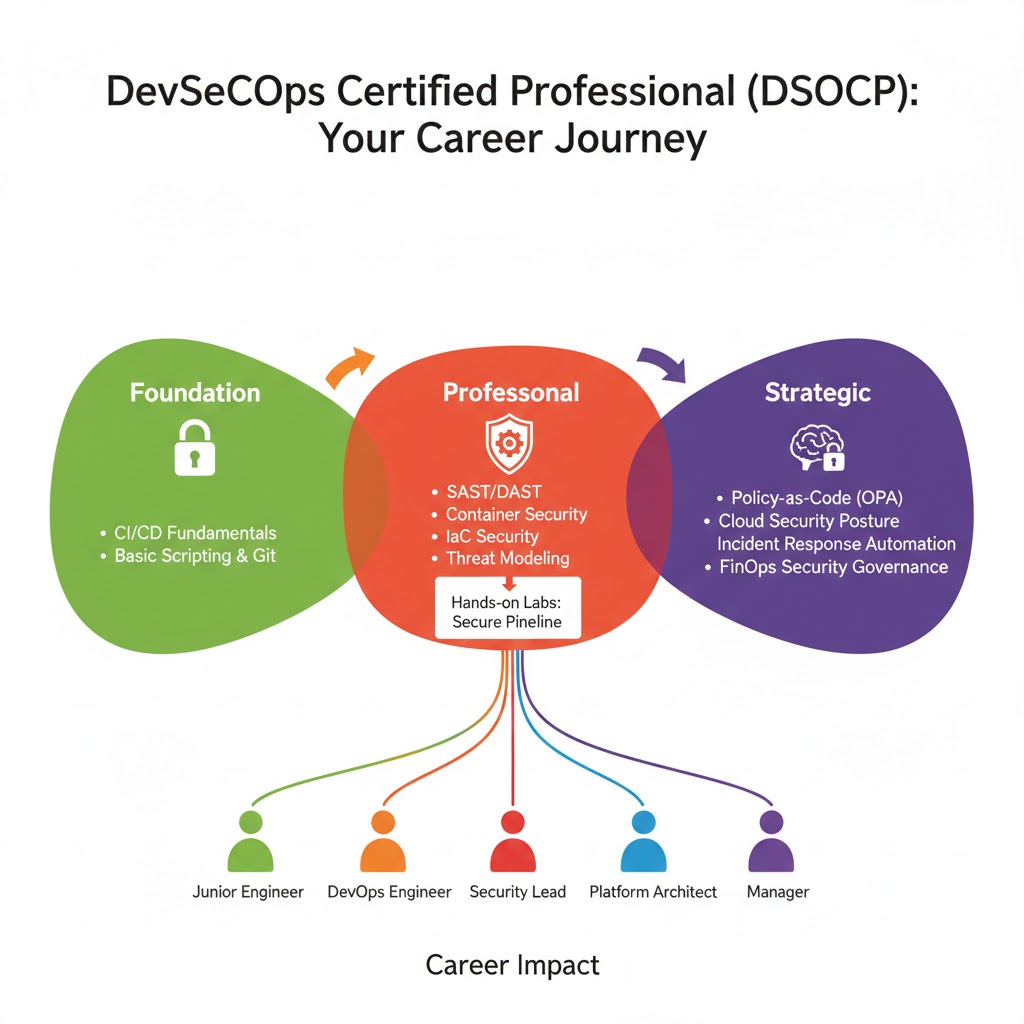
The DSOCP program utilizes a tiered hierarchy consisting of foundation, professional, and advanced levels to support continuous professional growth. The foundation level establishes the basics of automated scanning and the core philosophy of shared security responsibility. Transitioning to the professional level allows you to master infrastructure hardening, secrets management, and runtime application defense. Furthermore, the advanced level prepares you for high-impact roles involving compliance as code and multi-cloud security governance. This clear progression ensures that you build a robust technical foundation before you tackle the complex architectural challenges of a global enterprise. Each track aligns with specific career milestones, providing a clear path from individual contributor to strategic technical leader.
Complete DevSecOps Certified Professional (DSOCP) Certification Table
| Track | Level | Who it’s for | Prerequisites | Skills Covered | Recommended Order | Official Link |
| Core Security | Foundation | Junior Engineers | Basic Linux/Git | SAST, DAST, SCA | 1st | Official Site |
| Platform Safety | Professional | SREs/DevOps | Foundation | Vault, Docker, K8s | 2nd | Official Site |
| Governance | Advanced | Senior Leads | Professional | Compliance as Code | 3rd | Official Site |
| Architecture | Expert | Architects | Advanced | Risk Frameworks | 4th | Official Site |
Detailed Guide for Each DevSecOps Certified Professional (DSOCP) Certification
DevSecOps Certified Professional (DSOCP) – Foundation
What it is
The Foundation level validates your understanding of how to integrate basic security checks into a standard development pipeline. It serves as the primary entry point for anyone who wants to master the “Shift Left” approach to software safety.
Who should take it
Junior developers, entry-level system administrators, and manual security testers should start with this level. It also benefits IT professionals who want to pivot their careers toward modern automation and cloud-native security.
Skills you’ll gain
- You will learn to implement Static Application Security Testing (SAST) within the CI/CD flow.
- You will master Software Composition Analysis (SCA) to identify risks in open-source dependencies.
- You will understand the cultural changes required to align development and security teams.
- You will create automated reports that help developers fix vulnerabilities before they reach production.
Real-world projects you should be able to do
- You should be able to configure a GitHub Action that automatically scans code for vulnerabilities on every push.
- You should be able to set up a tool that prevents the build from completing if critical security flaws exist.
Preparation plan
- 7–14 days: Study the core principles of the DevSecOps Manifesto and the basics of pipeline orchestration.
- 30 days: Practice setting up open-source security scanners in a local environment using Jenkins or GitLab CI.
- 60 days: Complete a full project that integrates security at every stage of a simple application build.
Common mistakes
- Many candidates focus only on the technical tools while ignoring the necessary communication between departments.
- Beginners often fail to distinguish between actual security threats and minor false positives in scan results.
Best next certification after this
- Same-track option: DSOCP Professional
- Cross-track option: SRE Certified Professional
- Leadership option: Engineering Manager Foundation
DevSecOps Certified Professional (DSOCP) – Professional
What it is
The Professional level expands your focus into infrastructure security and the active protection of applications in a live runtime environment. It confirms your ability to secure containers, orchestration layers, and sensitive application data.
Who should take it
Experienced DevOps engineers, SREs, and cloud administrators who manage production workloads should pursue this track. It targets professionals who take the lead on technical security initiatives within their organizations.
Skills you’ll gain
- You will harden Docker images and secure the configurations of Kubernetes clusters against common exploits.
- You will implement HashiCorp Vault to manage secrets, keys, and dynamic credentials across the cloud.
- You will perform Dynamic Application Security Testing (DAST) to find vulnerabilities in running web applications.
- You will build monitoring dashboards that detect and alert on security anomalies in real-time.
Real-world projects you should be able to do
- You should be able to design an automated secrets rotation system for an enterprise-scale cloud application.
- You should be able to secure a microservices architecture using network policies and robust access controls.
Preparation plan
- 7–14 days: Research CIS Benchmarks and container security best practices for production-grade environments.
- 30 days: Spend significant time in the lab configuring and testing secrets management and runtime monitoring tools.
- 60 days: Develop a comprehensive security stack for a multi-service application and perform simulated attack scenarios.
Common mistakes
- Professionals sometimes create security policies that are too restrictive, which blocks legitimate developer productivity.
- Some engineers forget to secure the automation server itself, leaving the entire CI/CD pipeline vulnerable to attack.
Best next certification after this
- Same-track option: DSOCP Advanced
- Cross-track option: Cloud Security Architect
- Leadership option: Technical Lead Certification
DevSecOps Certified Professional (DSOCP) – Advanced
What it is
The Advanced level addresses the strategic side of security, focusing on large-scale governance and the automation of compliance frameworks. It validates your ability to design security systems that protect entire organizations across diverse cloud providers.
Who should take it
Principal engineers, enterprise architects, and senior security leads should focus on this advanced track. It prepares you for roles where you define the security standards and policies for multiple technical teams.
Skills you’ll gain
- You will write and enforce Policy as Code to ensure that infrastructure always follows company security standards.
- You will automate compliance auditing for global frameworks such as SOC2, ISO 27001, and GDPR.
- You will design secure multi-cloud architectures that maintain consistency across different cloud environments.
- You will lead complex threat modeling sessions to identify and mitigate risks during the early design phase.
Real-world projects you should be able to do
- You should be able to implement a global policy that prevents the creation of public, unencrypted storage buckets.
- You should be able to build a centralized dashboard that tracks the security health of hundreds of cloud accounts.
Preparation plan
- 7–14 days: Study the technical requirements of global compliance standards and how they map to automated checks.
- 30 days: Master policy languages like Rego to write custom enforcement rules for your cloud infrastructure.
- 60 days: Create a comprehensive security and governance framework for a simulated enterprise-scale organization.
Common mistakes
- Architects often design governance rules without consulting the teams that must implement them daily.
- Candidates frequently focus too much on compliance paperwork instead of technical resilience and active defense.
Best next certification after this
- Same-track option: Expert Governance track
- Cross-track option: FinOps Professional
- Leadership option: CISO Training and Certification
Choose Your Learning Path
DevOps Path
A DevOps professional should prioritize the seamless integration of security into existing automation workflows. Start with the DSOCP Foundation to learn how to add security gates to your current pipelines without slowing down the team. Furthermore, you should move toward the Professional level to master the security of containers and cloud infrastructure. This path ensures that security becomes a standard feature of your delivery process. Consequently, you will become a more versatile engineer capable of delivering safe, reliable code at high velocity.
DevSecOps Path
The specialized DevSecOps path targets those who want to dedicate their careers to security automation and defense. You should follow the DSOCP levels sequentially to build a deep, end-to-end understanding of the entire security lifecycle. This path requires you to understand both offensive security tactics and defensive automation techniques in equal measure. Moreover, you will learn to build self-healing infrastructures that detect and remediate threats automatically. This expertise is highly valued in regulated industries like finance, insurance, and healthcare.
SRE Path
Site Reliability Engineers must view security through the lens of system availability and operational health. Since security breaches often lead to significant downtime, your goal is to prevent these incidents through better engineering. Focus on the DSOCP Professional level to master secrets management, monitoring, and production safety protocols. Furthermore, use the Advanced concepts to implement automated recovery procedures for security-related failures. This path makes you a comprehensive reliability expert who handles both operational bugs and malicious threats effectively.
AIOps / MLOps Path
As companies adopt artificial intelligence, securing the underlying data and machine learning models becomes a top priority. Professionals in this path should use DSOCP to learn how to protect the infrastructure that hosts these complex workloads. You will focus on securing data pipelines and ensuring that models remain free from unauthorized tampering. Consequently, you will build a “Secure ML” lifecycle that protects your company’s intellectual property and user privacy. This specialization bridges the gap between data science and robust infrastructure security.
DataOps Path
DataOps professionals must ensure that data flows securely across the organization without any exposure to risk. Use the DSOCP Foundation to learn how to implement automated data masking and encryption in your daily pipelines. Furthermore, the Advanced modules help you automate the technical audits required for handling sensitive user information. This ensures that your organization meets privacy standards while maintaining a high speed of data delivery. Consequently, you become the primary advocate for data security and integrity within your engineering group.
FinOps Path
FinOps practitioners benefit from DSOCP by identifying the financial risks associated with insecure cloud resources. Unsecured or misconfigured assets can lead to massive cost spikes due to unauthorized usage or data breaches. By learning the Foundation and Professional levels, you identify expensive security gaps that directly impact the company’s bottom line. Furthermore, you will advocate for security tools that offer the best financial and operational efficiency. This path allows you to manage the cloud budget and the security posture as a single, unified goal.
Role → Recommended DevSecOps Certified Professional (DSOCP) Certifications
| Role | Recommended Certifications |
| DevOps Engineer | DSOCP Foundation, DSOCP Professional |
| SRE | DSOCP Professional, DSOCP Advanced |
| Platform Engineer | DSOCP Professional, DSOCP Advanced |
| Cloud Engineer | DSOCP Foundation, DSOCP Professional |
| Security Engineer | DSOCP Professional, DSOCP Advanced |
| Data Engineer | DSOCP Foundation, Data Security Track |
| FinOps Practitioner | DSOCP Foundation, FinOps Certified |
| Engineering Manager | DSOCP Foundation, Governance Track |
Next Certifications to Take After DevSecOps Certified Professional (DSOCP)
Same Track Progression
After you master the DSOCP Advanced level, you should pursue deep specialization in specific cloud platforms or advanced security domains. This might include earning security-specific credentials from AWS, Azure, or Google Cloud to solidify your platform expertise. Furthermore, exploring advanced penetration testing or digital forensics helps you understand the mindset of modern attackers. This deep technical knowledge makes you the go-to expert for solving the most complex enterprise security issues. Consequently, you prepare yourself for elite roles such as Principal Security Architect or Distinguished Engineer.
Cross-Track Expansion
Broadening your skills into related fields like SRE or FinOps creates a much more versatile and valuable professional profile. Understanding how security impacts system reliability or cloud costs allows you to provide holistic advice to your leadership. Moreover, earning certifications in Kubernetes administration or cloud architecture can strengthen your technical foundation. This cross-pollination of skills is highly valued in high-growth companies where engineers wear multiple hats. Therefore, expanding your knowledge ensures you stay competitive as the technology landscape continues to change.
Leadership & Management Track
For those who want to transition into strategy and people management, the leadership track is the natural next step. This path involves moving from managing tools to managing teams, budgets, and overall corporate risk. Certifications in engineering management or executive leadership will help you move into roles such as Engineering Director or CISO. You will use your deep technical background to make strategic decisions that protect the company’s long-term health. Consequently, this path focuses on communication, vision, and building a strong security culture across the entire organization.
Training & Certification Support Providers for DevSecOps Certified Professional (DSOCP)
DevOpsSchool currently stands as a primary provider for DevSecOps training, offering a comprehensive curriculum that bridges the gap between development and safety. They provide an immersive learning experience that combines deep theoretical knowledge with intense, hands-on lab sessions in the cloud. Furthermore, their instructors bring decades of combined industry experience, ensuring that students learn production-ready techniques that work in real enterprise environments. Consequently, candidates gain the technical confidence needed to lead security initiatives within their organizations. DevOpsSchool also maintains a robust alumni network and provides continuous support to help students achieve their certification goals. Their commitment to excellence has made them a trusted partner for thousands of professionals worldwide who seek to master the modern software delivery lifecycle.
Cotocus provides specialized training and consulting services that focus on the deep technical mastery of DevSecOps and cloud-native technologies. Their approach is highly practical, using real-world scenarios and hands-on exercises to ensure that students can apply their skills immediately in their workplace. Moreover, they tailor their programs to meet the specific needs of modern engineering squads, making them a preferred choice for corporate upskilling. Consequently, professionals who train with Cotocus find themselves better prepared for the challenges of high-scale cloud security and automated governance. They bridge the gap between classroom learning and actual operational requirements through rigorous, instructor-led training. Their expertise ensures that engineering teams can deliver secure software at the speed of current industry demands.
Scmgalaxy offers a massive library of tutorials, webinars, and technical articles that support professionals pursuing the DSOCP certification. They provide a unique perspective on security by focusing on its roots in software configuration management and automated release engineering. Furthermore, their platform serves as a global hub where engineers share knowledge, solve complex automation problems, and stay updated on the latest security trends. Scmgalaxy helps you understand the evolution of DevSecOps, giving you a deeper context for modern security as code practices. Their community-driven approach makes them an excellent resource for continuous learning and professional networking. They empower students with the documentation and case studies needed to master the complexities of automated defense in the cloud.
BestDevOps specializes in high-impact training sessions designed for busy, working professionals who need to master DevSecOps skills quickly and effectively. Their flexible programs emphasize the use of open-source tools, ensuring that your skills remain portable across different cloud providers and employers. Furthermore, they focus on building a strong foundation of core principles before moving into advanced automation and governance topics. Consequently, they produce well-rounded engineers who can lead security initiatives in any technical environment. They prioritize practical outcomes over theoretical concepts, ensuring that every session adds immediate value to your technical career. Their training methodology focuses on the real-world application of security tools within the modern CI/CD pipeline, making learning both relevant and actionable.
devsecopsschool.com acts as a centralized portal for everyone interested in the DevSecOps movement and achieving formal DSOCP certification. They offer structured learning paths, tool comparisons, and the latest industry news to keep you informed and relevant in a competitive market. Furthermore, their training modules take you from a complete beginner to an expert-level practitioner through a series of logical, hands-on steps. The platform also provides various free resources, guides, and community forums to help you get started on your security automation journey. It remains a vital resource for staying current in the rapidly changing world of security defense and infrastructure automation. They offer a community-centric approach that fosters collaboration among aspiring security professionals from across the globe.
sreschool.com focuses on the critical link between site reliability and security, making it a perfect partner for SRE professionals pursuing DSOCP. They teach you how to build systems that are both highly available and inherently secure against modern cyber threats and exploits. Furthermore, their curriculum highlights the importance of monitoring, alerting, and automated response in maintaining the overall health of production environments. Consequently, you gain a unique operational perspective that is often missing from traditional security courses or manual auditing programs. They ensure that uptime and safety remain equally important priorities in your daily engineering work. Their instructors bring a deep understanding of how security breaches impact the reliability of large-scale systems, providing students with invaluable production insights.
aiopsschool.com provides cutting-edge training for engineers who want to incorporate artificial intelligence and machine learning into their security workflows. They offer modules that explore how AI can detect threats and automate remediation at a massive scale across distributed systems. Furthermore, they help you understand the specific security requirements of protecting AI and ML models in a production cloud environment. Consequently, you prepare yourself for the next generation of technical roles where AI and security merge seamlessly into a single discipline. This provider remains ideal for those who want to stay on the bleeding edge of technology and automation. They provide the technical skills needed to build and protect AI-driven infrastructures effectively against sophisticated modern attacks.
dataopsschool.com addresses the urgent need for security within high-speed data engineering and analytics pipelines through specialized DSOCP training. They teach you how to apply security principles to protect sensitive data at every stage of its lifecycle, from collection to analysis. Furthermore, they focus on the automated implementation of data masking, encryption, and access controls to ensure compliance with global laws. Consequently, you learn to deliver fast insights without compromising user privacy or data integrity in the cloud. They bridge the gap between data science and corporate security standards effectively through hands-on training and real-world case studies. Their programs ensure that data remains a secure and valuable asset for the entire organization during rapid digital transformation.
finopsschool.com offers a unique perspective on how security decisions impact the financial performance and cloud budget of a modern organization. They help you identify misconfigured resources that pose both a security risk and a significant financial burden to the company. Furthermore, their training helps you build a business case for security by demonstrating long-term cost savings through automated prevention and optimization. Consequently, you learn to manage the cloud infrastructure with a focus on both technical safety and financial efficiency. This dual expertise makes you a highly valued asset to any leadership team managing large-scale cloud budgets. They provide the framework needed to balance technical security requirements with fiscal responsibility and cost optimization in the cloud.
Frequently Asked Questions (General)
- How difficult is it for an engineer to pass the DSOCP certification exam?The exam is moderately difficult because it tests your practical ability to implement security tools rather than just your memory of facts. You must demonstrate that you can solve real-world automation challenges in a live environment to pass.
- What is the typical timeframe for completing the entire DSOCP certification track?Most professionals spend three to six months to complete all levels from foundation to advanced. This allows for enough hands-on practice in the labs to master the technical topics and automated tools effectively.
- Are there any mandatory requirements before I start the Foundation level?You should have a basic understanding of the Linux command line and Git version control systems. Knowing at least one programming language like Python or Go will significantly help you with the automation modules.
- What kind of salary increase can I expect after I earn this certification?DevSecOps specialists often command higher salaries than standard DevOps engineers due to the specialized nature of security automation. It also opens doors to senior roles in high-paying sectors like fintech and healthcare.
- Is the DSOCP certification recognized by employers outside of India?Yes, the tools and principles taught in the program are global industry standards used by major tech firms worldwide. This makes your certification valuable in any international technology market or enterprise environment.
- Do I need to be a security expert before I join the DSOCP program?No, the program teaches you security from an engineering perspective, starting with the very basics of automation. You only need a strong technical foundation and a desire to learn defense and operations.
- Which specific tools will I learn to use during the DSOCP training?You will master a variety of tools including SonarQube, Snyk, Jenkins, Docker, Kubernetes, and HashiCorp Vault. These tools currently represent the standards for automated security in the software industry.
- How do the training providers deliver the certification exams to candidates?The exams are typically delivered online and include a mix of conceptual questions and practical lab tasks. You must successfully complete the technical exercises within a set timeframe to earn the credential.
- Is it possible for me to take the Professional exam before the Foundation exam?We strongly recommend taking the levels in order because the Professional curriculum assumes you already understand the concepts introduced in the Foundation level. Building a strong base is critical for success.
- When does the DSOCP certification typically expire after I earn it?The certification usually requires renewal or continuing education every two to three years. This ensures that you stay up to date with the latest security threats, exploits, and automated tools.
- How does DSOCP differ from other high-level security certifications like CISSP?CISSP focuses on high-level management and security theory, while DSOCP is a technical, hands-on certification focused on automation and engineering practices. It is for those who build and secure systems.
- Can my company get a discount for certifying our entire engineering team?Many providers like DevOpsSchool offer enterprise packages and group discounts for organizations looking to upskill their technical staff at scale. This helps teams build a consistent security culture quickly.
FAQs on DevSecOps Certified Professional (DSOCP)
- What is the “Shift Left” philosophy mentioned throughout the DSOCP course?Shift Left means moving security checks to the very beginning of the development cycle. This allows you to catch and fix issues much faster and cheaper than if you found them in production.
- How does the DSOCP program handle complex regulatory compliance requirements?The program teaches you to turn compliance rules into automated tests. This ensures your infrastructure always meets regulatory standards without the need for manual intervention or slow audits.
- Does the course focus only on a specific cloud provider like AWS?The program remains vendor-neutral, teaching you concepts that apply to AWS, Azure, and Google Cloud equally. You will use various open-source tools that work across all major platforms.
- What is the primary technical goal of the Professional level track?The Professional level focuses on securing the infrastructure and the application runtime environment. You will learn to harden containers, secure clusters, and manage sensitive application secrets at scale.
- How does the use of Policy as Code help a modern organization?Policy as Code allows you to define security rules in your configuration files. This ensures that every resource you deploy automatically follows your company’s security standards without manual checks.
- Can this certification help me move into a senior engineering management role?Yes, the Advanced level focuses on governance and strategy, which are critical skills for engineering managers and technical directors in modern tech firms. It teaches you how to manage risk.
- How do the hands-on labs help me prepare for real-world security threats?The labs simulate production environments where you must integrate security tools and respond to threats. This gives you the actual experience needed to succeed in a job from day one.
- Why is container security such a major focus in the DSOCP program?Since most modern applications run in containers, securing the images and the orchestration layer is vital. It protects the entire application stack from attack and ensures operational integrity.
Final Thoughts: Is DevSecOps Certified Professional (DSOCP) Worth It?
When you analyze the current trajectory of the technology industry, it is clear that security has become a fundamental part of the engineering process. Earning the DevSecOps Certified Professional (DSOCP) is a strategic move that transforms you into a highly valuable specialist in a high-demand field. This journey requires hard work and a dedication to continuous technical growth, but the career rewards remain exceptional. You will no longer just be building software; you will be building resilient, secure platforms that protect the future of your organization. My advice as a mentor is to embrace this challenge, master the automated tools, and lead the way toward a safer digital world.