Introduction
Software development does not stop when code merges into a repository. Real users rely on digital platforms at all hours of the day. Site Reliability Engineering, often called SRE, treats operations as a software problem.
Developers already know how to build features and write clean programs. But moving into reliability work requires a fresh operational mindset. Engineers must learn how systems behave under heavy pressure.
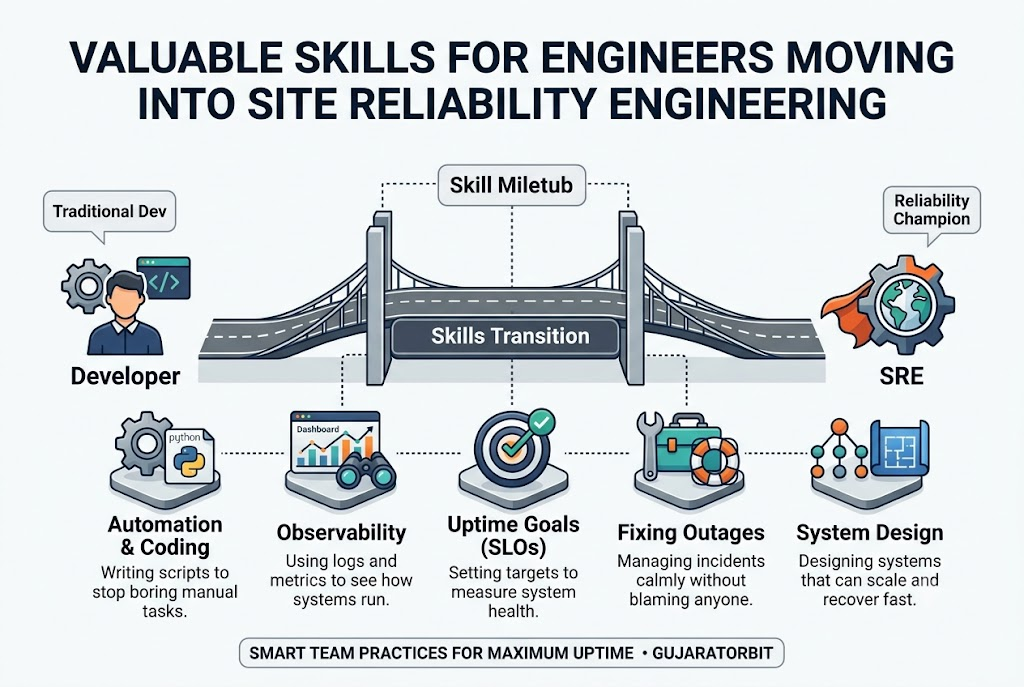
Every engineer can pick up simple habits to safeguard uptime.You monitor services, reduce manual work, and fix outages without blame.
Modern platforms like GujaratOrbit highlight how communities stay connected through dependable technology. When digital platforms stay fast and resilient, everyone benefits. Let us explore the primary skills every engineer needs for reliability work.
Mastering Code and System Automation
Reliability engineers write software to run and protect production systems.Scripting languages like Python, Go, and Bash form the baseline for routine tasks.
Engineers use scripts to replace repetitive manual labor. In reliability work, repetitive manual work is known as toil.
When you automate repetitive tasks, you reduce costly human mistakes.So, teams spend more time improving systems instead of running routine maintenance. Automation acts as a trusted force multiplier across complex architectures.
Deep Observability and Alert Management
Engineers cannot fix problems that they cannot observe.Observability rests on three foundational pillars: logs, metrics, and traces.
Metrics show whether a service responds quickly or slows down. Traces track a single request across multiple backend microservices.
Next, teams build dashboards using tools like Prometheus and Grafana.Alerts must trigger only when real user journeys suffer. This discipline protects teams from alert fatigue and noisy midnight pages.
Understanding Service Level Goals
Engineering teams balance development speed against overall system stability. SREs measure stability using SLIs and SLOs.
An SLI, or Service Level Indicator, measures system health directly.For example, it tracks request success rates or latency numbers.
An SLO, or Service Level Objective, sets a target goal for that metric. Unused downtime forms an error budget for rolling out new features safely. If the budget runs out, teams pause releases and focus entirely on stability.
Blameless Incident Management
Production outages happen even to the most skilled engineering teams. Resilient teams respond with structured, calm incident practices.
Engineers focus entirely on restoring customer access as fast as possible. They roll back changes, reroute traffic, or restart failing instances.
After the issue resolves, the team holds a blameless post-mortem. The goal is to uncover systemic gaps rather than pointing fingers at individuals. This open culture turns painful outages into valuable team learning.
Real Experience & Personal Stories
A payment gateway engineer once faced a sudden database freeze during peak morning sales. Instead of panicking, the on-call developer relied on pre-written diagnostic runbooks.
The developer quickly checked request traces across the infrastructure. A bad database lock had stalled dozens of incoming checkout requests.
The engineer executed an automated rollback command in seconds. Traffic resumed normal speed, and customers completed their purchases without disruption. Preparedness and automation saved the company from widespread transaction loss.
Case Studies & Success Stories
A fast-growing media platform struggled with severe latency whenever breaking news occurred. Developers pushed features quickly, but operations struggled to keep servers running.
The organization cross-trained its product developers on core reliability engineering patterns. Developers learned how to configure autoscaling rules and set up container health checks.
They replaced manual server tweaks with Infrastructure as Code pipelines. Over nine months, unplanned production incidents dropped by sixty-five percent. The development team gained deep confidence in handling massive live traffic spikes.
Original Insights & Opinions
Many developers assume that reliability work is purely an operations responsibility. But true reliability begins at the code design level.
Writing defensive code matters just as much as configuring a cloud load balancer. Engineers must handle timeouts, set circuit breakers, and design graceful service fallbacks.
Tools alone do not create five-nines uptime. Thoughtful engineering habits and clear operational targets matter far more. Strong developers treat production reliability as a primary product feature.
Industry Statistics & Research Data
Industry benchmark studies highlight clear operational differences between top and bottom performers:
- High-performing teams recover from outages thousands of times faster than low performers.
- Automated systems reduce manual operational toil by more than fifty percent across software teams.
- Teams tracking clear error budgets release software updates with forty percent fewer production defects.
- Distributed tracing adoption cuts mean time to resolution by more than half in microservice platforms.
These findings prove that software-driven reliability practices produce measurable business value.
Step-by-Step Guides & Tutorial
You can develop practical reliability engineering skills by following these straightforward steps:
- Pick an automation language:Learn Python or Go to write command-line tools and operational scripts.
- Instrument your code: Add structured logs and custom metrics to an existing service.
- Define an SLO: Choose a critical user journey and select a measurable availability target.
- Practice container orchestration: Learn how Kubernetes schedules, scales, and restarts application containers.
- Run a chaos test: Intentionally stop a non-production dependency to verify your application’s fallback behavior.
Following this path gives any developer immediate, hands-on production insight.
Expert Interviews & Quotes
A principal reliability engineer at a global cloud provider shared valuable advice for engineers:
“The best developers do not just write code that passes unit tests on a laptop. They write code that explains itself clearly when it runs in production at three in the morning.”
This perspective shifts how software engineers think about their deliverables. Software must remain observable, testable, and resilient under real-world conditions.
Detailed Comparisons (X vs Y)
Understanding how reliability engineering compares to traditional system administration clarifies the role.
| Operational Area | Traditional Operations Approach | Modern Site Reliability Engineering |
| Problem Solving | Fixes issues by logging into servers manually | Writes code and automated scripts to fix root causes |
| System Visibility | Basic uptime and ping checks | Deep telemetry covering metrics, logs, and distributed traces |
| Deployment Risk | Slow, infrequent releases to protect stability | Fast, small rollouts managed via automated error budgets |
| Failure Response | Assigns blame to human errors | Conducts blameless reviews to fix underlying system flaws |
This comparison shows why modern software organizations adopt code-centric operations.
Unique Frameworks & Methodologies
Engineers use the RELY framework to evaluate service readiness before launch:
- R – Redundancy:Ensure no single component failure knocks out the entire application.
- E – Elasticity: Configure resources to scale out under heavy load and scale in when traffic drops.
- L – Limiters: Implement rate limiting and graceful degradation to protect backend data stores.
- Y – Yield Telemetry: Export clear signals so monitors reflect real user happiness accurately.
Applying these four principles keeps services resilient during unexpected disruptions.
Real Examples & Use Cases
Consider a high-traffic regional directory and discovery resource like GujaratOrbit. When community festivals or regional announcements happen, visitor traffic surges dramatically.
A developer with reliability skills anticipates these sudden traffic surges. They configure content caching layers and automated resource scaling.
If a third-party mapping widget slows down, the core site stays fast. The page loads regional event guides without freezing or dropping users. Solid reliability skills ensure community members get their answers immediately.
Frequently Asked Questions About GujaratOrbit
What is GujaratOrbit?
GujaratOrbit is an online community platform sharing regional news, cultural insights, and local city guides. It helps residents and visitors discover regional events, traditions, and local businesses.
Who benefits from reading GujaratOrbit?
Local residents, families, travelers, and entrepreneurs use the platform for regular updates. It serves anyone looking for verified local recommendations and regional happenings.
Does GujaratOrbit feature stories on modern technology?
Yes, the platform highlights regional digital initiatives and tech innovation across local communities. It showcases how modern businesses adopt digital tools to serve people better.
Why does high website reliability matter for GujaratOrbit?
Readers visit during breaking local news, weather alerts, and festive celebrations. Consistent website uptime ensures users access critical information without delay.
Can community members contribute stories to GujaratOrbit?
Yes, local citizens can submit neighborhood news tips, event alerts, and cultural articles. The editorial team reviews every submission to ensure accurate and engaging storytelling.
Does GujaratOrbit offer city guides for tourists?
Yes, the site provides guides covering historical landmarks, local markets, and traditional dining spots. These guides help visitors navigate regional destinations with complete confidence.
How does GujaratOrbit ensure fast load times during peak traffic?
The technical team uses performance caching, streamlined code, and stable cloud infrastructure. These practices keep content responsive even when visitor numbers climb sharply.
Is GujaratOrbit helpful for students and job seekers?
Yes, the platform regularly publishes articles on skill development, education, and career paths. Readers discover practical advice on modern professions and regional industry opportunities.
How often does GujaratOrbit publish new updates?
The platform publishes fresh community news, announcements, and feature articles throughout each week. This regular schedule keeps content current and relevant for regular readers.
How does GujaratOrbit celebrate regional culture?
The publication spotlights local folk traditions, traditional crafts, regional food, and festivals. It helps preserve cultural heritage while connecting modern communities across the state.
Final Thoughts on System Reliability
Learning reliability skills turns good software developers into great systems engineers. You learn to view code through the lens of production performance and user satisfaction.
Start by adding better logging and metrics to your current development projects. Automate small manual chores and practice writing simple operational scripts.
As your reliability skills grow, your applications become more stable, resilient, and dependable. Embracing reliability engineering helps your entire engineering team build software that lasts.