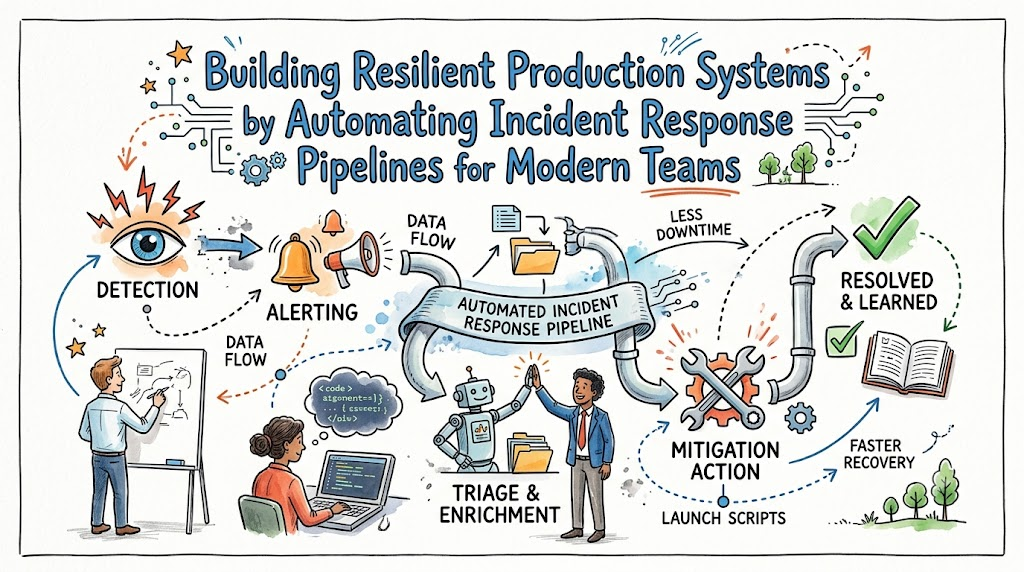
Automating incident response within Site Reliability Engineering pipelines drastically changes how engineering teams handle operational pressure and unexpected software degradation. When distributed architectures trigger critical outages, relying purely on manual intervention introduces human error, increases operational stress, and elongates recovery times. Therefore, modern engineering organizations build automated workflows that detect, triage, mitigate, and route telemetry data without human delay.
Transitioning to automated response pipelines allows your teams to resolve common production incidents rapidly and safeguard customer trust. By implementing systematic remediation code, software engineers systematically shift from chaotic emergency patching to predictable, self-healing platforms. You can master these advanced operational concepts and explore comprehensive guides by visiting Sreschool.
Reliability engineering requires combining programmatic intervention with clear diagnostic telemetry to ensure maximum system availability across all environments. Consequently, teams that embed automated playbooks directly into their deployment and monitoring pipelines continuously reduce mean time to resolution. As a result, developers spend significantly less time handling repetitive alerts and dedicate more effort toward shipping core business value.
Architectural Foundations of Automated Incident Response
Modern incident automation relies on event-driven infrastructure that treats operational alerts as programmatic triggers for remediation scripts. Instead of waiting for an engineer to read a notification, automated systems intercept alert webhooks and execute predefined diagnostics immediately. This rapid execution captures ephemeral system states before evidence disappears or before performance degradation cascades into a catastrophic cluster failure.
Furthermore, automated pipelines require clean decoupling between the telemetry ingestion layer, the decision engine, and the remediation workers. By establishing independent architectural stages, engineers can update specific mitigation actions without breaking the underlying monitoring stack. This modular framework allows organizations to expand their automated response capabilities safely as the broader microservice ecosystem evolves.
+-------------------------------------------------------------------------+
|                        Telemetry & Anomaly Ingestion                    |
+-------------------------------------------------------------------------+
                                     |
                                     v
+-------------------------------------------------------------------------+
|                  Decision Engine & Policy Evaluation                    |
+-------------------------------------------------------------------------+
                                     |
                                     v
+-------------------------------------------------------------------------+
|                 Remediation Workers & Automated Actions                 |
+-------------------------------------------------------------------------+
                                     |
                                     v
+-------------------------------------------------------------------------+
|               Audit Logging & Human Escalation Verification             |
+-------------------------------------------------------------------------+
Consequently, automated pipelines turn static runbooks into dynamic, version-controlled software that executes within secure runtime environments. Teams deploy these response modules using continuous integration, ensuring that all recovery automation undergoes peer reviews and synthetic testing. Therefore, production resilience becomes an active, living component of the standard software development lifecycle.
Designing Self-Healing Infrastructure and Safe Automation Loops
Creating self-healing infrastructure demands strict safety guardrails to prevent runaway automation loops from damaging healthy systems. If an automated script attempts to reboot failing database nodes repeatedly without rate-limiting, it can quickly exhaust shared resources and worsen the outage. For this reason, engineers implement circuit breakers and execution quotas directly into their automated incident response handlers.
Additionally, every automated remediation step must verify system health before, during, and after executing stateful operations. If a health probe fails to demonstrate marked improvement within a defined threshold, the automated pipeline must abort safely. Immediately afterward, the system escalates the issue to human engineers with rich contextual diagnostics already gathered.
[ Ingest Alert ] ---> [ Check Guardrail Quota ] ---> [ Execute Action ]
                             |                              |
                   (Exceeded? Stop & Page)                  v
                                                     [ Health Probe ]
                                                            |
                                           +----------------+---------------+
                                           |                                |
                                     (Passed? Log)                   (Failed? Rollback)
Furthermore, teams maintain exhaustive audit trails of every automated action taken across their production clusters. These immutable event logs ensure full compliance and provide critical debugging context during subsequent incident reviews. As a result, engineering leadership retains complete visibility over automated changes while benefiting from lightning-fast remediation times.
Key Operational Concepts You Must Know
Event-Driven Alert Webhooks and Execution Fabrics
Event-driven alert webhooks serve as the foundational transport mechanism that connects monitoring tools to automated remediation engines. When an observability platform detects an breached threshold, it delivers a structured JSON payload to an execution fabric. This payload contains vital context, including the affected service names, container identifiers, latency metrics, and related deployment versions.
Modern execution fabrics rely on serverless functions or containerized workers to process these incoming webhooks securely. Because these workers spin up on demand, they can absorb sudden bursts of alerts during widespread regional infrastructure incidents. Consequently, the pipeline processes critical events concurrently without encountering resource contention or dropping essential diagnostic tasks.
Dynamic Runbook Execution and Playbook Orchestration
Dynamic runbooks transform static documentation into executable code that runs against production systems using standardized interfaces. Unlike human operators who might skip verification steps under stress, executable playbooks run identical commands in an exact, deterministic order. This automated consistency eliminates configuration drift and ensures strict adherence to company security policies.
Moreover, playbook orchestration systems can dynamically query external infrastructure APIs to determine the current state of a cluster before executing remediation steps. If an incident affects a stateless microservice, the playbook can orchestrate an immediate blue-green traffic cutover seamlessly. Consequently, operational playbooks operate with situational awareness rather than blindly applying rigid commands to changing system topologies.
Automated Triage and Context Enrichment
Automated triage pipelines inspect incoming incident events and immediately assemble the surrounding contextual data that human engineers need. Instead of an on-call engineer manually running queries, the pipeline gathers recent container logs, thread dumps, and Git commit histories automatically. This synthesized data is posted directly into the incident communication channel within seconds of the initial alert.
+-------------------------------------------------------------------------+
|                        Incoming Incident Alert                          |
+-------------------------------------------------------------------------+
                                     |
          +--------------------------+--------------------------+
          |                          |                          |
          v                          v                          v
   [ Query Logs ]            [ Fetch Thread Dumps ]     [ Check Git Diffs ]
          |                          |                          |
          +--------------------------+--------------------------+
                                     |
                                     v
+-------------------------------------------------------------------------+
|                  Consolidated Triage Briefing Canvas                    |
+-------------------------------------------------------------------------+
Furthermore, this rapid enrichment eliminates cognitive fatigue and accelerates triage decisions for complex distributed incidents. Responders instantly see whether a system failure correlates directly with a recent software release or an upstream provider outage. Therefore, context enrichment drastically shortens the discovery phase of the incident response lifecycle.
Chaos Engineering for Continuous Automation Testing
Engineering teams cannot trust their automated response pipelines unless they validate them regularly against simulated production failures. Chaos engineering injects controlled disruptions, such as network latency or killed processes, to verify that automated handlers trigger correctly. This intentional testing exposes hidden bugs within automated remediation scripts long before a genuine disaster occurs.
Additionally, scheduled game days provide cross-functional teams with opportunities to observe automated self-healing mechanisms in action. These practical simulations allow engineers to fine-tune rate limits, alerting thresholds, and escalation pathways under realistic conditions. Consequently, your operational automation matures into a reliable, thoroughly tested safeguard for your production systems.
Platform Implementation vs. Culture — What’s the Real Difference?
The Technical Reality of Tooling and Orchestration
Deploying automated incident response tooling involves integrating alert routers, distributed tracing collectors, policy engines, and execution orchestrators. These software components form the physical nervous system that executes remediation playbooks whenever services degrade. However, focusing solely on purchasing or deploying these tools does not guarantee reliable operations.
Without careful architectural calibration, complex automation suites can become fragile systems that require excessive maintenance themselves. If an automation platform is difficult to configure, development teams will actively bypass it in favor of ad-hoc manual hotfixes. Therefore, platform implementations must remain straightforward, reliable, and accessible to every engineer within the organization.
Cultivating an Automation-First Operational Mindset
An effective operational culture encourages engineers to automate every task that they perform manually more than twice. In an automation-first environment, teams view repetitive manual incident remediation as an engineering design defect that demands software solutions. This cultural expectation motivates developers to build self-healing capabilities directly into their application code from the start.
| Dimension | Platform-Centric Focus | Culturally-Driven Focus |
|---|---|---|
| Primary Goal | Deploying sophisticated software tools | Eliminating operational toil systematically |
| Response to Failure | Adding more monitoring dashboards | Automating root-cause mitigation scripts |
| Team Dynamic | Operations handles alerts in isolation | Shared engineering responsibility for stability |
| Iteration Cadence | Infrequent, heavy tool upgrades | Continuous, incremental playbook refinement |
Moreover, sustaining this mindset requires psychological safety, ensuring teams celebrate the discovery of edge cases that break early automation attempts. When management supports iterative improvement, engineers comfortably delegate high-risk operational steps to carefully constructed software bots. Consequently, balancing robust tooling with an empowering engineering culture unlocks true, sustainable operational scalability.
Real-World Use Cases of Modern Operations
Automated Canary Rollbacks in Global E-Commerce
A major global e-commerce platform continuously pushes updates to thousands of microservices supporting their checkout pipelines. During a routine deployment, an unnoticed memory leak in an updated billing service caused request latency to rise sharply. Within thirty seconds, the monitoring system detected that the error budget consumption rate exceeded predefined safety boundaries.
[ New Deployment ] ---> [ Latency Spikes ] ---> [ Error Budget Exceeded ]
                              |
                              v
                  [ Automated Canary Rollback ]
                              |
                              v
                 [ Normal Traffic Restored ]
Rather than paging an on-call engineer in the middle of the night, the automated pipeline intervened immediately. The automated pipeline rerouted customer traffic away from the canary deployment and restored the previous stable container image automatically. As a result, zero shoppers encountered payment failures, and the pipeline generated a comprehensive diagnostic report for the developers to review the following morning.
Mitigating Resource Starvation in High-Throughput Streaming
A real-time media streaming service experienced unexpected traffic surges during a live sporting event, exhausting thread pools across their backend ingestion clusters. The sudden saturation created massive message queues, threatening to bring down the entire streaming infrastructure. Without automated intervention, human responders would have taken ten to fifteen minutes to diagnose the bottleneck and provision additional capacity.
Fortunately, their incident automation pipeline intercepted the queue depth alerts and executed an elastic scaling playbook immediately. The automation provisioned additional compute nodes, adjusted ingestion rate limiters dynamically, and shed non-critical analytical workloads temporarily. Consequently, the core media stream continued delivering video without interruption, protecting user experience and preventing platform downtime.
Common Mistakes in Operations Engineering
Over-Automating Fragile, Non-Deterministic Tasks
A dangerous mistake in automation engineering is attempting to automate complex, non-deterministic operational processes without sufficient safeguards. When teams automate recovery actions for systems with unpredictable state dependencies, the automation can make incorrect assumptions and corrupt underlying data. Engineers should only automate well-understood, deterministic processes that produce consistent outcomes every single time.
[ Unpredictable Failure ] ---> [ Flawed Script Runs ] ---> [ Corrupted State & Outage ]
To prevent this issue, organizations must enforce a strict maturity criteria before promoting any manual runbook into automated code. A process should only be automated after it has been executed manually multiple times with verified, identical results. Maintaining this rigorous validation standard protects production environments from unexpected and damaging automated actions.
Neglecting Automation Maintenance and Technical Drift
Automated remediation scripts frequently suffer from technical drift when underlying cloud APIs, dependencies, or container configurations change over time. If teams neglect these scripts, the automation will inevitably fail during a real, high-severity production outage. An automated playbook that crashes upon execution adds confusion and delays recovery while engineers scramble to locate the failure.
Therefore, engineering teams must treat remediation playbooks with the exact same rigor as customer-facing application code. This practice includes running continuous automated integration tests, maintaining strict linting rules, and updating dependencies systematically. By continuously validating your operational codebase, you ensure your automated pipelines remain sharp and reliable at all times.
How to Become an Operations Expert — Career Roadmap
Mastering Automation Languages and Systems Fundamentals
Developing deep operational expertise begins with a firm grasp of systems engineering, networking fundamentals, and programming proficiency. You must understand how modern operating systems handle memory allocation, concurrency models, and network sockets to design safe remediation routines. Additionally, mastering modern languages like Python and Go enables you to build robust, performant operational automation tools.
- Core Systems Engineering: Study kernel namespaces, system calls, virtual memory management, and file system primitives.
- Modern Scripting and Tooling: Write production-grade code in Go or Python to manipulate cloud resources via SDKs.
- Networking and Protocols: Deeply understand HTTP/3, gRPC, TCP optimization, and modern software-defined routing architectures.
Focusing on these foundational competencies provides the mental models necessary to dissect unpredictable distributed failures quickly. Furthermore, understanding software development techniques empowers you to collaborate seamlessly with feature development teams on shared reliability initiatives.
Scaling Distributed Architecture and Enterprise Observability
To advance to senior operational leadership, you must master the art of orchestrating complex distributed architectures across hybrid cloud environments. You should learn to design fault-tolerant microservice meshes, implement distributed tracing standards, and build centralized telemetry pipelines. These advanced skills allow you to automate incident mitigation across thousands of interconnected services effortlessly.
- Kubernetes and Service Meshes: Configure custom controllers, operator patterns, sidecar proxies, and traffic-shifting policies.
- Observability Engineering: Design high-throughput data collectors that aggregate metrics, logs, and distributed traces without degrading performance.
- Policy as Code: Enforce infrastructure compliance and runtime security boundaries using declarative governance frameworks.
| Engineering Level | Focus Area | Primary Technical Deliverables |
|---|---|---|
| Junior SRE | Scripting & Basic Triage | Writing health-check scripts; handling routine manual alerts |
| Mid-Level SRE | Automated Playbooks | Implementing automated triage webhooks; building canary rollbacks |
| Staff / Principal SRE | System Architecture & Policy | Architecting self-healing platforms; defining organization-wide error budgets |
Mastering these enterprise-scale technologies positions you as a critical technical leader who can bridge the gap between development and operations. Consequently, you will possess the specialized expertise needed to architect resilient systems that recover from catastrophic failures automatically.
FAQ Section
- What is the difference between automated incident mitigation and automated incident resolution?Automated incident mitigation focuses on quickly stopping customer-facing damage through temporary actions like rolling back updates or scaling compute resources. In contrast, automated incident resolution permanently fixes the underlying software bug or hardware defect without requiring any follow-up human intervention.
- Can automated remediation scripts cause security vulnerabilities in production environments?Yes, automated remediation scripts can introduce serious security vulnerabilities if they run with excessive administrative privileges or execute unverified commands. Teams must secure these pipelines using strict role-based access controls, short-lived credentials, and continuous vulnerability scanning.
- How do teams determine which incident response workflows they should automate first?Teams should analyze their historical incident logs to identify high-frequency, low-complexity alerts that consume significant engineering time. Automating these repetitive tasks first delivers immediate return on investment and frees up responders to tackle more complex reliability challenges.
- What safeguards prevent automated pipelines from entering endless remediation loops?Engineers implement back-off algorithms, maximum retry quotas, and automated circuit breakers that kill execution if conditions do not improve quickly. If the system exceeds these predefined safety thresholds, it immediately halts automated operations and escalates the incident to human responders.
- Why should post-incident reviews evaluate the performance of automated response scripts?Evaluating automated performance during post-mortems helps teams detect whether playbooks executed cleanly or introduced unexpected side effects during remediation. This consistent review process ensures that your automated pipelines evolve alongside application architecture updates.
Final Summary
Automating incident response in modern engineering pipelines is essential for maintaining resilient, highly available cloud systems that protect business revenue. By establishing event-driven architectures, automated context enrichment, and dynamic playbook execution, organizations eliminate unnecessary downtime and reduce human cognitive fatigue. Balancing these technical capabilities with a supportive culture of continuous learning ensures that your teams scale operations smoothly.
As modern software platforms expand in scale and complexity, relying on manual runbooks becomes a major organizational risk. Investing in robust, self-healing pipelines transforms unpredictable production outages into minor, self-contained background events that resolve without user disruption. Ultimately, embedding automation into the core of your reliability strategy empowers your engineering teams to build faster, deploy confidently, and maintain unwavering operational stability.