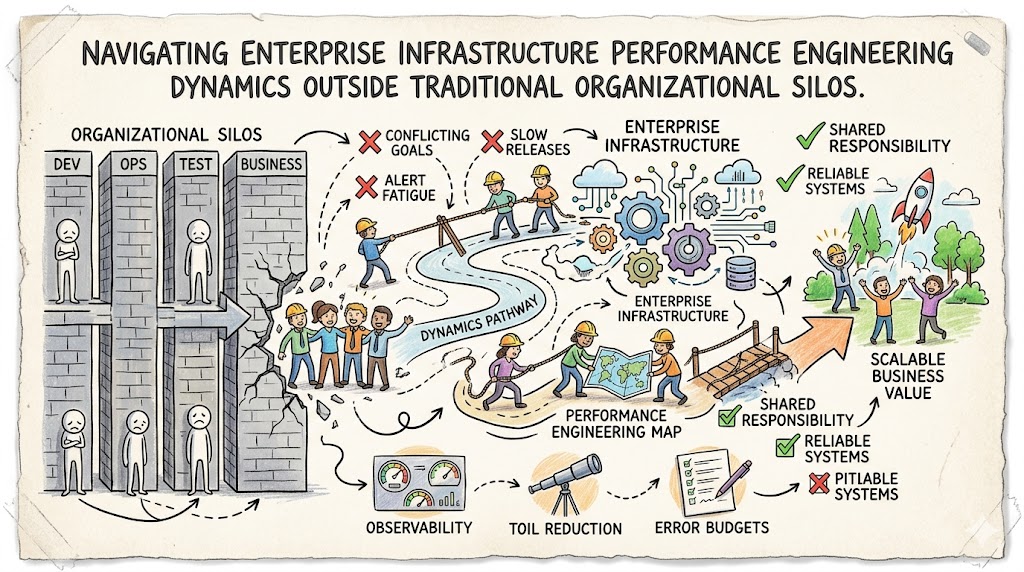
Imagine a sudden, catastrophic system blackout crashing your digital payment infrastructure right during peak business hours. Millions of frustrated transactions fail simultaneously, and your engineering slack channels erupt into chaotic, finger-pointing blame games. This operational bottleneck happens when your software developers build rapid features without coordinating with the system administrators who manage stability.
Understanding SRE vs DevOps: Understanding the Key Differences helps modern tech teams bridge this costly operational divide completely. Organizations need these unified frameworks because digital infrastructure now scales at a breakneck pace that manual tracking cannot support. Consequently, integrating smart deployment practices with automated system reliability ensures continuous software delivery without risking major downtime.
This comprehensive, deep-dive guide thoroughly covers the historical origins, core architectural principles, and real-world implementation strategies of both modern methodologies. Furthermore, you will discover practical toolsets, career roadmaps, and actionable methods to eliminate manual toil inside your daily deployment pipelines. To master these essential structural frameworks through expert-led mentorship, explore the advanced educational programs at Sreschool.
The Origin of Systems Infrastructure
The Early Industrial Bottlenecks
Traditional software operations suffered heavily from isolated organizational structures that separated development teams from system administrators. Developers focused entirely on pushing out rapid feature updates to satisfy immediate business requirements. Conversely, operations engineers prioritized absolute environment stability, creating an adversarial relationship between speed and safety.
Because these siloed teams used vastly different metrics, deployment days frequently turned into highly stressful, multi-hour firefighting sessions. Operations teams managed physical hardware servers manually, which made tracking configuration changes across different environments nearly impossible. As a result, software bugs slipped into production constantly, causing severe system performance degradation and lengthy service outages.
Moving Toward Unified Workflow Automation
To resolve these recurring operational bottlenecks, industry leaders began exploring unified workflow automation to bridge the corporate cultural divide. This shift emphasized treating infrastructure configuration exactly like application software code, allowing teams to version and track changes automatically. By breaking down ancient organizational walls, engineers created shared responsibility patterns where everyone prioritized seamless deployment quality.
Consequently, automated continuous integration and continuous delivery pipelines replaced slow, error-prone manual code transfers entirely. This architectural evolution allowed organizations to run automated tests early and frequently throughout the software development lifecycle. Ultimately, unifying these disparate operational workflows transformed corporate infrastructure from an expensive business bottleneck into a rapid innovation engine.
Global Expansion Across Commercial Ecosystems
As these automated operational frameworks proved successful, they spread rapidly across modern large-scale tech enterprises and global digital service providers. Software giants realized that traditional human-driven system management could never scale efficiently alongside distributed cloud-native applications. Therefore, enterprises codified these collaborative workflows into standardized corporate engineering practices to sustain massive user growth.
Today, commercial ecosystems across fintech, e-commerce, and cloud logistics rely completely on these unified systems to maintain market competitiveness. Smaller businesses and fast-growing tech startups quickly adopted these scaled infrastructure patterns to maximize their deployment velocity. This widespread global expansion established infrastructure automation as a baseline requirement for any organization delivering digital services.
Defining Strategic Operations Management
The Core Operational Structure
The foundational architecture of modern infrastructure relies on a continuous feedback loop linking software development directly with live system monitoring. Instead of manual software handoffs, telemetry data flows continuously from production servers back to engineering teams in real time. This structured loop enables organizations to identify emerging performance issues long before they impact the end-user experience.
Moreover, the entire infrastructure stack is managed programmatically through declarative configuration files rather than manual, unrecorded server adjustments. This structural design guarantees that development, testing, and production environments remain completely identical at all times. Ultimately, this predictable architectural flow minimizes hidden deployment risks and establishes a highly stable foundation for rapid feature releases.
Daily Tasks of Systems Coordinators
Systems coordinators and reliability engineers spend their daily schedules balancing active software engineering with automated infrastructure maintenance tasks. They write automated scripts to provision cloud resources dynamically, ensuring that systems scale up smoothly during heavy traffic spikes. Additionally, these specialists review system telemetry dashboards to identify and resolve underlying latency issues across distributed microservices.
- Writing clean, reusable infrastructure-as-code scripts to manage cloud server environments automatically.
- Configuring intelligent alerting thresholds within monitoring platforms to detect anomalous system behavior early.
- Conducting deep architectural reviews of upcoming software features to ensure optimal production scalability.
- Participating in structured on-call rotations to mitigate live application outages and system performance degradations.
- Automating repetitive database maintenance workflows to prevent human errors during high-stakes manual updates.
Localized Control vs. Broad System Architecture
Managing modern infrastructure requires balancing granular component tracking against administering a complex, multi-system global environment. Localized control focuses on optimizing individual application variables, such as microservice memory allocation or localized database query performance. While this micro-level optimization keeps specific components healthy, it can inadvertently introduce unexpected bottlenecks elsewhere in the broader system.
In contrast, broad system architecture demands a holistic understanding of how hundreds of interconnected services communicate across distributed networks. Infrastructure architects analyze global traffic patterns, cross-region data replication speeds, and overarching system dependency maps. Balancing these two distinct viewpoints allows engineering teams to keep individual features highly efficient while safeguarding the entire enterprise ecosystem.
The Efficiency Mindset
Transitioning to advanced infrastructure management requires a profound cultural shift that firmly prioritizes long-term systemic stability over short-term feature speed. Engineers must develop a deep intolerance for repetitive manual firefighting and band-aid fixes that mask root architectural flaws. This mindset treats every operational failure as an invaluable data source to improve automated guardrails and self-healing systems.
Furthermore, teams embracing this efficiency focus actively resist over-engineering software systems beyond actual business reliability requirements. They understand that pursuing flawless uptime blindly can stall feature innovation and create unnecessary operational complexity. Instead, they leverage data-driven metrics to make objective, collaborative decisions regarding deployment velocity and system risk management.
The 7 Core Principles of SRE vs DevOps: Understanding the Key Differences
1. Embracing Risk and Managing Variability
Absolute system perfection remains an impossible engineering goal because software code, third-party networks, and physical hardware will inevitably fail. Therefore, modern operations principles focus on defining and managing acceptable levels of systemic risk rather than avoiding it entirely. By acknowledging that minor disruptions occur, teams can design resilient, fault-tolerant architectures that degrade gracefully during complex outages.
This strategic management of risk allows organizations to balance aggressive feature deployment with essential infrastructure stability requirements. Engineers use clear mathematical formulas to calculate how much downtime their user base can realistically tolerate over a given period. Consequently, this calculated risk tolerance removes the paralyzing fear of system failure, encouraging safe, continuous innovation across development teams.
2. Establishing Service Level Objectives (SLOs)
Teams must define clear, measurable targets for systemic success to maintain high user satisfaction without over-engineering their applications. Service Level Objectives act as the foundational metrics that align technical performance directly with real-world business expectations. These objective performance goals keep engineering teams focused on what truly matters to users, such as API response speed.
To establish effective objectives, engineers gather precise metrics on system availability, request latency, and data processing throughput over time. These data-driven thresholds prevent internal teams from arguing subjectively about whether an application is performing adequately during peak hours. Ultimately, clear objectives provide an empirical framework for balancing code deployment velocity against system reliability investments.
3. Eliminating Toil and Manual Processes
Toil represents repetitive, manual, operational work that lacks long-term strategic value and scales linearly with system growth. Examples include manually restarting stuck servers, running routine database cleanup scripts, or manually approving basic user access requests. If left unchecked, accumulating massive amounts of administrative toil quickly drains engineering morale and severely stalls organizational innovation.
Modern operations principles demand that engineers systematically identify, measure, and automate away these repetitive manual interventions using software solutions. Teams deliberately allocate a significant portion of their engineering capacity directly to developing automated self-healing scripts. By aggressively eliminating manual tasks, organizations free up valuable engineering time to build scalable, high-impact architecture.
4. Monitoring & Observability Across the Pipeline
Deep, end-to-end visibility across the entire operational environment prevents dangerous technical blind spots from compromising system health. Modern observability frameworks move far beyond basic server ping tests by collecting rich metrics, distributed logs, and request traces. This comprehensive telemetry data allows engineers to observe the internal state of highly complex, distributed applications in real time.
[Telemetry Sources] ---> [Ingestion Pipeline] ---> [Storage & Indexing] ---> [Visualization & Alerts]
     (Logs, Metrics,                                (Time-Series DB)              (Grafana, Datadog)
      Traces)
By embedding observability deep within the continuous delivery pipeline, development teams can track how code changes impact system performance instantly. When a localized microservice slows down, automated observability systems trace the exact database query or network hop causing the bottleneck. Consequently, this pervasive visibility dramatically reduces the time required to diagnose and resolve subtle, intermittent system errors.
5. Automation Over Manual Coordination
Scaling modern enterprise software requires a strict engineering approach that leverages intelligent software automation over human-driven coordination. Manual server configurations, human approval chains, and ad-hoc deployment steps introduce significant risks of catastrophic operational errors. Therefore, infrastructure teams design automated workflows that programmatically handle routine system adjustments, software updates, and environment scaling.
This relentless focus on automation ensures that complex infrastructure changes remain entirely predictable, repeatable, and easily auditable. Whether provisioning a single development container or spinning up a multi-region cloud cluster, automation executes the task identical every time. Thus, software automation eliminates human configuration drift and allows lean engineering teams to manage thousands of production servers effortlessly.
6. Release Engineering and Deployment Stability
Safe, consistent, and predictable application delivery strategies are vital for maintaining system stability while shipping features rapidly. Release engineering focuses on treating the compilation, testing, and deployment of software artifacts as a strict, automated discipline. By utilizing standardized artifact repositories and automated verification steps, teams ensure that only fully validated code reaches live users.
Additionally, infrastructure specialists leverage advanced deployment strategies, including canary releases and blue-green environments, to minimize production risks. These methods route a tiny fraction of live user traffic to newly deployed code to monitor performance metrics safely. If the new release exhibits any anomalous behavior, automated rollback systems instantly restore the previous stable version.
7. Simplicity in Network Architecture
Keeping infrastructure environments clean, minimal, and highly modular directly reduces the overall failure surface of an enterprise application. Complex, convoluted network architectures with tangled microservice interdependencies create hidden failure modes that are exceptionally difficult to troubleshoot. Therefore, operations engineers actively champion simple structural designs that utilize well-defined interfaces and clean separation of concerns.
Every unnecessary architectural layer, redundant third-party tool, or custom ad-hoc configuration adds substantial long-term maintenance overhead. By deliberately prioritizing structural simplicity, engineering teams make their systems far easier to reason about, monitor, and scale over time. Ultimately, clean and minimal network architectures ensure that systems remain inherently resilient against unexpected operational anomalies.
Key Operational Concepts You Must Know
SLA vs. SLO vs. SLI — Explained Simply
To manage system reliability effectively, engineering teams must master three distinct yet deeply interconnected performance metrics. Service Level Agreements represent the overarching legal promises made directly to customers regarding baseline application uptime and performance. Violating these formal business contracts results in severe financial penalties, service credits, or damaged brand reputation.
Service Level Objectives serve as the internal target metrics that engineering teams strive to maintain to prevent agreement violations. These targets are intentionally set stricter than legal agreements to provide an early-warning buffer for internal teams. Finally, Service Level Indicators measure the precise, real-world performance of a specific system component at any given moment.
- Service Level Agreement (SLA): The official commitment guaranteeing system availability to external business clients.
- Service Level Objective (SLO): The targeted internal performance benchmark that teams use to measure systemic success.
- Service Level Indicator (SLI): The actual, real-time quantitative measurement of a specific operational metric, like latency.
Error Budgets — The Game Changer for Operational Risk
An error budget represents the exact amount of systemic unreliability an application can safely afford over a specific timeframe. Calculated mathematically as 1−SLO, this metric provides an objective framework for balancing innovation speed against system safety. For instance, if a microservice has an internal availability objective of 99.9%, its corresponding error budget is exactly 0.1%.
+--------------------------------------------------------+
| Total Error Budget (100% - SLO)                        |
|                                                        |
|  [ Shipped Features ]    [ Minor Outages ]   [ Remaining ]
|  (Consumed Budget)       (Consumed Budget)   (Safety Buffer)
+--------------------------------------------------------+
When a development team maintains a full, healthy error budget, they can aggressively deploy new features and experimental code updates. However, if unexpected production outages consume that budget entirely, all new feature releases are instantly halted. The entire engineering organization then shifts focus exclusively to fixing infrastructure bugs and improving system resilience until the budget recovers.
Toil — The Silent Productivity Killer in Infrastructure
Toil encompasses the repetitive, non-creative administrative tasks that must be executed to keep a production service running smoothly. This manual work lacks strategic value, requires no long-term engineering design, and scales directly alongside your user base growth. If left unchecked, excessive toil burns out operations engineers and leaves zero time for proactive system architecture improvements.
To systematically eliminate this productivity killer, teams must accurately track manual hours spent on routine server maintenance. Engineers then design automated scripts, self-service portals, or orchestrators to handle these repetitive tasks without human intervention. This aggressive automation ensures that engineering capacity remains firmly focused on building scalable, long-term infrastructure improvements.
Incident Management & Postmortems
When unexpected infrastructure failures occur, organizations must execute a highly structured, blameless incident management process to restore services quickly. Engineers focus entirely on mitigating user impact immediately, rather than wasting valuable time searching for individual scapegoats during the outage. Once the system returns to a stable state, the team conducts a comprehensive, blameless postmortem meeting.
These blameless postmortems analyze the root systemic flaws, configuration gaps, and tool failures that allowed the incident to happen. The primary objective is to learn from the failure and implement automated safeguards that prevent identical issues from recurring. Documenting these findings openly fosters a corporate culture of transparency and continuous operational improvement across the entire enterprise.
Capacity Planning
Capacity planning involves forecasting future business growth and preparing the underlying technical infrastructure well ahead of major user demand spikes. Engineers analyze long-term historical trends in data storage growth, network bandwidth usage, and server CPU consumption patterns. This data allows teams to purchase resources or adjust cloud auto-scaling parameters before infrastructure constraints degrade application performance.
Effective capacity planning prevents expensive over-provisioning of cloud instances while safely mitigating the risk of resource exhaustion during unexpected traffic surges. Teams run regular load tests and stress simulations to discover exactly how systems behave under extreme, highly realistic user workloads. Consequently, this proactive planning ensures that software delivery channels scale smoothly alongside expanding business operations.
The Four Golden Signals of Pipeline Performance
To maintain complete operational awareness, infrastructure specialists monitor four critical metrics that reflect the holistic health of any system. Latency measures the exact time it takes for an application service to process a specific user request successfully. Traffic quantifies the total demand being placed on the network infrastructure, such as total HTTP requests per second.
Errors track the rate of requests that fail explicitly, return server errors, or violate predefined processing rules. Finally, saturation measures how close a specific system resource is to reaching its absolute maximum operational capacity limit. Monitoring these four golden signals enables engineering teams to isolate root causes and resolve infrastructure bottlenecks rapidly.
Platform Implementation vs. Culture — What’s the Real Difference?
The Philosophy Difference
DevOps represents a high-level cultural philosophy aimed at destroying ancient institutional silos between software development and operations teams. This movement focuses heavily on shared organizational responsibility, collaborative communication styles, and a unified approach to the software lifecycle. It provides the broad cultural mindset required to align business objectives with modern engineering velocity.
In contrast, Site Reliability Engineering acts as a highly specific, concrete technical implementation of that overarching cultural philosophy. SRE treats operational problems as pure software engineering challenges that can be solved systematically using programmatic solutions. To clarify this relationship, industry experts frequently note that SRE implements DevOps philosophy by defining explicit metrics and engineering practices.
Roles & Responsibilities Compared
While both engineering methodologies share the foundational goal of improving delivery pipelines, their daily operational duties differ significantly. DevOps practitioners focus extensively on building seamless CI/CD automation pipelines, standardizing deployment tools, and improving developer productivity. They act as organizational facilitators who ensure that code moves smoothly from a local workstation into production.
Site Reliability Engineers spend their time writing software to automate infrastructure management, tuning alerting systems, and safeguarding production availability. They deeply analyze system telemetry, manage error budgets, and step in to remediate complex distributed systems failures. Their primary responsibility centers on ensuring that the live application environment remains inherently resilient and highly performant.
To understand how these duties divide across typical enterprise software teams, review the structural breakdown below:
- DevOps Focus Areas:
- Designing and maintaining continuous integration and continuous deployment automation pipelines.
- Standardizing containerization strategies across diverse software development environments.
- Improving inner-loop developer velocity and reducing local code compilation times.
- SRE Focus Areas:
- Developing automated self-healing scripts to remediate infrastructure alerts programmatically.
- Defining precise service level objectives and tracking real-time error budget consumption.
- Conducting detailed capacity planning and managing global distributed system resilience.
Can You Have Both Disciplines?
Modern enterprises do not have to choose between these two approaches; instead, they successfully run both disciplines simultaneously. DevOps provides the broad cultural foundation and automated tooling that allows development teams to move fast without friction. Meanwhile, dedicated SRE teams act as specialized reliability guards who protect infrastructure stability at massive enterprise scale.
When these two disciplines coexist, DevOps engineers build the pipelines that deliver software features safely to the production environment. Concurrently, SREs build the automated platforms, observability grids, and guardrails that keep that production environment stable under heavy load. This powerful combination allows organizations to maximize feature deployment speed while maintaining absolute system reliability.
Which One Should Your Team Adopt?
Selecting the optimal operational framework depends heavily on your specific organizational size, existing architecture, and engineering maturity level. Small startups and early-stage companies should focus first on adopting DevOps cultural principles and basic CI/CD pipeline automation. At this stage, building a shared collaborative mindset and automating manual builds delivers the highest immediate value.
As an organization grows into a massive enterprise managing highly complex, distributed microservices, introducing dedicated SRE practices becomes critical. These larger systems require specialized software engineering expertise to manage intricate network dependencies and scale infrastructure predictably. Evaluating your team’s specific pain points will guide you toward implementing the right balance of these frameworks.
To evaluate which approach aligns best with your current organizational requirements, consider the following structural comparison:
| Organizational Metric | DevOps Approach | SRE Approach |
|---|---|---|
| Primary Core Objective | Accelerate feature deployment speed and unify development-operations culture. | Maximize system reliability and automate complex infrastructure engineering. |
| Operational Execution | Standardizing automation toolchains and optimizing CI/CD delivery pipelines. | Managing error budgets, tracking SLOs, and coding self-healing scripts. |
| Ideal Organizational Size | Small startups to massive global enterprises seeking workflow collaboration. | Medium to large-scale enterprises managing distributed cloud microservices. |
| Core Technical Focus | Continuous integration, environment delivery, and structural developer agility. | Observability telemetry, capacity planning, and incident root cause mitigation. |
Real-World Use Cases of Modern Operations
How Tech Leaders Use Operational Metrics
Global technology leaders rely on real-time data tracking practices to manage thousands of active microservices without manual oversight. These enterprises stream billions of telemetry data points into central visualization grids to track infrastructure health continuously. By analyzing this massive stream of data, automated systems detect subtle anomalies and trigger auto-scaling events instantaneously.
These organizations completely eliminate subjective human evaluations of system performance by strictly adhering to their automated error budgets. When data indicators reveal that a service is consuming its budget too fast, deployment gates lock automatically. This data-driven discipline ensures that operational metrics directly dictate real-world engineering priorities across the company.
Chaos Engineering Approaches to Resilient Systems
Advanced infrastructure teams protect their systems against unpredictable cloud failures by practicing chaos engineering within live production environments. Engineers write automated tools that intentionally inject controlled failures, such as randomly shutting down core server instances or introducing artificial network latency. This practice allows teams to uncover hidden architectural flaws and validate that self-healing systems respond correctly.
Rather than waiting for a catastrophic real-world outage to occur at night, engineers surface system vulnerabilities safely during business hours. Chaos engineering proves that enterprise resilience cannot be achieved by simply hoping that software code works perfectly. Instead, resilience must be continuously tested, measured, and hardened by actively forcing the infrastructure to survive simulated failures.
Handling Reliability at Massive Scale
Distributed microservice architectures handling millions of concurrent user transactions require highly advanced reliability strategies to prevent cascading failures. Large-scale platforms leverage automated circuit breakers that instantly isolate failing application components from the rest of the network. This structural separation prevents a localized database slow-down from spreading across the entire global infrastructure.
Furthermore, these massive systems utilize intelligent load-balancing algorithms that route user traffic dynamically around damaged cloud regions. Data is replicated continuously across multiple geographic zones to guarantee instant recovery during total data center blackouts. Implementing these automated, distributed patterns allows modern software enterprises to maintain flawless service availability for global users around the clock.
High-Availability in Fintech Operations
Fintech platforms and digital payment networks operate under strict, zero-tolerance mandates for application downtime or transactional data loss. A single minute of network unreliability can result in millions of dollars in lost revenue and severe regulatory penalties. Therefore, fintech infrastructure teams design highly redundant database systems that utilize real-time synchronous consensus algorithms.
These high-availability environments embed pervasive observability monitoring across every single transaction path and network switch. Automated audit logs track every financial interaction, providing complete visibility for security compliance and rapid root cause isolation. By combining strict release engineering with robust system safeguards, fintech operations maintain unbroken stability under massive financial transaction loads.
Scaled-Down but Essential Systems for Startups
Early-stage startups with lean engineering teams can easily apply core reliability and automation principles without incurring massive software overhead. Instead of building complex custom monitoring grids, startups leverage managed cloud services and lightweight open-source toolsets. They focus on automating their primary code compilation and deployment paths to eliminate human errors completely.
By establishing simple service level objectives early, small teams can protect their limited engineering focus from distracting alert fatigue. Startups build automated infrastructure using clear, declarative templates that can be easily recreated if a cloud server crashes. This lightweight, disciplined approach allows fast-growing companies to scale up their software delivery safely without drowning in operational debt.
Common Mistakes in Operations Engineering
Mistake 1 — Confusing System Management with Just Being On-Call
A frequent and costly error organizations make is assuming that reliability engineering simply means assigning engineers to a high-stress on-call pager rotation. This reactive approach forces talented developers to spend their valuable time manually responding to endless streams of production alerts. True operations engineering focuses on proactive software development aimed at creating self-healing systems that fix problems automatically.
When teams fall into this reactive firefighting trap, long-term architectural improvements are completely abandoned, and systemic technical debt accumulates rapidly. Infrastructure engineers must be explicitly empowered to build automated software solutions that eradicate the root causes of recurring alerts. Shifting from manual firefighting to proactive automation is what differentiates a high-performing engineering culture from a chaotic operations silo.
Mistake 2 — Setting Unrealistic SLOs
Many engineering teams mistakenly demand perfect 100% uptime for their applications, believing that higher numbers always represent better engineering. However, pursuing absolute perfection is an unrealistic goal that drastically stalls feature innovation and completely exhausts your engineering staff. Achieving extreme levels of availability requires massive financial investments and complex architecture that slows down development velocity.
Every extra nine of reliability you chase makes it significantly harder to ship rapid software features to your users. Teams must analyze real-world user expectations to set practical, data-driven reliability targets that balance speed with stability. A realistic objective satisfies your customers completely while preserving an adequate error budget to run bold software experiments safely.
Mistake 3 — Ignoring Toil Until It’s Too Late
Organizations frequently ignore minor manual tasks, assuming that running an occasional manual script or restarting a server takes negligible effort. Over time, however, these individual manual interventions multiply exponentially as your application scales up and attracts more users. Before long, your highly paid engineering team spends their entire day executing repetitive manual tasks just to keep the system online.
Accumulating this massive mountain of operational toil cripples engineering velocity and severely damages team morale. Organizations must aggressively track manual hours and treat any growing toil as a critical system bug that requires immediate engineering remediation. Automating these routine workflows early ensures that your engineering capacity scales efficiently alongside your business growth.
Mistake 4 — Skipping Blameless Postmortems
When a major production outage occurs, toxic corporate cultures immediately seek out an individual engineer to blame for the mistake. This finger-pointing behavior causes team members to hide infrastructure flaws, cover up mistakes, and avoid taking innovative risks. Punishing an engineer for typing an incorrect terminal command does absolutely nothing to fix the systemic lack of safety guardrails.
High-performing tech organizations intentionally conduct blameless postmortems that focus entirely on technical gaps and process failures. They ask why automated testing systems failed to catch the bad code and why alerting platforms responded slowly. Turning every operational failure into a collective learning opportunity allows teams to build significantly stronger, more resilient infrastructure.
Mistake 5 — Monitoring Without Actionable Alerts
A dangerous operational pitfall is configuring monitoring platforms to trigger urgent notifications for every minor, non-critical system fluctuation. When engineers receive dozens of non-actionable alerts throughout the night, they rapidly develop severe alert fatigue. Consequently, when a catastrophic infrastructure failure actually occurs, the critical alert is frequently overlooked amidst the digital noise.
Every single notification sent to an on-call engineer must require immediate, well-defined human action to prevent a service disruption. If an alert does not require urgent human intervention, it should be logged silently to a dashboard rather than paging a person. Cleaning up your alerting thresholds keeps your engineering team well-rested, highly focused, and ready to respond effectively during real emergencies.
Mistake 6 — Not Involving Operational Engineers in the Design Phase
Software development teams frequently design complex application architectures in complete isolation, ignoring production infrastructure requirements entirely. They hand over completed features to the operations team right on deployment day, expecting them to magically make the code scale. This disconnected workflow results in severe performance bottlenecks, security vulnerabilities, and frequent production failures.
Operational specialists must be integrated directly into the initial software architectural design phases from day one. Their deep expertise in network routing, data caching, and cloud resource management helps prevent costly design mistakes early. Involving these engineers throughout the entire lifecycle ensures that upcoming applications are inherently stable, easy to monitor, and optimized for scale.
Essential Infrastructure Tools & Technologies
Monitoring & Observability
To maintain deep visibility across distributed cloud networks, modern infrastructure teams deploy robust monitoring and observability ecosystems. Prometheus serves as an industry-standard open-source engine that collects and indexes time-series performance metrics with high efficiency. For rich visual telemetry, teams connect these metrics directly to Grafana dashboards to track real-time resource utilization trends.
Enterprises managing massive, cross-cloud microservice environments frequently leverage managed platforms including Datadog and New Relic. These comprehensive tools provide end-to-end request tracing, deep application logging, and automated anomaly detection out of the box. Utilizing these advanced observability solutions ensures that performance bottlenecks are identified and resolved long before they impact the end-user experience.
Incident Management
When critical unexpected outages occur, organizations rely on dedicated incident management platforms to orchestrate their technical response efforts. PagerDuty acts as an intelligent routing engine that ingests alerts from monitoring tools and mobilizes the correct on-call engineers instantly. These platforms manage complex team schedules, automate escalation paths, and bridge communication channels seamlessly during high-stakes outages.
By integrating incident management software directly into internal chat environments, teams can track remediation steps transparently in real time. These tools document the exact timeline of the incident automatically, capturing critical data points for later review. Deploying reliable response platforms guarantees that production emergencies are handled calmly, systematically, and with minimal service downtime.
CI/CD & Release Engineering
Automating the movement of code from local developer workstations to production servers requires robust continuous integration and delivery engines. Jenkins remains a widely adopted, highly flexible automation server used to compile code bases, run test suites, and execute deployment scripts. For modern containerized environments, organizations utilize advanced GitOps delivery tools like Argo CD and Spinnaker.
These GitOps controllers continuously monitor your version control repositories and automatically synchronize the live cloud state with your declarative code. If someone manually alters a server configuration outside of git, the automation controller instantly detects and corrects the drift. Implementing these strict release technologies ensures that your application deployments remain completely predictable and easily auditable.
Chaos Engineering
To actively validate system resilience under unexpected stress, infrastructure specialists leverage purpose-built chaos engineering software tools. Chaos Monkey, originally pioneered by digital streaming giants, randomly terminates virtual server instances in production to test self-healing automated behaviors. This aggressive testing method forces engineering teams to build inherently fault-tolerant software architectures that survive unannounced hardware losses.
Modern open-source chaos frameworks allow teams to safely inject diverse failure scenarios, including network packet loss and disk saturation, into testing clusters. Running these controlled experiments regularly helps engineers uncover hidden bugs and optimize alerting configurations before real disasters strike. Ultimately, chaos engineering tools transform system reliability from an optimistic assumption into a proven, mathematically verifiable fact.
SLO Management
Tracking service level objectives against live user data streams requires specialized software platforms designed to calculate error budget consumption rates. Tools like Nobl9 integrate directly with existing monitoring data sources to continuously analyze performance metrics against agreed thresholds. These dedicated reliability platforms provide clear visibility into long-term system trends, helping teams balance feature delivery speed with stability investments.
SLO management software alerts engineering managers well before an error budget is completely exhausted, preventing costly service agreement violations. This early warning allows teams to adjust their deployment schedules and shift engineering focus to infrastructure hardening proactively. Utilizing these structured tracking platforms enables organizations to make objective, data-driven decisions that align engineering priorities with customer satisfaction.
How to Become an Operations Expert — Career Roadmap
Skills Every Specialist Must Have
Launching a successful career in advanced infrastructure engineering requires mastering a core set of foundational technical skills and tools. Aspiring specialists must become highly proficient with Linux terminal commands, shell scripting, and basic operating system internal mechanics. You need a strong command of scripting languages, particularly Python or Go, to automate repetitive manual workflows effectively.
Additionally, you must develop a deep understanding of core networking concepts, including TCP/IP routing, DNS resolution, and SSL/TLS security protocols. Modern experts must be fluent in infrastructure-as-code tools like Terraform and cloud-native container orchestration using Kubernetes. Developing these diverse technical competencies provides the essential foundation required to manage highly complex, distributed enterprise software systems.
The Professional Learning Path
The educational progression into senior infrastructure architecture begins with mastering basic local software deployment patterns and single-server environments. First, focus on understanding how to containerize basic applications using Docker and manage source code efficiently within Git repositories. Next, advance to building basic continuous integration pipelines that automate application testing and linting processes seamlessly.
Once you master local automation, expand your knowledge into provisioning multi-tier cloud environments across major public cloud providers. Learn how to configure distributed monitoring tools, aggregate application logs, and establish intelligent alerting thresholds across networks. Finally, study advanced systemic concepts like global load balancing, data replication strategies, blameless postmortems, and enterprise capacity planning frameworks.
Certifications Worth Pursuing
Earning industry-recognized professional credentials serves as an excellent way to validate your technical infrastructure expertise and accelerate career growth. The Certified Kubernetes Administrator (CKA) certification proves your hands-on ability to architect, configure, and manage production-ready containerized clusters. For delivery pipeline expertise, pursuing specialized certifications like a Jenkins Engineer credential showcases your deep mastery of automated release engineering.
Cloud-specific professional certifications from major providers also offer significant value for engineers designing modern cloud-native architectures. These rigorous examinations validate your practical knowledge of cloud security, distributed networking, and automated resource scaling patterns. Holding these recognized credentials demonstrates your technical commitment to maintaining high infrastructure standards across enterprise environments.
Educational Resources with Sreschool
Navigating the dense, rapidly evolving ecosystem of modern infrastructure methodologies requires structured, expert-led training programs. Aspiring and experienced engineers alike can access deeply practical, real-world educational resources designed specifically by industry veterans at Sreschool. The comprehensive curricula move far beyond abstract theory by immersing students in hands-on labs that simulate complex production environments.
Learners gain invaluable experience configuring enterprise monitoring grids, managing live error budgets, and orchestrating automated application deployments. This rigorous training equips technical professionals with the exact skills required to eliminate manual toil and optimize global systems. Exploring these tailored learning tracks allows you to transform your engineering capabilities and lead advanced infrastructure operations confidently.
The Future of Systems Management
AI and Automation in System Optimization
The integration of artificial intelligence and machine learning models is fundamentally transforming how modern production environments are optimized and maintained. Automated systems leverage advanced predictive analytics to analyze massive streams of telemetry data and discover subtle performance anomalies early. This proactive capability allows intelligent platforms to flag emerging resource constraints long before a service disruption impacts live users.
Furthermore, machine intelligence dramatically accelerates root cause analysis during complex outages by correlation across thousands of distributed logs instantly. Future optimization tools will execute automated self-healing remediation steps, adjusting configurations dynamically without requiring manual human intervention. Shifting from human-driven dashboards to intelligent automated oversight allows lean engineering teams to run hyper-scale global systems flawlessly.
Platform Engineering — The Evolution of Infrastructure
Platform engineering is rapidly emerging as a critical evolutionary phase that redefines how developers interact with underlying infrastructure resources. Instead of requiring software developers to manually configure complex cloud servers, internal platform teams build structured self-service portals. These Internal Developer Platforms encapsulate complex networking, security, and deployment guardrails into simple, automated interfaces.
+--------------------------------------------------------+
| Application Developers                                 |
+--------------------------------------------------------+
                           |
                           v  (Self-Service Request)
+--------------------------------------------------------+
| Internal Developer Platform (IDP)                      |
|  - Automated Guardrails   - Pre-approved Templates      |
+--------------------------------------------------------+
                           |
                           v  (Programmatic Provisioning)
+--------------------------------------------------------+
| Cloud Infrastructure (Kubernetes, Networks, Storage)   |
+--------------------------------------------------------+
This structural shift effectively minimizes cognitive load for application developers, allowing them to focus entirely on writing high-quality feature code. Pre-approved architectural templates guarantee that every newly provisioned service automatically complies with corporate security and reliability standards. Ultimately, platform engineering treats infrastructure as a product, driving massive organizational efficiency and accelerating software delivery timelines safely.
Management in Cloud-Native & Kubernetes Environments
The widespread enterprise adoption of dynamic, cloud-native container clusters introduces unique orchestration and management challenges for operations teams. Because containerized microservices are highly ephemeral, traditional static server monitoring methods are completely obsolete. Modern engineers deploy service meshes and declarative controllers to track container lifecycles, route traffic, and enforce security policies programmatically.
Managing these multi-tenant environments requires a deep understanding of container resource boundaries, cluster scaling mechanics, and distributed storage networking. Teams leverage GitOps workflows to manage cluster states transparently, ensuring that any unauthorized manual configuration drift is instantly remediated. Mastering these complex containerization frameworks remains a vital priority for organizations running resilient, high-volume digital platforms.
Operational Skills That Will Matter Most
As infrastructure systems become increasingly automated and abstracted, the core skills required by technical specialists are shifting profoundly. FinOps, or cloud financial cost optimization, is becoming a critical competency as organizations seek to eliminate wasteful cloud spending programmatically. Engineers must learn to design highly efficient architectures that balance performance targets perfectly against infrastructure cost constraints.
Additionally, data observability and mastering deep security integration across the delivery pipeline will become essential standard practices for operations experts. The ability to architect simple, clean network topologies amidst complex multi-cloud ecosystems will highly differentiate top-tier engineering talent. Cultivating these advanced, cross-disciplinary technical capabilities ensures that infrastructure professionals remain incredibly valuable assets within the modern technology ecosystem.
FAQ Section
- What is the primary difference between SRE and DevOps roles?
DevOps provides the foundational cultural philosophy centered on breaking down organizational silos and automating the software delivery pipeline. Site Reliability Engineering serves as a specific technical implementation of that philosophy by treating operational management as a pure software engineering challenge. - How do teams calculate and use an internal error budget?An error budget is calculated mathematically as 1−SLO and represents the allowed amount of system unreliability. Teams use this metric to objectively balance feature deployment speed against the need for dedicated infrastructure stability engineering.
- What are the four golden signals used in system monitoring?The four golden signals essential for comprehensive system observability are request latency, network traffic volume, processing error rates, and resource saturation. Tracking these critical metrics allows engineering teams to quickly isolate and remediate underlying system bottlenecks.
- Can a small tech startup implement site reliability engineering practices?Yes, small startups can successfully implement scaled-down reliability principles by utilizing managed cloud services and focusing on basic pipeline automation. Setting simple service level objectives early protects lean development teams from alert fatigue and limits manual toil accumulation.
- What is the purpose of practicing chaos engineering in production?Chaos engineering involves intentionally injecting controlled technical failures into systems to uncover hidden structural flaws and validate automated self-healing behaviors. This proactive testing method ensures that distributed architectures can safely survive real-world outages without impacting users.
- Why are blameless postmortems critical for organizational health?Blameless postmortems focus entirely on discovering technical gaps and process flaws after an incident rather than assigning individual human blame. This transparent approach encourages engineering teams to openly share data, learn from system failures, and build resilient guardrails.
Final Summary
Maintaining optimal infrastructure health requires a continuous, data-driven commitment to automation, comprehensive system observability, and a proactive software engineering approach. Modern organizations must aggressively move past traditional manual server management to thrive within highly complex cloud-native environments. By systematically balancing feature velocity against empirical error budgets, teams can safeguard user experiences without stalling essential product innovation. The future of enterprise technology belongs to engineering cultures that treat infrastructure reliability as a fundamental software design requirement. Embracing these advanced performance frameworks alongside expert training at Sreschool empowers teams to build scalable, self-healing architectures that navigate global digital challenges effortlessly.