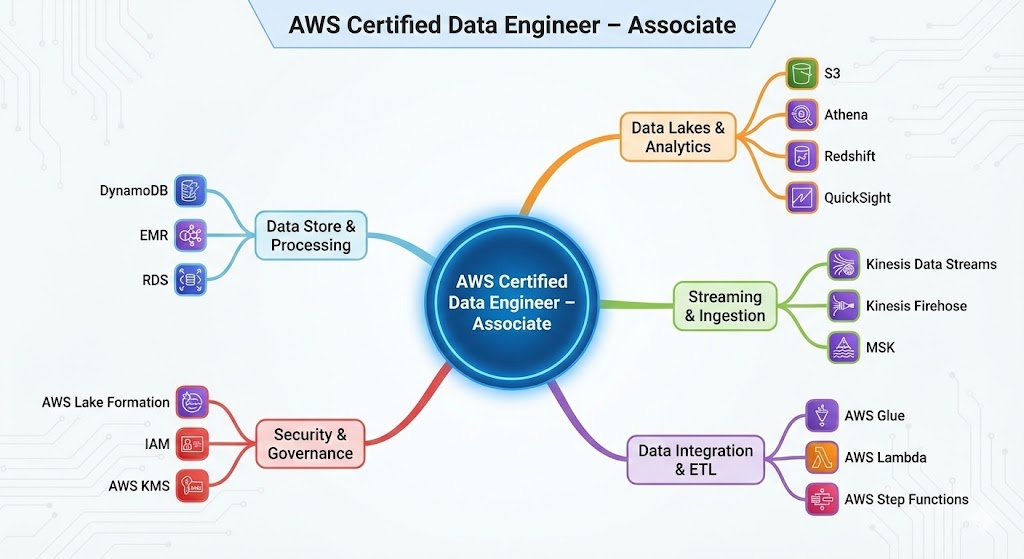
Cloud-native architecture relies heavily on high-quality data pipelines to drive business intelligence and machine learning. The AWS Certified Data Engineer – Associate credential provides a rigorous framework for professionals who manage these complex environments. Because DevOpsSchool principles emphasize the integration of data and operations, mastering these AWS services helps platform engineers and data specialists work in unison. This guide empowers engineers and technical leaders to assess the certification’s value for their career growth and organizational goals. By following this roadmap, you gain the clarity needed to advance your professional journey in the cloud data space.
Defining the AWS Certified Data Engineer – Associate
The AWS Certified Data Engineer – Associate validates your proficiency in designing, building, and maintaining production-grade data pipelines. This certification exists because modern enterprises now prioritize automated, highly integrated data orchestration over legacy database management. You will face real-world scenarios that require you to ingest, transform, and store data securely at an enterprise scale. The program aligns with modern engineering workflows by treating data infrastructure with the same precision as application code. Ultimately, it proves you can manage the entire data lifecycle within the AWS ecosystem using industry-standard practices.
Ideal Candidates for the Program
Software engineers, cloud architects, and data professionals find this credential essential for formalizing their technical expertise. Site Reliability Engineers (SREs) and platform engineers also benefit immensely, as they often oversee the stability and performance of large-scale data clusters. While beginners use the curriculum as a structured learning path, experienced managers gain the technical vocabulary required to lead specialized engineering teams. In competitive markets like India and the global tech sector, this certification distinguishes professionals who can handle petabyte-scale data challenges. It serves as a bridge for traditional administrators transitioning into modern, cloud-centric roles.
The Strategic Value of This Certification in 2026
As global organizations accelerate their migration to the cloud, the need for expert data engineers continues to grow. This certification secures your career longevity by focusing on evergreen architectural patterns rather than temporary tool trends. While specific AWS services may update, the core principles of data security, modeling, and governance remain relevant across the industry. Enterprises favor the AWS data stack for its maturity, making this certification a high-return investment for your professional time. It signals to potential employers that you possess the depth to manage the most valuable asset in modern business: data.
Certification Structure and Delivery
The program reaches learners through specialized training modules provided by DevOpsSchool and resides on the official platform of DevOpsSchool. This associate-level credential moves beyond entry-level cloud concepts to test deep technical skills in data collection and transformation. You will encounter scenario-based questions that replicate the actual obstacles engineers face in production environments. Unlike basic certifications, this program requires you to understand how various AWS services collaborate to form a robust data mesh. It provides a logical and practical progression for anyone seeking to master the AWS data landscape.
Progression Tracks and Professional Levels
The AWS certification ecosystem begins with foundational knowledge before branching into specialized associate levels like this one. Professionals typically advance toward professional or specialty certifications that explore advanced analytics and database optimization. Specific tracks exist for those focusing on DevOps, SRE, or FinOps, as cost management plays a vital role in data engineering. These levels support your career progression by moving you from a technical implementer to a high-level architect. By following these established tracks, you build a comprehensive skill set that covers every layer of the cloud-native stack.
Comprehensive AWS Data Certification Table
| Track | Level | Ideal Candidate | Prerequisites | Core Skills | Recommended Order |
| Data Engineering | Associate | Data Engineers, Cloud Pros | AWS Cloud Practitioner | Ingestion, ETL, Glue, Redshift | Step 2 |
| Data Analytics | Specialty | Senior Data Architects | 2+ Years Experience | Kinesis, EMR, QuickSight | Step 3 |
| Cloud Operations | Associate | DevOps & SRE Engineers | Linux & Networking | Automation, SysOps, Monitoring | Step 1 |
| Database Track | Specialty | Database Administrators | SQL & NoSQL Basics | RDS, Aurora, DynamoDB | Step 3 |
Deep Dive: AWS Certified Data Engineer – Associate
AWS Certified Data Engineer – Associate
Core Purpose
This certification confirms your ability to implement data pipelines and manage critical data assets on the AWS platform. It ensures you understand how to convert raw data into actionable insights efficiently and securely.
Target Audience
Ideal candidates include data engineers, backend developers, and cloud practitioners with at least one year of data experience. It also serves SREs who wish to specialize in the reliability of data infrastructure.
Key Skills Acquired
- Design scalable data ingestion systems using Kinesis and MSK.
- Orchestrate complex ETL workflows with AWS Glue and Step Functions.
- Optimize data storage formats like Parquet and Avro within Amazon S3.
- Implement strict data security and encryption using IAM and KMS.
- Manage high-performance data warehousing via Amazon Redshift.
Production-Grade Projects You Will Master
- Build real-time streaming dashboards for high-volume IoT data.
- Automate serverless data lake hydration processes.
- Migrate legacy on-premises databases to cloud-native AWS RDS instances.
- Implement centralized monitoring and logging for data pipelines.
Preparation Strategies
- 7–14 Days: Conduct an intensive review of AWS whitepapers focusing on Glue, S3, and Redshift.
- 30 Days: Complete a structured course and perform hands-on labs for every primary AWS service.
- 60 Days: Execute deep-dive projects and take practice exams to eliminate knowledge gaps.
Common Candidate Pitfalls
- Underestimating the complexity of AWS security and identity management.
- Focusing on theoretical knowledge while neglecting hands-on CLI and console experience.
- Ignoring the cost-efficiency aspects of data processing and storage.
Next Steps in Your Career
- Same-track Option: AWS Certified Data Analytics – Specialty.
- Cross-track Option: AWS Certified DevOps Engineer – Professional.
- Leadership Option: AWS Certified Solutions Architect – Professional.
Specialized Learning Paths
DevOps Path
This path emphasizes the automation of data infrastructure using tools like Terraform or CloudFormation. You will learn to integrate data pipelines into CI/CD workflows to ensure fast and reliable deployments. This approach bridges the gap between software delivery and data management. You also master monitoring techniques to identify and resolve bottlenecks before they impact operations.
DevSecOps Path
This trajectory focuses on a security-first mindset throughout the data engineering lifecycle. You will learn to implement automated compliance checks and fine-grained access controls for your data lakes. Because data privacy is a top priority, this path ensures you can encrypt data at rest and in transit. These skills allow you to protect your organization while maintaining high operational speed.
SRE Path
The SRE path prioritizes the reliability, scalability, and performance of your data systems. You will learn to define Service Level Objectives for data availability and build resilient, self-healing pipelines. This involves using error handling and circuit breaker patterns within AWS Lambda and Glue. Professionals on this path ensure data platforms remain stable during massive traffic surges.
AIOps / MLOps Path
This path supports professionals who build the infrastructure behind artificial intelligence. You will learn to prepare high-quality datasets for Amazon SageMaker and automate model retraining processes. This requires expertise in data versioning and feature stores within AWS. As AI adoption grows, engineering data specifically for machine learning becomes a highly valuable skill.
DataOps Path
DataOps focuses on improving data quality and reducing analytics cycle times. You will learn to apply version control to data schemas and implement automated testing for ETL scripts. This path fosters a collaborative culture between data scientists and engineers. By minimizing manual tasks, you enable your organization to generate insights much faster.
FinOps Path
The FinOps path addresses the economic challenges of cloud data engineering. Since processing can become expensive, you will learn to select the most cost-effective compute and storage tiers. This involves using AWS Cost Explorer and implementing tagging strategies to monitor spend. Mastering this path helps you maximize the business value of every dollar spent on the cloud.
Mapping Roles to Recommendations
| Professional Role | Recommended Certification Path |
| DevOps Engineer | AWS Data Engineer + AWS SysOps Associate |
| SRE | AWS Data Engineer + AWS Solutions Architect |
| Platform Engineer | AWS Data Engineer + AWS Security Specialty |
| Cloud Engineer | AWS Data Engineer + AWS Cloud Practitioner |
| Security Engineer | AWS Data Engineer + AWS Security Specialty |
| Data Engineer | AWS Data Engineer + AWS Data Analytics Specialty |
| FinOps Practitioner | AWS Data Engineer + AWS Cloud Practitioner |
| Engineering Manager | AWS Data Engineer + AWS Solutions Architect Professional |
Advancing After Your Certification
Deep Specialization
After earning your associate credential, the Data Analytics Specialty serves as your next milestone. This allows you to move beyond data movement and into complex visualization and predictive modeling. You will master tools like Amazon QuickSight and advanced EMR configurations. This path establishes you as a leading subject matter expert in the full data lifecycle.
Expanding Your Skill Set
Broaden your expertise by moving into the Security or DevOps tracks. Understanding how to secure a data lake at an enterprise scale provides a massive advantage in today’s regulatory environment. Alternatively, the DevOps Engineer Professional certification gives you the tools to manage the underlying infrastructure of your data pipelines more effectively.
Moving into Technical Leadership
The Solutions Architect Professional certification represents the gold standard for aspiring managers. It shifts your focus from “how to build” to “why a specific architecture meets business goals.” You will learn to align technical decisions with long-term strategy and lead large-scale migrations. This transition is vital for anyone aiming for a CTO or Head of Engineering role.
Premier Training and Support Providers
DevOpsSchool offers a robust ecosystem for engineers to master AWS data services through instructor-led sessions and practical labs. Their curriculum bridges the gap between academic theory and the demands of the modern tech industry.
Cotocus provides specialized training that helps corporate teams align their data practices with global standards. They focus on the practical application of AWS tools to solve complex, real-world business problems.
Scmgalaxy acts as a massive community hub, providing thousands of tutorials on version control and pipeline automation. It is a go-to resource for practitioners who want to stay informed on the latest industry trends.
BestDevOps delivers intensive bootcamps designed to prepare engineers for the exam in a short timeframe. Their structured approach is perfect for busy professionals balancing work and study.
devsecopsschool.com prioritizes the integration of security into every phase of the data engineering process. Their courses ensure that you build compliant and resilient data architectures from day one.
sreschool.com focuses on those who demand high uptime and system performance. Their training covers the reliability aspects of AWS data services, ensuring your pipelines stay available.
aiopsschool.com explores the intersection of AI and IT operations. They provide the training needed to build data foundations for advanced AI-driven monitoring and remediation.
dataopsschool.com dedicates its entire mission to the DataOps methodology. They teach you how to bring DevOps agility to the data world, focusing on speed, quality, and cross-team collaboration.
finopsschool.com addresses the urgent need for cloud financial management. Their courses empower you to take ownership of cloud costs and optimize your data architecture for maximum efficiency.
General Frequently Asked Questions
- How difficult is the Data Engineer Associate exam compared to the Solutions Architect Associate?
The Data Engineer exam is more specialized and technical because it focuses deeply on a specific subset of data-centric services. - What is the recommended preparation time for this exam?
Most professionals with some cloud experience require 30 to 60 days of consistent study to pass confidently. - Are there mandatory prerequisites for taking this exam?
No formal prerequisites exist, but AWS recommends at least one year of data-related experience before attempting the test. - How does this certification benefit an engineer in India?
India faces a high demand for skilled data engineers; this credential serves as a powerful differentiator for your resume. - Does the exam test third-party data tools?
The exam focuses on AWS-native services like Glue and Redshift, though it touches on how they interact with open-source standards. - Do I need to be a programmer to pass?
You should possess a strong understanding of SQL and a basic knowledge of Python for AWS Glue and transformation tasks. - How long does the AWS Data Engineer Associate certification last?
The certification remains valid for three years, after which you must recertify or earn a higher-level credential. - What is the current cost of the exam?
The standard price for this associate-level exam is 150 USD, plus any applicable local taxes. - Can I take the exam remotely from my home?
Yes, AWS offers online proctoring, allowing you to take the exam from your home or an authorized testing center. - Will AI automation make this role obsolete?
No, because AI systems require high-quality data pipelines to function, which actually makes the data engineer’s role more critical. - Does the exam cover data compliance and laws?
A significant portion of the test covers data security, encryption, and meeting various regulatory requirements. - Does the salary increase justify the cost of the exam?
Most engineers report a significant salary increase and more job opportunities immediately after earning this credential.
Technical FAQ on AWS Data Engineering
- Which specific AWS services are most prominent in the exam?
You should focus on AWS Glue, Amazon Redshift, Amazon S3, AWS Lake Formation, and Amazon Kinesis. - Is hands-on experience truly necessary to pass?
Yes, the scenario-based questions are difficult to answer correctly if you haven’t actually configured these services in the console. - Does the exam include machine learning model training?
It covers the data preparation stage for ML but does not dive into model training or algorithm selection. - How much SQL should I know?
A strong grasp of SQL is essential, as you will need to query data in Athena and Redshift during the exam. - Is this certification better than the old Big Data Specialty?
This associate exam is more accessible and focuses on the “engineer” role, whereas the specialty exams target senior architects. - What is the passing score for the test?
The passing score is 720 out of 1000, using a scaled scoring system. - Does the exam cover data migration techniques?
Yes, you will need to understand services like AWS DMS and the Snowball family for moving data into the cloud. - Where can I find reliable practice labs?
Platforms like DevOpsSchool provide sandbox environments where you can build pipelines without incurring high costs.
Final Thoughts: Is the AWS Data Engineer Associate Worth It?
The true value of a certification lies in the structured discipline it brings to your learning process. The AWS Certified Data Engineer – Associate proves that you have mastered the complexities of modern data architecture and gained a practical toolkit. For individual engineers, it offers a clear path to higher salaries and more impactful projects. For organizations, it ensures that technical teams follow industry best practices and maintain high standards. If you are committed to a career in the cloud data space, this credential is a rewarding and logical milestone. It focuses on the right skills at the right time for an industry defined by its data.
This guide for the data engineer associate path is super helpful for anyone trying to simplify their goals.