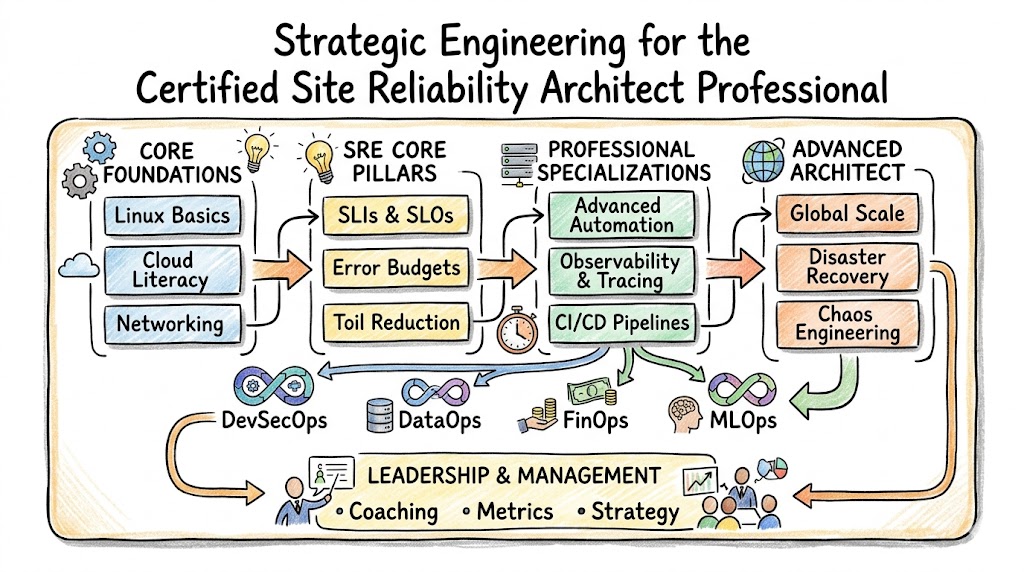
The Certified Site Reliability Architect program provides a structured approach for engineers to master the art of building resilient, high-scale digital infrastructures. This guide helps professionals navigate the evolving demands of cloud-native ecosystems by offering a clear roadmap for architectural mastery. By following these expert insights, you can enhance your technical leadership and ensure your systems remain stable under extreme pressure. Sreschool delivers the essential framework for this journey, focusing on practical outcomes that drive real-world impact.
What is the Certified Site Reliability Architect?
The Certified Site Reliability Architect designation represents a global standard for engineers who design and operate mission-critical systems. This program emphasizes the shift from manual operations to an engineering-first mindset where automation handles repetitive tasks. It prioritizes hands-on production experience over abstract theory to ensure that architects can solve complex performance bottlenecks. Professionals learn to align infrastructure goals with business objectives by treating reliability as the most important feature of any software product.
Who Should Pursue Certified Site Reliability Architect?
This path specifically targets DevOps engineers, systems architects, and cloud specialists who manage large-scale distributed environments. Security professionals and data engineers also find immense value in learning how to integrate their workflows into a reliable architectural framework. Whether you work in the thriving tech hubs of India or for a global enterprise, these skills validate your ability to manage high-stakes production environments. Managers use this certification to better understand the metrics and cultural shifts required to lead high-performing engineering teams.
Why Certified Site Reliability Architect is Valuable and Beyond
The move toward microservices and hybrid-cloud environments makes the role of a reliability architect more critical every day. This certification ensures your career remains future-proof by focusing on fundamental engineering principles that stay relevant despite tool changes. You gain the ability to quantify system health through data, which allows organizations to make smarter decisions about feature releases and risk. Consequently, this expertise yields a massive return on investment by reducing costly downtime and increasing operational efficiency.
Certified Site Reliability Architect Certification Overview
The program delivers comprehensive training through its official course page and utilizes the Sreschool platform for practical assessments. Candidates undergo a series of rigorous evaluations that test their ability to handle real-world failure scenarios in a controlled environment. This structure ensures that every certified individual can design, deploy, and maintain systems that meet the highest standards of availability. By completing this program, you demonstrate a deep commitment to the discipline of site reliability engineering and architectural integrity.
Certified Site Reliability Architect Certification Tracks & Levels
The curriculum offers foundation, professional, and advanced tiers to support professionals at every stage of their career growth. The foundation level introduces core concepts like error budgets, while the professional level focuses on deep automation and observability. Advanced tracks challenge architects to build global, multi-region systems that can survive entire data center failures. These levels provide a logical career ladder, helping engineers move from technical execution to strategic architectural leadership.
Complete Certified Site Reliability Architect Certification Table
| Track | Level | Who it’s for | Prerequisites | Skills Covered | Recommended Order |
| SRE Core | Foundation | Junior Engineers | Basic Linux | SLIs, SLOs, Metrics | 1 |
| Engineering | Professional | SREs & DevOps | Python or Go | Automation, CI/CD | 2 |
| Architectural | Advanced | Senior Architects | Cloud Platforms | DR, Scalability | 3 |
| Security | Specialist | DevSecOps | Networking | Chaos Security | 4 |
| DataOps | Specialist | Data Engineers | SQL/NoSQL | Pipeline Reliability | 5 |
Detailed Guide for Each Certified Site Reliability Architect Certification
Certified Site Reliability Architect – Advanced Level
What it is
This certification validates an individual’s ability to design global-scale architectures that maintain high availability across multiple regions. It focuses on the most complex aspects of distributed system design and disaster recovery.
Who should take it
Senior engineers and lead architects who are responsible for the overall reliability of an organization’s platform should pursue this level. It requires extensive experience in cloud architecture and high-level system design.
Skills you’ll gain
- Designing multi-region, active-active architectures.
- Implementing global traffic management and load balancing.
- Creating comprehensive disaster recovery and business continuity plans.
- Leading organizational shifts toward an SRE culture.
Real-world projects you should be able to do
- Design a system that survives a complete regional cloud outage without downtime.
- Implement a global database replication strategy with low latency.
- Conduct an enterprise-wide chaos engineering experiment.
Preparation plan
- 7–14 days: Review advanced architectural patterns and case studies of major outages.
- 30 days: Build a simulated multi-region environment with automated failover.
- 60 days: Fine-tune your disaster recovery protocols through repeated testing.
Common mistakes
- Underestimating the complexity of data consistency in global systems.
- Failing to account for the human and cultural elements of incident response.
Best next certification after this
- Same-track option: Principal Reliability Architect.
- Cross-track option: FinOps Professional.
- Leadership option: Director of Platform Engineering.
Choose Your Learning Path
DevOps Path
Professionals on this path focus on the speed and safety of the delivery lifecycle. They learn to build automated pipelines that include reliability checks as a core component of the deployment process. This ensures that every piece of code moving to production meets strict stability criteria.
DevSecOps Path
This track emphasizes the integration of security audits into the reliability framework. Candidates learn to treat security vulnerabilities as reliability risks that require automated detection and remediation. It builds a culture where security and operations work together to protect the system.
SRE Path
The SRE path focuses on the engineering rigor required to maintain production systems. These specialists spend their time building software to manage infrastructure, effectively replacing manual work with automated solutions. They are the primary guardians of the user experience and system uptime.
AIOps Path
Engineers here explore the use of machine learning to predict and prevent system failures. They build intelligent monitoring systems that can analyze vast amounts of data to find the root cause of issues automatically. This path is ideal for those looking to innovate in automated operations.
MLOps Path
This specialty focuses on the unique reliability challenges of machine learning in production. Candidates learn to manage model drift, data quality, and the scaling of inference engines. It ensures that AI-driven features remain as reliable as traditional software components.
DataOps Path
DataOps focuses on the continuous and reliable delivery of data across an organization. These professionals apply SRE principles to data pipelines to ensure accuracy and low latency for business intelligence. This path is vital for companies that rely on real-time data for operations.
FinOps Path
This path combines cloud engineering with financial accountability to optimize operational costs. Professionals learn to design architectures that are both highly reliable and cost-effective. It bridges the gap between the engineering team and the finance department.
Role → Recommended Certified Site Reliability Architect Certifications
| Role | Recommended Certifications |
| DevOps Engineer | SRE Professional, Automation Specialist |
| SRE | SRE Advanced, Chaos Engineering |
| Platform Engineer | Advanced Architect, SRE Professional |
| Cloud Engineer | SRE Professional, Cloud Foundation |
| Security Engineer | DevSecOps Specialist, SRE Foundation |
| Data Engineer | DataOps Specialist, SRE Foundation |
| FinOps Practitioner | FinOps Specialist, SRE Foundation |
| Engineering Manager | SRE Leadership, Foundation Level |
Next Certifications to Take After Certified Site Reliability Architect
Same Track Progression
Deepen your expertise by pursuing advanced certifications in chaos engineering or specialized performance tuning. These credentials solidify your position as a top-tier expert capable of solving the most difficult technical problems. Deep specialization makes you a highly sought-after professional in the global market.
Cross-Track Expansion
Broaden your skill set by moving into adjacent fields like MLOps or FinOps. Understanding how reliability interacts with other domains allows you to lead more complex, cross-functional projects. This approach ensures you can provide value across the entire engineering organization.
Leadership & Management Track
Transitioning into leadership requires a focus on people, processes, and long-term technical strategy. Certifications in engineering management or SRE leadership help you make this shift effectively. You will learn how to build teams that prioritize reliability while meeting aggressive business goals.
Training & Certification Support Providers for Certified Site Reliability Architect
DevOpsSchool
This provider offers comprehensive training programs that cover the entire spectrum of DevOps and SRE. They use interactive labs and real-world scenarios to ensure students gain practical skills they can use immediately.
Cotocus
This organization specializes in technical training for high-scale cloud-native architectures. They provide specialized tracks for enterprises looking to transition their teams to modern reliability practices through expert-led sessions.
Scmgalaxy
This platform serves as a massive resource for configuration management and automation training. They offer a mix of community content and professional certification courses designed for engineers at all levels.
BestDevOps
This group delivers focused training on the most popular tools used in the SRE and DevOps industries today. Their curriculum emphasizes hands-on mastery to ensure that candidates are ready for the challenges of production environments.
devsecopsschool.com
This institution focuses on the vital intersection of security and modern operations. They provide specialized training that helps engineers build security directly into their reliability and automation frameworks.
sreschool.com
This is the premier destination for dedicated SRE and site reliability architecture training. They offer a structured curriculum that follows the Certified Site Reliability Architect program from foundation to advanced levels.
aiopsschool.com
This school focuses on the future of operations by teaching the application of AI and machine learning. Students learn how to build intelligent systems that can manage and heal themselves in complex environments.
dataopsschool.com
This provider specializes in the reliability of data engineering and big data pipelines. They teach students how to apply SRE principles to the unique challenges of data at scale.
finopsschool.com
This platform teaches the essential skills of cloud financial management for engineers. They provide the tools needed to optimize cloud spending while maintaining the highest levels of system performance and reliability.
Frequently Asked Questions
- How much experience do I need for the Foundation level?A basic understanding of Linux and cloud concepts is usually enough to start your journey at the foundation level.
- Is the Certified Site Reliability Architect exam purely theoretical?No, the exam includes practical labs that require you to solve actual technical problems in a simulated production environment.
- How long does the certification remain valid?The certification typically stays valid for two years, after which you can renew it by passing a higher-level exam.
- Can I skip the Foundation level and go straight to Professional?While possible for experienced engineers, the foundation level ensures you understand the specific terminology and cultural mindset required for SRE.
- Does this certification help with career growth in India?Yes, Indian tech companies and global captives highly value these skills as they scale their digital operations.
- What programming languages should I know?Most SRE tasks use Python or Go, so having a working knowledge of at least one of these is highly recommended.
- How does this differ from a standard Cloud Architect certification?While cloud certifications focus on provider-specific services, this program focuses on the engineering principles of reliability and uptime.
- Are there any hands-on labs during the training?Yes, all major training providers include extensive lab environments where you can practice automation and incident response.
- What is the typical salary increase after getting certified?Professionals often see significant salary jumps as SRE roles are among the highest-paid positions in the technology sector.
- Is chaos engineering part of the curriculum?Yes, chaos engineering is a core component of the professional and advanced levels to test system resilience.
- Do I need to be an expert in Kubernetes?A strong understanding of Kubernetes is very helpful since most modern SRE practices revolve around container orchestration.
- Can I take the exam online from my home?Yes, the certification offers secure online proctoring, allowing you to take the exam from any location with a stable internet connection.
FAQs on Certified Site Reliability Architect
- How does the architecture level handle disaster recovery?The program teaches you to design systems that can automatically failover to different regions without losing data or impacting users.
- Is there a focus on cost optimization in this architect program?Yes, you learn to build efficient systems that use only the necessary resources, which naturally leads to lower cloud costs.
- What tools are most important for this certification?You will work with Prometheus for monitoring, Kubernetes for orchestration, and Terraform for infrastructure as code.
- Does the course cover blameless post-mortems?Cultural elements like blamelessness are central to the curriculum, as they are essential for long-term system and team health.
- How difficult are the practical labs in the exam?The labs are designed to be challenging and realistic, testing your ability to troubleshoot and fix issues under time pressure.
- Are there resources for beginners to get started?The foundation level is specifically designed to provide beginners with a clear entry point into the world of SRE.
- How does this certification help with enterprise adoption of SRE?It provides a common framework and set of standards that help organizations transition from traditional ops to a modern SRE model.
- Is there a community of certified architects I can join?Yes, the hosting platform often provides access to exclusive groups where you can network with other certified professionals globally.
Final Thoughts: Is Certified Site Reliability Architect Worth It?
Expertise in reliability architecture is no longer a luxury but a fundamental requirement for the modern digital enterprise. This program gives you the tools and the mindset to lead your organization through the most difficult technical challenges with confidence. You gain the ability to turn chaotic manual processes into streamlined, automated systems that practically manage themselves. While the learning curve is steep, the professional rewards and the stability it brings to your career are well worth the effort. Embracing this path means committing to a future where engineering excellence drives every operational decision you make.
I really love how this guide simplifies the architect path, making strategic engineering growth feel much more achievable.