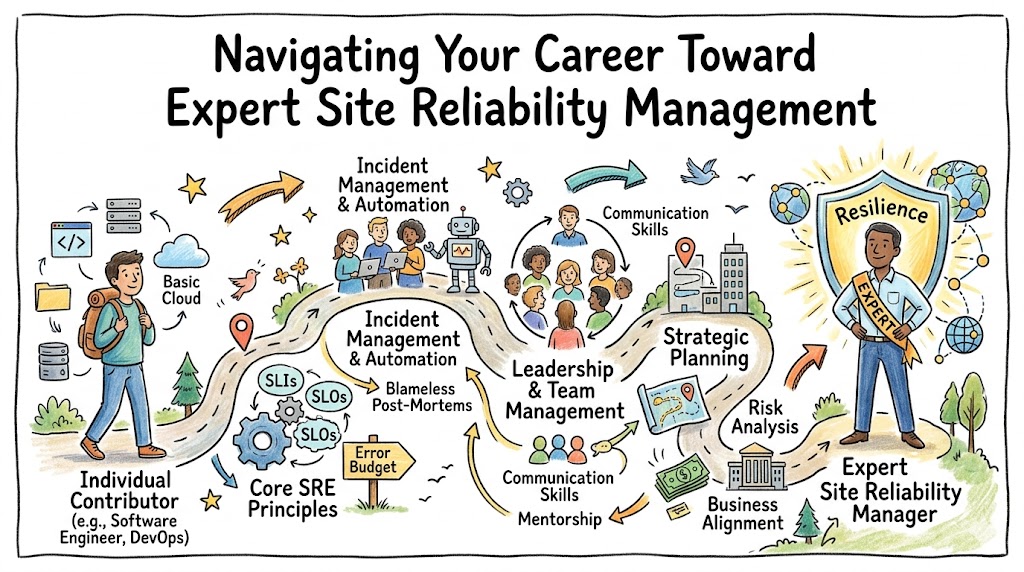
Modern enterprises prioritize system uptime above all else, making the role of a leader in this space critical. This Certified Site Reliability Manager roadmap offers a strategic perspective for engineers who want to bridge the gap between coding and high-level operational oversight. By utilizing the training modules at Sreschool, you gain the specific skills needed to manage distributed systems at scale while maintaining a healthy team culture. This guide explains how to transition into a managerial role and why this specific certification remains the gold standard for reliability leaders.
What is the Certified Site Reliability Manager?
The Certified Site Reliability Manager represents a professional standard for individuals who oversee the stability and scalability of distributed systems. It exists because technical expertise alone no longer suffices for managing modern production ecosystems where human factors and system architecture intersect. This program focuses on real-world, production-focused learning, moving beyond theoretical concepts to emphasize practical reliability strategies used in enterprise environments. By aligning with modern engineering workflows, it ensures that managers foster a culture of blamelessness while maintaining rigorous uptime standards.
Who Should Pursue Certified Site Reliability Manager?
Senior software engineers, lead SREs, and cloud architects who are transitioning into formal leadership or management roles benefit most from this curriculum. Engineering managers and technical leads responsible for security, data, and platform teams find the lessons highly relevant to their daily challenges. Furthermore, the program caters to both beginners looking for a structured career trajectory and experienced professionals aiming to validate their strategic capabilities. Given the global demand for reliability expertise, it holds significant relevance for the tech hubs in India and the broader international market.
Why Certified Site Reliability Manager is Valuable and Beyond
The demand for reliable digital services continues to grow as enterprises migrate mission-critical workloads to the cloud, ensuring long-term career longevity. As toolchains evolve and AI-driven operations become standard, the principles of SRE management remain a constant, helping professionals stay relevant despite rapid technological shifts. Organizations increasingly adopt reliability-first cultures, which means practitioners see a high return on their time and career investment through increased influence. Ultimately, this certification proves you can balance the pressure of rapid feature delivery with the absolute necessity of system stability.
Certified Site Reliability Manager Certification Overview
The program delivers its curriculum via gurukulgalaxy.com and uses the Sreschool platform for its primary hosting and assessment. It offers a comprehensive approach that validates both technical comprehension and the ability to make high-stakes operational decisions. The structure breaks down into logical levels, moving from foundational principles to advanced managerial frameworks that govern entire departments. Because the creators built it on practical terms, the ownership of the learning journey remains with the professional, allowing for a flexible yet rigorous mastery of SRE governance.
Certified Site Reliability Manager Certification Tracks & Levels
The certification categorizes its path into foundation, professional, and advanced levels to provide a clear growth trajectory. The foundation level introduces the core vocabulary and metrics of reliability, while the professional level dives into incident management and team scaling. Advanced levels focus on organizational transformation and cross-functional leadership across DevOps, SRE, and FinOps domains. By following these tracks, professionals align their learning with their specific career progression, ensuring they gain the right skills at the right time.
Complete Certified Site Reliability Manager Certification Table
| Track | Level | Who it’s for | Prerequisites | Skills Covered | Recommended Order |
| Core SRE | Foundation | Aspiring Leads | Basic Cloud Knowledge | SLIs, SLOs, Error Budgets | 1 |
| Leadership | Professional | Team Managers | 3+ Years Experience | Incident Response, Automation | 2 |
| Strategy | Advanced | Senior Directors | Professional Cert | Strategic Planning, Risk | 3 |
| Architect | Expert | Principal Leads | 7+ Years Experience | Enterprise Governance | 4 |
Detailed Guide for Each Certified Site Reliability Manager Certification
Certified Site Reliability Manager – Foundation Level
What it is
This level validates a fundamental understanding of the Site Reliability Engineering mindset and the basic metrics used to measure system health. It serves as the entry point for anyone looking to adopt a disciplined approach to operations.
Who should take it
Software engineers, junior DevOps practitioners, and system administrators who want to understand the core pillars of reliability should start here. It is ideal for those with limited experience in formal SRE roles.
Skills you’ll gain
- Defining and measuring Service Level Indicators (SLIs).
- Calculating and managing Error Budgets.
- Understanding the difference between SRE and traditional operations.
- Basic incident identification and reporting.
Real-world projects you should be able to do
- Create a monitoring dashboard for a web application.
- Draft a basic Service Level Objective (SLO) document for a small team.
Preparation plan
A 7-14 day plan involves reviewing the core SRE handbook principles. A 30-day plan allows for hands-on practice with monitoring tools. A 60-day plan is best for those new to cloud environments who need to learn infrastructure basics.
Common mistakes
Candidates often focus too much on specific tools rather than the underlying philosophy of error budgets and toil reduction.
Best next certification after this
- Same-track: Certified Site Reliability Manager – Professional Level
- Cross-track: Certified DevOps Professional
- Leadership: Technical Lead Essentials
Certified Site Reliability Manager – Professional Level
What it is
This certification validates the ability to lead a team through complex production incidents and manage the lifecycle of a service. It focuses on the bridge between technical execution and team coordination.
Who should take it
Experienced engineers and newly appointed team leads who are responsible for the uptime of production services should pursue this level. It requires a solid grasp of distributed systems.
Skills you’ll gain
- Advanced incident command and coordination.
- Post-mortem facilitation and blameless culture promotion.
- Managing toil and automating repetitive operational tasks.
- Resource forecasting and capacity planning.
Real-world projects you should be able to do
- Lead a complex incident response drill (Wheel of Misfortune).
- Implement an automated toil-reduction workflow for a production cluster.
Preparation plan
A 7-14 day plan is suitable for active SREs who handle incidents daily. A 30-day plan involves studying case studies of system failures. A 60-day plan is recommended for those transitioning from development into management.
Common mistakes
Many candidates fail to demonstrate how they balance feature velocity with reliability, often leaning too hard toward one side.
Best next certification after this
- Same-track: Certified Site Reliability Manager – Advanced Level
- Cross-track: Cloud Security Architect
- Leadership: Engineering Manager Professional
Choose Your Learning Path
DevOps Path
This path focuses on the seamless integration of development and operations through automation. Professionals learn to build robust CI/CD pipelines that incorporate reliability checks at every stage of the software lifecycle. Consequently, the emphasis is on reducing the friction between code commits and production deployments. Practitioners following this route become experts in infrastructure as code and configuration management.
DevSecOps Path
Security is a core component of reliability in this specialized track. It involves shifting security practices to the left, ensuring that vulnerability scanning and compliance checks are automated within the delivery pipeline. Furthermore, managers learn to handle security incidents with the same discipline as performance outages. This path is essential for those working in highly regulated industries like finance or healthcare.
SRE Path
The SRE path is the purest application of software engineering principles to operational problems. It prioritizes the creation of self-healing systems and the rigorous use of data to drive decision-making. Managers in this track focus heavily on defining acceptable levels of failure and managing the human cost of on-call rotations. This is the ideal route for those aiming to manage high-traffic, global-scale platforms.
AIOps Path
This track explores the use of machine learning and artificial intelligence to enhance operational efficiency. It focuses on using predictive analytics to identify potential system failures before they occur. Managers learn how to implement AI-driven alerting to reduce noise and improve incident response times. As systems grow more complex, this path provides the tools necessary to manage data at scale.
MLOps Path
Focusing on the lifecycle of machine learning models, this path ensures that AI products remain reliable in production. It covers the automation of model training, deployment, and monitoring for data drift. Practitioners learn to treat models as first-class citizens in the production environment, applying SRE principles to data science workflows. This is critical for organizations relying on real-time AI decision-making.
DataOps Path
The DataOps path applies the rigor of DevOps to data engineering and data science pipelines. It ensures that data remains high-quality, accessible, and reliable across the entire organization. Managers focus on reducing the cycle time of data analytics while maintaining strict governance and security. This path bridges the gap between data producers and data consumers in a scalable way.
FinOps Path
This track focuses on the financial management of cloud resources to ensure cost-effective reliability. Managers learn to align cloud spending with business value, ensuring that infrastructure is neither over-provisioned nor under-powered. By integrating financial accountability into the engineering culture, practitioners help organizations optimize their cloud investment. It is a vital path for managers overseeing large-scale cloud migrations.
Role → Recommended Certified Site Reliability Manager Certifications
| Role | Recommended Certifications |
| DevOps Engineer | Foundation + DevOps Specialization |
| SRE | Professional + SRE Advanced |
| Platform Engineer | Foundation + Cloud Architect |
| Cloud Engineer | Foundation + FinOps Track |
| Security Engineer | DevSecOps Professional |
| Data Engineer | DataOps Specialization |
| FinOps Practitioner | FinOps Foundation + Managerial Level |
| Engineering Manager | Professional + Leadership Track |
Next Certifications to Take After Certified Site Reliability Manager
Same Track Progression
After completing the core management levels, professionals should seek deep specialization in specific architectural patterns. This might involve diving into advanced container orchestration or serverless reliability strategies. Deepening your expertise in your primary track ensures you remain the go-to authority for complex system challenges. It also prepares you for principal-level roles where technical depth is as important as strategic vision.
Cross-Track Expansion
Broadening your skills into adjacent areas like security or finance makes you a more versatile leader. For instance, an SRE manager with FinOps expertise can effectively argue for infrastructure investments based on cost-benefit analysis. This expansion allows you to break down silos between different engineering departments. It also provides a safety net as industry trends shift toward integrated platform engineering.
Leadership & Management Track
For those aiming for Director or VP levels, the focus must shift toward organizational design and business strategy. This involves learning how to manage multiple teams, set department-wide KPIs, and influence executive leadership. The goal is to transition from managing systems to managing the people and processes that build those systems. This track emphasizes communication, mentorship, and long-term technical debt management.
Training & Certification Support Providers for Certified Site Reliability Manager
DevOpsSchool
This provider offers extensive training programs that focus on the practical application of DevOps tools in an enterprise setting. Their curriculum bridges the gap between basic automation and complex orchestration.
Cotocus
Known for its specialized consulting and training, this organization helps professionals master the nuances of cloud-native technologies. They provide hands-on labs that simulate real-world production environments for deep learning.
Scmgalaxy
This community-driven platform provides a wealth of resources for software configuration management and continuous integration. It is an excellent resource for those looking to stay updated on the latest industry trends.
BestDevOps
Focusing on high-quality instructional content, this provider offers targeted courses for various engineering roles. Their approach emphasizes the mastery of core principles before moving on to advanced tool implementation.
devsecopsschool.com
This site is dedicated to the integration of security into the DevOps lifecycle. They provide specialized certifications that help engineers and managers secure their pipelines and production environments effectively.
sreschool.com
As a primary host for reliability education, this platform offers structured paths for SRE practitioners at all levels. Their content is deeply rooted in the practical challenges of maintaining large-scale distributed systems.
aiopsschool.com
This provider focuses on the intersection of artificial intelligence and IT operations. Their training helps professionals leverage machine learning to automate complex monitoring and incident response tasks.
dataopsschool.com
Dedicated to the field of data engineering and analytics operations, this site provides the tools needed to manage data pipelines reliably. Their courses cover everything from data quality to scalable architecture.
finopsschool.com
This organization leads the way in cloud financial management education. They offer certifications that empower engineers to take ownership of their cloud spend and drive business value through optimization.
Frequently Asked Questions
- How hard is the Certified Site Reliability Manager exam?The difficulty depends on your practical experience. While the foundation is manageable for those with cloud knowledge, the professional level requires deep understanding of incident response.
- How much time do I need for preparation?Most professionals spend between 30 to 90 days preparing, depending on their starting point and the level they want to achieve.
- Are there any prerequisites for the foundation level?There are no formal prerequisites, but you should understand Linux, networking, and at least one cloud provider before starting.
- What is the return on investment for this cert?Professionals see immediate benefits through better job opportunities and higher salary brackets, as SRE management remains a high-demand field globally.
- Should I choose the DevOps or SRE track?If your goal is automation and delivery, start with DevOps. If your focus is on stability, scalability, and production management, choose the SRE track.
- Is the certification recognized globally?Yes, the principles taught are based on industry-standard practices used by major tech companies worldwide, making it highly portable.
- Does this certification require recertification?Typically, certifications remain valid for two to three years, after which you must pass an updated exam to prove your knowledge of current tools.
- Can I skip the foundation level?While possible, you should review foundation materials to ensure your vocabulary and mental models align with the specific framework used in the program.
- How does this help an engineering manager?It provides a structured way to measure team performance and system health, moving away from gut feelings to data-driven management.
- Are there hands-on labs involved?Yes, most reputable providers include practical labs where you solve real production issues to demonstrate your competency.
- What is the cost of the certification?Prices vary by provider and level, but it is generally a mid-range professional investment compared to broad cloud provider certifications.
- Is there a community for certified professionals?Yes, becoming certified gives you access to alumni networks and private forums where you can discuss advanced operational challenges with peers.
FAQs on Certified Site Reliability Manager
- What makes a manager different from a senior SRE in this program?The manager level focuses on the strategic why and when of reliability, emphasizing leadership and risk assessment over individual script writing.
- Can I pursue this if I do not know how to code?You need a basic ability to read and understand code, as SRE fundamentally uses engineering to solve operational problems.
- How does this certification handle multi-cloud?The principles are vendor-neutral, focusing on architectural patterns that apply whether you use AWS, Azure, or Google Cloud.
- Is incident management a large part of the curriculum?Absolutely, effective incident command and post-incident analysis are core pillars of the professional and advanced managerial levels.
- How does SRE management differ from traditional ITIL?SRE emphasizes automation, error budgets, and an engineering approach compared to the more process-heavy and gatekeeping nature of traditional ITIL.
- Does the program cover soft skills like hiring?Yes, the advanced levels include modules on building diverse teams, managing on-call burnout, and fostering a healthy engineering culture.
- Are there specific tools I must master?While tool-agnostic in principle, you will likely work with Prometheus, Kubernetes, and Terraform during the practical portions of the training.
- How does this certification address technical debt?It teaches managers how to quantify debt and use error budgets as a lever to negotiate for dedicated maintenance time.
Final Thoughts: Is Certified Site Reliability Manager Worth It?
Investing in this certification marks a serious commitment to the future of infrastructure leadership. It moves you beyond the firefighter mentality of traditional operations into a structured engineering discipline that values long-term stability. As a mentor, I see many talented engineers struggle to communicate the value of reliability to business stakeholders; this program provides the language to do exactly that. It is an honest, practical investment for anyone serious about the future of platform engineering. Ultimately, the value lies not just in the credential, but in the rigorous mindset you adopt to keep the digital world running smoothly.
I really love how this guide simplifies the path to reliability management, making expert career growth feel much more achievable.