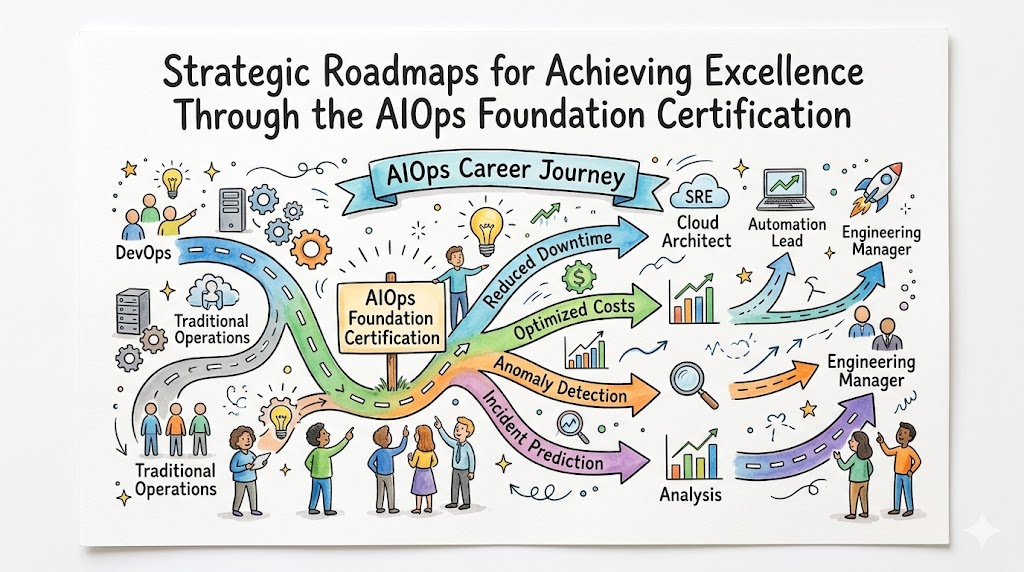
Professionals seeking to dominate the cloud-native era must embrace automated intelligence to manage complex modern infrastructures. This AIOps Foundation Certification provides the essential framework for SREs and DevOps experts to integrate machine learning into their daily operations. You will discover how to eliminate operational noise and enhance system uptime by leveraging the resources at AIOpsSchool. Mastering these skills ensures you remain at the forefront of the industry while making informed decisions for your career progression. This guide simplifies the journey toward becoming a leader in the rapidly expanding field of intelligent platform engineering.
What is the AIOps Foundation Certification?
Modern enterprises generate massive volumes of telemetry data that exceed human processing capabilities. The AIOps Foundation Certification validates your ability to use big data and machine learning to automate the detection and resolution of IT issues. It shifts the focus from theoretical concepts to production-ready skills that improve service reliability across distributed systems. By aligning with current industry needs, this credential prepares you to handle high-pressure environments through sophisticated, data-driven automation.
Who Should Pursue AIOps Foundation Certification?
Cloud architects, SREs, and platform engineers find immense value in this certification as they scale their infrastructure. Managers who lead technical teams also benefit by understanding how to implement AI strategies that drive business efficiency. Beginners gain a competitive edge by entering the workforce with specialized knowledge in autonomous operations. Whether you work in India or for a global firm, this certification serves as a powerful signal of technical maturity and forward-thinking expertise.
Why AIOps Foundation Certification is Valuable and Beyond
Companies continue to migrate to the cloud, creating a permanent demand for engineers who can manage complex digital ecosystems. This certification protects your career against the obsolescence of specific tools by teaching the core logic of algorithmic operations. You gain the ability to stay productive even as software stacks evolve because you understand the underlying patterns of system behavior. Investing in this knowledge yields high returns by positioning you as a specialist in the future of autonomous IT.
AIOps Foundation Certification Overview
The primary training portal delivers the program curriculum, while the official site hosts all necessary resources for candidates. Students experience a practical assessment model that prioritizes the application of AI concepts to real-world infrastructure problems. The certification maintains high standards through regular updates that reflect the newest trends in machine learning for operations. This structure allows you to build a solid base before tackling more advanced architectural challenges in the field.
AIOps Foundation Certification Tracks & Levels
The learning journey begins with foundation courses that establish a common vocabulary for AI and big data. Professionals then move into specialized tracks that focus on either deep technical implementation or high-level strategic planning. These levels follow a natural career progression, moving from basic monitoring tasks to the design of self-healing systems. Each tier adds a layer of expertise that allows you to take on more responsibility within your organization.
Complete AIOps Foundation Certification Table
| Track | Level | Who it’s for | Prerequisites | Skills Covered | Recommended Order |
| Core | Associate | Junior Engineers | IT Basics | Data Filtering | 1 |
| Advanced | Professional | SRE / DevOps | Associate | Root Cause Analysis | 2 |
| Mastery | Expert | Architects | Professional | Neural Networks | 3 |
| Leadership | Strategist | Directors | Experience | AI Governance | 4 |
Detailed Guide for Each AIOps Foundation Certification
AIOps Foundation – Associate Level
What it is
This certification proves you understand how to apply basic machine learning principles to solve common IT operational hurdles. It confirms your proficiency in the core components of an automated monitoring ecosystem.
Who should take it
System administrators and aspiring DevOps engineers should start here to build a foundation in intelligent automation. It requires no prior experience in complex data science or high-level statistics.
Skills you’ll gain
- Mastery of data ingestion workflows
- Ability to identify anomalies in system metrics
- Knowledge of incident correlation techniques
Real-world projects you should be able to do
- Build an automated dashboard that identifies trend deviations
- Configure a system to suppress redundant alerts during outages
Preparation plan
- 7–14 days: Study the core terminology and basic architectural flowcharts
- 30 days: Complete all interactive modules and pass the mock exams
- 60 days: Deploy a small-scale AIOps pilot project in a sandbox environment
Common mistakes
- Focusing too much on coding models rather than understanding operational logic
- Neglecting the quality of the data entering the system
Best next certification after this
- Same-track: AIOps Professional Certification
- Cross-track: SRE Foundation Certification
- Leadership: Engineering Manager Certification
Choose Your Learning Path
DevOps Path
Engineers on this path integrate AI directly into the deployment pipeline to prevent unstable code from reaching users. You learn to analyze historical deployment data to predict the success of new releases automatically. This proactive approach significantly reduces the time developers spend on manual rollbacks and hotfixes. It creates a faster, safer delivery cycle that benefits the entire software organization.
DevSecOps Path
This track utilizes artificial intelligence to identify subtle security threats that traditional firewalls often overlook. You train models to spot unusual behavioral patterns that suggest a potential breach or insider threat. By automating the response to these anomalies, you maintain a more resilient security posture. This path is essential for protecting sensitive data in high-traffic cloud environments.
SRE Path
Site Reliability Engineers use these skills to build autonomous systems that require minimal human intervention. You focus on using data to manage error budgets and automate the remediation of recurring issues. This reduces manual toil and allows your team to focus on high-value architectural improvements. Mastering these AI concepts is the key to achieving true system reliability at scale.
AIOps Path
This dedicated track focuses on the engineering behind the AIOps platform itself, from data lakes to algorithmic selection. You learn to manage the massive streams of telemetry data that fuel the intelligent core of the system. This path suits those who enjoy building the internal tools that empower other engineering departments. It represents the pinnacle of operations-focused data engineering.
MLOps Path
Professionals in this area manage the lifecycle of the machine learning models that drive automated operations. You ensure that these models remain accurate by building continuous training and validation pipelines. This role bridges the gap between the data scientist’s research and the engineer’s production environment. It is a critical function for any organization relying on AI for long-term stability.
DataOps Path
DataOps focuses on the integrity and speed of the data pipelines that support all other AI activities. You apply agile principles to data management to ensure that telemetry is always available and accurate. Without this foundation, AIOps models cannot function effectively or provide reliable insights. This path ensures the “fuel” for your intelligent systems remains clean and consistent.
FinOps Path
This path applies machine learning to cloud billing to find hidden savings and predict future expenses. You learn to automate the rightsizing of resources based on actual usage patterns rather than static guesses. This helps companies scale their infrastructure without losing control of their monthly cloud budget. It is a vital skill for maximizing the economic efficiency of cloud migrations.
Role → Recommended AIOps Foundation Certifications
| Role | Recommended Certifications |
| DevOps Engineer | AIOps Foundation + DevOps Professional |
| SRE | AIOps Foundation + SRE Practitioner |
| Platform Engineer | AIOps Foundation + Kubernetes Expert |
| Cloud Engineer | AIOps Foundation + Cloud Solutions Architect |
| Security Engineer | AIOps Foundation + DevSecOps Specialist |
| Data Engineer | AIOps Foundation + Data Analytics |
| FinOps Practitioner | AIOps Foundation + Cloud Finance |
| Engineering Manager | AIOps Foundation + Strategic Leadership |
Next Certifications to Take After AIOps Foundation Certification
Same Track Progression
Deepening your expertise through Professional and Expert levels makes you an indispensable asset for large-scale infrastructure projects. You will learn to fine-tune specific models that handle complex root cause analysis across microservices. This vertical growth ensures you can lead the implementation of enterprise-grade AI platforms. It solidifies your reputation as a master of modern operational technology.
Cross-Track Expansion
Broadening your skills into areas like Kubernetes or advanced security creates a versatile professional profile. This “T-shaped” development allows you to understand how AI interacts with every layer of the technology stack. You become a more effective collaborator who can bridge the gap between different engineering silos. This versatility is highly prized in fast-paced, high-growth tech companies.
Leadership & Management Track
Moving into leadership requires a shift from technical execution to high-level strategic planning and ROI analysis. You will learn how to build teams that embrace automation and how to justify AI investments to stakeholders. This path prepares you for roles like VP of Infrastructure or Chief Technology Officer. It empowers you to shape the future direction of your organization’s technology.
Training & Certification Support Providers for AIOps Foundation Certification
DevOpsSchool
This institution provides rigorous training programs that focus on the practical application of automation tools. Students gain access to expert-led workshops and hands-on labs that reflect real industry challenges. They specialize in transforming traditional IT workers into modern DevOps professionals.
Cotocus
This provider offers specialized consulting and high-level technical training for corporate engineering teams. They focus on delivering custom learning paths that align with specific business goals and infrastructure needs. Their instructors bring decades of experience to the classroom.
Scmgalaxy
This community-centric organization offers a vast library of resources for version control and continuous integration. They facilitate knowledge sharing among thousands of engineers globally through blogs and webinars. Their support helps professionals master the complexities of the modern software supply chain.
BestDevOps
This portal curates the most effective learning materials for engineers who want to stay competitive. They provide clear roadmaps and tool comparisons that simplify the path to technical mastery. Their programs focus on getting candidates job-ready in a short timeframe.
devsecopsschool.com
This platform emphasizes the critical intersection of security and rapid software delivery. They teach engineers how to automate compliance and vulnerability scanning within the DevOps pipeline. Their mission centers on building inherently secure software systems.
sreschool.com
This school focuses exclusively on the principles and practices of Site Reliability Engineering. They provide deep dives into incident response, monitoring, and the reduction of manual toil. It is the premier destination for anyone managing high-availability platforms.
aiopsschool.com
This leader in the field provides dedicated training for artificial intelligence in operations. They offer comprehensive certifications that cover the entire AIOps lifecycle from data to insights. Their curriculum prepares you for the future of autonomous infrastructure management.
dataopsschool.com
This provider teaches the essential skills needed to manage high-velocity data pipelines for AI. They focus on data quality, governance, and the orchestration of complex telemetry streams. Their training ensures that your AI models always have reliable data.
finopsschool.com
This institution specializes in the financial management of cloud resources through data-driven insights. They provide the tools and training necessary to optimize cloud spending and maximize ROI. Their certifications are essential for modern cloud financial operations.
Frequently Asked Questions (General)
- Does the foundation exam require advanced coding skills?
The exam focuses on concepts and logic rather than deep programming or model development. You only need a basic understanding of scripts and monitoring tools to succeed. - How much time do I need to study every day?
Allocating one to two hours daily for a month usually provides enough preparation time. This consistency helps you absorb the complex concepts of machine learning and data patterns. - Can I take the exam online from my home?
Most certification providers offer remote proctoring options for their exams. This allows you to complete the assessment from any location with a stable internet connection. - Will this certification help me get a promotion?
Acquiring specialized skills in AI for operations demonstrates a commitment to innovation and efficiency. Many engineers find that this credential opens doors to lead positions and higher salaries. - Is the content of the course vendor-specific?
The foundation level teaches universal principles that apply to any AIOps or monitoring platform. This ensures your skills remain portable across different companies and technology stacks. - Are there any practical labs included in the training?
Yes, high-quality providers include hands-on exercises to ensure you can apply the theory. These labs simulate real-world scenarios like alert suppression and incident correlation. - How does this certification differ from a standard DevOps course?
Standard courses focus on the pipeline and tools, while this certification focuses on intelligence. It adds a layer of predictive analytics to the traditional DevOps workflow. - Is there a community for certified professionals?
Certified individuals often gain access to exclusive forums and networking events. These groups provide valuable opportunities for career advice and technical collaboration. - Does the exam cover big data technologies?
The curriculum explains how big data serves as the foundation for effective AI models. You will learn about data ingestion, storage, and processing at a high level. - What is the passing score for the foundation exam?
Passing scores vary by provider but generally hover around the 70% mark. Review the specific guidelines of your chosen provider before the test. - Can I retake the test if I fail?
Most organizations allow at least one retake, though policies on fees and waiting periods vary. Always check the retake policy before booking your first attempt. - Are there practice exams available for students?
Top training providers offer mock exams that mimic the format and difficulty of the real test. Using these tools significantly increases your chances of passing on the first try.
FAQs on AIOps Foundation Certification
- What exactly does “event correlation” mean in this context?
It refers to the process of grouping related alerts together to find the single root cause. This prevents engineers from being overwhelmed by hundreds of separate notifications for one issue. - How does the certification teach noise reduction?
You learn to use algorithms that filter out irrelevant data and minor fluctuations in system performance. This ensures that only high-priority, actionable alerts reach the SRE team. - Will I learn about neural networks in the foundation course?
The course introduces the concept of neural networks and how they apply to operations. Deep training on building these networks usually happens in more advanced certification levels. - Does the exam address the ethics of AI in IT?
The curriculum often touches upon data privacy and the responsible use of automation. It ensures that engineers understand the implications of letting AI make critical system decisions. - How does this certification help with root cause analysis?
It teaches you to use AI to trace the path of a failure across complex microservices. This significantly speeds up the time it takes to fix critical production bugs. - Does the course cover real-time telemetry streaming?
Yes, you learn how to handle data that arrives in a continuous flow from thousands of sources. This is a critical skill for managing large-scale, high-traffic infrastructures. - What is the role of NLP in AIOps?
Natural Language Processing helps the system understand logs and human communication in chat tools. This allows for better automated documentation and incident reporting. - Is predictive maintenance a core part of the syllabus?
Predictive maintenance is a key outcome of the AIOps framework. The course teaches you how to identify signs of failure before they actually impact the user experience.
Final Thoughts: Is AIOps Foundation Certification Worth It?
Choosing to pursue this certification reflects a strategic decision to lead the next wave of technological evolution. You gain the ability to manage vast infrastructures with a level of precision that manual efforts can never match. This credential proves that you possess the vision to integrate machine learning into the heart of software operations. Instead of fearing automation, you learn to harness it to make your systems more resilient and your job more rewarding. The time spent mastering these foundations will pay dividends throughout your career in the cloud-native landscape.
I really love how this roadmap simplifies the foundation certification, making excellence in AIOps feel much more achievable.