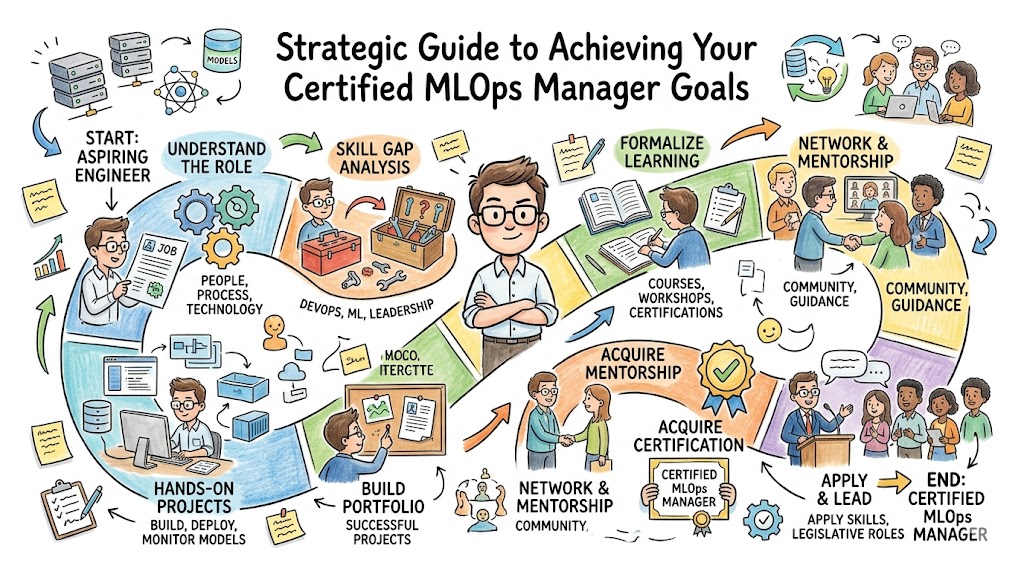
A complex combination of leadership and machine learning operations is needed in today’s engineering environments. This Certified MLOps Manager program bridges the gap between raw data science and production-grade reliability. This guide serves professionals navigating the complexities of AIOpsSchool certifications, providing a roadmap for platform engineers, SREs, and technical leaders. You will find clarity on how to align these credentials with your career trajectory to make informed decisions about your professional growth in the cloud-native era.
What is the Certified MLOps Manager?
The Certified MLOps Manager designation represents a professional standard for individuals leading the integration of machine learning into DevOps workflows. It focuses on the lifecycle management of models, ensuring they remain performant, scalable, and secure in production environments. Unlike theoretical courses, this program emphasizes operational excellence and the automation of ML pipelines within enterprise ecosystems. It aligns perfectly with modern engineering practices by treating models as software artifacts that require continuous integration and deployment.
Who Should Pursue Certified MLOps Manager?
This path serves senior software engineers and DevOps professionals who want to pivot into the high-demand field of machine learning operations. Systems engineers and SREs looking to manage ML infrastructure will find the curriculum highly relevant to their daily stability goals. Engineering managers and technical leads should pursue this to better oversee teams building intelligent applications. Both beginners in India and experienced global professionals gain a structured framework for managing complex data-driven systems.
Why Certified MLOps Manager is Valuable and Beyond
The demand for specialized MLOps talent continues to outpace the available workforce as enterprises shift from experimental AI to production-scale deployments. Holding this certification ensures long-term career longevity because it focuses on architectural principles rather than just ephemeral toolsets. It helps professionals remain relevant by mastering the orchestration of data pipelines and model monitoring. The return on time is significant, as it positions you for leadership roles in the rapidly evolving platform engineering space.
Certified MLOps Manager Certification Overview
The program is delivered via the official portal and hosted on the specialized site mentioned in the introduction. It utilizes a practical assessment approach that tests your ability to handle real-world infrastructure challenges rather than simple memorization. The ownership of the program lies with industry experts who ensure the content stays updated with current cloud-native trends. The structure includes hands-on labs and comprehensive evaluations designed to validate true technical and managerial competency.
Certified MLOps Manager Certification Tracks & Levels
The certification framework begins with foundation levels that establish a common vocabulary for machine learning and operations. Professional levels dive deep into technical specialization, covering aspects like automated testing for models and resource optimization. Advanced tracks focus on organizational leadership, strategy, and the governance of large-scale ML departments. These levels align with your career progression, moving from individual contributor tasks to high-level architectural oversight.
Complete Certified MLOps Manager Certification Table
| Track | Level | Who it’s for | Prerequisites | Skills Covered | Recommended Order |
| Operations | Foundation | Junior Engineers | Basic Linux | CI/CD, ML Basics | First |
| Management | Professional | Team Leads | 3+ Years Exp | Governance, Budgeting | Second |
| Architecture | Advanced | Principal SREs | 5+ Years Exp | System Design, Scaling | Third |
| Security | Specialist | SecOps | InfoSec Basics | Model Robustness | Optional |
Detailed Guide for Each Certified MLOps Manager Certification
Certified MLOps Manager – Foundation Level
What it is
This certification validates your understanding of the core intersection between data science and IT operations. It confirms you speak the language of both developers and data scientists fluently.
Who should take it
Aspiring MLOps engineers and junior DevOps practitioners should start here to build a solid baseline. It is also ideal for project managers entering the AI space.
Skills you’ll gain
- Understanding ML lifecycles
- Basic pipeline automation
- Version control for data
Real-world projects you should be able to do
- Setup a basic automated model training trigger
- Organize data versioning for a small team
Preparation plan
The 7-14 day strategy involves reviewing core terminology and basic cloud concepts. For 30 days, focus on hands-on lab exercises. The 60-day plan includes building a full end-to-end sandbox pipeline.
Common mistakes
- Ignoring the data science components
- Over-complicating the initial infrastructure
Best next certification after this
- Same-track: Professional MLOps Engineer
- Cross-track: SRE Foundation
- Leadership: Technical Team Lead
Certified MLOps Manager – Professional Level
What it is
This level confirms your ability to manage production-grade ML environments at scale. It focuses on reliability, monitoring, and the continuous delivery of high-quality models.
Who should take it
Senior DevOps engineers and mid-level managers who handle live traffic and model deployments. It requires a solid grasp of containerization and orchestration.
Skills you’ll gain
- Advanced model monitoring
- Scalable infrastructure management
- Cost optimization for ML
Real-world projects you should be able to do
- Deploy a model with blue-green deployment strategies
- Implement automated drift detection and alerting
Preparation plan
Spend the first 14 days mastering Kubernetes for ML. Use the 30-day window for intensive model serving practice. The 60-day plan should culminate in a capstone project involving production-level scaling.
Common mistakes
- Focusing only on the code and ignoring the data drift
- Failing to account for cloud costs during training
Best next certification after this
- Same-track: Advanced MLOps Architect
- Cross-track: FinOps Professional
- Leadership: Certified MLOps Manager (Advanced)
Choose Your Learning Path
DevOps Path
This path focuses on extending traditional CI/CD practices to include machine learning assets. You will learn how to treat models as software, ensuring they pass through rigorous testing before reaching production. It emphasizes the use of Jenkins, GitLab, or GitHub Actions in an ML context. This is ideal for those who want to remain at the core of delivery.
DevSecOps Path
Security is paramount when dealing with sensitive data and proprietary models. This track teaches you how to implement security scanning within the ML pipeline. You will explore model poisoning prevention and secure API management for inference. It is a vital path for professionals working in regulated industries like finance or healthcare.
SRE Path
The SRE path focuses on the “Ops” part of MLOps, emphasizing uptime and latency. You will learn how to set Service Level Objectives for model performance. This track covers the automation of recovery and how to handle massive spikes in inference requests. It is perfect for those obsessed with system reliability and performance tuning.
AIOps Path
This specialization focuses on using AI to improve IT operations themselves. You will learn how to apply machine learning to log analysis and predictive maintenance. This path bridges the gap between being a consumer of ML and using ML as a tool for system health. It is highly valued in large-scale enterprise environments.
MLOps Path
The dedicated MLOps path dives deep into the specific needs of the data science workflow. You will master feature stores, model registries, and experiment tracking. This is the most direct path for those wanting to work side-by-side with data scientists. It ensures the smooth transition of experimental code into stable production services.
DataOps Path
Data is the fuel for machine learning, and this path ensures the fuel is clean and available. You will focus on the orchestration of data pipelines and quality checks. It covers the automation of ETL processes and data governance. This is essential for ensuring that models are always trained on high-quality, relevant information.
FinOps Path
Managing the high costs of GPU clusters and cloud storage is a specialized skill. This path teaches you how to track and optimize the spending associated with ML training and hosting. You will learn how to implement cost-allocation tags and budget alerts. It is a critical track for managers who need to prove the ROI of their AI initiatives.
Role → Recommended Certified MLOps Manager Certifications
| Role | Recommended Certifications |
| DevOps Engineer | MLOps Foundation, Professional DevOps |
| SRE | MLOps Foundation, SRE Professional |
| Platform Engineer | MLOps Architect, CloudOps Specialist |
| Cloud Engineer | CloudOps Professional, MLOps Foundation |
| Security Engineer | DevSecOps Specialist, MLOps Security |
| Data Engineer | DataOps Professional, MLOps Foundation |
| FinOps Practitioner | FinOps Certified, MLOps Professional |
| Engineering Manager | Certified MLOps Manager (All Levels) |
Next Certifications to Take After Certified MLOps Manager
Same Track Progression
Once you master the management level, you should look toward architectural mastery. Deepening your knowledge in specific cloud providers like AWS or Azure for ML is a logical step. You can also specialize in edge computing for ML to push your technical boundaries. This ensures you remain an expert in the specialized field of operations.
Cross-Track Expansion
Broadening your skills into FinOps or DevSecOps adds a layer of versatility to your profile. Understanding the financial impact or the security risks of your ML pipelines makes you a more valuable asset to any enterprise. This “T-shaped” skill set allows you to collaborate effectively with diverse departments. Expanding into DataOps is also highly recommended for a holistic view.
Leadership & Management Track
If you aim for the C-suite or Director-level roles, focus on broader business strategy certifications. Learning about organizational change management and digital transformation is crucial at this stage. You will shift from managing pipelines to managing people, budgets, and long-term technical roadmaps. This transition is essential for those looking to influence the overall direction of the company.
Training & Certification Support Providers for Certified MLOps Manager
DevOpsSchool provides a comprehensive ecosystem for learning automation and infrastructure management through expert-led sessions and updated curriculum.
Cotocus specializes in delivering high-end technical training with a focus on real-world implementation and hands-on lab environments for professionals.
Scmgalaxy acts as a massive knowledge hub for community-driven learning, offering extensive resources for configuration management and continuous delivery.
BestDevOps focuses on curated paths for engineers looking to master the latest tools in the DevOps and MLOps landscape efficiently.
devsecopsschool.com offers specialized training that integrates security into every phase of the development and machine learning lifecycle for engineers.
sreschool.com provides a dedicated focus on site reliability engineering, teaching the principles of stability and performance at a massive scale.
aiopsschool.com leads the way in teaching how to use artificial intelligence to automate and optimize complex IT operations for modern enterprises.
dataopsschool.com ensures that professionals understand how to manage data pipelines with the same rigour and automation used in software development.
finopsschool.com focuses on the financial management of cloud resources, helping teams maximize the value of every dollar spent on infrastructure.
Frequently Asked Questions
- How difficult is the Certified MLOps Manager exam?
The exam is moderately difficult as it requires both technical knowledge and a solid understanding of management principles. - How much time does it take to get certified?
Most professionals with a technical background can complete the requirements within two to three months of focused study. - What are the prerequisites for the manager level?
You generally need a few years of experience in DevOps or software engineering and a basic understanding of machine learning. - What is the typical ROI for this certification?
Professionals often see a significant increase in salary and access to more senior roles in high-growth AI companies. - In what order should I take these certifications?
Start with the Foundation level, move to the Professional technical tracks, and finish with the Managerial levels. - Does this certification expire?
Most technical certifications recommend a renewal or update every two years to ensure you stay current with the industry. - Is there a global demand for MLOps Managers?
Yes, there is a massive global demand, particularly in tech hubs like India, the United States, and Europe. - Can I pass the exam with only online study?
While online study is essential, hands-on experience with cloud tools is highly recommended to pass the practical components. - Does it cover specific tools like Kubernetes?
Yes, it covers the orchestration of models using industry-standard tools like Kubernetes and various cloud-native ML platforms. - Is the certification recognized by major tech companies?
Major enterprises recognize these credentials as they align with the skills needed for modern digital transformation and AI. - Are there any lab requirements?
Most advanced tracks require the completion of specific hands-on labs to prove your ability to configure live environments. - Who can I contact for support during the course?
The hosting website provides dedicated mentors and community forums to help students through the learning process.
FAQs on Certified MLOps Manager
- How does this certification help an engineering manager?
It provides the technical vocabulary and strategic framework needed to oversee data science teams and align their output with business goals. - Will I learn about model monitoring?
Yes, the professional and manager tracks emphasize tracking model health, data drift, and performance metrics in live production environments. - Is coding required for the manager track?
While deep coding is less emphasized than in the engineer track, you must understand code structures and automated pipeline scripts. - Does it cover cloud-specific MLOps?
The principles are cloud-agnostic but include practical examples that are applicable across major providers like AWS, Azure, and Google Cloud. - How does MLOps differ from standard DevOps?
MLOps introduces the complexities of data versioning, model retraining, and experiment tracking which are not present in traditional software DevOps. - Can a data scientist take this certification?
Absolutely, it is an excellent way for data scientists to learn the operational side of putting their models into production. - Are there case studies included?
The curriculum often uses real-world enterprise scenarios to teach you how to handle failures and scale infrastructure under pressure. - What is the focus of the final assessment?
The final assessment tests your ability to design a scalable, secure, and cost-effective MLOps strategy for a hypothetical organization.
Final Thoughts: Is Certified MLOps Manager Worth It?
Investing your time in this certification is a strategic move if you want to lead in the era of artificial intelligence. It moves you beyond being just a technician and into the realm of a technical strategist. The curriculum avoids the hype often found in AI courses and instead focuses on the hard work of keeping systems running. If you are looking for a way to formalize your experience and signal your readiness for high-stakes leadership roles, this path is highly recommended. Focus on the practical applications, stay consistent with your labs, and you will find the career impact to be substantial.
This strategic guide is incredibly helpful for anyone looking to master MLOps and reach their certification goals effectively.