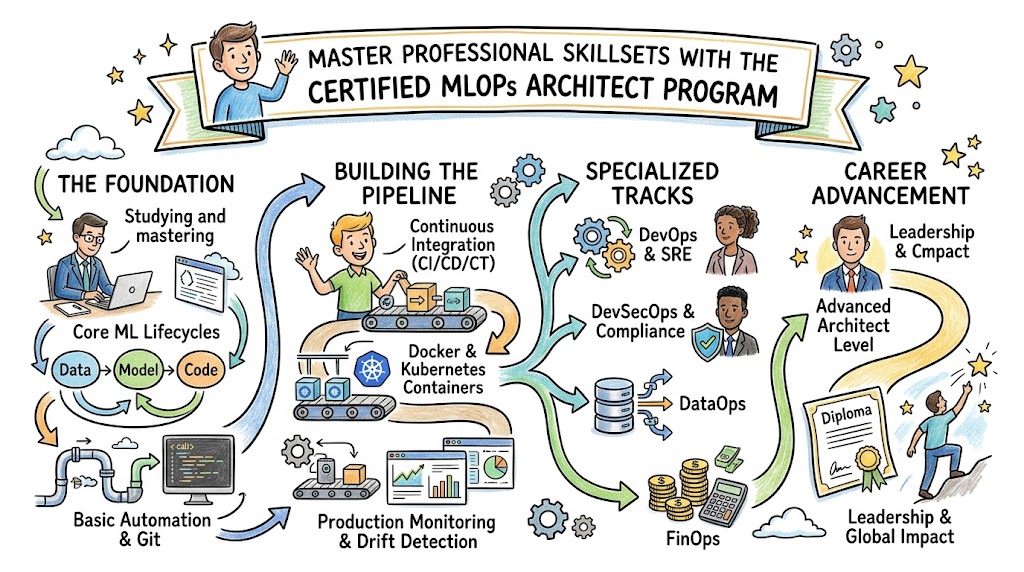
Modern engineering teams often struggle to bridge the gap between machine learning development and production-grade operations. This guide focuses on the Certified MLOps Architect program, which provides a comprehensive curriculum for professionals who want to master the lifecycle of AI models. Whether you work as a cloud engineer, a data scientist, or an SRE, you must understand how to build scalable and resilient ML pipelines today. This resource helps you navigate automation and monitoring within the AIOpsSchool ecosystem to ensure your career remains competitive. By following this roadmap, you will gain the clarity needed to choose the right learning path and implement enterprise-level engineering practices effectively.
What is the Certified MLOps Architect?
The Certified MLOps Architect establishes a professional standard at the intersection of machine learning, DevOps, and data engineering. It solves the “last mile” problem where models fail to reach production due to infrastructure gaps. This certification prioritizes production-focused learning over abstract theory, focusing on deployment, scaling, and governance. It treats ML code and data as first-class citizens within a continuous integration and delivery pipeline.
Who Should Pursue Certified MLOps Architect?
DevOps professionals and software engineers looking to transition into machine learning operations gain the most from this track. SREs and cloud architects who manage GPU workloads or large-scale data clusters also find these skills essential. Security and data roles use this knowledge to maintain compliance and data integrity throughout the model lifecycle. Technical leaders in India and global markets pursue this certification to understand the architectural constraints of modern AI systems.
Why Certified MLOps Architect is Valuable
The demand for professionals who can operationalize AI grows faster than the supply of qualified talent. This certification keeps engineers relevant by focusing on architectural principles that persist even as specific tools change. Enterprises are shifting toward integrated, automated systems, making the architect role vital for organizational success. Investing in this program provides a high return by positioning you as a bridge between data science and reliable production engineering.
Certified MLOps Architect Certification Overview
The official curriculum on AIOpsSchool delivers this program through a hands-on assessment approach. It covers various certification levels ranging from fundamental concepts to advanced architectural design. Industry experts who prioritize practical application over rote memorization manage the program. Candidates demonstrate their ability to design systems that handle data drift, model retraining, and scalable inference in cloud-native environments.
Certified MLOps Architect Certification Tracks & Levels
The structure begins with a foundation level that introduces core ML lifecycle concepts and basic automation. Professional levels move into complex orchestration, model containerization, and advanced monitoring strategies. Advanced levels focus on global-scale architecture, cost optimization, and multi-cloud strategies. These levels align with career progression from junior engineer to principal architect, allowing specialization in DevOps, SRE, or FinOps tracks.
Complete Certified MLOps Architect Certification Table
| Track | Level | Who it’s for | Prerequisites | Skills Covered | Recommended Order |
| * Core MLOps | Foundation | Beginners | Basic Python | ML Lifecycle, Git | 1 |
| * Engineering | Professional | DevOps/SRE | Cloud Basics | CI/CD, Docker | 2 |
| * Architecture | Advanced | Senior Leads | 5+ Years Exp | Scalability, Drift | 3 |
| * Governance | Professional | Data Leads | Data Privacy | Compliance, Bias | 2 |
| * Platform | Advanced | Cloud Arch | K8s Knowledge | Kubeflow, Vertex | 3 |
Detailed Guide for Each Certified MLOps Architect Certification
Certified MLOps Architect – Foundation Level
What it is
This level validates your understanding of the components required to move a machine learning model from a notebook to a reproducible pipeline.
Who should take it
Entry-level engineers or experienced IT professionals new to the machine learning domain should start here.
Skills you’ll gain
- Mastery of the ML pipeline lifecycle.
- Version control for datasets and experiments.
- Continuous integration for ML code.
Real-world projects you should be able to do
- Automate basic data cleaning scripts.
- Set up version-controlled repositories for ML projects.
Preparation plan
Spend 7–14 days on core definitions and lifecycle diagrams. Use a 30-day plan for hands-on labs with automation tools. A 60-day strategy allows a deep dive into Python-based frameworks.
Common mistakes
- Focusing on model math instead of the operational pipeline.
- Ignoring the importance of data versioning.
Best next certification after this
- Same-track: Professional MLOps Engineer
- Cross-track: DataOps Professional
- Leadership: AI Strategy Manager
Certified MLOps Architect – Professional Level
What it is
The professional level confirms your ability to build and manage automated deployment systems for machine learning models.
Who should take it
DevOps engineers and SREs with at least two years of experience should pursue this level.
Skills you’ll gain
- Docker and Kubernetes implementation for ML.
- Automated testing for data quality.
- Monitoring dashboards for model drift.
Real-world projects you should be able to do
- Deploy containerized models to Kubernetes clusters.
- Build pipelines that trigger retraining upon data drift.
Preparation plan
The 14-day path requires intense focus on container orchestration. A 30-day plan allows for building complete CI/CD pipelines. The 60-day plan provides time to master Kubeflow or MLflow.
Common mistakes
- Over-complicating architecture for small-scale models.
- Failing to account for GPU resource costs.
Best next certification after this
- Same-track: Advanced MLOps Architect
- Cross-track: DevSecOps Engineer
- Leadership: Technical Product Manager (AI)
Choose Your Learning Path
DevOps Path
This path focuses on the seamless integration of ML code into existing software delivery pipelines. Professionals learn to treat models like software artifacts, emphasizing speed and reliability. You will master Jenkins and GitHub Actions specifically for ML tasks. This path ensures that deployment never becomes a bottleneck for innovation.
DevSecOps Path
Security integrates directly into the ML lifecycle here, focusing on securing data pipelines and model endpoints. You will learn to scan for vulnerabilities in model containers and protect against adversarial attacks. This path ensures that AI does not become a security liability. It serves industries like finance and healthcare perfectly.
SRE Path
The SRE path emphasizes the reliability and observability of ML systems in production. You will focus on service-level objectives for model inference and data processing. This track teaches you how to handle massive scale and ensure high availability. It suits those interested in high-availability systems.
AIOps Path
AIOps focuses on using machine learning to improve traditional IT operations like log analysis. This path teaches you how to build models that predict system failures before they occur. You will automate the remediation of infrastructure issues using intelligent algorithms. This specialized path transforms how IT departments function.
MLOps Path
This core path covers the end-to-end lifecycle management of machine learning models. It includes everything from data ingestion to model serving and monitoring. You will manage the unique challenges of stateful ML systems compared to traditional software. This is the primary choice for aspiring specialists.
DataOps Path
DataOps focuses on the delivery of high-quality data for ML models through automated pipelines. You will learn about data versioning and automated quality checks to solve data integrity issues. This track is essential because model performance depends strictly on the data it consumes.
FinOps Path
The FinOps path teaches you how to manage the significant costs associated with training and running ML models. You will track cloud spending and implement cost-effective spot instances for GPU clusters. This path ensures that AI projects remain financially sustainable. It grows more important as AI budgets rise.
Role → Recommended Certified MLOps Architect Certifications
| Role | Recommended Certifications |
| * DevOps Engineer | MLOps Professional, DevSecOps Foundation |
| * SRE | MLOps Architect, SRE Professional |
| * Platform Engineer | MLOps Advanced, Kubernetes Architect |
| * Cloud Engineer | MLOps Foundation, Cloud Professional |
| * Security Engineer | MLOps Governance, DevSecOps Professional |
| * Data Engineer | DataOps Professional, MLOps Foundation |
| * FinOps Practitioner | MLOps FinOps Specialist, Cloud Cost Lead |
| * Engineering Manager | MLOps Strategy, AI Governance |
Next Certifications to Take After Certified MLOps Architect
Same Track Progression
After reaching the architect level, you should pursue deep specialization in specific cloud ecosystems. Mastering MLOps on AWS or Azure provides localized knowledge for enterprise environments. You can also explore research certifications to move closer to model development science.
Cross-Track Expansion
Broadening your skills into DevSecOps or DataOps provides a holistic view of the modern software factory. Understanding how security impacts ML pipelines makes you a versatile architect. This expansion allows you to lead cross-functional teams through digital transformation.
Leadership & Management Track
If you aim for leadership, focus on certifications that emphasize AI ethics and strategic decision-making. Transitioning to a VP of AI role requires balancing technical debt with business value. These certifications help you translate architectural needs into clear business outcomes.
Training & Certification Support Providers for Certified MLOps Architect
DevOpsSchool
This provider offers extensive resources for professionals mastering the intersection of development and operations.
Cotocus
This organization helps engineers bridge the gap between traditional IT and modern cloud-native architectures.
Scmgalaxy
This hub provides deep insights into software configuration management and its evolution into MLOps.
BestDevOps
This platform focuses on curated content and high-quality tutorials for engineers seeking career growth.
devsecopsschool.com
This site focuses on integrating security into the modern delivery pipeline for MLOps architects.
sreschool.com
This provider helps professionals maintain high availability and performance in complex AI systems.
aiopsschool.com
This destination offers professional certification for managing the lifecycle of machine learning models.
dataopsschool.com
This provider teaches engineers how to build robust, automated data pipelines for ML systems.
finopsschool.com
This site provides the knowledge needed to manage the high costs of machine learning infrastructure.
Frequently Asked Questions
- How difficult is the Certified MLOps Architect exam?
The exam presents a moderate challenge because it requires both theoretical knowledge and practical tool experience.
- How much time do I need for preparation?
Most technical professionals require 30 to 60 days of consistent study and hands-on practice.
- Are there prerequisites for the foundation level?
You should understand Python and general IT operations, though no formal prerequisites exist.
- What is the typical return on investment?
Certified professionals often see significant salary increases and access to architectural roles within months.
- Does the industry recognize this certification globally?
Yes, the curriculum uses industry-standard tools and practices recognized by major enterprises worldwide.
- Must I be a data scientist to take this?
No, this program focuses on engineering and architecture rather than mathematical model building.
- How does this differ from standard DevOps?
It specifically addresses unique ML challenges like data versioning and hardware acceleration.
- Do I need hands-on experience?
Practical experience is crucial for passing the professional and advanced levels of the program.
- Which cloud platform does the training use?
The principles remain cloud-agnostic, though labs often utilize AWS or Google Cloud.
- Can this help me reach a management role?
Yes, it provides the technical authority needed to lead AI and data engineering teams.
- How long does the certification stay valid?
You typically need to renew the certification every two to three years to stay current.
- Should I complete DataOps training first?
It is helpful but not required, as both skill sets complement each other perfectly.
FAQs on Certified MLOps Architect
- Does the curriculum cover generative AI and LLMs?
The architectural principles apply directly to deploying and scaling large language models in production.
- Which tools does the program emphasize?
The program focuses on Docker, Kubernetes, MLflow, and various cloud-native ML services.
- How does the program address model monitoring?
You learn to track system latency along with ML-specific metrics like feature drift.
- Does it include a focus on cost management?
Yes, advanced levels include strategies for optimizing GPU usage and reducing infrastructure costs.
- Does the program cover automated retraining?
Professional tracks focus heavily on creating Continuous Training loops based on data events.
- Is security a major component of the training?
Security remains integrated throughout, focusing on data privacy and model endpoint integrity.
- How much coding does the exam involve?
You must feel comfortable writing Python scripts and YAML configurations for orchestration.
- Can I choose a specific track to focus on?
While the core is standard, you can choose electives that align with your specific interests.
Final Thoughts: Is Certified MLOps Architect Worth It?
Pursuing this certification future-proofs your career as the industry moves toward execution and reliability. Companies no longer just need model builders; they require experts who ensure those models work consistently for customers. This program provides a structured path to gain that expertise without getting lost in tool updates. It offers a rigorous journey that positions you at the center of the next enterprise technology wave. Focus on the fundamentals and build your labs to see career opportunities follow naturally.
This guide provides such a clear path for anyone looking to master MLOps and reach their professional goals.