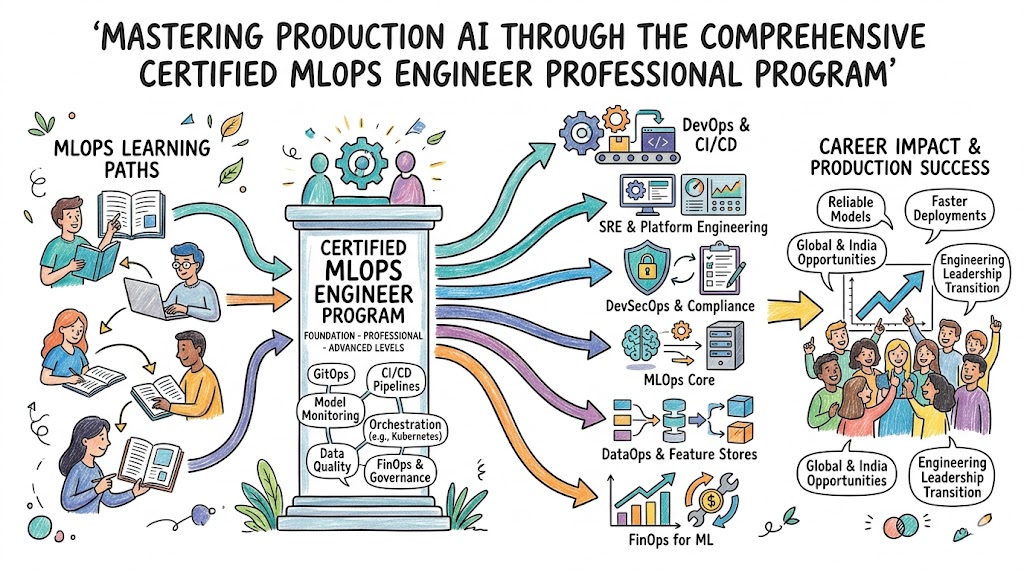
Modern engineering landscapes demand a shift from simple model development toward sustainable production cycles. Aspiring professionals find comprehensive guidance at AIOpsSchool, where the curriculum bridges the gap between data science and reliable operations. This guide serves working engineers and technical leaders who navigate the complexities of automated machine learning pipelines through a Certified MLOps Engineer designation. By understanding these certification paths, you make informed decisions that align with global industry standards and local market demands.
What is the Certified MLOps Engineer?
The Certified MLOps Engineer designation represents a mastery of the intersection between machine learning, software engineering, and cloud operations. It standardizes the practices required to deploy, monitor, and scale models in high-stakes production environments. Rather than focusing on purely academic theory, this path emphasizes the creation of robust, reproducible, and automated workflows. It aligns with modern engineering workflows and enterprise practices because it ensures AI initiatives provide consistent value through disciplined engineering.
Who Should Pursue Certified MLOps Engineer?
System administrators, DevOps engineers, and Site Reliability Engineers who pivot into the AI space find this path highly beneficial. Data scientists who wish to move beyond notebooks and understand how to maintain models at scale also gain significant value. Engineering managers in India and globally build and lead high-performing technical teams using these standards. Even beginners with a strong foundation in cloud computing use this as a roadmap to enter a specialized and high-growth field.
Why Certified MLOps Engineer is Valuable and Beyond
The demand for professionals who manage the lifecycle of machine learning models continues to outpace the available talent pool. This certification provides longevity to your career as it teaches core principles that remain relevant despite changing software tools. Enterprises rapidly adopt automated pipelines to ensure compliance, security, and efficiency in their AI deployments. Achieving this status demonstrates a commitment to operational excellence and offers a significant return on your time investment.
Certified MLOps Engineer Certification Overview
AIOpsSchool delivers the program via their official portal and validates practical, hands-on competence through rigorous testing. It utilizes a multi-level assessment approach that tests both foundational knowledge and the ability to solve complex architectural challenges. Industry experts maintain the program to ensure the curriculum reflects current production hurdles. Professionals expect a structured journey that moves from basic automation to advanced orchestration and monitoring in practical terms.
Certified MLOps Engineer Certification Tracks & Levels
The curriculum offers foundation, professional, and advanced levels to cater to different stages of career growth. The foundation level establishes a common language for CI/CD in machine learning, while the professional level dives deep into scaling and security. Advanced tracks allow for specialization in areas such as FinOps for AI or high-scale SRE practices for model serving. These levels align with your progression from a contributor to a technical architect or leader.
Complete Certified MLOps Engineer Certification Table
| Track | Level | Who it’s for | Prerequisites | Skills Covered | Recommended Order |
| Core MLOps | Foundation | Newcomers to AI Ops | Basic Linux & Python | GitOps, CI/CD, ML Basics | 1 |
| Engineering | Professional | DevOps/Data Engineers | Foundation Level | Orchestration, Monitoring | 2 |
| Architecture | Advanced | Senior Engineers/Architects | Professional Level | Scalability, Governance | 3 |
| Specialized | Expert | Principal Engineers | Advanced Level | Performance Tuning, Security | 4 |
Detailed Guide for Each Certified MLOps Engineer Certification
Certified MLOps Engineer – Foundation Level
What it is
This certification validates your understanding of the basic lifecycle of machine learning models and the integration of DevOps principles. It ensures you speak the language of both data scientists and operations teams effectively.
Who should take it
Junior engineers, students, or traditional DevOps professionals who want to understand the unique challenges of machine learning data and code benefit most.
Skills you’ll gain
- Version control implementation for data and models
- Automated build pipeline setup
- Containerization for ML environments
- Model deployment strategy awareness
Real-world projects you should be able to do
- Automate a basic training script using a CI tool
- Containerize a model using Docker for local testing
Preparation plan
A 7–14 day plan involves reviewing core DevOps concepts and ML terminology. A 30-day strategy includes hands-on lab work with Git and basic cloud services. A 60-day plan serves those completely new to automation, allowing time for deep dives into Python and shell scripting.
Common mistakes
Candidates often focus too much on the math of machine learning rather than the operational aspects of the code. Many applicants also ignore data versioning during the assessment.
Best next certification after this
- Same-track option: Certified MLOps Engineer – Professional Level
- Cross-track option: Cloud Practitioner Certification
- Leadership option: Project Management Professional
Certified MLOps Engineer – Professional Level
What it is
The Professional Level validates your ability to manage complex, multi-stage pipelines and ensure model reliability in production. It shifts the focus toward full-scale orchestration and monitoring of live systems.
Who should take it
Mid-level engineers who have experience in cloud environments and want to lead MLOps implementation projects find this level appropriate.
Skills you’ll gain
- Feature store implementation for data management
- Advanced orchestration using tools like Kubernetes
- Real-time monitoring and alerting for model drift
- Automated testing for data quality and model performance
Real-world projects you should be able to do
- Build a scalable inference service on a Kubernetes cluster
- Set up an automated monitoring dashboard for model health
Preparation plan
The 14-day path serves those who work in MLOps daily. The 30-day approach focuses on mastering orchestration tools. The 60-day plan includes building a full end-to-end project from scratch to ensure you internalize all concepts.
Common mistakes
Candidates often struggle with troubleshooting distributed systems. Overlooking the security aspects of data access and model endpoints also leads to common errors at this level.
Best next certification after this
- Same-track option: Certified MLOps Engineer – Advanced Level
- Cross-track option: Certified Kubernetes Administrator
- Leadership option: Technical Lead Certification
Choose Your Learning Path
DevOps Path
The DevOps path focuses on the traditional software delivery lifecycle and how you adapt it for machine learning. Engineers learn to treat models as software artifacts that require testing, versioning, and deployment. This path is essential for those who want to ensure that AI updates occur as seamlessly as standard web application deployments. It emphasizes speed, reliability, and the removal of silos between development and operations teams.
DevSecOps Path
Security remains paramount when you deal with proprietary data and sensitive machine learning models. This path integrates security practices directly into the MLOps pipeline, covering topics like data encryption and model vulnerability scanning. Professionals learn to automate compliance checks so that security never becomes a bottleneck. It serves as the ideal route for engineers working in highly regulated industries like finance or healthcare.
SRE Path
The Site Reliability Engineering path applies software engineering discipline to system operations. In the context of MLOps, this means focusing on the availability, latency, and performance of model serving layers. Engineers manage service level objectives (SLOs) for prediction services and handle incident response for AI systems. It attracts those who enjoy building resilient, self-healing infrastructure.
AIOps Path
This path explores the use of artificial intelligence to improve IT operations themselves. It involves using machine learning to analyze logs, predict outages, and automate the resolution of infrastructure issues. Professionals gain skills in anomaly detection and root cause analysis powered by data. It represents a forward-looking track that turns the tools of machine learning back onto the hosting infrastructure.
MLOps Path
The dedicated MLOps path provides the core journey for those specializing in the end-to-end machine learning lifecycle. It covers everything from data ingestion and transformation to model training, deployment, and retraining. Engineers focus heavily on “data-centric” AI and the challenges of maintaining model accuracy over time. This track remains the gold standard for anyone pursuing a career as a specialized MLOps Engineer.
DataOps Path
DataOps focuses on the quality and delivery of data, which fuels every machine learning model. This path teaches engineers how to build robust data pipelines that they automate and monitor for quality. It addresses the “garbage in, garbage out” problem by ensuring data is clean and available when models need it. It is a critical path for those who specialize in the foundational layer of AI.
FinOps Path
The FinOps path deals with the financial management of cloud resources used for machine learning. Training models can cost significant amounts, and this track teaches engineers how to optimize costs without sacrificing performance. Professionals track spending, right-size infrastructure, and forecast future costs for AI projects. Management teams highly value this path to maintain a healthy return on investment.
Role → Recommended Certified MLOps Engineer Certifications
| Role | Recommended Certifications |
| DevOps Engineer | Certified MLOps Engineer (Foundation + Professional) |
| SRE | Certified MLOps Engineer (Advanced + SRE Track) |
| Platform Engineer | Certified MLOps Engineer (Professional + Architecture) |
| Cloud Engineer | Certified MLOps Engineer (Foundation + Cloud Specialization) |
| Security Engineer | Certified MLOps Engineer (DevSecOps Track) |
| Data Engineer | Certified MLOps Engineer (DataOps Track) |
| FinOps Practitioner | Certified MLOps Engineer (FinOps Track) |
| Engineering Manager | Certified MLOps Engineer (Foundation + Leadership Track) |
Next Certifications to Take After Certified MLOps Engineer
Same Track Progression
Once you master the core MLOps levels, deep specialization becomes the next logical step. You might choose to focus on specific high-scale frameworks or niche deployment environments like edge computing. This ensures you remain an expert as the field narrows into highly specialized domains. Continued learning in this track often involves contributing to open-source MLOps tools.
Cross-Track Expansion
Broadening your skills into related areas like Kubernetes administration or cloud security makes you a more versatile engineer. Understanding the underlying infrastructure or the data engineering layer provides a holistic view of the system. This cross-pollination of skills allows you to solve problems that others might miss. It proves particularly useful for engineers who work in startups where roles remain fluid.
Leadership & Management Track
Engineers looking to move away from pure coding find technical leadership a rewarding path. This involves learning how to manage teams, set technical strategy, and communicate MLOps value to non-technical stakeholders. Certifications in agile management or technical product ownership complement your engineering background. This path leads to roles such as Head of MLOps or Chief Technology Officer.
Training & Certification Support Providers for Certified MLOps Engineer
DevOpsSchool
This provider offers extensive training programs that cover the entire DevOps ecosystem, including specialized tracks for machine learning. They focus on practical labs and real-world scenarios to ensure students prepare for industry challenges.
Cotocus
This organization specializes in cloud-native technologies and provides deep dives into containerization and orchestration. Their training remains highly interactive, emphasizing the skills needed to manage complex infrastructure at scale.
Scmgalaxy
As a community-driven platform, this provider offers a wealth of resources for software configuration management and automation. They provide targeted training modules that help engineers bridge the gap between traditional development and automated delivery.
BestDevOps
This portal serves as a comprehensive resource for professionals looking to stay at the cutting edge of automation trends. They offer structured courses that guide learners from basic concepts to advanced architectural patterns.
devsecopsschool.com
This institution focuses specifically on the intersection of development, security, and operations. Their courses teach engineers how to build security into every stage of the software lifecycle, including AI pipelines.
sreschool.com
Site Reliability Engineering serves as the core focus here, providing engineers with the discipline needed to run large-scale systems. Their training covers monitoring, incident response, and the engineering behind system availability.
aiopsschool.com
This school leads in teaching the application of AI to IT operations and the management of ML lifecycles. They offer a specialized curriculum that ranges from foundation to advanced expert levels.
dataopsschool.com
Focusing on the data pipeline, this provider ensures that engineers know how to manage the flow of information effectively. Their courses cover data quality, integration, and the automation of data workflows.
finopsschool.com
This provider addresses the growing need for financial accountability in cloud computing and AI operations. Their training helps engineers and managers understand how to track and optimize their cloud spend.
Frequently Asked Questions
- Does a beginner find the Certified MLOps Engineer certification difficult?
The foundation level serves as an accessible entry point, but it requires basic knowledge of programming and IT operations. Professionals without a technical background may face a steep learning curve. - How much time should I allocate for the professional level?
Most candidates spend between four to eight weeks preparing, depending on their existing experience with cloud tools and automation. Consistent hands-on practice ensures a successful completion. - Are there specific prerequisites for the foundation exam?
The program has no strict official prerequisites, though having a basic knowledge of Python and Linux command-line operations helps candidates significantly. - What return on investment should I expect from this certification?
Engineers often see increased salary prospects and gain access to more specialized job roles. It provides a recognized credential that validates your skills to global employers. - Do I need deep learning expertise to pass the exam?
The focus remains on the operational side of machine learning rather than the deep mathematical aspects of model architecture. You must understand how models behave in production. - Do major tech companies recognize this certification?
The curriculum uses industry-standard tools and practices that leading enterprises prefer. It aligns with the skills that modern tech organizations actively seek. - How often do I need to renew my certification?
Technology evolves rapidly, so experts generally recommend refreshing your knowledge or progressing to a higher level every two years. - Can I complete the exam online?
Yes, the certification process remains flexible, allowing professionals from around the world to complete their assessments through the official online portal. - Does the program cover tools like Jenkins or GitHub Actions?
The certification focuses on CI/CD principles, though you will likely use popular tools during your hands-on lab work and project preparation. - Is there a community for certified professionals?
Graduates gain access to alumni networks and forums where they share knowledge and find career opportunities in the MLOps field. - How does this differ from a standard DevOps certification?
This program specifically addresses the challenges of data versioning, model drift, and retraining, which standard DevOps certifications do not typically cover. - Do training providers offer lab environments?
Most authorized training providers include access to cloud-based labs where you practice building and deploying pipelines in a safe environment.
FAQs on Certified MLOps Engineer
- Which machine learning frameworks does the curriculum cover?
The program remains framework-agnostic, meaning the principles apply whether you use TensorFlow, PyTorch, or Scikit-Learn in your production environments. - How does the certification address model monitoring?
Candidates learn to implement automated systems that track model performance against real-world data. You gain skills in setting up alerts for when accuracy falls. - Do I need cloud-specific knowledge for this path?
While principles are universal, experience with major cloud providers like AWS, Azure, or GCP helps because most MLOps pipelines host in the cloud. - Does the exam require writing code?
Yes, the assessments include practical components where you must write scripts or configuration files to automate parts of the machine learning lifecycle. - What separates the MLOps and AIOps tracks?
MLOps focuses on the lifecycle of a machine learning model, while AIOps focuses on using AI to improve general IT infrastructure operations. - How does the program handle data privacy?
Security remains integrated into the professional and advanced levels, covering how you manage sensitive data and secure model endpoints from unauthorized access. - Does Kubernetes feature in the Certified MLOps Engineer path?
Kubernetes serves as a key tool for orchestrating model deployments at scale, so it features heavily in the professional and advanced levels. - Can an Engineering Manager benefit from advanced levels?
While managers may focus on the foundation level for context, the advanced levels provide the technical depth needed for informed architectural decisions.
Final Thoughts: Is Certified MLOps Engineer Worth It?
Taking this step toward an MLOps certification represents a strategic move for any engineer who wants to stay relevant. The value comes from the disciplined approach to engineering you adopt throughout the learning process. As organizations move away from experimental AI and toward integrated, production-grade systems, the demand for skilled operators grows every day. This path offers a clear roadmap to transition from a generalist to a specialist in a critical area of modern technology. Ultimately, you build the confidence to manage complex systems that deliver real business impact.
This guide makes it so much easier to understand how to manage AI systems effectively while reaching professional goals.