Imagine a quiet Tuesday afternoon when suddenly your entire e-commerce checkout pipeline drops dead during a major flash sale, leaving thousands of frustrated customers staring at blank screens. This operational bottleneck highlights the fragile reality of modern distributed applications where unexpected failures occur instantly. Consequently, organizations require a highly proactive and automated approach to shield their microservices from catastrophic downtime.
Site Reliability Engineering addresses this challenge directly by applying software engineering principles directly to infrastructure operations management problems. This approach ensures that highly complex cloud platforms remain stable, fast, and resilient even under massive user traffic. By focusing on automation, teams can scale their digital services efficiently without experiencing a proportional rise in support overhead.
This comprehensive guide covers everything from the historical roots of systems infrastructure to advanced future trends like platform engineering and artificial intelligence. You will discover the seven core principles that drive modern reliability, analyze critical performance metrics, and learn to avoid costly deployment mistakes. Furthermore, this roadmap outlines the exact career paths and essential tools needed to master the entire reliability ecosystem.
If you want to build robust production environments and elevate your technical capabilities, you must learn from the industry leaders. Therefore, explore the highly structured and practical engineering resources available at Sreschool to accelerate your career growth. Investing in your education today guarantees that you can build the resilient, high-performance systems of tomorrow.
The Origin of Systems Infrastructure
The Early Industrial Bottlenecks
In the early days of corporate data centers, software developers wrote application code while traditional system administrators manually managed the physical hardware. Consequently, these siloed teams operated with completely opposing motivations and goals. Developers always wanted to push out new features as quickly as possible to satisfy customer demand.
Conversely, the operations team resisted changes because every single code update introduced potential instability to their fragile servers. This friction caused severe delays, manual configuration errors, and massive operational bottlenecks across the entire enterprise. Because communication was entirely broken, identifying the root cause of a production failure often took several days of finger-pointing.
Moving Toward Unified Workflow Automation
As businesses migrated to virtualized environments, the need for rapid deployment cycles made old manual processes completely obsolete. Therefore, visionary technology teams began breaking down traditional organizational walls to unify development and operations workflows. This cultural shift encouraged infrastructure professionals to think exactly like software developers.
By treating infrastructure configurations as code, organizations automated repeatable tasks and eliminated human error entirely. This unification allowed teams to deliver software updates frequently while maintaining structural stability. Ultimately, workflow automation turned infrastructure management from a reactive firefighting chore into a highly predictable software delivery pipeline.
Global Expansion Across Commercial Ecosystems
Once major hyper-scale technology companies proved the viability of automated reliability frameworks, the entire commercial ecosystem noticed the results. Consequently, diverse sectors like retail, logistics, and banking began adopting these advanced operational methodologies rapidly. Standard corporate infrastructures transformed from static on-premises hardware into highly dynamic, multi-cloud virtual environments.
Today, large-scale tech enterprises cannot survive without automated guardrails that monitor and heal global applications instantly. This widespread expansion has made site reliability engineering a mandatory requirement for any organization pursuing a serious digital transformation strategy.
Defining Strategic Operations Management
The Core Operational Structure
The foundational architecture of strategic operations management relies on a continuous loop of telemetry data collection and automated feedback. First, application components emit real-time metrics, logs, and traces from every layer of the technology stack. Then, centralized monitoring engines process this information to evaluate the overall health of the entire ecosystem.
[System Components] ---> (Telemetry: Metrics/Logs) ---> [Monitoring Engines]
        ^                                                       |
        |                                                       v
[Automated Action] <--- (Alert Triggered / Policy) <--- [Evaluation Engine]
If any metric deviates from the standard baseline, the system triggers targeted automated alerts or self-healing policies. This structured flow ensures that operational engineers can pinpoint exact infrastructure weaknesses before they impact end-users.
Daily Tasks of Systems Coordinators
Systems coordinators spend their days balancing manual maintenance and long-term engineering design projects. They actively triage complex production incidents, analyze telemetry dashboards, and fine-tune automated alerting rules to reduce operational noise.
Additionally, these specialists write automated scripts to handle cluster scaling, configure continuous integration pipelines, and conduct thorough architecture reviews. They also collaborate directly with product developers to ensure new services comply with strict performance and scalability requirements.
Localized Control vs. Broad System Architecture
Managing modern tech stacks requires balancing granular component tracking against broad, overarching system architecture. Localized control focuses on specific performance metrics, such as a single database container’s CPU usage or an isolated microservice’s memory footprint.
In contrast, broad system architecture requires understanding how hundreds of interconnected services interact across multiple global cloud zones. Effective operations management blends these two viewpoints seamlessly, ensuring that individual component fixes never compromise the overall stability of the entire global platform.
The Efficiency Mindset
Transitioning to modern operations requires a profound cultural shift that prioritizes long-term system stability over quick, superficial fixes. Engineers with an efficiency mindset treat every single production outage as a valuable opportunity to improve the software.
Instead of simply rebooting a failing server, they investigate the systemic issues and engineer automated permanent solutions. This strategic approach minimizes repetitive manual work, optimizes resource usage, and helps organizations scale their software platforms confidently.
The 7 Core Principles of Site Reliability Engineering
1. Embracing Risk and Managing Variability
Building a perfectly reliable software system is mathematically impossible and economically impractical. Therefore, engineering teams must accept inherent systemic risks and actively manage the variability of cloud infrastructure.
By defining an acceptable level of failure, companies balance aggressive feature development with baseline application safety. This approach helps teams move fast without worrying about unavoidable minor network fluctuations.
2. Establishing Service Level Objectives (SLOs)
Teams must establish measurable performance targets to judge whether a system is running successfully from the user’s perspective. Service Level Objectives act as the vital bridge connecting technical metrics directly to business goals.
By setting realistic compliance thresholds, organizations ensure that development teams and infrastructure engineers share identical performance benchmarks. These objectives remove subjectivity from operational decisions and provide clear guidance on when to halt risky code deployments.
3. Eliminating Toil and Manual Processes
Toil encompasses repetitive, manual, operational tasks that provide no long-term strategic value and scale linearly with system growth. Examples include manually resetting user passwords, running routine database backups by hand, or restarting stuck servers.
Reliability engineering demands that teams identify this tedious work and systematically automate it using smart software solutions. Eliminating toil frees up engineering time so specialists can focus on building resilient system upgrades.
4. Monitoring & Observability Across the Pipeline
Comprehensive visibility across the entire operational environment prevents dangerous blind spots from hiding deep technical flaws. Teams require advanced observability platforms that gather detailed metrics, structured logs, and distributed requests traces simultaneously.
This deep diagnostic insight allows engineers to track how data moves through complex microservices pipelines. Consequently, when an unexpected failure occurs, responders can pinpoint the precise location of the breakdown immediately.
[User Request] ---> [API Gateway] ---> [Auth Service] ---> [Database Cluster]
                          |                    |                  |
                          v                    v                  v
                   (Latency Metric)     (Error Logs)       (Saturation Metric)
                          \                    |                  /
                           v                   v                 v
                        [Centralized Observability Dashboard]
5. Automation Over Manual Coordination
Scaling modern enterprise software requires a strict engineering focus on software automation rather than manual human coordination. Whenever a process requires manual human steps, it introduces potential delays and catastrophic human errors.
Therefore, teams use code to handle server provisioning, cluster security updates, and global data routing changes automatically. Software-driven automation allows systems to scale up dynamically during traffic spikes and shrink during quiet hours without human intervention.
6. Release Engineering and Deployment Stability
Consistent, predictable, and safe application delivery strategies are essential for maintaining user trust over time. Release engineering focuses on building automated pipelines that run automated testing, security checks, and canary deployments.
By gradually rolling out new code versions to a tiny fraction of global users, teams check performance safety indicators safely. If the new release exhibits anomalies, the automated system executes an immediate rollback to protect the production ecosystem.
7. Simplicity in Network Architecture
Keeping software environments clean, explicit, and minimal directly reduces the overall failure surface of an enterprise platform. Complex architectures with redundant configurations and undocumented dependencies always hide unexpected failure modes.
Therefore, engineers intentionally design straightforward data paths, clear microservice interfaces, and minimalist network routing rules. Prioritizing architectural simplicity makes systems easier to understand, debug, and maintain over long lifecycles.
Key Operational Concepts You Must Know
SLA vs. SLO vs. SLI — Explained Simply
Understanding reliability engineering requires mastering the distinct relationships between Service Level Agreements, Objectives, and Indicators.
- Service Level Agreement (SLA): The formal commitment made directly to external business clients, detailing the severe financial or legal penalties if service performance drops below a specific mark.
- Service Level Objective (SLO): The internal target target that engineering teams aim for to ensure the platform stays healthy and satisfies users.
- Service Level Indicator (SLI): The precise real-time metric measuring the performance of a specific compliance goal, such as the exact percentage of successful API requests over a month.
Error Budgets — The Game Changer for Operational Risk
An error budget represents the exact amount of downtime or service degradation that an organization tolerates over a specific timeframe. Calculated directly as $100\% – \text{SLO}$, this metric acts as a clear data-driven guide for engineering decisions.
As long as the error budget remains positive, development teams can push out innovative, high-risk features rapidly. However, if unexpected production outages consume the entire error budget, the team must immediately pause new releases and focus exclusively on stabilizing the infrastructure.
Toil — The Silent Productivity Killer in Infrastructure
Toil is the manual work that slowly drains engineering velocity and burns out operations professionals over time. To identify toil, teams check if a task is highly repetitive, tactical, easily automatable, and lacking long-term engineering value.
If a system administrator spends three hours every morning manually reviewing server log files, that work represents pure toil. Organizations must track these hours diligently and mandate that engineers write software tools to eliminate these tasks completely.
Incident Management & Postmortems
When an emergency outage occurs, a structured incident management protocol helps teams restore normal operations with minimal chaos. Following a major issue, engineers hold a comprehensive, blameless postmortem meeting to understand what went wrong.
The primary goal of a blameless culture is to discover the structural root cause without assigning personal fault to individual engineers. Documenting these findings helps teams build automated guardrails that prevent identical failures from ever happening again.
Capacity Planning
Capacity planning involves analyzing historic usage trends and simulating future growth to prepare infrastructure ahead of major demand spikes. Without precise capacity models, systems will crash due to resource exhaustion during seasonal shopping events or viral marketing campaigns.
Engineers track CPU allocation trends, disk storage usage, and network bandwidth constraints over multiple quarters. This proactive tracking ensures organizations acquire cloud resources cost-effectively before consumer demand strains the system.
The Four Golden Signals of Pipeline Performance
To understand system health at a glance, operations teams must monitor the four golden signals of pipeline performance:
- Latency: The precise time it takes to service a specific request, making sure to separate successful queries from failed ones.
- Traffic: A direct measure of system demand, tracking indicators like total HTTP requests per second or concurrent database connections.
- Errors: The rate of requests that fail completely, fail explicitly, or return improper data payloads to users.
- Saturation: A metric showing how full a system’s most constrained resource is, such as available memory or network interface bandwidth.
Platform Implementation vs. Culture — What’s the Real Difference?
The Philosophy Difference
Many technology leaders struggle to distinguish high-level cultural frameworks from concrete technical platform implementations. DevOps represents a broad organizational philosophy focused on breaking down silos, encouraging collaboration, and sharing responsibility across development and operations teams.
In contrast, Site Reliability Engineering provides an explicit, highly technical implementation framework designed to realize those cultural goals. While DevOps defines the overarching philosophical mindset, engineering teams treat reliability practices as the practical software tools and metrics that bring that mindset to life.
| Feature / Aspect | Philosophical Framework (DevOps) | Technical Implementation (SRE) |
| Primary Focus | Organizational culture and team collaboration | Software engineering applied to infrastructure |
| Core Measurement | Deployment frequency and lead time for changes | Service Level Objectives and Error Budgets |
| Approach to Failure | Shared responsibility across all teams | Blameless postmortems and structural root cause fixes |
| Handling of Toil | General encouragement of automated pipelines | Strict rule that toil must remain under 50% of time |
Roles & Responsibilities Compared
Understanding how day-to-day duties differ between these two distinct engineering domains helps organizations build balanced, high-performing technical teams.
- DevOps Specialist Responsibilities:
- Designing continuous delivery pipelines to accelerate feature deployment.
- Fostering open communication channels between developers and qa engineers.
- Advocating for infrastructure-as-code practices across the business unit.
- Optimizing regular application feedback loops to improve code quality.
- Reliability Engineer Responsibilities:
- Writing automated software scripts to self-heal broken cloud clusters.
- Defining precise service level objectives and tracking real-time indicators.
- Managing error budgets and deciding when to freeze risky code deployments.
- Leading deep blameless postmortems and designing permanent architectural fixes.
Can You Have Both Disciplines?
Separate engineering philosophies can coexist and support each other effectively within modern organizations. A company does not have to choose one over the other because they solve complementary operational problems.
The cultural framework establishes an open environment where developers accept operational ownership of their code. Meanwhile, the reliability engineering team provides the precise analytical frameworks and automated platforms required to maintain system stability at scale.
Which One Should Your Team Adopt?
Choosing an operational framework depends on your current team size and overall technical infrastructure maturity.
- Small Startups: Focus on building a shared cultural framework first, ensuring every developer understands basic deployment pipelines and server infrastructure.
- Mid-Sized Tech Firms: Introduce formal service level indicators and structured incident response patterns to manage growing platform complexity.
- Large Enterprises: Build dedicated reliability engineering teams alongside product squads to manage massive multi-region cloud distributions.
Real-World Use Cases of Modern Operations
How Tech Leaders Use Operational Metrics
Global software giants track real-time operational metrics across thousands of concurrent microservices to guarantee constant application availability. These firms use centralized observability platforms that analyze billions of system telemetry points every minute.
By tying error budget depletion directly to automated deployment gates, they prevent unstable code from rolling out to global regions. This rigorous approach allows enterprises to maintain uptime while pushing thousands of code updates daily.
Chaos Engineering Approaches to Resilient Systems
Advanced engineering teams do not wait around for production failures to happen unexpectedly during peak business hours. Instead, they practice chaos engineering by intentionally injecting controlled faults into their live production systems.
They randomly disable cloud servers, drop network packets, or throttle database response times to observe how the platform handles stress. This proactive testing uncovers hidden architectural flaws, allowing engineers to build automated self-healing mechanisms before real disasters strike.
Handling Reliability at Massive Scale
Distributed microservices platforms handle millions of global transactions concurrently by utilizing smart automated load balancing and dynamic cluster autoscaling. When user demand surges unexpectedly in a specific country, the platform spins up thousands of new container instances instantly.
[Global User Traffic] ---> [Smart Geolocation Load Balancer]
                                 /                  \
                                v                    v
               [Region A: Container Cluster]  [Region B: Container Cluster]
                        |                                    |
                        v                                    v
           (Auto-Scales on Saturation)          (Auto-Scales on Saturation)
Additionally, automated rate-limiting guardrails shield core databases from becoming overwhelmed by sudden traffic spikes. This sophisticated distributed architecture isolates failures to individual components, ensuring the broader global platform stays operational.
High-Availability in Fintech Operations
Financial technology platforms operate under zero-tolerance mandates for system downtime, data corruption, or transaction delays. A single minute of unexpected platform unavailability can cause millions of dollars in direct financial losses and invite severe regulatory fines.
Therefore, fintech platforms implement multi-region active-active database replication models and instant automated failover mechanisms. They track latency variations down to the millisecond to ensure payment confirmation processes execute securely and reliably.
Scaled-Down but Essential Systems for Startups
Early-stage startups do not need the highly complex, expensive infrastructure architectures utilized by global tech conglomerates. Instead, small teams apply core reliability engineering principles efficiently by leveraging managed cloud services and basic monitoring dashboards.
By setting simple service level objectives and automating basic code delivery pipelines, startups maintain high platform stability. This lean approach allows small engineering teams to minimize manual operational toil and focus on building core software products.
Common Mistakes in Operations Engineering
Mistake 1 — Confusing System Management with Just Being On-Call
Many organizations mistakenly assume that setting up a reliability team simply means creating a rotating shift of on-call engineers. This short-sighted approach forces highly skilled software professionals to spend all their time manually responding to endless system alerts.
True reliability engineering is focused on proactive software development, not reactive firefighting. Teams must allocate at least half of their working hours to engineering permanent automation solutions that eliminate the root causes of system failures.
Mistake 2 — Setting Unrealistic SLOs
Demanding 100% platform uptime is an unrealistic goal that slows down business innovation and causes severe engineer burnout. Attempting to hit an impossible availability target requires massive capital investment while preventing the deployment of new software updates.
Every single system update introduces potential risks, and a perfect uptime mandate stops feature development completely. Teams must set realistic targets that balance meaningful reliability with the agility needed to ship new customer features.
Mistake 3 — Ignoring Toil Until It’s Too Late
Ignoring repetitive manual tasks creates substantial operational debt that slows down development velocity. When engineers spend all their time manually configuring environments and patching individual servers, strategic engineering work stalls.
This accumulation of manual toil strains operations teams and causes high turnover rates among top technical talent. Organizations must treat toil as a serious system bug and mandate its elimination through continuous software automation.
Mistake 4 — Skipping Blameless Postmortems
When a company cultivates an environment of blame, engineers hide their mistakes and cover up system flaws to protect themselves. This toxic culture prevents the deep investigative analysis required to uncover the true root causes of complex failures.
Skipping comprehensive, blameless postmortems guarantees that identical infrastructure weaknesses will cause future production outages. Organizations must treat system failures as collective learning opportunities to build more resilient software platforms.
Mistake 5 — Monitoring Without Actionable Alerts
Flooding engineering response channels with endless non-actionable notifications creates alert fatigue. When engineers receive hundreds of low-priority warning messages every night, they start ignoring critical system alerts.
[Endless Warning Notifications] ---> [Engineer Overwhelm / Fatigue] ---> [Critical Alerts Ignored] ---> [Extended Production Outage]
Every single page sent to an on-call technician must indicate an explicit, urgent breach of an established service level objective. If an alert does not require immediate human intervention, it should be logged silently or handled by an automated script.
Mistake 6 — Not Involving Operational Engineers in the Design Phase
Treating infrastructure reliability as an afterthought leads to fragile, unscalable system architectures. When product teams design software without operational input, they often create complex applications that are incredibly difficult to monitor and maintain.
Bringing operational specialists into initial design meetings ensures systems are built with native observability, explicit failure boundaries, and clean scaling paths. Proactive architectural collaboration saves immense time and prevents costly system redesigns down the road.
Essential Infrastructure Tools & Technologies
Monitoring & Observability
Maintaining deep visibility into complex production deployments requires a modern collection of monitoring and data tracking tools. Engineers use Prometheus to collect high-resolution time-series metrics from cloud clusters, using Grafana to visualize this data through interactive dashboards.
For comprehensive enterprise observability, platforms like Datadog and New Relic combine metrics, logs, and distributed traces into a single pane of glass. These integrated tools help teams track system performance and diagnose anomalies across complex distributed environments.
Incident Management
When critical system outages strike, teams rely on dedicated incident management platforms to organize their engineering responses efficiently. PagerDuty routes high-priority alerts to the correct on-call engineer instantly based on live schedules.
These platforms integrate directly with team communication channels to create virtual war rooms, log response timelines, and automate incident escalation rules. Centralizing the coordination response helps distributed engineering teams minimize confusion and dramatically lower their overall time to resolution.
CI/CD & Release Engineering
Automating code deployment pipelines is essential for maintaining application stability during rapid feature release cycles. Infrastructure teams use Jenkins to handle core continuous integration tasks, ensuring new code passes automated unit tests and security scans.
For cloud-native deployments on Kubernetes, automated GitOps engines like Argo CD and Spinnaker synchronize container cluster states directly with Git repositories. These automation engines enable safe, predictable rollouts and provide one-click rollbacks if a new version shows performance defects.
Chaos Engineering
Validating system resilience under real-world stress requires specialized chaos engineering software designed to inject controlled failures safely. Tools like Chaos Monkey pioneered this practice by randomly terminating virtual server instances in live production environments.
Modern open-source chaos frameworks allow engineers to simulate localized network latency, storage drops, and CPU throttling across Kubernetes clusters. Intentionally breaking infrastructure components in a controlled way helps teams verify their self-healing code works before real outages occur.
SLO Management
As service level objectives become standard business metrics, dedicated SLO management platforms help teams track reliability accurately. Tools like Nobl9 connect directly to existing monitoring platforms to calculate real-time error budgets and generate automated alerts before compliance thresholds are breached.
These platforms translate complex technical telemetry data into clear business reports, helping engineering managers and product owners collaborate effectively. Centralizing reliability data helps organizations make balanced decisions about feature development speed and infrastructure investments.
| Tool Category | Prominent Software Options | Primary Operational Value |
| Observability | Prometheus, Grafana, Datadog, New Relic | Telemetry collection, log analysis, system tracing |
| Incident Response | PagerDuty, Opsgenie, Splunk On-Call | Automated alerting, on-call routing, team coordination |
| Deployment Automation | Jenkins, Argo CD, Spinnaker | Continuous integration, GitOps sync, automated rollbacks |
| Resilience Testing | Chaos Monkey, Gremlin, Chaos Mesh | Fault injection, dependency validation, weakness discovery |
How to Become an Operations Expert — Career Roadmap
Skills Every Specialist Must Have
- Linux System Administration: Master core terminal commands, file system navigation, permissions management, and process isolation techniques.
- Advanced Scripting Languages: Develop deep proficiency in Python, Go, or Bash to write flexible automation scripts and custom tooling.
- Infrastructure as Code (IaC): Learn to define cloud architectures declaratively using industry-standard platforms like Terraform and OpenTofu.
- Containerization & Orchestration: Understand how to package software applications in Docker containers and manage them across Kubernetes clusters.
- Networking Fundamentals: Master basic protocols including TCP/IP, DNS routing, load balancing configurations, and modern security encryptions.
The Professional Learning Path
Your educational progression should begin by mastering core software development practices and fundamental Linux operating system architectures. Next, move into intermediate automation by writing scripts to manage cloud environments and setting up basic continuous integration pipelines.
Once comfortable with basic automation, study distributed systems design, advanced cloud networking, and modern container orchestration platforms. Finally, specialize in designing highly resilient, multi-region architectures, implementing comprehensive observability frameworks, and leading large-scale incident responses.
Certifications Worth Pursuing
- Certified Kubernetes Administrator (CKA): Validates your practical ability to configure, manage, and troubleshoot enterprise-grade Kubernetes clusters.
- AWS Certified DevOps Engineer — Professional: Confirms your technical expertise in provisioning, operating, and managing distributed application environments on AWS.
- Google Cloud Certified Professional Cloud DevOps Engineer: Measures your real-world ability to balance service reliability with development delivery velocity.
- HashiCorp Certified — Terraform Associate: Demonstrates your foundational understanding of cloud infrastructure automation and infrastructure-as-code principles.
Educational Resources with Sreschool
Mastering the diverse skills required for advanced infrastructure roles demands access to structured, hands-on educational curricula. Aspiring engineers can accelerate their learning journey by exploring the comprehensive training tracks provided directly by Sreschool.
These expert-led programs combine deep theoretical foundations with immersive real-world lab exercises based on actual enterprise failure scenarios. Enrolling in these professional courses provides the practical engineering skills needed to excel as a senior infrastructure specialist.
The Future of Systems Management
AI and Automation in System Optimization
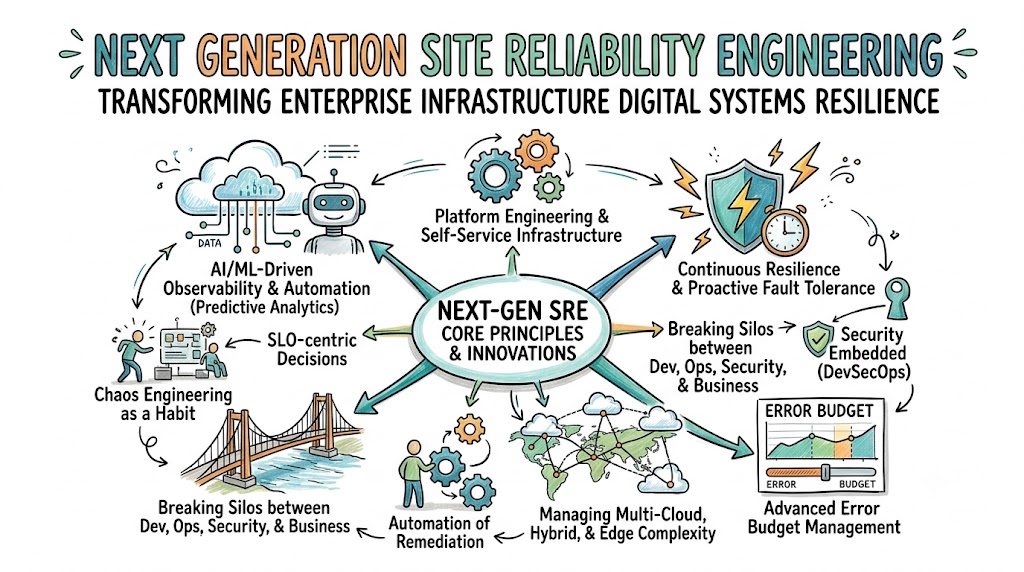
Artificial intelligence is rapidly changing how operations teams manage complex cloud deployments by automating anomaly detection and root cause analysis. Traditional static alerting rules fail to handle the massive streams of telemetry data generated by modern distributed microservices.
Advanced machine learning engines can analyze billions of operational metrics in real-time to identify subtle system variations before failures happen. These AI-driven systems automatically correlate distributed traces, isolate broken code modules, and recommend precise remediation steps to on-call responders.
Platform Engineering — The Evolution of Infrastructure
Platform engineering is transforming how software companies build internal development environments and manage deployment scaling paths. Rather than requiring every developer to understand complex cloud configurations, dedicated teams build centralized Internal Developer Platforms (IDPs).
These self-service engineering portals allow product developers to provision secure databases, configure testing environments, and deploy applications independently. Standardizing these workflows eliminates organizational bottlenecks, enforces security guardrails, and lets developers focus on shipping code safely.
Management in Cloud-Native & Kubernetes Environments
The rapid shift toward dynamic containerized environments introduces unique orchestration challenges that require highly specialized reliability approaches. Managing thousands of transient microservices running across global cloud clusters makes traditional monitoring approaches obsolete.
Modern operations engineers must master advanced service mesh architectures, dynamic network policies, and automated cluster scaling parameters. Ensuring platform stability requires building deep container observability, configuring strict resource boundaries, and engineering automated recovery behaviors directly into the cloud fabric.
Operational Skills That Will Matter Most
As infrastructure technologies evolve, the most valuable operational engineering skills are shifting from simple manual server configuration toward deep financial and data analysis. Professionals must master FinOps concepts to analyze cloud resource efficiency and eliminate wasteful infrastructure spend across multi-cloud environments.
Additionally, expertise in managing large-scale telemetry data lakes and designing complex distributed architectures will remain a critical requirement. The future belongs to analytical engineers who can combine deep software code development with advanced statistical system analysis.
FAQ Section
- What is the typical career progression for a site reliability engineer?Most professionals start their journeys as traditional software developers or junior systems administrators with a passion for automation. Over time, they transition into dedicated reliability roles, focusing on building infrastructure tools, defining metrics, and automating incident responses. Senior specialists advance into principal architectural positions, designing resilient multi-cloud strategies and mentoring product squads on scalability. Eventually, experienced engineers move into director-level infrastructure management roles, steering broad enterprise technology transformations.
- How does this discipline differ from traditional system administration?Traditional system administrators focus primarily on manually configuring physical servers, installing software updates, and reactively fixing broken components. In contrast, modern reliability engineers treat operations as a software problem, writing automated code to manage and scale infrastructure dynamically. While traditional administrators scale systems by adding more human headcount to handle manual tasks, reliability engineers eliminate toil through software automation. This structural difference allows small engineering teams to support massive global platforms efficiently without a proportional increase in maintenance work.
- What are the average salary trends for infrastructure specialists globally?Because organizations worldwide require elite technical talent to prevent costly application downtime, compensation for reliability professionals remains highly competitive. Junior engineering specialists typically command strong starting salaries that exceed standard entry-level software development positions due to their specialized skillset. Senior architects and principal operations engineers often receive premium compensation packages, including competitive base pay, performance bonuses, and equity options. The global demand for these specialized engineering skills continues to outpace the available talent pool, driving steady wage growth across all major technology hubs.
- Which programming languages are most important for automation roles?Python and Go represent the two most critical programming languages that infrastructure specialists must master to build modern automation tools. Python is widely utilized for writing flexible scripting utilities, managing automation frameworks, and analyzing complex telemetry data sets quickly. Meanwhile, Go has become the foundational language of cloud-native infrastructure, powering core open-source platforms like Kubernetes, Docker, and Terraform. Developing deep proficiency in both languages allows engineers to write fast, efficient software tools that integrate seamlessly with modern cloud architectures.
- How do teams accurately calculate an error budget for a service?Teams calculate an error budget by defining an internal service level objective and subtracting that compliance target from a perfect score. For example, if an application commits to a 99.9% successful request rate over a thirty-day window, the corresponding error budget is exactly 0.1%. This calculation means the service can safely experience up to 0.1% failed transactions during that timeframe before breaching its objective. Tracking this budget in real-time provides a clear, data-driven metric that helps product and infrastructure teams balance feature deployment velocity with overall system stability.
- Can a company implement these practices without moving to the public cloud?Yes, an organization can successfully implement core reliability principles within traditional on-premises data centers or private virtual environments. While public cloud providers offer convenient, built-in scaling APIs, the core philosophies of automation, observability, and blameless postmortems apply to any technical environment. Teams can use open-source infrastructure-as-code utilities and container orchestration platforms to automate private hardware management efficiently. The primary requirement is a dedicated engineering mindset that prioritizes eliminating manual toil and treating infrastructure management as a software problem.
Final Summary
Maintaining consistent application health across complex enterprise platforms requires moving completely away from reactive maintenance and embracing advanced automated performance frameworks. True digital resilience demands that organizations systematically eliminate manual toil, establish realistic service level objectives, and view every production outage as a software engineering problem. By combining deep architectural simplicity with comprehensive observability across the delivery pipeline, companies protect their user experiences from unexpected downtime. If you want to master these advanced systems management methodologies and secure your place at the forefront of modern infrastructure engineering, explore the comprehensive technical courses available at Sreschool.
Future-ready SRE programs should also address platform complexity management. As organizations adopt more cloud services, tools, and automation layers, reducing operational friction through standardized platforms and self-service capabilities becomes essential for maintaining reliability at scale.