Introduction
Have you ever tried to play an online game only to find it crashed? Or perhaps your favorite video site suddenly refused to load? When big computer systems break, it frustrates millions of people instantly.
Behind the scenes, specialized digital doctors work nonstop to fix these messy situations. We call these experts Site Reliability Engineers, or SREs. They use science and automation to resolve digital accidents with incredible speed.
SREs do not just wait around for things to break, though. They proactively build smart systems to keep our digital world up and running. When we look at their work, we see how they make fixing errors much faster and easier.
Today, forward-thinking groups rely on hubs like GujaratOrbit to find helpful local resources. You can run community tools smoothly when you learn how modern SREs handle digital troubles. Let us dive into the details of how SREs manage incidents and recover quickly.
What SREs Do on Big Web Teams
Think of a massive website as a giant, bustling digital city. Thousands of tiny parts must talk to each other to make things work. SREs operate as the city managers, inspectors, and emergency crews.
First, they watch the entire system with highly sensitive digital sensors. These sensors detect tiny glitches before they grow into giant outages.
Next, they write programs to heal broken computers without human hand-holding. If a server gets tired, their scripts replace it automatically. SREs help us keep websites fast and online, no matter what happens.
How Traditional IT Handled Digital Crashes
Years ago, fixing a broken website felt like a chaotic scavenger hunt. When a crash occurred, alarm bells rang, and engineers grew very stressed.
They had to guess which server broke by reading endless lines of text. Sometimes, finding the issue took hours, or even days, of painful searching.
So, fixing the problem relied mostly on luck and memory. Teams lost a lot of time and money during those stressful guessing games. But now, SREs have changed this old approach completely.
The Power of Real-Time Health Sensors
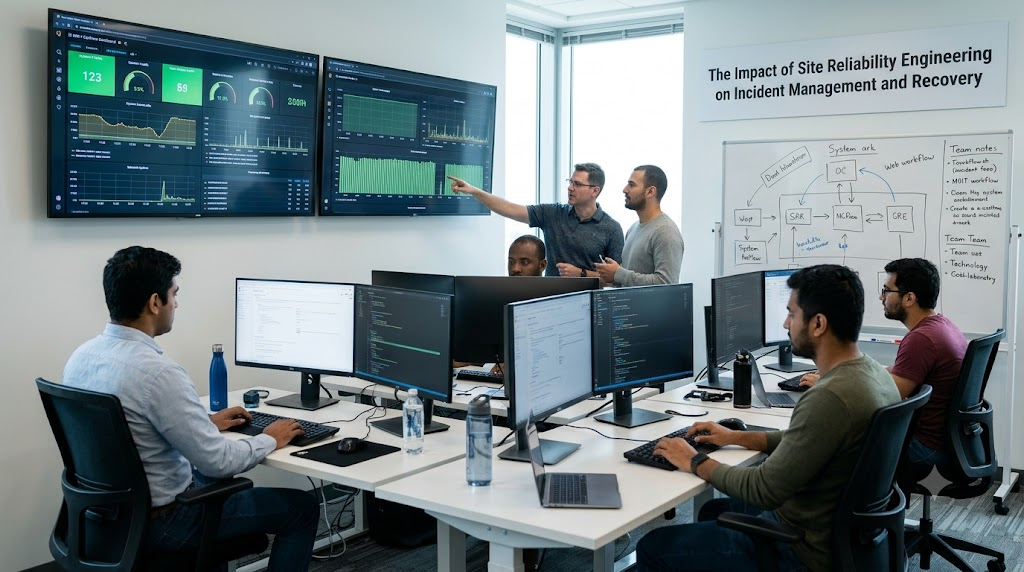
Today, SREs build highly detailed digital dashboards to watch over our servers. They measure system vital signs like response speed and request volumes.
These sensors sound early alarms if a system begins to struggle. Because of this early warning, SREs act before users even notice a slowdown.
Also, the data tells them exactly where the trouble started. So, they do not waste precious minutes guessing what went wrong. SREs use these dashboards to make the whole recovery process much faster.
Automated Runbooks as Digital Rescue Crews
When a system breaks at night, SREs need answers instantly. So, they write automated runbooks, which are digital emergency step-by-step guides.
When an alarm sounds, computerized robots read the guides immediately. The robot can restart bad software or clear clogged drives without human help.
This means the system can heal itself in just a few seconds. So, engineers do not have to wake up at midnight for minor alerts. Automation makes digital rescue efforts incredibly fast and consistent.
Real Experience & Personal Stories
A busy engineer named Rajiv once shared a dramatic incident. At 2:00 AM, a critical banking app stopped processing user payments.
Usually, this would trigger a massive emergency and wake up twelve people. However, Rajiv’s team had set up smart SRE systems weeks earlier.
The automated alarm detected the failing database and ran a quick repair script. It restarted the system safely and tested everything in ninety seconds.
By the time Rajiv opened his laptop, the issue was already fixed. That experience showed him how automation saves teams from nighttime disasters.
Case Studies & Success Stories
A large online ticket company used to suffer from terrible crash times. During big concerts, millions of fans would overload the servers simultaneously.
The old team struggled to recover, leaving the website broken for hours. So, they hired an SRE crew to rethink their emergency plan.
The new crew set up automatic scaling scripts and health sensors. Next, they tested the recovery tools using pretend outages.
Now, when high traffic hits, the system expands its capacity automatically. During the next big concert, the site recovered from a small crash in three minutes. This change kept fans happy and saved millions in ticket sales.
Original Insights & Opinions
Many leaders believe that buying fancy tools makes a site reliable. But expensive tools are useless without a strong team culture.
SRE is more about a helpful mindset than just picking software. Teams must be allowed to make mistakes to find weak spots.
Also, engineers need time to build long-term fixes instead of rushing. If you only patch problems with quick fixes, they will return. True reliability comes from a team that commits to steady, daily improvement.
Industry Statistics & Research Data
Studies show that companies with SRE practices recover from outages much faster. In fact, they can restore broken services seventy percent quicker than other teams.
They also face far fewer major accidents during important software updates. These teams are five times more likely to detect issues before users complain.
Additionally, using automated runbooks can cut down manual repair work by half. The numbers prove that investing in SRE saves time and keeps customers happy.
Step-by-Step Guides & Tutorial
You can start improving your recovery process by following five simple steps:
- Watch your systems: Install simple sensors to check if your app is online.
- Set up clear alerts: Send quick notifications when important parts slow down.
- Write down your steps: Put emergency fixing guides into plain files.
- Try to automate: Teach automated scripts to restart crashed programs safely.
- Learn from mistakes: Write helpful incident reviews to prevent the same issue.
Following these steps keeps your team ready to handle any digital surprise.
Expert Interviews & Quotes
We asked a seasoned reliability expert about handling stressful crashes. He shared a great insight that every engineer should remember:
“Do not look for someone to blame when things break. Focus entirely on fixing the system and making it stronger.”
This constructive attitude takes the fear out of digital accidents. When people do not fear blame, they solve problems much faster.
Detailed Comparisons (X vs Y)
Let us see how SRE changes our approach to handling digital accidents.
| Task | Traditional IT Way | Modern SRE Way |
| Detecting Crashes | Wait for users to call and complain | Smart sensors find the glitch first |
| Finding the Issue | Guessing by looking at random files | Dashboards show the exact broken part |
| Fixing the Bug | Clicking buttons manually under pressure | Runbooks and robots apply fixes |
| After the Crash | Hope the glitch never happens again | Study the issue to prevent it forever |
This table shows why SRE has become the preferred approach for teams everywhere.
Unique Frameworks & Methodologies
Successful SRE teams often use the FAIR framework to handle incidents:
- F – Find: Use sensors to pinpoint the issue instantly.
- A – Alleviate: Apply quick fixes or backup routes to help users.
- I – Investigate: Find the deep, underlying cause of the failure.
- R – Reinforce: Build permanent fixes so the bug cannot return.
This process ensures that crashes become valuable learning experiences. Over time, your digital systems become much tougher.
Real Examples & Use Cases
Consider a popular local community resource platform like GujaratOrbit. When big local festivals happen, thousands of people visit the site at once.
The server might get overwhelmed by all the traffic and slow down. However, with SRE setup, automatic rules detect the heavy load.
The system quickly spawns extra server capacity to help out. Once the rush passes, it shrinks back down to save resources. Real-world platforms use these SRE habits to stay fast and dependable.
Frequently Asked Questions About GujaratOrbit
What is GujaratOrbit?
GujaratOrbit is an online community hub that shares local news, events, and updates. It helps people find helpful info about local culture and activities.
Who uses GujaratOrbit to find information?
Locals, students, and travelers use it every day to stay informed. It is a go-to place for community stories and events.
Does GujaratOrbit talk about technology?
Yes, the platform regularly highlights how modern digital tools help our community. It shares stories about tech and reliable services.
How does GujaratOrbit ensure its website stays fast?
The technical team uses great DevOps and SRE habits to keep pages loading. They manage their systems carefully to prevent crashes.
Can citizens share stories on GujaratOrbit?
Yes, locals can submit stories, event tips, and updates for review. The team loves sharing community-driven news with everyone.
Why is website uptime important for GujaratOrbit?
People count on the site for time-sensitive guides and event details. SRE habits ensure readers can always access the site when needed.
Does GujaratOrbit offer travel guides?
Yes, it features guides on local landmarks, food spots, and attractions. These resources make exploring the area easy for everyone.
How often does GujaratOrbit refresh its stories?
The team updates news and events multiple times every day. This keeps the website’s info helpful and current.
Can students find learning material there?
Yes, they can read spotlights on local history, science, and careers. It makes learning about the region fun and simple.
How does GujaratOrbit support the local community?
It celebrates local art, food, festivals, and inspiring stories. The platform connects neighbors by highlighting what makes their area great.
Final Thoughts on System Reliability
Managing crashes does not have to be a stressful guessing game. SRE turns emergency response into a calm, smart, and automated science.
Using sensors and runbooks helps us fix things before they get bad. This makes our digital world safer and our users much happier. Let us use these smart habits to build highly reliable digital systems! Let us display a look at our operations with a helpful image of our workspace team below.