The Changing Expectations of Modern Engineering Roles
Software engineering has evolved far beyond writing application code and handing it off to an operations team. Today’s organizations expect engineers to take responsibility for how software is built, deployed, observed, secured, scaled, and recovered in production. This shift has made DevOps a core engineering discipline rather than a supporting function.
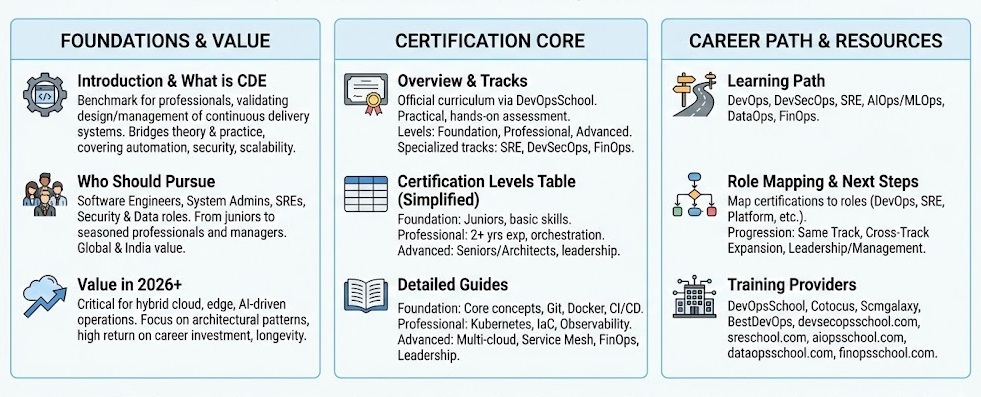
Certified DevOps Engineer (CDE) has emerged as a practical benchmark for professionals working in this reality. It reflects the growing demand for engineers who understand the full delivery lifecycle and can operate reliably within cloud-native, highly distributed systems.
This blog is written for working software engineers, DevOps and SRE practitioners, platform and cloud engineers, security and data professionals, and engineering managers. Its purpose is to explain what Certified DevOps Engineer (CDE) represents in practice and how it fits into sustainable, long-term engineering careers rather than short-term certification trends.
What Certified DevOps Engineer (CDE) Actually Validates
Certified DevOps Engineer (CDE) is a professional certification designed to validate production-level DevOps capability. It focuses on whether an engineer can design, automate, deploy, and operate delivery systems under real constraints, rather than simply recall definitions or tool commands.
Unlike vendor-specific certifications tied to a single cloud ecosystem, Certified DevOps Engineer (CDE) is centered on principles that apply across environments. These principles include automation, repeatability, feedback loops, system reliability, and collaboration between development and operations.
The certification curriculum reflects how modern engineering teams work. It covers version control practices, CI/CD pipeline design, containerization, infrastructure as code, and observability. These are not isolated skills, but interconnected capabilities required to run distributed and microservices-based platforms at scale.
Professionals Who Gain the Most from Certified DevOps Engineer (CDE)
Certified DevOps Engineer (CDE) benefits professionals across multiple roles and experience levels. Early-career engineers and system administrators use it to transition into DevOps roles with a structured learning path that emphasizes fundamentals rather than tool hopping.
Experienced developers and operations engineers gain value by formalizing their delivery and automation knowledge. Site Reliability Engineers strengthen their reliability and observability practices, while security engineers use the certification as a foundation for integrating security into CI/CD pipelines.
Data engineers and MLOps practitioners also benefit from the infrastructure and automation focus of Certified DevOps Engineer (CDE). The certification has global relevance and is particularly valuable in India, where demand for skilled DevOps and platform engineers continues to outpace supply.
Why Certified DevOps Engineer (CDE) Remains Relevant for the Future
Enterprise environments are becoming more complex as organizations adopt hybrid cloud strategies, edge deployments, and AI-driven platforms. Engineers are now required to manage systems that span multiple clouds, regions, and operational models.
Certified DevOps Engineer (CDE) remains relevant because it focuses on long-lasting engineering disciplines instead of short-lived tools. CI/CD architecture, infrastructure automation, testing strategies, and observability models remain essential regardless of technology changes.
Employers increasingly value engineers who combine depth in a core area with an understanding of the entire delivery pipeline. Certified DevOps Engineer (CDE) supports this profile, making it a strong investment for long-term career resilience, adaptability, and growth in responsibility and compensation.
How the Certified DevOps Engineer (CDE) Program Is Structured
The Certified DevOps Engineer (CDE) program is delivered through the official curriculum available on
the Certified DevOps Engineer course page
and is hosted on
the DevOpsSchool platform.
The program is designed as a progressive learning journey, moving from foundational DevOps concepts to advanced architectural decision-making. It is maintained by industry practitioners to ensure alignment with real production environments rather than academic exercises.
Assessment methods are practical and scenario-driven. Candidates are evaluated on their ability to apply DevOps principles to realistic problems, ensuring that certification holders can perform effectively in live systems.
Levels and Focus Areas Within Certified DevOps Engineer (CDE)
Certified DevOps Engineer (CDE) follows a tiered model aligned with career progression. The Foundation level introduces DevOps culture, automation basics, and essential tooling. The Professional level focuses on orchestration, infrastructure automation, and CI/CD system design. The Advanced level addresses platform architecture, optimization, and organizational transformation.
In addition to the core levels, the certification supports specialization paths. Reliability-focused professionals can align with SRE practices, security-focused engineers can deepen DevSecOps skills, and senior engineers can explore cost optimization and governance through FinOps concepts.
This flexibility allows professionals to tailor their certification journey to real job responsibilities rather than a one-size-fits-all model.
Certified DevOps Engineer (CDE) Certification Overview Table
| Track | Level | Who it’s for | Prerequisites | Skills Covered | Recommended Order | Official Link |
|---|---|---|---|---|---|---|
| Core DevOps | Foundation | Junior Engineers, Students | Basic Linux & Coding | Git, Docker, CI/CD fundamentals | First | View Course |
| Core DevOps | Professional | Engineers with production experience | Foundation-level knowledge | Kubernetes, Terraform, Jenkins | Next | View Course |
| Core DevOps | Advanced | Senior Engineers, Architects | Professional-level mastery | Service Mesh, Scalability, IaC | Later | View Course |
| SRE Track | Professional | Reliability Engineers | System administration experience | SLOs, SLIs, Error Budgets | Parallel | View Course |
| Security Track | Professional | Security Engineers | Security fundamentals | Secrets, SAST/DAST, Compliance | Parallel | View Course |
What Mastery Looks Like at Each Certification Stage
Certified DevOps Engineer (CDE) – Foundation
The Foundation level establishes a mental model for modern delivery systems. Candidates learn how code moves from version control to production through automated pipelines and containers. They are expected to understand DevOps culture alongside basic automation.
Practical expectations include containerizing applications, creating simple CI pipelines, and managing structured Git workflows. Preparation typically combines conceptual study with hands-on labs and a complete end-to-end deployment project.
A frequent mistake at this stage is treating DevOps as a checklist of tools rather than a systems mindset.
Certified DevOps Engineer (CDE) – Professional
The Professional level focuses on operating production systems reliably. It emphasizes container orchestration, infrastructure as code, monitoring, observability, and controlled deployment strategies.
Candidates should be able to deploy and operate Kubernetes clusters, automate infrastructure provisioning, and handle real production incidents. Preparation requires extensive hands-on work and exposure to failure scenarios.
Engineers who skip troubleshooting practice often struggle at this level, as real-world DevOps work is failure-driven rather than success-driven.
Certified DevOps Engineer (CDE) – Advanced
The Advanced level validates architectural and leadership capability. It targets engineers who design platforms and guide teams rather than execute individual tasks.
Candidates are expected to design disaster recovery strategies, implement service mesh solutions, and optimize systems for performance and cost. Preparation focuses on architecture reviews, documentation, and peer validation.
A common pitfall is over-engineering systems without accounting for operational complexity and team readiness.
Aligning Certified DevOps Engineer (CDE) With Career Directions
Certified DevOps Engineer (CDE) can support multiple career paths. Traditional DevOps paths focus on CI/CD automation and developer productivity. DevSecOps paths integrate security controls throughout the delivery lifecycle. SRE paths emphasize reliability, observability, and incident response.
AIOps and MLOps paths address infrastructure automation for AI systems. DataOps paths adapt DevOps principles to data pipelines and analytics platforms. FinOps paths focus on cloud cost governance and accountability.
Mapping Roles to Recommended Certifications
| Role | Recommended Certifications |
|---|---|
| DevOps Engineer | CDE Foundation, CDE Professional |
| Site Reliability Engineer | CDE Professional, Certified SRE Professional |
| Platform Engineer | CDE Professional, CDE Advanced |
| Cloud Engineer | CDE Foundation, Cloud Associate Certifications |
| Security Engineer | CDE Foundation, Certified DevSecOps Professional |
| Data Engineer | CDE Foundation, Certified DataOps Professional |
| FinOps Practitioner | CDE Foundation, Certified FinOps Professional |
| Engineering Manager | CDE Foundation, DevOps Leadership Track |
Career Growth After Certified DevOps Engineer (CDE)
After completing Certified DevOps Engineer (CDE), professionals may choose to deepen expertise within DevOps, broaden skills across reliability or security disciplines, or move into leadership roles. The certification provides technical credibility that supports informed decision-making in senior engineering and management positions.
Rather than locking professionals into a single path, Certified DevOps Engineer (CDE) keeps career options flexible across delivery, platform, reliability, and leadership roles.
Training and Ecosystem Support Around Certified DevOps Engineer (CDE)
Professionals pursuing Certified DevOps Engineer (CDE) are supported by a broad ecosystem that includes DevOpsSchool, Cotocus, Scmgalaxy, BestDevOps, devsecopsschool.com, sreschool.com, aiopsschool.com, dataopsschool.com, and finopsschool.com. Each platform focuses on different aspects of DevOps, reliability, security, data engineering, AI operations, or cloud financial management.
Final Reflection on Certified DevOps Engineer (CDE)
Certified DevOps Engineer (CDE) is not valuable because of the certificate itself. Its real value lies in the discipline it reinforces. Modern engineering requires professionals who can automate delivery, observe systems, recover from failures, and scale responsibly.
For engineers willing to apply these principles consistently, Certified DevOps Engineer (CDE) provides a durable foundation for long-term relevance and leadership in the evolving software delivery landscape.
📞 Call to Action & Contact Details
End the article with the following contact information:
📞 USA: +1 (469) 756-6329
📞 India: +91 99057 40781
✉️ Email: Contact@DevOpsSchool.com
A practical addition would be emphasizing disaster recovery readiness. Engineers should regularly test backup restoration, failover procedures, and infrastructure recovery to ensure production systems remain resilient during unexpected outages or major incidents.