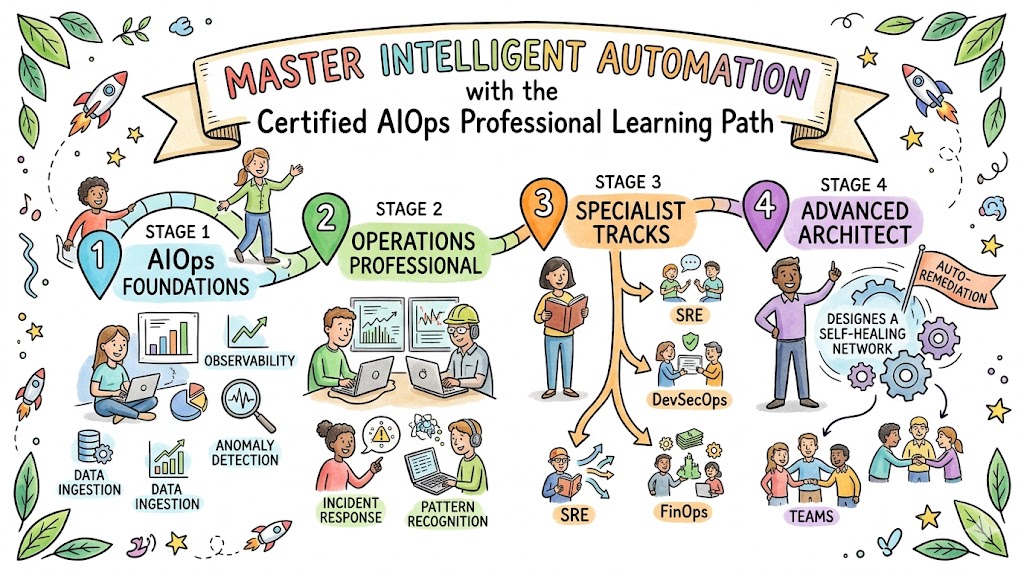
The rapid evolution of modern IT ecosystems makes the Certified AIOps Professional a critical milestone for ambitious technical experts. This comprehensive guide targets engineers and managers who want to integrate machine learning within operational frameworks effectively. As digital systems expand, traditional monitoring methods often fail, creating a need for smarter, automated responses. By following this roadmap, you bridge the gap between data science and system reliability. AIOpsSchool provides the necessary framework to help you navigate your professional development and long-term career goals successfully.
What is the Certified AIOps Professional?
The Certified AIOps Professional designation proves your ability to embed machine learning algorithms into IT operations seamlessly. This certification exists because enterprise environments now generate more telemetry data than human teams can process manually. It prioritizes production-ready skills over abstract theory, ensuring practitioners can manage high-velocity data streams with precision. The program aligns perfectly with cloud-native workflows where automated incident response and predictive maintenance define modern engineering excellence.
Who Should Pursue Certified AIOps Professional?
DevOps engineers, SREs, and system administrators gain the most from this credential by automating their daily operational tasks. Cloud architects and security professionals also benefit by learning how to detect threats and scale resources using intelligent algorithms. This path serves entry-level enthusiasts and seasoned managers who must oversee complex digital transformation projects. Companies in India and across the globe actively seek these skills to lead their high-stakes technical departments.
Why Certified AIOps Professional is Valuable Beyond Today
Organizations adopt automated intelligence to ensure system longevity and stay competitive in a data-driven market. This certification maintains its relevance because it focuses on core automation principles rather than specific, fleeting software tools. Mastering these concepts allows you to reduce mean time to resolution through advanced predictive analytics. Investing your time here offers a high return by protecting your career against the manual toil common in traditional IT roles.
Certified AIOps Professional Certification Overview
The program delivers training via the official course URL and resides on the AIOpsSchool platform to maintain high educational standards. It employs a multi-level assessment strategy that evaluates foundational knowledge and practical problem-solving abilities. The curriculum focuses on how specific algorithms analyze log files and metric data in real-world scenarios. Obtaining this credential demonstrates that you command the entire lifecycle of an automated operations pipeline.
Certified AIOps Professional Certification Tracks & Levels
The curriculum features foundation, professional, and advanced levels to support engineers at every career stage. Specialized tracks allow you to focus on SRE-driven automation or FinOps-related cost management using AI. These levels mirror typical career growth, moving from data visualization basics to the design of self-healing infrastructure. Selecting a specific track helps you align your learning with the immediate needs of your current organization.
Complete Certified AIOps Professional Certification Table
| Track | Level | Who it’s for | Prerequisites | Skills Covered | Recommended Order |
| Foundations | Associate | Junior Engineers | Basic Linux | Data Collection | First |
| Operations | Professional | SRE / DevOps | 2 Years Exp | Pattern Recognition | Second |
| Architecture | Specialist | Lead Architects | Associate Cert | System Design | Third |
| Intelligence | Advanced | Data Scientists | Math Basics | Neural Networks | Fourth |
Detailed Guide for Each Certified AIOps Professional Certification
Certified AIOps Professional – Foundation Level
What it is
This level confirms your grasp of core AIOps terminology and the essential role data plays in modern IT. It ensures you can distinguish between simple monitoring and advanced AI-driven observability.
Who should take it
Recent graduates and junior DevOps engineers should start here to build a strong foundation in automation. Non-technical managers also find this level useful for understanding the technical landscape.
Skills you’ll gain
- Identifying various telemetry data types.
- Understanding basic anomaly detection principles.
- Navigating the AIOps lifecycle effectively.
Real-world projects you should be able to do
- Creating a basic data ingestion pipeline for logs.
- Configuring threshold-based alerts within a monitoring suite.
Preparation plan
- 14 Days: Focus on fundamental terminology and observability pillars.
- 30 Days: Complete all introductory labs and review industry case studies.
- 60 Days: Only necessary for individuals with zero prior IT experience.
Common mistakes
- Confusing supervised and unsupervised learning models.
- Focusing on tool-specific buttons rather than general architectural concepts.
Best next certification after this
- Same-track: Professional Level AIOps.
- Cross-track: Cloud Practitioner.
- Leadership: ITIL Foundation.
Certified AIOps Professional – Professional Level
What it is
This certification validates your ability to deploy machine learning models within CI/CD pipelines to boost system reliability. It emphasizes practical applications like event correlation and noise reduction.
Who should take it
Mid-level SREs and DevOps experts with two or more years of production experience should pursue this level. It suits those aiming to lead major automation initiatives.
Skills you’ll gain
- Implementing automated incident remediation workflows.
- Mastering advanced log clustering and pattern discovery.
- Tuning performance for AI-driven observability platforms.
Real-world projects you should be able to do
- Reducing alert fatigue significantly through intelligent event correlation.
- Developing a predictive scaling model for production Kubernetes clusters.
Preparation plan
- 14 Days: Review essential statistics and advanced mathematical concepts.
- 30 Days: Practice model deployment and testing in sandbox environments.
- 60 Days: Dive deep into complex, multi-layered troubleshooting scenarios.
Common mistakes
- Overlooking data quality issues during production deployment.
- Ignoring the difficulties of integrating AI with legacy infrastructure.
Best next certification after this
- Same-track: Advanced AIOps Architect.
- Cross-track: Certified Kubernetes Administrator.
- Leadership: Engineering Manager Certification.
Choose Your Learning Path
DevOps Path
Engineers on this path integrate intelligence into the delivery lifecycle to accelerate software deployments. You learn to identify potential deployment failures using predictive analytics before they impact users. This proactive approach minimizes rollbacks and enhances the developer experience across the company.
DevSecOps Path
This track utilizes AI to detect security vulnerabilities and abnormal traffic patterns in real-time. By applying machine learning to security logs, you automate threat hunting and defensive responses. This ensures your infrastructure stays resilient while maintaining high delivery speeds.
SRE Path
The SRE path focuses on maintaining service availability through automated incident management and root cause analysis. You master noise reduction techniques, allowing your team to prioritize critical issues that affect service levels. This path is vital for managing large-scale systems with minimal manual effort.
AIOps Path
This focus area explores the architecture of AI engines and how they ingest operational data. You spend time building data lakes and selecting the best algorithms for various IT challenges. It serves as the primary path for becoming a specialist in intelligent operations.
MLOps Path
MLOps centers on operationalizing machine learning models to ensure long-term accuracy and reliability. You learn about model versioning, data drift detection, and automated retraining workflows. This path connects data science goals with traditional infrastructure engineering.
DataOps Path
The DataOps path manages the quality and flow of data that fuels AI models. You build robust pipelines ensuring that observability platforms receive structured and timely information. Success in AI depends entirely on the reliability of the underlying data.
FinOps Path
Practitioners on this path apply AI to optimize cloud spending across multi-cloud environments. You use predictive modeling to forecast costs and identify underutilized resources. This ensures your organization extracts maximum value from cloud investments.
Role → Recommended Certified AIOps Professional Certifications
| Role | Recommended Certifications |
| DevOps Engineer | AIOps Foundation + DevOps Track |
| SRE | Professional Level + SRE Track |
| Platform Engineer | AIOps Architect + Cloud Specialist |
| Cloud Engineer | Associate Level + FinOps Track |
| Security Engineer | Professional Level + DevSecOps Track |
| Data Engineer | DataOps Track + MLOps Foundation |
| FinOps Practitioner | FinOps Track + AIOps Foundation |
| Engineering Manager | Foundation Level + Leadership Track |
Next Certifications to Take After Certified AIOps Professional
Same Track Progression
After mastering the professional level, you should move toward expert-level architecture certifications. This involves designing entire ecosystems that support autonomous operations for large organizations. You will focus on high-level strategy and the long-term integration of emerging technologies.
Cross-Track Expansion
Broadening your skills into DevSecOps or FinOps provides a holistic view of the technical landscape. Understanding the intersection of AI, security, and cost makes you an invaluable multi-disciplinary expert. This versatility prepares you for senior consulting or principal engineering roles.
Leadership & Management Track
If you prefer leading teams over hands-on coding, the leadership track focuses on driving digital transformation. You learn how to justify AI investments to business stakeholders and build a culture of automation. This transition suits those who want to shape the future of engineering departments.
Training & Certification Support Providers for Certified AIOps Professional
DevOpsSchool This provider offers deep-dive training and bootcamps for mastering modern infrastructure automation. They emphasize practical labs to ensure students remain industry-ready.
Cotocus A premier consulting and education firm that delivers high-end training for enterprise professionals. They specialize in complex cloud architectures and current industry trends.
Scmgalaxy This community-focused platform provides resources for software configuration and continuous integration. It connects engineers with peers to share automation best practices.
BestDevOps Providing expert-led sessions, this provider helps individuals navigate the complexities of AIOps. Their curriculum takes students from basic concepts to advanced strategies.
devsecopsschool.com This site focuses on the intersection of security and operations for modern engineers. They teach students how to shift security left using intelligent automation.
sreschool.com A dedicated platform for Site Reliability Engineering education, focusing on performance and scalability. Their courses define the principles of reliability in cloud-native worlds.
aiopsschool.com As a primary hub for AIOps education, this site provides specific training for intelligent operations. They solve daily IT challenges through practical machine learning.
dataopsschool.com This provider addresses the data management side of operations by teaching robust pipeline construction. They focus on data quality as the driver for business decisions.
finopsschool.com Specializing in cloud financial management, this school balances cost and performance effectively. They provide the tools necessary for a successful FinOps practice.
Frequently Asked Questions
- Does the foundation exam present difficulties for new engineers?
The exam offers a fair challenge while remaining accessible to anyone with basic IT knowledge.
- How much time should I dedicate to the professional level?
Most candidates succeed by spending 30 to 60 days on hands-on practice and study.
- Are there prerequisites for starting the foundation track?
No formal requirements exist, though basic Linux and cloud knowledge prove very helpful.
- What kind of career growth does this certification offer?
Certified professionals often secure senior roles and higher salaries due to the high demand for automation.
- Is it better to learn DevOps before AIOps?
A solid DevOps background provides excellent context for how AI improves the delivery pipeline.
- Does this credential require periodic renewal?
Yes, most professional certifications require updates every few years to keep your skills current.
- Do the exams include practical laboratory tasks?
Higher-level certifications usually feature hands-on scenarios to test your problem-solving abilities.
- Can I complete the testing process from home?
Most providers offer proctored online exams for global accessibility and convenience.
- How does this path benefit an Engineering Manager?
It provides the technical vocabulary needed to lead teams through automated digital transformations.
- Where can I find community support for my studies?
Platforms like Scmgalaxy host forums where you can interact with experts and fellow students.
- Which software tools does the curriculum cover?
The training includes industry standards for monitoring, logging, and machine learning model deployment.
- Do global organizations recognize this certification?
The curriculum follows industry standards respected by major technology companies worldwide.
FAQs on Certified AIOps Professional
- How does AIOps change the way teams handle data?
AIOps replaces manual threshold monitoring with machine learning that analyzes data and automates responses instantly. - Will my current monitoring stack work with AIOps?
Most AIOps strategies integrate with existing tools like Prometheus and Datadog to enhance their efficiency. - Must I have a background in data science?
No, the program focuses on applying AI to operations rather than creating new mathematical models. - Which coding languages help the most in this field?
Python remains the most useful language due to its vast libraries for automation and data analysis. - Is this relevant for companies not using the cloud?
Yes, the principles of automated remediation and intelligent monitoring apply to any complex IT infrastructure. - In what way does AI improve incident response?
AI reduces noise by correlating events, allowing teams to find root causes faster than manual searches. - Does the training include a focus on AI ethics?
Yes, understanding data bias and ensuring transparent automation are key parts of the curriculum. - Do providers offer help with job placement?
Many organizations provide career guidance and connect certified individuals with a global employer network.
Final Thoughts: Is Certified AIOps Professional Worth It?
Pursuing this certification acts as a strategic investment for any engineer who wants to excel in an automated future. Managing complex systems through artificial intelligence has transitioned from a niche advantage to a core requirement for infrastructure success. This guide has detailed your journey from foundational knowledge to expert architecture, highlighting specialized tracks that match your interests. By emphasizing practical skills over theory, you prepare yourself for the unique challenges of modern enterprise environments. Commit to validating your expertise today and lead the next generation of digital excellence.
I really appreciate this clear learning path for AIOps, it makes mastering intelligent automation feel so much more achievable.