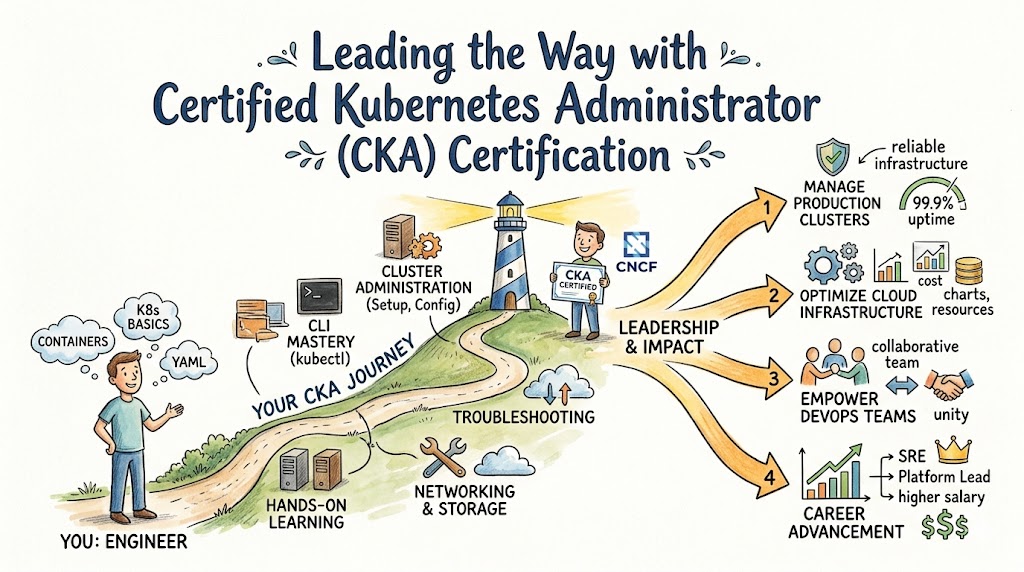
Industry leaders recognize the Certified Kubernetes Administrator (CKA) Certification as the primary standard for verifying container orchestration expertise. This roadmap helps professionals transition from basic container management to high-level platform engineering and site reliability roles. Because Kubernetes serves as the essential cloud operating system today, earning this credential represents a critical milestone for any modern infrastructure career. By utilizing this guide, you will gain the clarity needed to navigate your technical development at DevOpsSchool.
What is the Certified Kubernetes Administrator (CKA) Certification?
The Certified Kubernetes Administrator (CKA) Certification provides a rigorous test of an engineer’s capability to build and manage clusters in production environments. It bridges the gap between theoretical study and the practical demands of distributed systems. Unlike standard multiple-choice tests, this program utilizes a performance-based assessment that reflects the actual challenges SREs and DevOps professionals face daily. It supports enterprise requirements where stability, security, and automation define the success of an engineering organization.
Who Should Pursue Certified Kubernetes Administrator (CKA) Certification?
Cloud architects, system administrators, and software developers who manage application lifecycles find immense value in this program. SREs who handle intricate networking and storage configurations within clusters benefit significantly from the hands-on requirements. While newcomers to cloud technology find the path challenging, seasoned managers use the curriculum to better understand the technical constraints of their teams. Across India and global markets, startups and major enterprises consistently seek verified Kubernetes talent.
Why Certified Kubernetes Administrator (CKA) Certification is Valuable and Beyond
The dominance of Kubernetes in the enterprise world ensures that the Certified Kubernetes Administrator (CKA) Certification remains a high-value professional asset. As companies adopt cloud-native architectures, the skill to troubleshoot these environments becomes a critical capability that outlasts specific tool trends. Professionals holding this certificate show a dedication to technical mastery, which yields a high return on career investment. It establishes a technical foundation that allows engineers to stay agile as the broader ecosystem changes.
Certified Kubernetes Administrator (CKA) Certification Overview
DevOpsSchool delivers this industry-leading program via an official training path hosted on their primary platform. The assessment follows a practical approach where candidates resolve real-world infrastructure issues through a command-line interface. It ignores rote memorization in favor of demonstrating actual control over the Kubernetes control plane and worker nodes. The exam design ensures that every certified candidate can manage a live production environment while upholding cluster health standards.
Certified Kubernetes Administrator (CKA) Certification Tracks & Levels
The certification ecosystem provides a structured path from basic knowledge to specialized security and development expertise. Engineers usually begin with the administrator track to grasp core architecture before exploring SRE or security specializations. These levels match career growth, moving from entry-level administration to senior platform architecture roles. By following these tracks, professionals develop a multi-layered skill set that encompasses networking, storage, and security in a logical flow.
Complete Certified Kubernetes Administrator (CKA) Certification Table
| Track | Level | Who it’s for | Prerequisites | Skills Covered | Recommended Order |
| Core Admin | Professional | SysAdmins & DevOps | Linux Basics | Cluster Setup, Logging | 1 |
| App Developer | Professional | Software Engineers | YAML Basics | Pod Design, Services | 2 |
| Security | Advanced | Security Engineers | CKA Knowledge | Hardening, Secrets | 3 |
| Cloud Native | Foundation | Project Managers | General IT | Architecture Overview | 0 |
Detailed Guide for Each Certified Kubernetes Administrator (CKA) Certification
Certified Kubernetes Administrator (CKA) – Administrator Level
What it is
This certification confirms that an individual can perform the essential duties of a Kubernetes administrator in a live setting. It proves the holder can install, configure, and maintain production-ready clusters.
Who should take it
Infrastructure engineers and administrators who manage the core components of a cluster should pursue this. It fits perfectly for those targeting SRE or DevOps positions.
Skills you’ll gain
- Cluster installation and architecture
- Troubleshooting and system maintenance
- Managing the application lifecycle
- Configuring networking and storage
- Implementing scheduling and security policies
Real-world projects you should be able to do
- Building a high-availability cluster from the ground up
- Setting up persistent storage for data-heavy applications
- Fixing complex network connectivity between namespaces
- Executing cluster upgrades without downtime
Preparation plan
- 7–14 days: Study core API objects and practice imperative commands to increase speed.
- 30 days: Explore deep networking and storage scenarios using simulated environments.
- 60 days: Conduct intensive labs with multi-node setups to master CLI troubleshooting.
Common mistakes
- Relying excessively on documentation during the timed exam
- Spending too much time on low-point questions
- Forgetting to check the cluster context before running commands
Best next certification after this
- Same-track option: Certified Kubernetes Security Specialist (CKS)
- Cross-track option: Certified Kubernetes Application Developer (CKAD)
- Leadership option: CNCF Strategy Professional
Choose Your Learning Path
DevOps Path
Engineers on the DevOps path focus on integrating Kubernetes into automated CI/CD pipelines. They learn to manage environment consistency across different stages of development. This route emphasizes GitOps workflows and Helm charts to keep infrastructure in sync with application code. Most professionals choosing this path aim to streamline the transition between software development and IT operations.
DevSecOps Path
The DevSecOps path embeds security into every layer of the cluster architecture. Professionals prioritize network policies, admission controllers, and container image scanning to protect the supply chain. You will learn to enforce the principle of least privilege in complex multi-tenant clusters. This track is vital for those working in highly regulated sectors where security is a non-negotiable requirement.
SRE Path
SREs treat infrastructure challenges as software problems, focusing on the observability and reliability of the system. You will master monitoring stacks and automated recovery tools to ensure maximum uptime. This path prepares you to manage massive distributed systems where human intervention must remain minimal. It suits engineers who enjoy solving systemic performance issues and scaling challenges.
AIOps Path
This path investigates how artificial intelligence improves cluster management and operational efficiency. Engineers use machine learning to predict system failures and automate resource planning based on data trends. You will focus on AI tools that process telemetry data in real-time to prevent outages. This emerging field helps administrators reduce their manual workload through intelligent automation.
MLOps Path
The MLOps path focuses on running machine learning models and data pipelines on Kubernetes platforms. You will learn to optimize GPU resources and handle specialized scheduling for large-scale model training. This track covers model serving and the orchestration of complex data science workflows. It remains the top choice for engineers who support data science teams in cloud-native settings.
DataOps Path
DataOps professionals ensure the reliability and speed of data delivery using Kubernetes as the primary platform. You will manage distributed databases and stateful sets within the container environment. This path highlights the automation of data pipelines and the configuration of large-scale storage. It assists those who want their data infrastructure to match the agility of their software.
FinOps Path
The FinOps path targets the financial management and optimization of cloud resources. You will implement resource quotas and cost-tracking tags to eliminate cloud waste. This route is essential for companies that want to scale infrastructure without incurring unnecessary costs. It merges technical management with fiscal responsibility to ensure sustainable cloud growth.
Role → Recommended Certified Kubernetes Administrator (CKA) Certifications
| Role | Recommended Certifications |
| DevOps Engineer | CKA, CKAD |
| SRE | CKA, CKS |
| Platform Engineer | CKA, CKS |
| Cloud Engineer | CKA, KCNA |
| Security Engineer | CKS, CKA |
| Data Engineer | CKA, DataSpecialist |
| FinOps Practitioner | CKA, FinOps-Certified |
| Engineering Manager | KCNA, CKA |
Next Certifications to Take After Certified Kubernetes Administrator (CKA)
Same Track Progression
Specializing further within the ecosystem often leads engineers to the Security Specialist (CKS) credential. This jump allows you to master cluster hardening and proactive threat detection in live environments. Sticking to the core track ensures you remain a leading expert as the Kubernetes project evolves. This path solidifies your reputation as a master of the foundational layers of container technology.
Cross-Track Expansion
Expanding your skills usually involves pursuing the CKAD certification to understand the developer’s journey. This perspective helps administrators design more efficient platforms that cater to software development needs. You might also explore cloud-specific certificates for Azure or AWS to learn how Kubernetes interacts with managed services. This versatility makes you a more valuable asset in multi-cloud organizations.
Leadership & Management Track
Moving toward leadership requires shifting your focus from technical tasks to high-level strategic planning. Combining your technical background with project management certifications helps you lead large engineering teams effectively. You will evaluate the long-term ROI of technology stacks and guide digital transformation efforts. This track suits those who want to shape the engineering culture and operational vision of a company.
Training & Certification Support Providers for Certified Kubernetes Administrator (CKA)
DevOpsSchool
DevOpsSchool offers a deep technical environment for those pursuing Kubernetes mastery. Their curriculum uses expert-led training and hands-on labs to simulate actual production scenarios. Students access updated content that reflects the latest cloud-native trends, ensuring their skills remain relevant for enterprise roles.
Cotocus
Cotocus delivers specialized engineering training that focuses on orchestration and automation. Their programs help professionals transition into advanced cloud roles by teaching the mechanics of cluster scaling. Learners receive practical support that prioritizes results over abstract architectural theories.
Scmgalaxy
Scmgalaxy acts as a major knowledge center for the Kubernetes community. They provide extensive documentation and troubleshooting guides for engineers solving complex infrastructure problems. The platform supports a self-paced learning style backed by a massive global network of peers.
BestDevOps
BestDevOps provides streamlined training paths that focus on the most critical SRE skills. Their methodology emphasizes efficiency, helping candidates pass the certification without dealing with unnecessary information. The modules ensure that every administrator can handle cluster challenges with total confidence.
devsecopsschool.com
This platform leads the way for engineers who want to build security into their Kubernetes workflows. The training covers the security specialist syllabus, teaching professionals how to create secure-by-default systems. They prepare students for the high-stakes environment of modern enterprise data compliance.
sreschool.com
Sreschool highlights the reliability and observability of Kubernetes at an enterprise level. Their courses assist engineers who want to keep systems running smoothly under heavy traffic. The curriculum ranges from monitoring setups to automated incident response systems.
aiopsschool.com
Aiopsschool remains at the forefront of intelligent infrastructure management through automation. They teach professionals how to apply machine learning to daily cluster operations for better performance. This program helps forward-thinking admins use data to automate system maintenance.
dataopsschool.com
Dataopsschool solves the specific challenges of running data-heavy workloads on Kubernetes. Their training covers database management and data pipelines within the container ecosystem. It helps data engineers use orchestration to deliver scalable and reliable data services.
finopsschool.com
Finopsschool bridges the communication gap between engineering and finance departments. Their courses focus on cloud cost management and resource optimization within Kubernetes. Professionals learn to drive financial accountability across their teams to ensure project sustainability.
Frequently Asked Questions (General)
- Does the CKA exam feel more difficult than other IT tests?
Most candidates find it harder because it requires you to perform tasks in a real terminal rather than picking from a list of answers.
- How many hours should I dedicate to my study plan?
Engineers typically spend 60 to 90 days practicing in labs to ensure they can complete the exam tasks within the time limit.
- Do I need any specific certificates before I attempt the CKA?
No formal requirements exist, but you should possess a solid understanding of Linux and networking to navigate the exam successfully.
- Will this certification actually increase my earning potential?
Industry data shows that certified administrators often secure higher salaries because the credential proves practical, hands-on expertise.
- Can I complete the certification from my own home?
Yes, the Linux Foundation provides a proctored online environment so you can take the test from any quiet location.
- For how many years does the certification stay active?
The certificate remains valid for three years, after which you must retake the exam to keep your status current.
- Does the syllabus cover specific cloud tools like EKS?
The exam focuses on the standard Kubernetes distribution, which provides the skills needed to manage any cloud-specific version.
- Should I take the developer exam before the administrator one?
You can choose either path first, but the administrator track provides a more comprehensive look at the cluster’s inner workings.
- Are any external resources permitted during the test?
Candidates can access official Kubernetes documentation and certain community pages to find information during the exam.
- What happens if I fail my first attempt at the exam?
The registration usually includes one free retake, giving you a second chance to pass after you review your mistakes.
- How does an engineering manager benefit from this technical certificate?
It helps managers understand the technical hurdles their teams face and makes them more effective at planning infrastructure projects.
- Do companies outside of India recognize this credential?
Yes, the CNCF issues this certification globally, making it a respected standard for employers in every tech hub worldwide.
FAQs on Certified Kubernetes Administrator (CKA)
- Which version of the software does the exam currently use?
The examiners update the test regularly to match a recent stable release, keeping the requirements aligned with current industry standards.
- Must I know how to write complex code to pass?
You do not need to be a developer, but you must master YAML syntax and basic shell scripting for cluster automation.
- How does the grading system work for this assessment?
Grading depends on your ability to complete specific tasks in the lab, with points assigned based on the importance of the task.
- Is the documentation search useful during the session?
Knowing how to find information in the official docs quickly is a vital skill that helps you save time during the exam.
- Can I use a Windows laptop for the exam?
Yes, you can use any OS that supports a modern web browser and the required proctoring software.
- What differentiates the CKA from the CKS?
The CKA covers general administration and maintenance, while the CKS focuses strictly on securing the cluster against attacks.
- Do mock exams help with the final result?
Practicing with mock exams is the best way to build the speed and confidence needed to finish the real test on time.
- Is there a place where I can discuss study topics with others?
Many aspirants join dedicated Slack and Discord communities to share resources and solve practice problems together.
Final Thoughts: Is Certified Kubernetes Administrator (CKA) Worth It?
Earning the Certified Kubernetes Administrator (CKA) Certification represents a powerful investment for any professional pursuing a cloud-native career. It signals to the marketplace that you possess the hands-on technical skills required to build the future of infrastructure. While the preparation demands significant effort and the exam presents a high bar, the practical knowledge you gain proves invaluable in production environments. This credential transforms your technical perspective, moving you from basic maintenance to expert-level cluster architecture. If you seek to solidify your position in the competitive engineering landscape, this certification provides the most reliable path forward.
This CKA certification breakdown is exactly what I needed to help simplify my study plan and goals.