In 2021, Facebook experienced a massive six-hour outage that wiped out approximately $60 million in revenue. This historic downtime sent shockwaves through the tech industry, transforming into a worst-nightmare scenario for any operations team. Organizations quickly realized that traditional systems administration could no longer sustain the rapid pace of continuous deployment. Consequently, modern enterprise infrastructure demands a highly specialized discipline to maintain uptime and ensure systemic resilience. This operational demand is exactly where Site Reliability Engineering becomes crucial for software engineering teams. As an innovative discipline, Site Reliability Engineering bridges the gap between software development and production operations by applying engineering principles directly to infrastructure challenges. Tech teams recognize that relying on traditional IT workflows creates silos, slows down feature deployment, and increases system vulnerabilities. Therefore, embracing this structured methodology allows businesses to scale efficiently while guaranteeing predictable system availability. This extensive guide explores the historical evolution of modern operations, foundational reliability principles, essential metrics, and practical career frameworks. For those who want to master these core concepts through structured learning, exploring the professional programs available at SREschool provides a practical foundation for building highly resilient, production-grade distributed architectures.
The Origin of Site Reliability Engineering — How Google Invented It
The 2003 Google Problem
During the early 2000s, Google experienced unprecedented exponential growth that pushed standard infrastructure management strategies to their limits. The infrastructure team faced thousands of servers running complex, distributed applications that required frequent manual interventions. Traditional operations frameworks separated the development teams from the systems administration teams, which naturally caused friction between speed and stability. Systems administrators focused heavily on preserving uptime by restricting changes, whereas software developers prioritized releasing features rapidly. This structural division created major communication bottlenecks, operational inefficiencies, and frequent production outages that impacted users globally. Manual interventions failed to scale at the same pace as the physical hardware, leading to unsustainable workloads for operations personnel. Google required an entirely new paradigm to manage massive data centers without linearly expanding human resource requirements.
Ben Treynor Sloan and the First Site Reliability Engineering Team
To resolve this growing operational crisis, Google executive Ben Treynor Sloan formed the very first Site Reliability Engineering team in 2003. He famously defined the discipline as what happens when you ask a software engineer to design an operations function. Instead of relying on manual firefighting, this team approached infrastructure operations through the lens of automated software architecture. Sloan insisted that operations teams must spend at least half of their time writing code to eliminate manual management tasks. This structural requirement prevented the team from becoming a typical operations silo and kept them focused on scalable engineering solutions. The first team introduced automated server provisioning, algorithmic load balancing, and programmatic self-healing systems that shifted operations from reactive troubleshooting to proactive engineering.
From Google to the World
As the benefits of this automated operational model became clear, other massive tech organizations began experiencing similar infrastructure scaling challenges. Pioneer enterprises like Amazon, Netflix, and Microsoft recognized that traditional operations models hindered their continuous deployment goals. Consequently, they adopted and adapted these foundational reliability engineering methodologies to fit their unique microservice ecosystems. Netflix advanced the discipline by introducing automated chaos testing inside production environments to validate resilience continuously. Amazon integrated reliability metrics directly into their decentralized two-pizza development teams to distribute operational ownership. Over the last decade, this approach transitioned from an exclusive internal Google strategy into a universal global industry standard for enterprise cloud architecture.
Defining the Scope and Professional Objectives of Reliability Engineers
The Official Definition
The official definition formulated by Google describes Site Reliability Engineering as an engineering discipline dedicated to designing, building, and operating highly scalable, fault-tolerant distributed computing systems. The industry has broadened this definition to incorporate diverse cloud environments, hybrid infrastructures, and various organizational cultures. Today, the discipline represents an operational philosophy that utilizes software engineering workflows to optimize system availability, scalability, and efficiency. It systematically replaces manual administrative tasks with automated code-driven frameworks, ensuring that production systems adapt dynamically to changing traffic patterns.
What Site Reliability Engineers Actually Do Day-to-Day
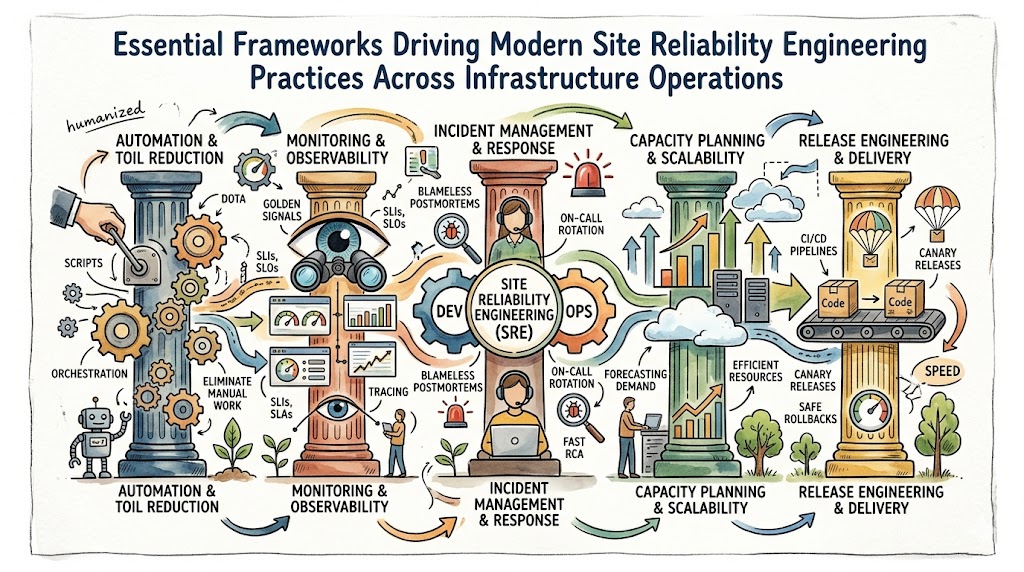
A Site Reliability Engineer balances daily tasks between maintaining active production stability and developing long-term engineering automation. The everyday responsibilities of these professionals include the following primary activities:
- On-Call Duties and Incident Response: Managing live production alerts, mitigating active outages, and triaging complex system failures.
- Automation Development: Writing custom software, scripts, and Kubernetes operators to eliminate repetitive infrastructure tasks.
- Capacity Planning: Analyzing infrastructure utilization trends to forecast hardware, network, and cloud budget requirements accurately.
- Performance Optimization: Tuning database queries, caching layers, and network routing configurations to minimize system latency.
Site Reliability Engineer vs. System Administrator — The Key Difference
The fundamental distinction between a Site Reliability Engineer and a traditional System Administrator lies in their approach to problem-solving. A System Administrator typically configures hardware, patches operating systems, and resolves active alerts manually using interactive command-line interfaces. In contrast, a Site Reliability Engineer manages infrastructure by writing declarative code that automates those exact maintenance procedures. When a System Administrator fixes a server crash, they manually restart the broken service to restore immediate operations. When a Site Reliability Engineer encounters the same crash, they write automated scripts to detect the failure, restart the service, and patch the root software bug across thousands of machines simultaneously.
The Site Reliability Engineering Mindset
The foundational mindset of a reliability engineer treats system availability and reliability as the core product feature rather than an afterthought. If an application remains inaccessible to end-users, the underlying software features lose all business and operational value. This mindset requires engineers to accept that failure is an inevitable characteristic of complex, distributed cloud environments. Instead of aiming for unachievable perfection, professionals focus on building resilient systems that gracefully degrade during partial infrastructure failures. This philosophy encourages data-driven decision-making, where real-time operational metrics dictate deployment velocities and architectural priorities.
The 7 Core Principles of Site Reliability Engineering
1. Embracing Risk
This discipline acknowledges that maintaining 100% uptime is an unrealistic, cost-prohibitive goal that severely restricts product development velocity. Attempting to build an absolutely flawless system requires massive infrastructure redundancy and extreme testing cycles that delay code deployments. Furthermore, user-facing experiences are constrained by the reliability of local internet service providers and mobile networks, which rarely exceed 99% uptime. Therefore, engineering teams must intentionally define an acceptable level of operational risk to maintain a rapid pace of software innovation. This intentional risk tolerance allows organizations to balance high-speed feature delivery with steady infrastructure stability.
2. Service Level Objectives
Systems cannot be effectively optimized without clear, data-driven targets that define what acceptable operational performance looks like. Teams establish specific performance thresholds to align engineering efforts with actual end-user expectations. These targets serve as the primary operational contract between product managers, developers, and reliability teams. By measuring system metrics against these clear goals, organizations remove emotional opinions from stability discussions. Consequently, these metrics determine whether a team should focus on developing new features or improving infrastructure reliability.
3. Eliminating Toil
Toil represents manual, repetitive, operational tasks that lack long-term strategic value and scale linearly with infrastructure growth. Examples include manually creating user accounts, running routine database backups, and restarting web services by hand. Left unchecked, excessive toil demoralizes engineering teams, causes human errors, and prevents engineers from working on impactful projects. This discipline mandates that teams limit daily operational toil to less than half of their working hours. The remaining time must be dedicated to writing software that automates those manual tasks out of existence permanently.
4. Monitoring and Observability
Effective operations require deep insight into internal system states based on external telemetry data. True observability goes far beyond simple server uptime checks by providing comprehensive context regarding complex distributed interactions. Teams implement robust observability pipelines to gather granular insights from microservices, databases, and third-party APIs. This deep visibility allows engineers to detect performance degradations long before they evolve into full-scale consumer outages.
5. Automation Over Manual Work
Automation serves as the primary mechanism for scaling modern cloud infrastructure without adding proportional engineering headcount. Manual configurations introduce human error, create documentation gaps, and slow down disaster recovery processes. Teams leverage programmatic tools to handle server provisioning, code deployments, and security patching uniformly. Software-driven automation guarantees that every infrastructure component remains consistent, predictable, and rapidly reproducible during catastrophic regional failures.
6. Release Engineering
Release engineering focuses on building safe, predictable, and highly repeatable strategies for deploying software into production environments. Fast development cycles lose value if code deployments cause frequent platform instabilities or data corruption. Teams construct automated continuous integration and continuous deployment pipelines that incorporate rigorous testing, automated canary testing, and instant rollback capabilities. This disciplined approach ensures that software updates transition smoothly from local development environments into live production clusters.
7. Simplicity
Complex software architectures contain hidden dependencies, unexpected failure modes, and difficult troubleshooting procedures. Reliability engineers continually advocate for minimalist software configurations, clear architectural boundaries, and clean, readable automation scripts. Software engineers achieve systemic reliability by reducing unnecessary components, consolidating redundant tools, and removing dead code. Maintaining clean, simple architectures allows engineering teams to understand, monitor, and repair production infrastructures quickly during critical incidents.
Key Site Reliability Engineering Concepts You Must Know
SLA vs. SLO vs. SLI — Explained Simply
Navigating operational performance requires a clear understanding of three core metrics: Service Level Agreements, Service Level Objectives, and Service Level Indicators.
- Service Level Indicator (SLI): This metric represents a precise, real-time measurement of system behavior, such as the specific latency of an API endpoint.
- Service Level Objective (SLO): This target defines the acceptable performance threshold that the infrastructure team commits to achieving consistently.
- Service Level Agreement (SLA): This formal legal contract outlines the financial or material penalties a company faces if it fails to meet its stated performance commitments.
| Metric Type | Definition | Practical Example |
| SLI | Real-time measured compliance | The system successfully processed 99.97% of HTTP requests over the past 30 days. |
| SLO | Target operational goal | The application must maintain an uptime greater than 99.95% each calendar month. |
| SLA | Legal contract with penalties | If platform availability drops below 99.9%, customers receive a 15% billing credit. |
Error Budgets — The Game Changer
The error budget represents the exact amount of acceptable downtime an application can experience over a given timeframe. Mathematically, it is the inverse of the defined Service Level Objective target. For instance, if an application maintains a monthly objective of 99.9% uptime, its allocated error budget allows for 0.1% downtime. This budget acts as an objective, data-driven referee between innovation-focused developers and stability-focused reliability engineers.
Error Budget = 100% - SLO Target
When a development team preserves a healthy, remaining error budget, they retain full authorization to deploy risky new features rapidly. However, if consecutive production incidents completely drain the error budget, the deployment pipeline locks automatically. The entire engineering organization then shifts its focus toward bug remediation, performance optimization, and infrastructure stabilization until the budget resets.
Toil — The Silent Productivity Killer
Toil must be clearly differentiated from ordinary administrative work like attending team meetings or completing human resource compliance training. True operational toil possesses specific negative characteristics: it is manual, repetitive, automatable, tactical, and scales linearly with infrastructure size. If managing an infrastructure expansion from ten servers to one hundred servers requires ten times the human effort, the workflow is heavily driven by toil. Teams actively track, quantify, and measure hours spent on toil to keep it below the strict 50% organizational limit. Eliminating this manual burden allows engineers to focus on architectural design and system resilience.
Incident Management and Postmortems
When severe production outages occur, teams follow highly structured incident response frameworks to restore system operations quickly. Engineers assign clear operational roles, including an incident commander to lead mitigation strategies and a communications lead to update external stakeholders. Once normal operations resume, the team conducts a comprehensive, blameless postmortem meeting. This review focuses exclusively on identifying systemic flaws, software bugs, and process gaps without pointing fingers at individual human mistakes. The primary objective is translating unexpected infrastructure failures into actionable engineering tasks to prevent similar outages from happening again.
Capacity Planning
Capacity planning is the proactive process of analyzing system workloads to ensure infrastructures scale seamlessly ahead of customer demand. Traditional operations teams often waited for hardware resources to saturate completely before purchasing additional bare-metal servers. Modern cloud environments demand algorithmic forecasting based on historical trends, seasonal traffic spikes, and business growth projections. Engineers run automated load tests to discover hidden architectural bottlenecks within databases, network interfaces, and container storage layers. Accurate capacity management prevents unexpected service degradation during high-traffic marketing events or sudden user acquisition waves.
The Four Golden Signals
To maintain full operational awareness across distributed microservices, engineers closely monitor the four golden signals of infrastructure performance:
- Latency: The exact time required to process a specific request, distinguishing between successful requests and failed operations.
- Traffic: A precise measurement of total system demand, quantified via HTTP requests per second or network bandwidth consumption.
- Errors: The total rate of requests that fail explicitly, return 500-level status codes, or corrupt system data.
- Saturation: The measurement of infrastructure resource utilization, highlighting memory constraints, CPU bottlenecks, and disk IOPS limits.
Site Reliability Engineering vs. DevOps — What is the Real Difference?
The Philosophy Difference
DevOps and Site Reliability Engineering are not competing methodologies; rather, they operate as complementary frameworks designed to break down organizational silos. DevOps represents an expansive cultural philosophy that champions shared ownership, continuous delivery, and tight integration between developers and operations. This cultural shift encourages teams to communicate openly and share delivery responsibilities, but it does not dictate specific daily engineering implementations. Site Reliability Engineering acts as a practical, code-driven implementation of that exact DevOps culture. To use a common industry analogy, if DevOps is an abstract programming interface, Site Reliability Engineering is the concrete class that implements that interface.
Roles and Responsibilities Compared
While both methodologies aim to deliver stable software rapidly, their daily engineering focuses differ significantly:
| Operational Dimension | DevOps Focus | Site Reliability Engineering Focus |
| Primary Objective | Optimizing delivery pipelines from code commit to release. | Engineering highly reliable, production-grade distributed architectures. |
| Daily Workloads | Configuring CI/CD tools, infrastructure as code scripts, and testing setups. | Managing live incidents, creating SLO metrics, and eliminating toil via code. |
| Failure Approach | Utilizing automated testing to catch bugs before production releases. | Building self-healing systems and conducting blameless postmortems. |
| Core Skillset | Proficient in pipeline automation, configuration tools, and collaboration. | Expert in software development, operating systems, and distributed networks. |
Can You Have Both Site Reliability Engineering and DevOps?
Modern technology organizations successfully integrate both practices simultaneously to construct highly efficient software delivery lifecycles. In these modern setups, DevOps engineers design the continuous integration and continuous deployment pipelines that transform source code into deployable artifacts. Concurrently, reliability engineers design the scalable runtime platforms, orchestrators, and observability fabrics that support those applications in production. This division of labor allows DevOps specialists to optimize code delivery speeds while reliability engineers guarantee continuous platform stability. Together, they create a unified operational loop that accelerates feature releases without risking infrastructure availability.
Which One Should Your Team Adopt?
Choosing between these operational practices depends on organizational scale, product architecture maturity, and existing engineering bottlenecks. Small startups with simple monolithic architectures should initially focus on establishing basic DevOps culture and continuous deployment automation. At this early stage, building dedicated reliability teams introduces unnecessary overhead before reaching significant scale. As companies grow into complex, multi-cluster microservice ecosystems, managing system dependencies and downtime costs becomes a critical business priority. Organizations should adopt dedicated reliability engineering practices when infrastructure complexity outpaces the ability of development teams to handle production operations safely.
Real-World Use Cases of Site Reliability Engineering
How Google Uses Site Reliability Engineering
Google runs its global search engines, YouTube streaming platforms, and Google Cloud datacenters utilizing deeply integrated reliability engineering practices. At Google, individual reliability teams have full authority to hand production ownership back to development teams if software stability deteriorates. If a product development team continually depletes its error budget, they must manage all live on-call pages manually. This organizational policy forces developers to prioritize code stability and write comprehensive tests before pushing changes. Google also shifts reliability engineers between different product teams regularly to spread automation patterns and maintain high engineering standards across the company.
Netflix’s Chaos Engineering Approach
Netflix revolutionized infrastructure operations by introducing Chaos Engineering, a practice that injects intentional failures into live production environments. Their engineers developed an internal automation suite called Chaos Monkey to randomly terminate production containers during standard business hours. This forced disruption ensures that microservices are built with automated regional failover capabilities and resilient degradation mechanisms. If an individual microservice crashes unexpectedly, the client application gracefully hides the broken component without degrading the overall user experience. This intentional injection of risk proves that infrastructure resilience must be tested continuously in production to guarantee true reliability.
Amazon’s Approach to Reliability at Scale
Amazon manages its massive retail platforms and cloud infrastructure by enforcing decentralized ownership across hundreds of small microservice teams. Each team retains complete operational responsibility for the specific services they build, following a strict you-build-it, you-run-it organizational philosophy. Amazon engineers utilize highly automated release systems that deploy software changes incrementally using strict canary testing strategies. These automated systems route a tiny fraction of live user traffic to newly updated microservices while monitoring error rates continuously. If the deployment system detects any deviation in performance metrics, it triggers automated rollbacks within seconds to protect global operations.
Site Reliability Engineering in Fintech — Zero Tolerance for Downtime
Financial technology organizations like Stripe and major banking institutions apply these reliability principles to protect transactional data pipelines. In fintech ecosystems, a few minutes of infrastructure downtime can result in millions of dollars in uncompressed financial losses and severe regulatory fines. These teams enforce highly conservative error budgets and establish strict multi-region database replication protocols to ensure zero data loss. They design their systems around advanced consensus algorithms and automated circuit breakers to isolate failing payment gateways instantly. This programmatic insulation ensures that a localized banking api failure never disrupts the broader financial clearing network.
Site Reliability Engineering for Startups — Scaled-Down but Essential
Early-stage startups lack the vast financial and human engineering resources required to maintain large, dedicated reliability departments. However, small tech teams successfully adopt core reliability engineering principles by utilizing managed cloud services and serverless architectures. Startups focus their limited engineering time on defining basic Service Level Objectives and establishing simple, automated continuous delivery systems. They eliminate manual toil early by using infrastructure as code frameworks like Terraform to manage cloud assets predictably. This early adoption of reliability automation prevents startups from accumulating massive technical debt, allowing them to scale quickly when user demand increases.
Common Mistakes in Site Reliability Engineering
Mistake 1 — Confusing Site Reliability Engineering with Just Being On-Call
A frequent corporate error involves simply renaming an existing, stressed operations team to a Site Reliability Engineering team without changing their responsibilities. When organizations make this surface-level change, engineers remain trapped in a continuous loop of manual troubleshooting and firefighting. True reliability engineering is a rigorous software development discipline, not merely a rotating pager schedule for server reboots. If engineers spend their entire shift responding to alerts without time to write automation software, the implementation has failed. Organizations must actively protect engineering schedules to ensure teams dedicate significant time to developing long-term structural improvements.
Mistake 2 — Setting Unrealistic SLOs
Many product managers and executives mistakenly demand 100% platform availability, believing that any amount of downtime represents organizational failure. Setting an impossible target of perfect uptime completely halts software development velocity and quickly exhausts engineering resources. Achieving successive nines of availability requires exponential investments in infrastructure infrastructure redundancy, automated testing, and architectural complexity. Teams must establish realistic performance targets that accurately balance product stability with the velocity of new feature delivery. This balanced approach protects engineers from operational burnout while ensuring that product performance aligns with actual user expectations.
Mistake 3 — Ignoring Toil Until It’s Too Late
When engineering organizations scale rapidly, manual tasks can grow quietly until they overwhelm development velocities and damage team morale. Unmonitored toil creates an operational environment where engineers spend their days executing manual database fixes and running custom support scripts. This continuous operational overhead prevents engineers from designing core platform upgrades, which leaves the infrastructure fragile and difficult to scale. Teams must implement structured tracking mechanisms to identify, measure, and log manual tasks during every engineering sprint. Identifying operational toil early allows organizations to prioritize automation projects before manual workloads stall engineering progress.
Mistake 4 — Skipping Blameless Postmortems
When severe outages occur within cultures focused on assigning blame, individuals naturally hide mistakes, cover up configuration errors, and withhold critical information. This defensive behavior prevents engineering teams from discovering the true technical and organizational root causes of system failures. Consequently, organizations repeat identical operational mistakes because they fix surface-level symptoms rather than addressing underlying architectural vulnerabilities. Teams must cultivate an operational environment that embraces honest, objective, and completely blameless incident reviews. Prioritizing systemic learning over personal punishment helps teams identify systemic bugs and build resilient infrastructures.
Mistake 5 — Monitoring Without Actionable Alerts
Configuring monitoring systems to send notifications for minor metric variations often floods engineering communication channels with non-critical noise. This continuous stream of low-priority notifications causes alert fatigue, leading engineers to ignore notifications or miss critical production failures entirely. Alerts should only trigger when a system degradation directly threatens defined Service Level Objectives or impacts end-user experiences. Every automated page sent to an on-call engineer must contain a clear, actionable diagnostic description and a link to a troubleshooting playbook. Streamlining alert notifications ensures that operations teams respond rapidly to genuine system emergencies.
Mistake 6 — Not Involving Site Reliability Engineers in the Design Phase
Treating reliability teams as an isolated operations group that merely inherits completed software from developers creates significant systemic risk. When engineers are excluded from early software design discussions, development teams frequently deliver architectures that are difficult to monitor, scale, or upgrade safely. Attempting to add reliability features to a poorly designed distributed application after it launches is incredibly difficult and expensive. Organizations should involve reliability engineers from the very beginning of the software design and architectural prototyping phases. This early collaboration ensures that applications are built from the start with robust observability and scalable failover mechanisms.
Essential Site Reliability Engineering Tools and Technologies
To implement these core operational principles effectively, engineering teams deploy a robust, modern technology stack across their infrastructure:
Monitoring and Observability
- Prometheus: A powerful time-series database and open-source monitoring tool that collects real-time metrics via a pull-based architecture.
- Grafana: A flexible visualization platform that connects with Prometheus to build rich, dynamic, and scannable performance dashboards.
- Datadog: A comprehensive, enterprise SaaS platform that unifies metrics, distributed application tracing, and log aggregation in a single pane of glass.
- New Relic: An all-in-one observability platform that provides deep application performance monitoring and transactional path tracing for distributed cloud applications.
Incident Management
- PagerDuty: An enterprise incident response engine that integrates with monitoring stacks to route critical pages to on-call engineers via smart schedules.
- OpsGenie: A flexible alerting and on-call management platform by Atlassian that ensures critical infrastructure alerts are triaged rapidly.
- FireHydrant: A dedicated incident management platform that automates postmortem documentation, step-by-step incident tracking, and team communications.
CI/CD and Release Engineering
- Spinnaker: An open-source, multi-cloud continuous delivery platform designed by Netflix for high-velocity deployment strategies.
- Argo CD: A declarative, GitOps-driven continuous delivery tool tailored specifically for deploying applications to native Kubernetes clusters.
- Jenkins: A highly extensible, open-source automation server used worldwide to construct customizable continuous integration and deployment pipelines.
- GitHub Actions: A modern, cloud-integrated workflow automation platform that builds, tests, and deploys code directly from source control repositories.
Chaos Engineering
- Chaos Monkey: The pioneering open-source tool created by Netflix to randomly terminate live production instances to test infrastructure resilience.
- Gremlin: A comprehensive Chaos Engineering framework that allows teams to safely inject controlled CPU, network, and storage failures into test environments.
- LitmusChaos: An open-source, cloud-native Chaos Engineering platform designed to orchestrate resilience experiments inside Kubernetes clusters.
SLO Management
- Nobl9: A dedicated platform that integrates with existing monitoring tools to calculate error budgets, track SLOs, and trigger alerts.
- Dynatrace: An AI-powered observability platform that automates the discovery, measurement, and alerting of Service Level Objectives.
- OpenSLO: An open-source, declarative standard for defining Service Level Objectives as code using consistent YAML configurations.
How to Become a Site Reliability Engineer — Career Roadmap
Skills Every Site Reliability Engineer Must Have
Entering this competitive engineering field requires building a strong multi-disciplinary technical foundation that spans both software development and systems operations:
- Systems Internals: A comprehensive understanding of the Linux operating system, including kernel processes, file structures, and memory management.
- Networking Architecture: Deep knowledge of core internet protocols, including TCP/IP handshakes, DNS routing hierarchies, and HTTP/S handshakes.
- Software Development: Strong programming proficiency in modern systems languages like Python or Go to write clean infrastructure automation tools.
- Container Orchestration: Expert capability managing production-grade Kubernetes clusters, service meshes, and containerized deployment patterns.
The Site Reliability Engineering Learning Path
Developing the necessary expertise to become a senior infrastructure professional requires a structured, step-by-step learning approach:
- Master Systems Administration: Begin by acquiring strong proficiency in Linux command-line operations, shell scripting, and basic network configurations.
- Learn Software Engineering: Move beyond basic scripting to learn object-oriented programming, data structures, algorithm design, and version control via Git.
- Adopt Cloud Architecture: Gain practical experience with major public cloud platforms, focusing on software-defined networking, cloud databases, and compute scaling.
- Implement Infrastructure as Code: Master declarative provisioning frameworks like Terraform and configuration management tools like Ansible to automate environments.
- Study Observability Ecosystems: Learn to configure advanced monitoring networks, build scannable dashboards, and analyze distributed tracing logs.
- Deep Dive into Orchestration: Complete advanced training in container design, microservice architectures, and high-availability Kubernetes deployments.
Certifications Worth Pursuing
Industry certifications help engineers validate their technical skills, stand out to recruiters, and cement their understanding of complex distributed systems:
- Google Cloud Professional Cloud DevOps Engineer: Validates an engineer’s practical ability to build, manage, and optimize reliable Google Cloud environments.
- AWS Certified DevOps Engineer – Professional: Demonstrates expert-level proficiency in automating, monitoring, and maintaining complex distributed systems on AWS.
- Linux Foundation Certified System Administrator (LFCS): Confirms an engineer’s foundational capability to configure, maintain, and troubleshoot Linux systems.
- Certified Kubernetes Administrator (CKA): Highly valued industry credential that proves an engineer can configure, manage, and troubleshoot production Kubernetes clusters.
Learn Site Reliability Engineering
Building a successful career in this field requires high-quality, practical training designed by experienced engineering mentors. Prospective students can find comprehensive, hands-on learning paths tailored to modern industry demands by visiting the educational programs at SREschool. This specialized educational institution offers structured, deep-dive courses that guide learners from fundamental cloud operations to advanced site reliability engineering architectures. Students gain valuable experience by writing real automation scripts, configuring observability pipelines, and managing live, simulated staging incidents. Exploring these professional curricula equips engineers with the practical, production-level skills necessary to excel in modern enterprise technology organizations.
The Future of Site Reliability Engineering
AI and AIOps in Site Reliability Engineering
Artificial intelligence and specialized machine learning models are rapidly transforming how engineering teams manage large-scale cloud operations. Traditional monitoring setups often rely on rigid, manual thresholds that fail to catch complex, non-linear system anomalies. Modern AIOps platforms analyze millions of real-time telemetry streams to discover hidden system correlations and detect early signs of infrastructure degradation. These intelligent automated systems quickly isolate root failure causes, recommend optimal patches, and execute pre-approved self-healing scripts. Incorporating AI assistants allows engineers to offload routine alert triaging, which dramatically reduces average mitigation timelines during complex outages.
Platform Engineering — The Evolution of Site Reliability Engineering
The technology industry is experiencing a natural convergence between site reliability frameworks and the growing discipline of platform engineering. Instead of manually configuring individual servers for separate application teams, engineers focus on building Internal Developer Platforms. These self-service portals package complex cloud configurations, security guardrails, and deployment pipelines into simple automated workflows. Software developers can independently spin up secure databases, provision compliant clusters, and configure monitoring pipelines without manual operations tickets. This evolution reduces organizational friction, minimizes configuration errors, and allows teams to scale infrastructure security uniformly across the enterprise.
Site Reliability Engineering in Cloud-Native and Kubernetes Environments
The widespread industry migration toward containerized, multi-cloud Kubernetes architectures introduces brand-new reliability and orchestration challenges. Modern cloud-native environments feature hundreds of ephemeral pods, dynamic service meshes, and distributed microservices that scale continuously across multiple geographic cloud regions. Managing these complex environments requires engineers to design advanced automated controllers, strict network security policies, and resilient storage synchronization systems. Teams rely on GitOps workflows to ensure that actual production states match declarative code repositories exactly. This automated approach ensures that massive container environments remain predictable, easy to audit, and simple to recover during unexpected regional cloud outages.
Site Reliability Engineering Skills That Will Matter Most
As infrastructure architectures continue to evolve, professionals must expand their expertise to include critical adjacent technical domains. Modern engineers must master FinOps strategies to programmatically track, analyze, and optimize cloud consumption costs alongside system performance metrics. Additionally, building robust security automation directly into continuous deployment pipelines ensures that software updates remain continuously compliant with industry guardrails. Engineers will also need deep expertise in AI observability to monitor specialized machine learning training pipelines and large language model inference networks. Expanding into these advanced technical areas ensures that reliability professionals can continue to safeguard complex, next-generation enterprise application ecosystems.
Frequently Asked Questions
- What does a site reliability engineer do daily?A site reliability engineer splits their daily schedule between active production operations and writing automation code to improve system stability. They respond to critical system pages, manage live production incidents, analyze system logs, and conduct comprehensive, blameless postmortems. The rest of their day is spent developing software tools, building CI/CD pipelines, and writing automation scripts to eliminate repetitive manual tasks.
- Is site reliability engineering only for big companies like Google?No, these fundamental engineering principles offer immense value to technology companies of all sizes, including early-stage startups. While smaller organizations might not need a large, dedicated reliability department, adopting core automation practices prevents dangerous technical debt from accumulating. Using infrastructure as code and setting realistic uptime targets helps growing businesses scale smoothly without experiencing catastrophic system downtimes.
- What is the average salary of a site reliability engineer?Due to the high demand for cross-disciplinary expertise in both software engineering and operations, these professionals earn highly competitive tech salaries. Compensation packages vary based on geographic location, years of experience, and specific industry sectors like finance or cloud computing. Senior engineers who excel at managing large-scale distributed architectures frequently receive top-tier offers from major global tech enterprises.
- How is a site reliability engineer different from a DevOps engineer?DevOps is a broad cultural philosophy focused on breaking down silos and improving collaboration between software developers and operations teams. In contrast, site reliability engineering is a specific, code-driven discipline that applies software engineering workflows directly to infrastructure challenges. DevOps focuses heavily on optimizing delivery pipelines, while reliability engineering prioritizes maintaining live platform availability and architectural resilience.
- Do I need a computer science degree to become a site reliability engineer?No, a formal computer science degree is not a mandatory requirement to enter this engineering field successfully. Many top-tier professionals are self-taught or come from traditional systems administration, technical support, or quality assurance backgrounds. Success in this role depends on a deep practical understanding of Linux systems, networking protocols, cloud automation tools, and modern scripting languages.
- What is an error budget in site reliability engineering?An error budget represents the exact amount of acceptable downtime an application can experience over a given timeframe, calculated as the inverse of its SLO. For example, a 99.9% monthly uptime target leaves a remaining error budget of 0.1% for unexpected failures or routine maintenance. This metric serves as an objective guide, determining whether teams can deploy new features or must pause updates to focus on platform stability.
Concluding Thoughts on Modern System Reliability and Infrastructure Engineering
Implementing modern site reliability principles marks a major milestone in an organization’s journey toward building truly resilient, scalable distributed computing systems. Shifting away from manual operations allows tech teams to eliminate systemic technical debt, resolve performance bottlenecks, and dismantle traditional communication silos. Embracing data-driven service level objectives and protecting error budgets empowers organizations to balance rapid software innovation with reliable infrastructure performance. As cloud-native technologies, artificial intelligence, and platform engineering continue to evolve, the demand for skilled reliability professionals will keep growing. Prioritizing automated code over manual work ensures that enterprise networks stay highly secure, available, and ready for future scale.