Introduction
Navigating the complexities of cloud financial management requires a specialized skill set that blends finance, engineering, and business strategy. The Certified FinOps Professional designation serves as a high-level validation for practitioners who manage large-scale cloud environments. This guide is designed for cloud architects, platform engineers, and financial analysts who want to master the art of cloud cost optimization. By following this roadmap at FinOpsSchool, professionals can bridge the gap between technical operations and fiscal accountability. Choosing this path ensures that your organization achieves maximum business value from every dollar spent on cloud resources.
What is the Certified FinOps Professional?
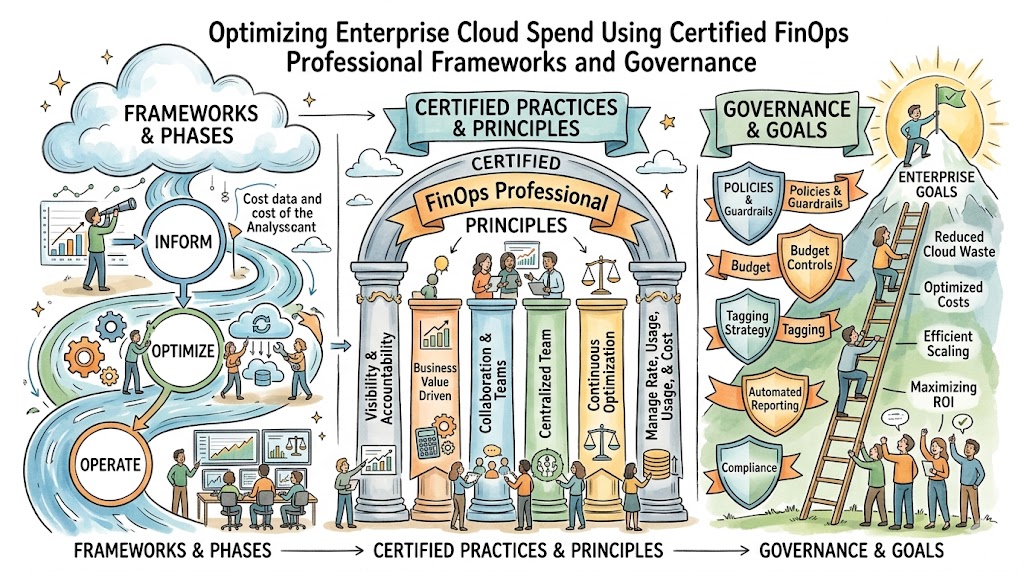
The Certified FinOps Professional is a rigorous credential that validates an individual’s ability to implement and lead FinOps practices within an enterprise. It goes beyond basic cost-tracking to focus on the cultural shift and real-time decision-making necessary for cloud agility. This certification represents a deep understanding of the FinOps lifecycle: Inform, Optimize, and Operate. It emphasizes production-focused learning, ensuring that engineers can manage unit economics rather than just looking at monthly bills. Modern enterprise practices demand this level of expertise to ensure that cloud-native workflows remain sustainable and profitable.
Who Should Pursue Certified FinOps Professional?
This certification is ideal for SREs, DevOps engineers, and cloud architects who find themselves increasingly responsible for the cost implications of their infrastructure choices. It is equally valuable for finance professionals and procurement officers who need to speak the language of engineering to manage cloud budgets effectively. Beginners with a strong interest in cloud economics will find a clear path forward, while experienced managers can use it to standardize practices across global teams. In the context of the Indian and global tech markets, this credential distinguishes leaders who can balance rapid innovation with strict financial discipline.
Why Certified FinOps Professional is Valuable and Beyond
As organizations continue to scale their cloud footprints, the demand for experts who can curb “cloud sprawl” is reaching an all-time high. This certification ensures long-term career relevance because it focuses on principles that apply regardless of whether you use AWS, Azure, or Google Cloud. Enterprise adoption of FinOps is no longer optional; it is a core component of digital transformation strategy. Investing time in this credential provides a significant return by positioning you as a strategic asset who understands both the CLI and the P&L statement. It protects your career against tool-specific volatility by grounding you in universal economic frameworks.
Certified FinOps Professional Certification Overview
The program is delivered via the official portal and hosted on the specialized website. This certification is structured to test both theoretical knowledge and the practical application of cost-saving strategies in complex environments. The assessment approach involves a mixture of scenario-based questions and deep dives into cloud billing data. It is designed for those who take ownership of the cloud journey, providing a clear structure for professional growth. The program ensures that practitioners can lead a FinOps team and drive cross-functional collaboration between disparate departments.
Certified FinOps Professional Certification Tracks & Levels
The certification hierarchy begins with foundation levels that introduce the core terminology and the six pillars of FinOps. As practitioners progress to the professional level, the focus shifts to advanced topics like commitment-based discounts and automated governance. Specialized tracks allow engineers to align their FinOps expertise with existing roles in SRE or Platform Engineering. These levels are mapped directly to career progression, moving from individual contributor roles to leadership positions. Each stage of the track builds upon the last, ensuring a comprehensive understanding of how to scale financial operations globally.
Complete Certified FinOps Professional Certification Table
| Track | Level | Who it’s for | Prerequisites | Skills Covered | Recommended Order |
| Core FinOps | Foundation | Beginners, Finance | Basic Cloud Knowledge | Terminology, Lifecycle | 1st |
| Engineering | Professional | SRE, DevOps | 2 Years Cloud Exp | Automation, Tooling | 2nd |
| Strategic | Advanced | Directors, Leads | Professional Cert | Governance, Policy | 3rd |
| Data | Specialist | Data Engineers | SQL, Analytics | Granular Billing, ETL | Optional |
Detailed Guide for Each Certified FinOps Professional Certification
Certified FinOps Professional – Foundation Level
What it is
This certification validates a fundamental understanding of the FinOps framework and the ability to communicate its value to stakeholders. It covers the basic principles of cloud transparency and the shared responsibility model between finance and engineering.
Who should take it
It is suitable for entry-level cloud analysts, non-technical managers, and engineers who are new to the financial aspects of cloud computing. No deep technical experience is required to start here.
Skills you’ll gain
- Understanding the Inform, Optimize, and Operate phases.
- Ability to identify common cloud waste areas.
- Knowledge of FinOps personas and their responsibilities.
Real-world projects you should be able to do
- Creating a basic cloud cost visibility dashboard for a small team.
- Identifying orphaned snapshots and unattached storage volumes.
Preparation plan
- 7–14 days: Review the official FinOps framework documentation and core terminology.
- 30 days: Attend a foundational workshop and practice with billing mock-ups.
- 60 days: Conduct a mock “FinOps audit” of a sample cloud environment.
Common mistakes
- Focusing too much on technical shortcuts and ignoring the cultural aspect.
- Underestimating the importance of precise terminology.
Best next certification after this
- Same-track option: Professional FinOps Practitioner.
- Cross-track option: Cloud Platform Associate.
- Leadership option: Project Management Professional.
Certified FinOps Professional – Professional Level
What it is
This level confirms the ability to execute complex cost-optimization strategies and automate financial guardrails. It proves that the candidate can handle multi-cloud billing complexities and drive significant savings for the enterprise.
Who should take it
This is for senior engineers, SREs, and dedicated FinOps practitioners with at least two years of experience in cloud environments. It requires a deep understanding of cloud provider pricing models.
Skills you’ll gain
- Implementing automated rightsizing and scheduling.
- Advanced management of Reserved Instances and Savings Plans.
- Developing custom billing ingestion pipelines for multi-cloud.
Real-world projects you should be able to do
- Automating the shutdown of non-production environments during off-hours.
- Designing a tagging strategy that achieves 95% cost allocation accuracy.
Preparation plan
- 7–14 days: Focus on advanced RI/SP mechanics and commitment strategies.
- 30 days: Solve scenario-based case studies involving large-scale cloud waste.
- 60 days: Build an automated reporting tool using cloud-native APIs.
Common mistakes
- Failing to account for the performance impact of rightsizing recommendations.
- Ignoring the organizational silos that prevent policy adoption.
Best next certification after this
- Same-track option: FinOps Specialized Architect.
- Cross-track option: SRE Certified Professional.
- Leadership option: FinOps Director Track.
Choose Your Learning Path
DevOps Path
The DevOps path focuses on integrating cost-awareness directly into the CI/CD pipeline. Engineers learn to treat “cost” as a first-class metric, similar to performance or security. By adopting this path, teams ensure that every code deployment is evaluated for its financial impact. This leads to the creation of self-healing infrastructure that scales down automatically when not in use.
DevSecOps Path
In this track, professionals learn the intersection of security compliance and financial waste. It covers how over-provisioned security appliances or logging systems can lead to runaway costs. Practitioners focus on optimizing the cost of security data retention while maintaining strict regulatory standards. It ensures that protecting the cloud does not become a financial burden on the organization.
SRE Path
The SRE path emphasizes the balance between reliability and cost, often referred to as “Error Budgets” meets “Financial Budgets.” SREs learn to optimize cloud resources to meet Service Level Objectives without over-spending. This path involves deep technical work in container orchestration and spot instance utilization. The goal is to build highly resilient systems that operate at the lowest possible cost point.
AIOps Path
This path explores how machine learning can be used to predict cloud spending patterns and detect anomalies. Professionals learn to implement AI-driven tools that provide proactive recommendations for cost saving. It focuses on large-scale data analysis of billing files to find hidden patterns in resource consumption. Practitioners in this path are at the forefront of automated financial operations.
MLOps Path
The MLOps path is specifically tailored for those managing the high costs associated with training and deploying machine learning models. It covers the optimization of GPU instances and the cost-effective management of large datasets. Engineers learn how to lifecycle data and models to ensure that innovation remains affordable. This path is crucial for companies scaling their AI initiatives.
DataOps Path
DataOps professionals focus on the financial implications of data gravity and egress fees. This path teaches how to architect data lakes and warehouses to minimize storage and query costs. It covers the implementation of data lifecycle policies that move cold data to cheaper storage tiers automatically. By mastering this, data engineers can deliver insights without the shock of high cloud bills.
FinOps Path
The pure FinOps path is for those who want to lead the entire cloud financial management practice. It focuses on the strategic alignment of engineering, finance, and executive leadership. Professionals learn to build a FinOps Center of Excellence and drive a culture of accountability across the entire company. This is the ultimate path for those aspiring to be Chief Cloud Officers.
Role → Recommended Certified FinOps Professional Certifications
| Role | Recommended Certifications |
| DevOps Engineer | * FinOps Foundation * Engineering Specialist |
| SRE | * Professional FinOps * SRE Optimization |
| Platform Engineer | * FinOps Architect * Infrastructure Automation |
| Cloud Engineer | * Foundation * Multi-Cloud Optimization |
| Security Engineer | * FinOps for Security * Compliance Audit |
| Data Engineer | * DataOps Financial Management |
| FinOps Practitioner | * Professional FinOps * Strategic Leadership |
| Engineering Manager | * FinOps Foundation * Leadership Track |
Next Certifications to Take After Certified FinOps Professional
Same Track Progression
Deepening your specialization in FinOps involves moving toward architectural mastery. This means focusing on multi-cloud environments where the complexity of billing increases exponentially. You should look for advanced certifications that cover specific cloud provider deep dives, such as AWS Certified Billing or Azure Cost Management. This ensures that you remain the go-to expert for high-level strategic cost decisions.
Cross-Track Expansion
Broadening your skills into SRE or Platform Engineering creates a “T-shaped” professional profile. Understanding how infrastructure is provisioned through Terraform or Pulumi allows a FinOps professional to suggest technical fixes, not just financial ones. Expanding into data science can also help in building better cost-prediction models. This cross-pollination of skills makes you invaluable in a modern, agile engineering organization.
Leadership & Management Track
Transitioning to leadership requires a shift from managing tools to managing people and processes. Certifications in ITIL or COBIT can complement your FinOps knowledge by providing a framework for IT governance. Focus on learning how to communicate cloud value to the CFO and Board of Directors. This path leads to roles like Director of Cloud Operations or Head of Infrastructure.
Training & Certification Support Providers for Certified FinOps Professional
DevOpsSchool
This provider offers extensive resources for those looking to master the intersection of automation and cloud economics. Their curriculum is updated frequently to reflect the latest shifts in the industry. They provide hands-on labs that simulate real-world cloud billing scenarios for better learning outcomes.
Cotocus
A specialized training firm that focuses on high-end engineering certifications for corporate teams. They offer tailored bootcamps that help organizations transition their entire staff to a FinOps-oriented mindset. Their instructors are veteran practitioners with years of field experience.
Scmgalaxy
This platform serves as a community hub and educational resource for supply chain and configuration management professionals. They provide unique insights into how FinOps integrates with the broader software development lifecycle. Their guides are known for being practical and easy to follow.
BestDevOps
Focusing on the elite tier of engineering practices, this provider delivers in-depth courses on cloud optimization. They emphasize the use of open-source tools to manage and monitor cloud spending. Their certification support is highly regarded by senior architects.
devsecopsschool.com
This site provides the necessary training to bridge the gap between security and financial efficiency. They offer specialized modules on how to implement “Shift Left” for cost just as one would for security. Their approach is holistic and highly technical.
sreschool.com
Dedicated to the principles of site reliability, this provider teaches how to maintain high availability while minimizing waste. Their courses are essential for SREs who want to take control of their cloud budgets. They focus on automation and system efficiency.
aiopsschool.com
This provider is the leader in teaching how to apply artificial intelligence to operational challenges. Their FinOps-related content focuses on anomaly detection and automated forecasting. It is the perfect place for data-driven professionals.
dataopsschool.com
Focused on the data lifecycle, this training provider helps engineers manage the costs of massive data estates. They offer specialized certifications in data storage optimization and egress management. Their labs use real-world datasets for practice.
finopsschool.com
As the primary host for this certification, they provide the most direct and authoritative learning path available. Their curriculum is the gold standard for anyone serious about becoming a FinOps professional. They offer a comprehensive suite of tools and resources for students.
Frequently Asked Questions (General)
- How difficult is the certification exam for a technical professional?
The exam is challenging because it requires both technical cloud knowledge and an understanding of financial accounting principles.
- How much time should I dedicate to studying each day?
Dedicated students usually spend one to two hours daily over a period of four to eight weeks to pass.
- Are there any mandatory prerequisites before I can take the professional exam?
While not always mandatory, having a foundational certification and two years of cloud experience is highly recommended for success.
- What is the typical return on investment for this certification?
Professionals often see immediate career advancement and the ability to save their companies thousands of dollars in cloud costs.
- Should I take the foundation level if I am already an experienced engineer?
Yes, because the foundation level establishes the specific language and framework used throughout the more advanced certification levels.
- Does this certification cover specific cloud providers like AWS or Azure?
The certification is cloud-agnostic, focusing on universal principles that apply across all major cloud service providers and platforms.
- How often do I need to renew my FinOps certification status?
Most certifications in this field require renewal every two to three years to ensure you stay current with industry trends.
- Is this certification recognized by major global technology firms and enterprises?
Yes, FinOps is a globally recognized framework and many Fortune 500 companies now require this certification for cloud roles.
- Can a finance professional without an engineering background pass this?
Yes, though they will need to study cloud infrastructure basics to understand where the costs are coming from.
- What is the best way to gain practical experience for the exam?
Working with cloud billing consoles and attempting to tag and organize resources in a lab environment is the best practice.
- Are there community groups available to help with the learning process?
There are many Slack and LinkedIn communities dedicated to FinOps where practitioners share advice and study tips.
- Does the certification focus more on tools or on culture?
It focuses heavily on both, as successful FinOps requires the right tools and a shift in organizational behavior.
FAQs on Certified FinOps Professional
- What specific billing tools are covered during the training process?
The training covers a variety of native tools like AWS Cost Explorer and Azure Cost Management, as well as third-party solutions.
- How does this certification help with career growth in India?
India has a massive cloud market, and companies are aggressively looking for experts to manage their growing infrastructure costs efficiently.
- Does the exam involve a lot of complex mathematical calculations?
It involves basic arithmetic and an understanding of percentages, but the focus is more on logic and strategic decision-making.
- Can I take the certification exam online from my home?
Yes, most certification paths offered through the official website provide a secure, proctored online examination option for global candidates.
- Is there a focus on container costs like Kubernetes in the exam?
The professional level specifically addresses the challenges of allocating costs in shared environments like Kubernetes and container clusters.
- How does FinOps differ from traditional IT financial management?
FinOps is designed for the variable, pay-as-you-go nature of the cloud, whereas traditional IT management focuses on fixed capital expenses.
- What is the passing score required to earn the certification?
The passing score varies slightly by level but generally requires answering at least 70% to 75% of the questions correctly.
- Are there practice exams available to test my knowledge before the final?
Yes, the official learning portal provides sample questions and practice tests to help candidates assess their readiness for the real exam.
Final Thoughts: Is Certified FinOps Professional Worth It?
Investing in this certification is a strategic move for any professional involved in the cloud ecosystem. As the industry moves away from unchecked spending toward a model of fiscal responsibility, the ability to manage cloud economics will be a required skill. This credential provides a clear, unbiased framework for achieving that goal. It empowers engineers to have a seat at the business table and gives finance professionals the technical context they lack. If you want to lead in the next era of cloud computing, mastering FinOps is not just an option; it is a necessity for long-term success.