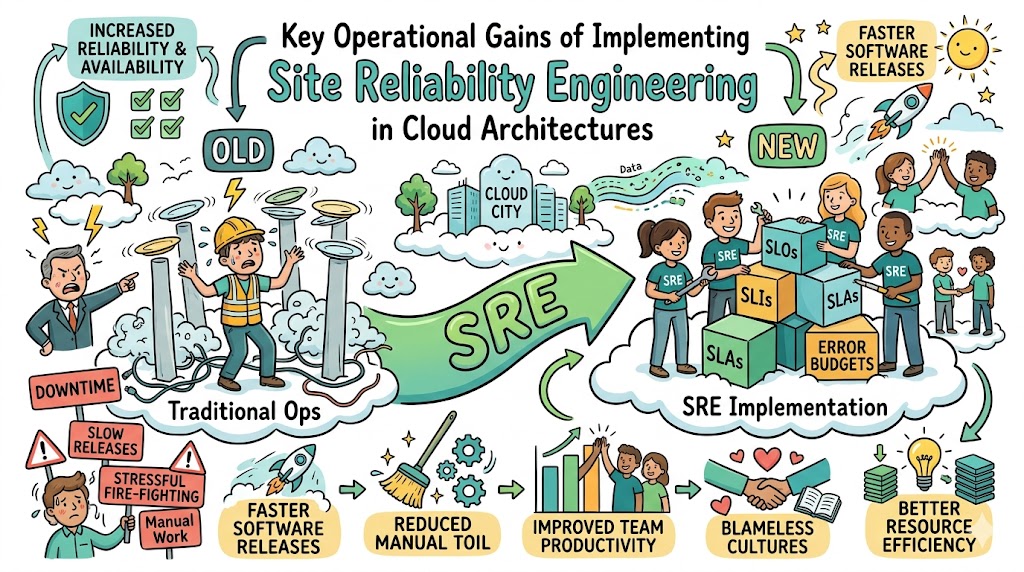
Imagine waking up at two in the morning because a sudden software glitch has completely crashed your checkout page, stopping thousands of transactions. Traditional operations teams would spend hours pointing fingers at developers while customers walked away frustrated. Today, massive digital platforms cannot survive such old-school, slow responses.
Modern software architectures face immense scaling challenges that traditional infrastructure setups simply cannot handle efficiently. For this reason, digital engineering teams require a proactive approach that treats operational management as a software problem. Embracing site reliability engineering allows businesses to automate repetitive tasks, balance fast software feature releases with system stability, and build highly resilient systems.
This deep-dive guide covers foundational principles, key metrics, structural cultural transformations, and industry-standard deployment tools. You will learn how to turn chaotic firefights into predictable systems engineering workflows. To master these essential frameworks, you can join the professional programs at sreschool to scale your infrastructure skills effectively.
The Origin of Systems Infrastructure
The Early Industrial Bottlenecks
Historically, software development and IT operations lived in completely separate silos. Developers focused exclusively on shipping new code features quickly to satisfy market demands. Meanwhile, operations teams faced the burden of keeping systems up and running on rigid physical servers.
Consequently, these opposing goals created massive internal organizational friction. Developers pushed frequent changes without understanding infrastructure limits, while operations teams resisted updates to prevent crashes. This lack of alignment resulted in slow deployments, frequent outages, and highly stressful work environments.
Moving Toward Unified Workflow Automation
As cloud computing emerged, the traditional boundaries between writing code and managing physical hardware began to blur. Organizations realized that manual server configurations could no longer keep pace with rapid deployment demands.
Therefore, cross-functional engineering teams began treating infrastructure management exactly like software development. They introduced automated configuration tools, version control for environments, and shared operational responsibility. This shift successfully transformed slow, manual processes into fast, predictable software delivery pipelines.
Global Expansion Across Commercial Ecosystems
Eventually, pioneering hyperscale tech enterprises codified these unified practices to manage thousands of distributed microservices. They proved that software engineers could successfully run large-scale production environments by applying engineering disciplines to operations.
Today, this methodology has expanded far beyond the world of tech giants. Enterprises in finance, healthcare, and e-commerce regularly implement these reliability frameworks to secure system uptime. As a result, maintaining resilient systems has shifted from an internal IT concern to a core business strategy.
Defining Strategic Operations Management
The Core Operational Structure
At its foundation, modern systems management functions by turning infrastructure operational workflows into predictable software code loops. The architecture relies on continuous telemetry pipelines that gather metrics, logs, and traces from every running service.
Then, this real-time data flows directly into automated tracking engines that monitor performance baselines. When a system metric crosses a dangerous threshold, the platform triggers automated self-healing scripts rather than manual human intervention. This technical flow ensures that systems detect and mitigate issues before users ever experience an outage.
Daily Tasks of Systems Coordinators
Reliability specialists spend their workdays split evenly between operational support and proactive software engineering. They do not sit around waiting for infrastructure alerts or manually configuring servers all day long.
Instead, they spend significant time writing automated scripts to eliminate repetitive maintenance work. They design deployment pipelines, build robust monitoring frameworks, and optimize database queries for better performance. Additionally, they participate in structural architectural reviews to ensure new services meet strict reliability standards before production rollout.
Localized Control vs. Broad System Architecture
Managing modern environments requires a deep understanding of both individual software components and broad system architecture. Localized control focuses on specific elements like a single container, an individual database instance, or a specific microservice.
In contrast, broad system architecture monitors how hundreds of these independent components interact across global cloud networks. Reliability engineers must balance these two perspectives daily. They optimize specific application code while simultaneously designing global failover strategies to prevent massive cascading network drops.
The Efficiency Mindset
Adopting this advanced operational framework requires a fundamental shift in engineering team culture. Teams must abandon the old mindset of fearing production failures and hiding system errors.
Instead, they view every system failure as a valuable data point to build stronger automation. This mindset prioritizes long-term architectural stability over quick, temporary technical fixes. By treating reliability as a core feature, organizations build a sustainable ecosystem where innovation and stability coexist safely.
The 7 Core Principles of Key Benefits of Adopting Site Reliability Engineering Practices
1. Embracing Risk and Managing Variability
This methodology accepts a fundamental truth: no software system can ever achieve perfect one hundred percent uptime. Striving for absolute perfection is incredibly expensive, slows down product innovation, and hurts engineering velocity.
Therefore, teams learn to calculate and accept a manageable amount of operational risk. They determine exactly how much downtime their users can tolerate without becoming frustrated. By managing this structural variability, businesses can safely deploy new features without wasting resources on unnecessary uptime goals.
2. Establishing Service Level Objectives (SLOs)
Systems require clear, quantitative targets to measure operational success objectively. Teams establish clear metrics that define acceptable performance from the perspective of the end user.
These measurable targets remove emotional debates between development and operations teams regarding system performance. If the data shows the system is meeting its objectives, developers can launch new features freely. However, if performance drops below the objective, the entire team focuses exclusively on fixing architectural stability.
3. Eliminating Toil and Manual Processes
Repetitive, manual tasks that lack long-term value can quickly drain engineering productivity. Activities like manually resetting servers, running routine database cleanups, or manually checking system logs are classified as toil.
Reliability engineering rules state that teams should cap manual operational work at fifty percent of their time. They must spend the remaining half of their time engineering software solutions to automate those exact tasks away. This strict elimination of manual work allows engineering teams to scale infrastructure without needing a massive headcount.
4. Monitoring & Observability Across the Pipeline
You cannot fix a system issue if you do not have complete visibility into your production environment. Modern reliability relies on deep observability, which goes beyond basic system alerts to provide true operational context.
Engineers configure detailed telemetry pipelines to track how requests travel across complex, multi-cloud microservices. This deep visibility helps teams spot subtle performance degradation before it triggers a complete system crash. Consequently, comprehensive monitoring transforms operations from reactive fire-fighting into clear, data-driven system management.
5. Automation Over Manual Coordination
When systems scale to handle millions of concurrent users, manual human coordination becomes a major operational bottleneck. This methodology prioritizes software automation over manual human intervention at every stage of the lifecycle.
Whether provisioning cloud infrastructure, running regression tests, or managing security patches, code handles the execution. Automation eliminates human error, speeds up operational tasks, and ensures environments remain completely identical. This engineering-first approach allows lean teams to manage massive, complex global platforms smoothly.
6. Release Engineering and Deployment Stability
Shipping software updates should be a boring, predictable, and frequent event rather than a risky gamble. Release engineering focuses on building automated pipelines that test and deploy code safely.
Teams use advanced deployment strategies like canary releases, where updates roll out to a tiny percentage of users first. If the telemetry data shows any performance drop, the pipeline automatically rolls back the update. This careful approach protects the user experience while maintaining a fast, continuous delivery model.
7. Simplicity in Network Architecture
Complex software architectures are inherently fragile because they create massive, unpredictable failure surfaces. This core principle demands that teams design the simplest possible systems that successfully fulfill business requirements.
Engineers avoid unnecessary software dependencies, keep data paths straightforward, and remove redundant code paths. Simple systems are significantly easier to monitor, troubleshoot, and fix when things go wrong. By prioritizing structural simplicity, organizations reduce hidden bugs and ensure long-term system stability.
Key Operational Concepts You Must Know
SLA vs. SLO vs. SLI — Explained Simply
Understanding operational metrics requires breaking down three closely related terms that govern reliability engineering. These terms form the foundation of data-driven performance management:
- Service Level Indicator (SLI): This is a quantitative measure of a system’s behavior in real time, such as request latency or error rates.
- Service Level Objective (SLO): This is a target reliability percentage specified for an SLI, defining acceptable performance over time.
- Service Level Agreement (SLA): This is the overarching legal agreement with users detailing financial penalties if the system fails to meet the SLO.
Error Budgets — The Game Changer for Operational Risk
An error budget represents the exact amount of downtime a system can legally afford before users complain. It is calculated simply as one hundred percent minus the agreed-upon SLO percentage. For instance, a system with a ninety-nine percent SLO has a one percent error budget for innovation and updates.
This metric acts as a formal balance control between development speed and system reliability. Developers use this budget to ship innovative features rapidly. However, if unexpected outages completely exhaust the error budget, the team must pause all new feature releases and focus entirely on stabilization.
Toil — The Silent Productivity Killer in Infrastructure
Toil defines manual, repetitive operational tasks that can be scaled linearly with system size and do not require creative engineering. Examples include manually creating user accounts or restarting services. Toil drains engineer morale and stalls long-term engineering progress.
To eliminate this productivity killer, teams must first measure time spent on manual operations. Next, they write automated scripts to handle these tasks and design self-healing workflows. Eliminating toil ensures that engineers focus on high-value system design rather than mundane, repetitive tasks.
Incident Management & Postmortems
When production outages inevitably occur, teams follow structured incident management frameworks to restore services quickly. They assign clear operational roles, coordinate internal communication channels, and document every step of the resolution.
Once the system is stable, the team conducts a blameless postmortem. This practice assumes that engineers acted with good intentions based on the information they had. Instead of punishing individuals, the postmortem focuses on identifying systemic weaknesses and creating concrete tracking tickets to prevent the issue from happening again.
Capacity Planning
Proactive infrastructure management requires forecasting resource needs long before demand spikes occur. Capacity planning analyzes historical data trends to predict future usage of CPU, memory, storage, and network bandwidth.
Engineers use these insights to optimize resource distribution and prevent costly system over-provisioning. During major seasonal traffic events, accurate capacity planning ensures systems scale up dynamically without crashing. This disciplined forecasting balances high application performance with smart cloud cost control.
The Four Golden Signals of Pipeline Performance
To maintain a healthy production environment, engineers focus heavily on tracking the four golden signals of monitoring. These core metrics provide an immediate snapshot of system health:
- Latency: The total time it takes for a system to process a specific request successfully.
- Traffic: A measure of the total demand being placed on the system, such as HTTP requests per second.
- Errors: The rate of requests that fail completely or return incorrect status codes.
- Saturation: A measure of the system’s utilization, showing how close resources are to their maximum limits.
Platform Implementation vs. Culture — What’s the Real Difference?
The Philosophy Difference
Many organizations make the mistake of treating reliability engineering as just another set of automation tools. In reality, platform implementation represents the technical toolset, while this framework represents a deeper cultural philosophy.
The cultural philosophy focuses on breaking down organizational silos, embracing systemic risk, and fostering blameless accountability. Without this cultural shift, installing advanced monitoring tools will not make a company resilient. True reliability requires combining modern automated platforms with a cultural commitment to collaborative engineering.
Roles & Responsibilities Compared
While DevOps and SRE share the core goal of breaking down silos, they focus on different areas of the software lifecycle. DevOps provides a high-level cultural framework for continuous delivery and shared responsibility. SRE applies specific engineering disciplines directly to operations to solve reliability challenges.
- DevOps engineers focus on building continuous delivery pipelines and speeding up feature delivery.
- Reliability engineers focus on monitoring production environments, managing error budgets, and maintaining system availability.
- DevOps focuses on the cultural alignment of development and operations teams.
- Reliability engineers focus on treating infrastructure strictly as a software engineering problem.
- DevOps measures success by deployment frequency and velocity.
- Reliability engineers measure success by system uptime, SLO compliance, and toil reduction.
Can You Have Both Disciplines?
These two technical philosophies are not competing frameworks that force an organization to choose between them. Instead, they complement each other perfectly within a modern engineering ecosystem.
DevOps provides the cultural foundation and delivery principles that allow teams to collaborate effectively. SRE provides the concrete metrics, engineering practices, and operational structures needed to sustain that collaboration at scale. Modern tech organizations use both models simultaneously to ship software rapidly while maintaining excellent uptime.
Which One Should Your Team Adopt?
Choosing an implementation path depends on your organization’s size, engineering maturity, and operational challenges. Small startups with simple applications should start with core DevOps workflows to set up automated deployment pipelines.
As your platform grows to manage complex distributed microservices, you must adopt disciplined reliability practices. If your engineering team spends more time dealing with production fires than building new features, you need dedicated reliability engineering. This transition ensures your operational structure scales smoothly alongside your growing business.
Real-World Use Cases of Modern Operations
How Tech Leaders Use Operational Metrics
Global technology leaders use precise operational metrics to drive business decisions and manage infrastructure. They link technical SLIs directly to business performance indicators, like tracking how database latency affects user checkout rates.
By analyzing real-time data feeds, these companies can shift user traffic away from degraded data centers instantly. This data-driven approach removes guesswork from operations. It ensures that infrastructure investments focus on improvements that directly enhance the end-user experience.
Chaos Engineering Approaches to Resilient Systems
Top engineering teams do not wait for unexpected production outages to test their system resilience. Instead, they practice chaos engineering, which involves intentionally introducing failures into production environments under controlled conditions.
They use specialized software tools to randomly shut down microservices, inject network latency, or terminate server instances. These controlled experiments help engineers uncover hidden software bugs and validate automated failover systems. By breaking things on purpose, teams ensure their systems can survive real-world emergencies without user disruption.
Handling Reliability at Massive Scale
Distributed microservices handling millions of transactions every second require specialized architectural patterns to stay reliable. Engineers implement circuit breakers that automatically isolate failing services before they drop the entire platform.
They use rate-limiting scripts to block malicious traffic spikes and prevent server saturation. Additionally, decoupling systems with asynchronous message queues prevents data loss during high-volume spikes. These architectural patterns allow global platforms to stay online even when individual components fail.
High-Availability in Fintech Operations
Financial technology platforms operate in a strict environment with zero tolerance for system downtime or data loss. A single minute of downtime can cause millions of dollars in lost transactions and severe regulatory penalties.
Fintech operations use multi-region deployment strategies, keeping duplicate environments running simultaneously in separate geographic locations. They use strict consensus algorithms to ensure databases stay perfectly synchronized across regions. This design guarantees that if a data center fails, another takes over instantly with no loss of transaction data.
Scaled-Down but Essential Systems for Startups
Early-stage startups do not need the massive, complex infrastructure used by global tech giants to benefit from reliability principles. They apply these core concepts efficiently by focusing on basic, high-impact automation workflows.
Startups use managed cloud services to handle basic scaling, set up simple monitoring alerts for critical user paths, and run blameless postmortems. This lightweight approach helps small teams eliminate repetitive toil early on. By building a reliable architecture from day one, startups can scale smoothly as their user base grows.
Common Mistakes in Operations Engineering
Mistake 1 — Confusing System Management with Just Being On-Call
A frequent mistake organizations make is rebranding their traditional system administrators as reliability engineers without changing their daily duties. If your engineers spend all their time manually responding to alerts and fighting production fires, you are not practicing true reliability engineering.
This discipline requires dedicating at least fifty percent of engineering time to proactive software projects. Treating engineers as a continuous on-call support team burns out staff and leaves underlying architectural flaws unfixed. True reliability engineering prioritizes proactive system design over reactive fire-fighting.
Mistake 2 — Setting Unrealistic SLOs
Product managers often demand perfect one hundred percent system uptime because they think it guarantees user satisfaction. However, setting unrealistic SLOs creates an overly restrictive environment that hurts engineering velocity.
Demanding perfect uptime means developers exhaust their error budget almost immediately, which stops all feature releases. Teams must set realistic targets based on actual user expectations and business needs. This balanced approach protects system stability while allowing the business to innovate and ship features quickly.
Mistake 3 — Ignoring Toil Until It’s Too Late
When engineering teams ignore repetitive, manual tasks, they build up massive amounts of operational debt. Manual work might seem manageable when a startup is small, but it scales linearly as systems grow.
Eventually, manual tasks like server configurations and account management consume the team’s entire schedule, leaving no time for engineering. This bottleneck slows down feature releases, frustrates engineers, and leads to costly human errors. Organizations must track and automate routine work early to keep their systems scalable.
Mistake 4 — Skipping Blameless Postmortems
When an outage happens, cultures focused on assigning blame look for an individual human scapegoat to punish. This approach causes engineers to hide mistakes, cover up system flaws, and avoid taking risks.
Skipping blameless postmortems prevents teams from uncovering the true root causes of system failures. Outages are rarely caused by a single human mistake; they usually happen because of flawed system designs. Fostering a blameless culture allows teams to openly analyze failures and build stronger, self-healing systems.
Mistake 5 — Monitoring Without Actionable Alerts
Setting up alerts for every single system metric creates a chaotic environment flooded with noisy notifications. When engineers receive dozens of non-critical alerts every hour, they quickly develop severe alert fatigue.
Consequently, they start ignoring notifications, which causes them to miss real, critical production issues. Alerts should only trigger when a system issue threatens an agreed-upon SLO and requires immediate human action. Filtering out low-priority noise keeps on-call teams focused and improves incident response times.
Mistake 6 — Not Involving Operational Engineers in the Design Phase
Many companies treat operations as an afterthought, passing fully built software to infrastructure teams only at deployment. This separation often leads to major production issues because developers rarely understand real-world infrastructure constraints.
Reliability engineers must participate in architectural design reviews from day one. Their input ensures that new applications are built with proper logging, modular decoupling, and automated scaling capabilities. Involving operational experts early saves significant engineering time and prevents costly production rewrites.
Essential Infrastructure Tools & Technologies
To implement these core principles effectively, engineering teams rely on a modern ecosystem of automation tools. To visualize how these technologies fit together across your infrastructure, review the foundational data categories below:
Infrastructure Operations Matrix
| Operational Category | Industry Standard Tooling | Primary Infrastructure Benefit |
| Monitoring & Observability | Prometheus, Grafana, Datadog, New Relic | Eliminates system blind spots with real-time telemetry pipelines. |
| Incident Management | PagerDuty, Opsgenie, VictorOps | Coordinates on-call routing and speeds up team incident response. |
| CI/CD & Automation | Jenkins, Spinnaker, Argo CD, GitLab | Ensures safe, automated, and repeatable application deployments. |
| Chaos Engineering | Chaos Monkey, Gremlin, LitmusChaos | Injects controlled failures to uncover hidden system bugs. |
| SLO Tracking | Nobl9, Sloth | Tracks reliability metrics against user satisfaction thresholds. |
Monitoring & Observability
Observability tools collect and analyze telemetry data from every layer of your infrastructure. Prometheus gathers time-series performance metrics, while Grafana turns that raw data into clear, interactive dashboards.
Enterprise platforms like Datadog and New Relic combine metrics, log management, and distributed tracing into a single view. These tools help teams trace requests across complex microservices and catch performance issues before they cause an outage. Deep observability transforms operations from guesswork into clear, data-driven system management.
Incident Management
When production outages occur, incident management platforms coordinate emergency responses to minimize downtime. PagerDuty and Opsgenie connect directly to monitoring tools to route critical alerts to the right on-call engineer.
These platforms manage rotation schedules, handle team escalations, and create dedicated communication channels automatically. By organizing the incident response process, these tools eliminate confusion and help teams restore services faster. Automated incident routing reduces downtime and minimizes stress for on-call teams.
CI/CD & Release Engineering
Automated deployment pipelines are essential for shipping software updates safely and predictably. Automation servers like Jenkins handle core code compilation and run regression test suites.
Modern continuous delivery platforms like Spinnaker and Argo CD automate advanced deployment patterns, such as canary and blue-green rollouts. These tools verify code health in staging environments before gradually routing live user traffic to the update. Automated pipelines remove human error from deployments and protect the user experience.
Chaos Engineering
Chaos engineering tools allow teams to safely test their system resilience by injecting controlled failures into production. Chaos Monkey randomly terminates server instances to ensure the surrounding cluster automatically heals itself.
Advanced platforms like Gremlin and LitmusChaos let engineers simulate specific failures, such as network latency or disk saturation. Running these controlled experiments helps teams uncover hidden bugs and validate their automated failover systems. Proactive failure testing ensures your platform can survive real-world emergencies.
SLO Management
Dedicated SLO platforms help teams track their reliability goals using real production data. Tools like Nobl9 and Sloth connect to your monitoring platforms to measure SLIs against your error budgets.
These platforms give developers and business leaders a clear, shared view of system health over time. They alert teams when an error budget is burning too fast, allowing them to adjust deployment speeds before an outage happens. Data-driven SLO tracking removes emotion from performance reviews and aligns product goals with system stability.
How to Become an Operations Expert — Career Roadmap
To help you navigate this career path, review the progression of core competencies and engineering focus areas below:
Technical Competency Pipeline
- Foundational Engineering Level: Focuses on Linux systems administration, bash scripting, and basic network troubleshooting.
- Infrastructure Automation Level: Focuses on containerization with Docker, infrastructure as code, and basic CI/CD pipeline design.
- Advanced Orchestration Level: Focuses on Kubernetes cluster management, distributed tracing setup, and large-scale cloud architecture.
- Strategic Reliability Level: Focuses on defining enterprise SLOs, designing global failover strategies, and leading blameless postmortems.
Skills Every Specialist Must Have
Building a career in this advanced field requires a strong mix of systems administration and software engineering skills. You must master Linux systems administration, including navigating terminal commands, managing processes, and troubleshooting network protocols.
Additionally, you need proficiency in a scripting language like Python or Go to automate repetitive tasks. Understanding container technologies like Docker and cloud platforms like AWS or Azure is also essential. These foundational skills allow you to treat infrastructure as code and design scalable systems.
The Professional Learning Path
Your educational journey should progress step-by-step, starting with basic systems administration before moving into complex automation architecture. Begin by mastering local environment setups, configuring web servers, and writing simple automation scripts.
Next, focus on cloud infrastructure provisioning, container orchestration with Kubernetes, and setting up centralized monitoring pipelines. Finally, learn to design global failover strategies, manage error budgets, and lead incident responses for distributed microservices. This structured progression turns you from a traditional IT admin into a strategic reliability expert.
Certifications Worth Pursuing
Earning industry-recognized certifications is an excellent way to validate your infrastructure expertise and advance your career. Aspiring specialists should target credentials that prove their hands-on skills with modern cloud platforms and orchestration tools.
Key certifications include the Certified Kubernetes Administrator (CKA) and the Certified Kubernetes Application Developer (CKAD). Cloud-specific credentials, such as the AWS Certified DevOps Engineer or the Google Cloud Professional Cloud DevOps Engineer, are also highly valued. These credentials demonstrate your ability to manage complex, production-grade cloud infrastructure.
Educational Resources with sreschool
While certifications are valuable, gaining practical experience is the true key to mastering large-scale systems management. The comprehensive training courses at sreschool provide hands-on labs that simulate real-world production challenges.
You will practice building automated CI/CD pipelines, configuring real monitoring systems, and managing live incident rollouts. Learning from experienced industry mentors helps you develop the practical problem-solving skills needed for enterprise environments. Exploring these professional programs accelerates your transition into high-paying operations engineering roles.
The Future of Systems Management
AI and Automation in System Optimization
The next evolution of infrastructure management relies heavily on integrating machine intelligence into telemetry pipelines. AI-driven monitoring platforms can analyze terabytes of system logs to detect subtle performance anomalies before they trigger an outage.
These smart systems speed up root cause analysis during incidents by automatically pointing out the exact code change that caused the failure. Automation is shifting from basic scripted tasks to intelligent, self-healing workflows. Embracing machine intelligence allows lean engineering teams to manage growing cloud environments efficiently.
Platform Engineering — The Evolution of Infrastructure
Platform engineering is rapidly changing how enterprise development teams interact with cloud infrastructure. Instead of requiring developers to configure their own cloud resources, platform teams build Internal Developer Platforms (IDPs).
These IDPs provide curated, automated self-service menus that allow developers to deploy code independently and safely. This trend reduces cognitive load for developers while ensuring all deployments follow corporate security and reliability standards. Platform engineering turns infrastructure management into a scalable internal product.
Management in Cloud-Native & Kubernetes Environments
As organizations migrate to dynamic, ephemeral cloud-native environments, traditional monitoring strategies are becoming obsolete. Managing hundreds of auto-scaling containers across distributed Kubernetes clusters requires highly adaptable observability frameworks.
Engineers use service meshes to manage service-to-service communication, enforce security policies, and track network latency dynamically. Cluster management focuses on optimizing resource requests to prevent node saturation across public clouds. Mastering container orchestration is essential for maintaining system reliability at scale.
Operational Skills That Will Matter Most
The changing tech landscape requires infrastructure specialists to continuously expand their technical skill sets. Future career success will rely on cloud financial optimization (FinOps), which balances high system reliability with smart cloud cost control.
Engineers must also master deep data observability to track complex data pipelines across distributed databases. Additionally, securing automated pipelines against supply chain vulnerabilities is becoming a core operational duty. Developing these advanced skills ensures you remain a highly valuable asset to modern digital enterprises.
FAQ Section
- What is the typical career path for an aspiring site reliability engineer?Most professionals transition into this role from background fields like software development or systems administration. You begin by mastering foundational scripting and Linux commands, then advance to managing cloud orchestration tools. Over time, you grow from a junior engineer into an enterprise systems architect or engineering manager.
- How does this discipline differ from traditional IT operations roles?Traditional IT operations rely on manual server setups, reactive firefighting, and isolated engineering silos. This modern discipline applies software engineering mindsets directly to infrastructure challenges to automate maintenance work. Reliability engineers spend half their time writing automation code to eliminate repetitive manual tasks permanently.
- What are the current global salary trends for reliability specialists?Due to the high demand for cloud infrastructure management, these specialists earn top-tier compensation across the tech industry. Base salaries regularly match or exceed standard software developer pay scales within major tech hubs. Senior architects and expert leads command significant premiums because of their specialized system stabilization skills.
- Can a small early-stage startup benefit from adopting these methodologies?Yes, implementing these core principles early prevents young startups from accumulating unmanageable operational debt. Small teams can use basic managed cloud services and simple alerts to keep their overhead low. Building a reliable deployment foundation from day one helps your platform scale smoothly as business demand grows.
- How do error budgets balance rapid software innovation with system safety?An error budget defines the exact amount of system downtime a business can safely afford before users get frustrated. Developers use this budget to launch new features quickly without needing constant management approval. If unexpected outages exhaust the budget, the team pauses feature releases to focus entirely on stability fixes.
- What programming languages are most useful for infrastructure automation?Python and Go are the industry-standard programming languages used to build modern infrastructure automation. Python is widely used for writing fast maintenance scripts, managing data pipelines, and interacting with cloud APIs. Go has become the foundational language for cloud-native tools like Docker, Kubernetes, and Terraform.
Final Summary
Maintaining clean system health requires moving away from manual infrastructure management and adopting an automated, data-driven engineering approach. Modern enterprises scale by setting clear SLOs, managing error budgets, and automating away repetitive operational tasks. This structural transition protects the end-user experience, reduces developer friction, and ensures platforms remain resilient during major traffic spikes. Combining a blameless culture with strong continuous delivery pipelines allows businesses to innovate rapidly without sacrificing system stability.
The future of digital enterprise performance relies on building self-healing architectures that scale dynamically alongside market demands. As systems become more complex, the need for skilled infrastructure specialists will continue to grow. You can prepare for these future engineering challenges by exploring the expert-led courses at sreschool. Embracing these advanced operational frameworks helps organizations turn infrastructure reliability into a sustainable, long-term competitive advantage.