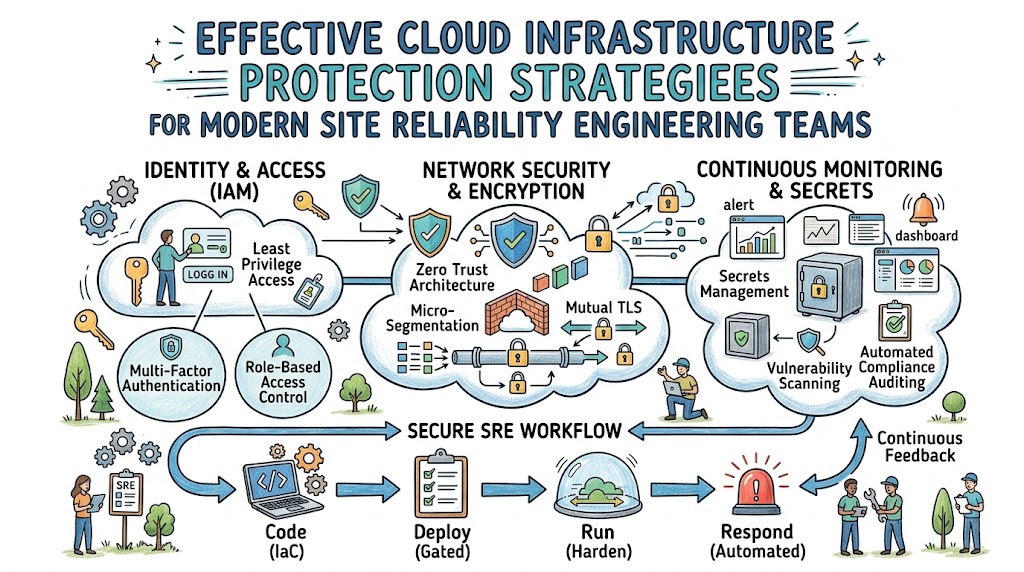
Ensuring enterprise cloud environment resilience requires a proactive approach toward securing distributed systems against modern technical threats. As organizations transition from legacy datacenters to dynamic cloud environments, engineering teams must embed protective controls into every stage of their software development pipelines. This alignment prevents system disruptions, safeguards sensitive business data, and maintains operational continuity under heavy workloads.
Implementing comprehensive cloud security safeguards helps your engineering organization minimize risk while maintaining high service availability. By integrating these essential engineering strategies, modern teams can easily protect their cloud infrastructure and build highly resilient services. You can master these modern operational and architectural concepts by exploring the comprehensive resources available at Sreschool.
Maintaining a strong defense requires continuous infrastructure auditing, strict identity controls, and automated incident response workflows. Consequently, engineering teams that adopt systematic protection practices drastically reduce their system vulnerability window during operational incidents. Thus, your infrastructure engineers gain deeper confidence in their production environments and safely accelerate software deployment velocity.
Defining Integrated Cloud Security Strategies Within SRE Workflows
Integrating defensive practices directly into core systems architecture allows modern infrastructure teams to eliminate potential system vulnerabilities early. Rather than treating technical safeguards as a final compliance checkpoint, engineers embed automated auditing policies into automated continuous deployment pipelines. This systematic integration guarantees that security configurations scale smoothly along with your cloud workload requirements.
Establishing rigorous infrastructure controls forms the foundation of this methodology, allowing engineering teams to protect dynamic cloud resources effectively. Consequently, you can observe system access patterns continuously, pinpointing unauthorized configuration changes before they cause critical system downtime. This real-time visibility enables organizations to make informed decisions regarding network policies and data permissions.
Furthermore, these structural workflows transform how infrastructure teams interact with cloud environments through automated security checks. Instead of relying on manual code audits, developers utilize automated compliance templates to deploy infrastructure safely. Therefore, every team member maintains a clear understanding of compliance requirements, which prevents inadvertent data exposure and strengthens internal security postures.
Ultimately, this unified discipline prioritizes sustainable cloud protection over temporary operational hotfixes, establishing a reliable lifecycle for production services. By treating security rules as infrastructure code, teams can replicate verified security policies across multi-region environments seamlessly. Thus, your organization builds a durable engineering environment capable of handling unexpected access spikes and evolving threat vectors.
Key Operational Concepts You Must Know
Implementing the Principle of Least Privilege
The principle of least privilege ensures that every cloud service, human operator, and automated script receives only the minimum permissions necessary to complete its assigned tasks. For instance, an application server requiring read access to a storage bucket should never possess administrative write permissions across the enterprise tenant. Enforcing these tight boundaries prevents compromised service accounts from causing widespread infrastructure damage.
Managing these permissions effectively requires continuous access reviews, temporary session credentials, and automated identity management policies across your entire cloud organization. If an identity displays unusual permission usage, your automated security systems must restrict those access rights immediately. Consequently, these granular identity policies act as a defensive boundary, isolating compromised components and protecting core enterprise assets.
Enforcing Zero Trust Network Architectures
A Zero Trust network architecture operates on the explicit assumption that technical threats exist both inside and outside network perimeters. Consequently, every incoming connection request must undergo strict authentication, authorization, and encryption before gaining access to underlying microservices. This continuous verification model eliminates implicit trust based purely on physical location or internal network IP addresses.
+------------------+     +------------------+     +------------------+
| Incoming Request | --> | Identity & Context| --> | Microservice /   |
| (Untrusted Zone) |     |  Verification    |     | Cloud Resource   |
+------------------+     +------------------+     +------------------+
Implementing this defensive model requires deploying micro-segmentation policies, mutual TLS encryption, and centralized identity verification gateways across all services. If a malicious actor breaches an outer network boundary, micro-segmentation prevents them from moving laterally into adjacent database clusters. Therefore, adopting a Zero Trust posture significantly reduces your system’s overall attack surface and contains unexpected operational breaches.
Managing Cloud Infrastructure Secrets Safely
Cloud secrets include sensitive API keys, database credentials, encryption keys, and digital certificates required for application communications. Storing these credentials in plaintext within source code repositories exposes your platform to severe security risks and unauthorized exploitation. Engineering teams must store all credentials within centralized, hardware-backed secret management systems that encrypt data both at rest and in transit.
| Secret Category | Potential Vulnerability Risk | Recommended Mitigation Strategy |
|---|---|---|
| API Keys | Hardcoded keys leaked in public source code | Use centralized secret vaults with dynamic credential injection. |
| Database Credentials | Static passwords used across multiple environments | Implement automated password rotation policies via dynamic secret engines. |
| TLS Certificates | Expired certificates causing application outages | Automate certificate generation and renewal using managed public key infrastructure. |
Applying this dynamic secrets management strategy consistently ensures that your cloud platforms protect sensitive authentication tokens across all environments. Furthermore, it automates credential rotation, eliminating the need for manual password updates and reducing operational overhead for site reliability engineers.
Automating Infrastructure Code Security Scanning
Integrating automated security scanners into your continuous deployment pipelines allows software teams to identify configuration defects before code reaches production. Tools should scan infrastructure templates for common misconfigurations, such as open storage buckets, exposed database ports, and unencrypted disk volumes. Catching these vulnerabilities early prevents risky deployments and maintains strict compliance standards.
Additionally, formal automated gating procedures must block non-compliant code pulls from merging into production branches without manual review. If a configuration file violates mandatory security policies, the deployment pipeline must automatically halt and notify the responsible engineering team. This immediate feedback loop encourages software developers to fix misconfigurations quickly while learning best practices.
Platform Implementation vs. Culture — What’s the Real Difference?
Deploying Technical Protection Tooling Infrastructure
Building a secure cloud ecosystem requires deploying automated compliance checkers, web application firewalls, and centralized logging mechanisms across your entire cloud deployment. These technical platforms collect security telemetry in real time, allowing on-call engineers to respond rapidly to unauthorized access attempts. However, simply installing sophisticated security tools will not automatically protect your business from sophisticated social engineering attacks.
Without proper rule configuration and continuous maintenance, advanced security platforms can generate excessive noise, swamping engineers with false alarms. Technical security tools serve as the defensive engine, but they require human intelligence to analyze potential threats accurately. Therefore, technical tools form a necessary operational layer, but they cannot replace a well-trained, safety-conscious engineering team.
Cultivating a Blameless Security Awareness Culture
A healthy operational culture encourages engineering teams to report security misconfigurations, inadvertent credential leaks, and system anomalies without fear of personal penalty. In a blameless culture, organizations recognize that technical mistakes stem from inadequate guardrails rather than individual negligence. This supportive atmosphere motivates developers to flag risks early, allowing the team to patch vulnerabilities before attackers exploit them.
+-------------------------------------------------------+
|                 Blameless Culture                     |
|  - Focuses on systemic safeguards                     |
|  - Encourages early threat reporting                  |
|  - Promotes psychological safety                      |
+-------------------------------------------------------+
                           ^
                           | (Divergent Approaches)
                           v
+-------------------------------------------------------+
|                  Blameful Culture                     |
|  - Punishes individual operational errors             |
|  - Leads to hidden security flaws                     |
|  - Creates defensive, hesitant teams                  |
+-------------------------------------------------------+
When management punishes accidental mistakes, engineers tend to conceal security incidents, leaving critical system vulnerabilities exposed to potential exploitation. Conversely, combining modern security platforms with a supportive workplace culture allows your organization to build highly resilient platforms. Cultivating this collaborative environment ensures that your engineering team treats every security review as a valuable opportunity to harden infrastructure.
Real-World Use Cases of Modern Operations
Mitigating Data Leakage in Multi-Tenant Cloud Environments
A fast-growing cloud software provider experienced significant security risks when legacy storage bucket permissions allowed shared data visibility across distinct customer environments. To eliminate this critical risk, the engineering team introduced automated policy enforcement, applying strict isolation rules to every tenant directory. This architectural upgrade ensured that multi-tenant applications could only access explicit, authenticated customer datasets.
Additionally, they implemented continuous resource monitoring to identify and remediate public storage permissions automatically within seconds of creation. As a result of this policy automation, their infrastructure compliance score improved dramatically, protecting sensitive customer records from unauthorized exposure. This successful implementation shows how combining clear isolation patterns with automated policy scanning protects vital business data.
Defending Cloud Microservices Against Distributed Denial of Service Attacks
During a high-profile product release, a major online gaming company encountered a massive distributed denial of service attack targeting its core authentication APIs. The influx of malicious request traffic threatened to overwhelm application servers, causing widespread latency for legitimate end users. This dynamic traffic overload required immediate intervention to maintain system stability and service availability.
[ Attack Traffic Spike ] ---> [ API Gateway Latency ] ---> [ Rate Limiter Engaged ]
                                     ^                                    |
                                     |                                    v
                                     +--- [ Malicious IPs Blocked ] <-----+
Fortunately, the on-call infrastructure response team identified the source IPs using real-time traffic dashboards and activated automated edge rate limiting. They deployed web application firewall rules dynamically, filtering out malicious traffic before it reached backend microservice clusters. By reviewing this incident afterward, they constructed automated edge defenses that permanently mitigated similar large-scale traffic threats.
Common Mistakes in Operations Engineering
Over-Privileging Service Accounts and Role Accumulation
A widespread mistake in cloud engineering is granting broad, administrative permissions to service accounts to resolve complex software access issues quickly. Over time, these elevated rights accumulate across environments, creating massive, unmonitored attack vectors for malicious actors to exploit. If an attacker compromises a high-privilege service account, they gain unrestricted access to your critical data resources.
To solve this issue, teams should audit active cloud permissions regularly and revoke unused rights using automated privilege management tools. Enforce role-based access controls that grant specific permissions based on the explicit technical requirements of each individual service. Maintaining minimal permission profiles keeps your cloud architecture secure and limits the potential blast radius of compromised credentials.
Ignoring Automated Patch Management for Cloud Workloads
Failing to update container base images, operating system kernels, and software dependencies regularly leaves cloud infrastructure exposed to known software vulnerabilities. Some teams avoid automated patching out of fear that updates might introduce software bugs or disrupt critical production services. However, delaying updates ensures that your infrastructure remains exposed to known exploits that malicious actors scan for constantly.
Furthermore, teams should integrate automated patch management pipelines that test and deploy software updates across staging environments automatically. Validating system stability through automated tests gives engineers the confidence required to push updates into production environments swiftly. Prioritizing automated updates transforms routine maintenance into a seamless operational process that continuously protects system health.
How to Become an Operations Expert — Career Roadmap
Mastering Cloud Fundamentals and Infrastructure Automation
Building a successful career in cloud security engineering requires a deep foundational understanding of networking, cloud identity management, and operating system controls. You must understand how cloud providers handle network isolation, firewalls, and resource policies to design secure architectures effectively. Additionally, mastering infrastructure-as-code tools like Terraform or CloudFormation allows you to deploy reproducible, security-hardened environments programmatically.
- Cloud IAM Foundations: Master role-based access, identity federation, and fine-grained resource permission policies.
- Network Segmentation: Study virtual private cloud design, subnet isolation, and automated firewall configuration.
- Declarative Infrastructure: Write automated infrastructure templates to deploy secure, standardized cloud components reliably.
Focusing on these foundational concepts equips you with the necessary expertise to protect complex cloud environments efficiently. Automation ensures that your security controls remain consistent across all deployments, reducing human configuration errors significantly.
Deepening Cloud Native Defense and Compliance Mastery
As you advance in your career, you must learn to secure containerized applications running on orchestration platforms like Kubernetes. Understanding container runtime security, admission controllers, and service mesh encryption helps you defend modern microservice architectures against sophisticated attacks. Expanding your knowledge in these technical areas prepares you to lead comprehensive security initiatives across enterprise platforms.
- Container Runtime Protection: Implement image signing, vulnerability scanning, and restricted runtime security profiles.
- Service Mesh Encryption: Configure mutual TLS policies to secure communication channels between internal cloud microservices.
- Automated Compliance Auditing: Deploy continuous monitoring tools to verify regulatory compliance across multi-cloud environments automatically.
Developing deep expertise in these cloud-native defense strategies enables you to manage complex cloud operations with confidence and speed. Consequently, you can build self-healing, highly secure platforms that adapt smoothly to evolving threat patterns and business demands.
FAQ Section
- How does cloud security differ from traditional on-premises IT infrastructure protection?Cloud protection focuses heavily on identity management, continuous API auditing, and software-defined perimeter rules rather than static physical firewalls. This shift requires infrastructure teams to automate compliance controls and secure dynamic, ephemeral cloud resources effectively.
- What is the most effective way to handle shared security responsibilities in cloud environments?Organizations must understand that cloud providers protect the underlying physical infrastructure, while the customer remains responsible for securing data, configurations, and applications. Defining clear operational boundaries prevents gaps in coverage and ensures all technical components stay properly configured.
- How often should engineering teams review cloud identity permissions and access roles?Teams should automate continuous permission analysis and conduct formal human reviews on a quarterly basis to identify over-privileged accounts. Regular audits prevent permission accumulation and ensure that inactive service credentials are completely removed from the environment.
- Why is dynamic secret rotation important for modern cloud application safety?Dynamic secret rotation minimizes the exposure window if a credential leaks, automatically invalidating old passwords and generating fresh credentials regularly. This continuous rotation limits an attacker’s window of opportunity and keeps backend systems secure against credential theft.
- Can automated security tools replace human code reviews during software deployments?Automated tools scan code quickly for known misconfigurations, but human reviews remain essential for evaluating high-level architecture decisions and logical flaws. Combining automated pipeline checks with human peer reviews ensures both technical compliance and overall structural safety.
Final Summary
Implementing effective cloud infrastructure protection strategies is essential for building resilient, highly available cloud environments that safeguard enterprise resources. By applying the principle of least privilege, zero trust network controls, and dynamic secrets management, teams can secure systems systematically. Balancing these technical protection platforms with a supportive, blameless culture keeps your engineering teams proactive, vigilant, and highly efficient.
As cloud architectures continue to scale in complexity, investing in automated compliance pipelines serves as your strongest defense against technical vulnerabilities. Embracing these foundational practices helps your engineering organization transform security requirements into seamless operational workflows that drive platform reliability. Ultimately, prioritizing integrated cloud security enables your business to innovate rapidly while delivering a safe, dependable experience for all users.