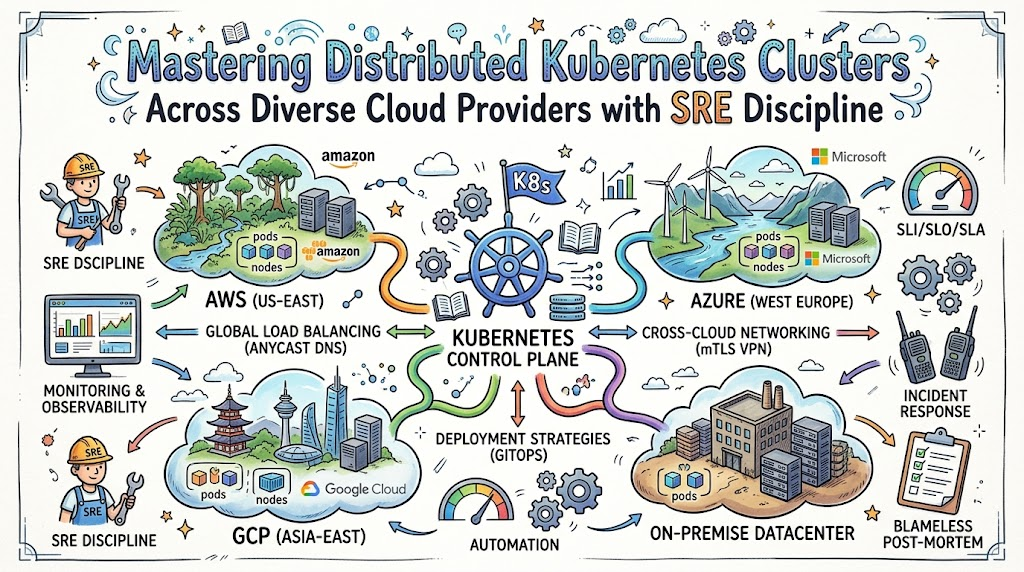
Managing container workloads across multiple cloud providers has become a vital requirement for organizations seeking high availability and vendor independence. When infrastructure spans diverse public clouds, engineering teams must maintain consistent deployment pipelines, unified security policies, and reliable operational visibility. Site Reliability Engineering provides the structural framework necessary to handle this complexity without sacrificing developer agility or system stability.
Operating a multi-cloud environment requires teams to treat infrastructure as declarative code, ensuring identical cluster behaviors regardless of the underlying cloud vendor. By applying proven engineering principles, organizations can eliminate single points of failure, optimize infrastructure expenses, and meet strict regional compliance mandates. You can master these advanced cloud orchestration and architectural strategies by exploring the professional resources at Sreschool.
Distributed systems naturally introduce network latency, policy drift, and fragmented telemetry across different infrastructure providers. Consequently, operations teams need automated reconciliation loops, centralized control planes, and robust service mesh architectures to govern their fleet effectively. Building this structural resilience ensures that your critical business workloads remain online even during complete cloud provider outages.
Architectural Foundations of Multi-Cloud Kubernetes Orchestration
Multi-cloud Kubernetes architecture relies on abstracting provider-specific implementations into a unified operational interface. Instead of managing disparate control planes with proprietary tools, engineers utilize standardized Application Programming Interfaces to interact with all clusters uniformly. This abstraction layer prevents teams from building vendor-locked infrastructure and establishes consistent runtime environments across AWS, Azure, Google Cloud, and private datacenters.
+-------------------------------------------------------------+
|                  Centralized GitOps Engine                  |
+-------------------------------------------------------------+
                               |
       +-----------------------+-----------------------+
       |                                               |
       v                                               v
+-----------------------------+         +-----------------------------+
|    AWS EKS Cluster Fleet    |         |    GCP GKE Cluster Fleet    |
|  - Ingress Controller       |         |  - Ingress Controller       |
|  - CNI Plugin               |         |  - CNI Plugin               |
|  - Local Storage Class      |         |  - Local Storage Class      |
+-----------------------------+         +-----------------------------+
Achieving this uniformity requires teams to decouple workload configurations from the underlying hardware and network topologies. For instance, developers must avoid hardcoding cloud-specific load balancers or storage classes directly into their deployment manifests. Instead, teams define generalized ingress resources and dynamic persistent volume claims that resolve automatically within each specific cloud environment.
Furthermore, managing multi-cloud clusters demands an agent-based pull architecture rather than direct, push-based API access. In this model, lightweight agents running inside each remote cluster continuously synchronize state from a central configuration repository. This approach eliminates the dangerous requirement of opening cluster API endpoints to the public internet, thereby hardening your security perimeter.
Ultimately, standardizing cluster provisioning using tools like Cluster API allows engineers to manage Kubernetes clusters as declarative custom resources. Therefore, you can create, update, and decommission entire cluster fleets using the exact same declarative workflows you use for standard applications. This repeatability streamlines infrastructure scaling and drastically cuts operational overhead.
Unified Fleet Management and Configuration Synchronization
Operating multiple Kubernetes clusters requires a single source of truth for desired cluster state to prevent dangerous configuration drift. GitOps serves as the operational standard here, where Git repositories store all manifests, policies, and networking rules for the entire fleet. When an engineer pushes an update, automated controllers detect the diff and safely apply the changes across all target clusters.
+------------------+     +--------------------+     +-------------------+
|  Git Repository  | --> |  ArgoCD / Flux     | --> | Multi-Cloud Nodes |
|  (Source Truth)  |     |  (Reconciliation)  |     | (Target Clusters) |
+------------------+     +--------------------+     +-------------------+
This automated synchronization guarantees that security baselines, network policies, and monitoring daemons exist on every single cluster without manual intervention. If an engineer manually alters a cluster setting through a local command line, the GitOps controller immediately overwrites the change. Consequently, this strict reconciliation loop protects production environments from unauthorized and untracked modifications.
Additionally, progressive rollout patterns allow teams to release updates safely across distinct geographic regions and cloud providers. Engineers can deploy a change to a single canary cluster, observe real-time telemetry, and only proceed to broader fleets once performance metrics stabilize. This systematic rollout strategy reduces the blast radius of unexpected software defects and infrastructure regressions.
Key Operational Concepts You Must Know
Global Service Level Objectives and Multi-Cluster Error Budgets
Service Level Objectives in a multi-cloud topology must measure overall end-user satisfaction rather than the uptime of a single, isolated compute node. SRE teams define global metrics that aggregate request success rates and latencies across all active regions. When a single cloud region degrades, the global error budget absorbs the impact while automated traffic routers redirect users to healthy clusters.
- Composite Latency Budgets: Measure the 99th percentile round-trip time experienced by global end users across all cloud providers.
- Regional Availability Targets: Track individual cluster health to trigger automated workload evacuation before user traffic experiences significant failure.
- Error Budget Burn Rates: Monitor the speed at which errors consume allowable downtime, automatically freezing deployments when thresholds exceed safe limits.
Managing these metrics effectively requires continuous telemetry aggregation into a centralized observability backend. If your multi-cloud error budget burns too fast, your automated systems must trigger traffic shedding or fallback routing immediately. Thus, global metrics provide the operational guardrails needed to maintain reliable user experiences across diverse infrastructure.
Cross-Cloud Networking and Service Mesh Topologies
Connecting Kubernetes clusters across disparate cloud networks presents major routing, encryption, and service discovery challenges. Engineering teams implement multi-cluster service meshes to establish a unified data plane spanning multiple cloud providers. This architecture enables secure pod-to-pod communication across different cloud boundaries using mutual Transport Layer Security.
+---------------------------+               +---------------------------+
|      AWS EKS Cluster      |               |      Azure AKS Cluster    |
|   +-------------------+   |    mTLS Wan   |   +-------------------+   |
|   | Pod: Auth Service | <-+==============+-> | Pod: User Profile |   |
|   +-------------------+   |   Encrypted   |   +-------------------+   |
+---------------------------+               +---------------------------+
Furthermore, multi-cluster service discovery allows microservices in one cloud to locate and communicate with services running in another provider seamlessly. Distributed DNS resolvers translate global service names into local or remote IP addresses based on latency and endpoint health. Consequently, applications maintain seamless communication without needing custom, hardcoded networking logic inside their application code.
Centralized Identity and Role-Based Access Control
Managing separate user credentials and permissions for every cloud provider introduces massive administrative overhead and critical security vulnerabilities. SRE teams implement federated OpenID Connect authentication to unify access controls across all Kubernetes clusters. Engineers authenticate using a single corporate identity provider, granting them standardized access rights based on their specific organizational role.
| Access Management Layer | Traditional Single-Cloud Approach | Modern Multi-Cloud SRE Approach |
|---|---|---|
| Authentication Source | Provider-specific IAM (e.g., AWS IAM) | Centralized OIDC / SAML Identity Provider |
| Cluster RBAC | Manually configured per cluster | Declaratively managed via GitOps repositories |
| Secret Management | Local Kubernetes secrets or cloud key vault | External secrets synced from HashiCorp Vault |
| Audit Logging | Fragmented cloud provider audit streams | Unified security information and event log backend |
Standardizing access policies through declarative configuration prevents accidental privilege escalation across different environments. Moreover, enforcing the principle of least privilege ensures developers only access the specific namespaces required for their daily tasks. This centralized governance keeps your infrastructure compliant with strict regulatory standards.
Automated Traffic Steering and Global Server Load Balancing
Routing user traffic dynamically across multiple cloud providers requires Global Server Load Balancing coupled with intelligent Anycast DNS systems. These traffic managers continuously poll health endpoints on each ingress controller across all active cloud regions. If an entire cloud region experiences an outage, the global routing engine shifts DNS responses to healthy clusters within seconds.
Additionally, teams use weighted routing policies to balance operational costs and resource utilization between different cloud providers. You can route baseline traffic through reserved, lower-cost instances while bursting excess traffic into secondary clouds during unexpected spikes. This dynamic traffic control ensures optimal system performance while keeping infrastructure expenditures within budgetary constraints.
Platform Implementation vs. Culture — What’s the Real Difference?
Deploying Multi-Cluster Management Platforms
Building a multi-cloud platform involves deploying control planes, continuous delivery pipelines, unified logging collectors, and automated policy engines. These technical tools provide the mechanisms required to govern hundreds of distributed Kubernetes clusters efficiently. However, simply installing these software suites does not automatically guarantee operational resilience or high availability.
+-------------------------------------------------------------+
|             Platform Tools (The Technical Engine)           |
|   - Kubernetes APIs, Service Meshes, GitOps Controllers     |
+-------------------------------------------------------------+
                              +
+-------------------------------------------------------------+
|             SRE Culture (The Operational Mindset)           |
|   - Blameless Post-Mortems, Shared Ownership, SLI Discipline|
+-------------------------------------------------------------+
                              =
+-------------------------------------------------------------+
|             Resilient Multi-Cloud Operations                |
+-------------------------------------------------------------+
Without rigorous operational discipline, sophisticated management platforms quickly become unmaintainable, creating alert fatigue and confusing deployment workflows. Engineering teams must understand how to configure, tune, and maintain these platforms to extract real operational value. Therefore, platform tooling serves as the technological foundation, but human competence determines actual system reliability.
Fostering SRE Mindsets and Operational Ownership
A resilient multi-cloud strategy demands a cultural shift where software development teams share full accountability for production stability. Instead of throwing code over the wall to an operations team, developers actively participate in on-call rotations and cluster architecture reviews. This shared responsibility encourages engineers to design fault-tolerant applications capable of surviving sudden node evictions and cross-cloud latency spikes.
Furthermore, organizations must cultivate a blameless post-mortem culture that treats infrastructure outages as systemic learning opportunities. When a multi-cloud network partition occurs, teams analyze the architectural failure points rather than blaming individual engineers. This supportive environment encourages transparency and drives continuous improvements across your entire software engineering lifecycle.
Real-World Use Cases of Modern Operations
Active-Active Disaster Recovery Across Heterogeneous Clouds
A global financial technology enterprise needed to guarantee zero downtime for its payment processing engine, even during complete cloud provider outages. The engineering team deployed identical, active-active Kubernetes clusters across AWS and Google Cloud Platform, using a distributed service mesh for cross-cloud communication. Application state was synchronized in real time using a distributed, cloud-agnostic database cluster.
                      [ Global Anycast DNS Router ]
                                   |
            +----------------------+----------------------+
            |                                             |
            v                                             v
+-------------------------+                 +-------------------------+
|   AWS Primary Region    |                 |    GCP Secondary Region |
|  - Ingress Gateway      |                 |  - Ingress Gateway      |
|  - Stateless App Pods   | <== mTLS Sync == |  - Stateless App Pods   |
|  - Distributed DB Node  |                 |  - Distributed DB Node  |
+-------------------------+                 +-------------------------+
When a major fiber cut caused a massive networking blackout across a primary cloud region, the global load balancer automatically redirected all transactions to the secondary provider. Because the architecture avoided provider-specific APIs, the application continued processing payments without dropping a single user session. This real-world implementation proves that vendor-agnostic design provides the ultimate protection against catastrophic cloud infrastructure failures.
Dynamic Workload Bursting and Spot Instance Optimization
An artificial intelligence research company faced massive compute costs when training large-scale machine learning models on dedicated cloud instances. To optimize their spending, the SRE team implemented a multi-cloud Kubernetes strategy that dynamically scheduled training jobs on discounted spot instances across multiple providers. An automated controller monitored spot market pricing in real time and provisioned worker nodes where compute was cheapest.
- Cost-Aware Scheduling: Specialized custom controllers match compute requirements with the lowest real-time market prices across clouds.
- Automated Checkpointing: Machine learning workloads save state every ten minutes to object storage, ensuring resilience against spot instance terminations.
- Graceful Workload Migration: When a cloud provider reclaims spot capacity, the scheduler instantly spins up replacement pods in an alternate cloud.
By decoupling their compute layer from any single cloud vendor, the company reduced its monthly infrastructure expenses by more than 40%. Moreover, their training pipelines achieved faster completion times by utilizing available GPU capacity across several cloud ecosystems simultaneously. This strategy shows how multi-cloud Kubernetes architectures unlock significant financial and performance advantages.
Common Mistakes in Operations Engineering
Overcomplicating Network Topologies and CNI Plugins
A frequent mistake in multi-cloud operations is attempting to build a fully flat, interconnected software-defined network spanning every single cluster. Creating complex Virtual Private Network tunnels and custom Container Network Interfaces between all nodes introduces immense operational fragility. When a single network tunnel fails, troubleshooting routing tables across multiple cloud vendors becomes a nightmare.
[ Complex Overlay VPN ] ---> [ Fragile IP Routing ] ---> [ Hard-to-Debug Network Outages ]
Instead of forcing a flat network across clouds, SRE teams should isolate cluster networks and connect services via secure, application-layer ingress gateways. Utilizing API gateways and service meshes to manage cross-cluster communication keeps networking layers simple, isolated, and robust. This architectural separation limits the blast radius of network failures and simplifies day-to-day cluster maintenance.
Ignoring Cross-Cloud Data Transfer Costs and Egress Traps
Many organizations design multi-cloud architectures without accounting for the substantial egress fees charged when moving data between different cloud providers. Streaming gigabytes of telemetry data, database replication traffic, or large application payloads across cloud boundaries quickly creates exorbitant monthly bills. Neglecting these egress fees can easily erase the cost benefits of a multi-cloud strategy.
To avoid this financial trap, teams must design applications to keep high-bandwidth data transfers localized within the same cloud provider and region. Use local caching proxies, compress telemetry data before export, and replicate databases asynchronously during off-peak hours. Proactive traffic management keeps cloud expenses predictable while maintaining the resilience of your distributed systems.
Inconsistent Security Policy Enforcement and Policy Drift
Deploying Kubernetes clusters across different cloud providers using manual configurations inevitably leads to policy drift and serious security gaps. An administrator might enable strict pod security standards on an Azure cluster but forget to apply the same admission controllers on an AWS environment. Attackers actively look for these inconsistencies to compromise vulnerable workloads.
- Lack of Centralized Admission Control: Failing to deploy tools like Open Policy Agent or Kyverno across all clusters allows unvalidated pods to run.
- Hardcoded Provider Secrets: Storing cloud-specific credentials inside local namespace secrets increases the risk of credential leakage.
- Unpatched Node Images: Neglecting automated node image updates creates clusters running outdated, vulnerable Linux kernels.
Organizations must enforce policy-as-code universally, using automated scanners to validate that every cluster adheres to corporate compliance standards. Continuous auditing tools should automatically quarantine or remediate any cluster that drifts from the approved security baseline. This automated enforcement protects distributed fleets from vulnerabilities.
How to Become an Operations Expert — Career Roadmap
Mastering Container Internals and Linux Systems
Becoming an expert in multi-cloud operations requires a deep understanding of Linux kernel mechanics, container runtimes, and low-level networking primitives. You must understand how namespaces, control groups, and iptables rules function beneath the Kubernetes abstraction layer. This foundational knowledge is crucial for troubleshooting obscure container crashes and performance bottlenecks.
+-------------------------------------------------------------+
|                  Phase 1: Linux & Networking                |
|  - Namespaces, Cgroups, Systemd, eBPF                       |
|  - TCP/IP, DNS, Routing, Overlay Networks                   |
+-------------------------------------------------------------+
                               |
                               v
+-------------------------------------------------------------+
|             Phase 2: Kubernetes Fleet Orchestration         |
|  - Custom Resource Definitions (CRDs), Cluster API          |
|  - GitOps Workflows (ArgoCD, Flux), Helm/Kustomize          |
+-------------------------------------------------------------+
                               |
                               v
+-------------------------------------------------------------+
|             Phase 3: SRE Reliability Engineering            |
|  - Multi-Cluster Observability (Thanos, OpenTelemetry)      |
|  - Chaos Engineering, Service Meshes (Istio, Linkerd)       |
+-------------------------------------------------------------+
Additionally, learning low-level debugging tools such as eBPF, strace, and tcpdump allows you to inspect system calls and network packets directly on host nodes. When high-level Kubernetes dashboards show vague error messages, these command-line utilities provide the exact technical data needed to resolve root issues. Mastering these core systems transforms you into an indispensable infrastructure engineer.
Advancing to Fleet Orchestration and SRE Automation
Once you master single-cluster operations, advance your career by building declarative multi-cluster automation tools using Go and the Kubernetes operator pattern. Write custom controllers that automate routine operational tasks, such as certificate renewals, cluster upgrades, and automated node remediation. Automating repetitive manual toil frees up your time to focus on high-impact architectural design.
- Operator Development: Build custom controllers using the Operator SDK to extend Kubernetes functionality for multi-cloud deployments.
- Chaos Engineering: Conduct controlled failure simulations across clouds to validate automated failover mechanisms and resilience policies.
- Advanced Observability: Architect distributed tracing and metric aggregation pipelines using tools like Thanos and OpenTelemetry.
Developing these advanced engineering capabilities prepares you to lead large-scale infrastructure transformations for enterprise organizations. You will design self-healing, distributed platforms capable of running mission-critical workloads seamlessly across any cloud provider.
FAQ Section
- What is the main operational challenge when running Kubernetes across multiple clouds?The most significant challenge is managing network complexity, data replication latency, and configuration drift across different cloud provider environments.
- How does GitOps help prevent configuration drift in a multi-cluster setup?GitOps uses automated controllers running inside each cluster that continuously pull desired configurations from a central Git repository and overwrite any unauthorized manual changes.
- Can an application running in AWS communicate directly with a database in GCP?Yes, applications can communicate securely across cloud boundaries using a multi-cluster service mesh that provides encrypted mutual TLS connections and cross-cloud service discovery.
- Why is it important to use cloud-agnostic storage classes in Kubernetes?Using cloud-agnostic storage abstractions ensures that application manifests remain portable, allowing workloads to run on any cloud provider without requiring manifest rewrites.
- How do multi-cloud environments impact disaster recovery planning?Multi-cloud architectures enhance disaster recovery by allowing engineering teams to failover active workloads from an unavailable cloud provider to an operational one within seconds.
Final Summary
Managing Kubernetes clusters across a multi-cloud SRE environment requires a careful balance of declarative tooling, robust networking, and disciplined operational culture. By treating infrastructure as code, standardizing cluster provisioning with Cluster API, and deploying GitOps pipelines, teams eliminate configuration drift across diverse cloud environments. Global Service Level Objectives and automated traffic steering ensure that critical workloads remain resilient against single-provider failures.
As modern cloud ecosystems evolve, adopting vendor-neutral architectures and automating operational toil becomes the defining factor in building sustainable, scalable platforms. Embracing these core Site Reliability Engineering methodologies empowers your engineering organization to optimize cloud spending, improve system availability, and accelerate software delivery velocity. Ultimately, mastering multi-cloud orchestration enables your business to deliver exceptional, uninterrupted digital experiences to users worldwide.