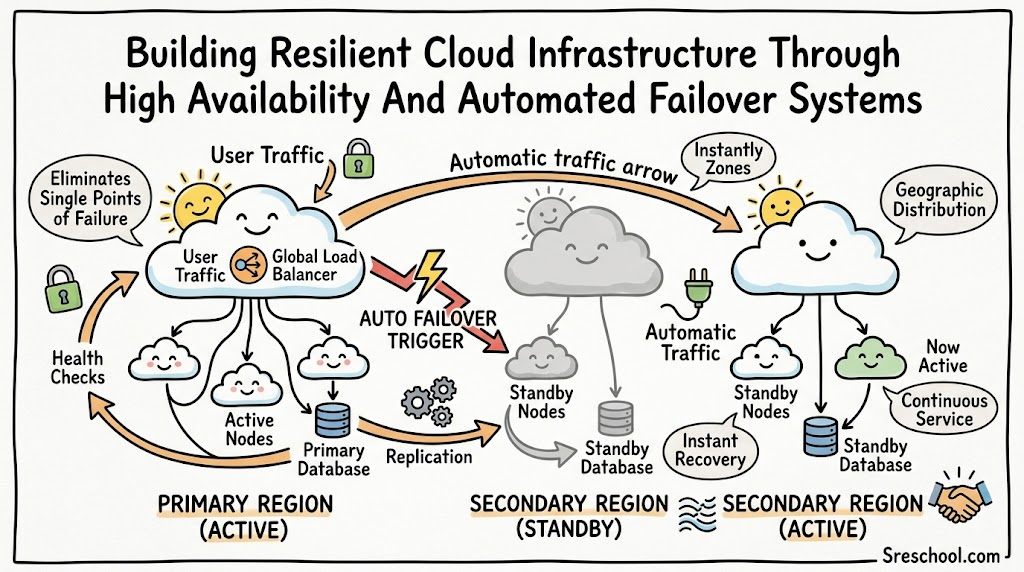
Modern enterprise platforms require continuous uptime, minimal latency, and instant recovery from unexpected hardware outages. When critical cloud infrastructure fails, organizations rely on high availability architectures to maintain service continuity and protect revenue streams. Therefore, implementing automated failover mechanisms shifts engineering teams from stressful emergency troubleshooting to predictable, automated recovery workflows.
Building a dependable distributed system demands a clear understanding of fault domains, traffic steering, and data consistency models. By embracing these essential operational frameworks, engineering teams can easily eliminate single points of failure across their infrastructure. You can master these advanced architectural and reliability principles by learning directly with Sreschool.
System resilience relies on continuous testing, active replication strategies, and disciplined architectural design across all deployment environments. Consequently, engineering organizations that implement proactive failover patterns drastically reduce their recovery times during regional outages. Furthermore, teams build greater confidence in production operations while safely accelerating deployment cycles.
Key Operational Concepts You Must Know
Redundancy Models and Fault Domain Isolation
High availability begins by eliminating every single point of failure through physical and logical infrastructure redundancy. Systems achieve this by distributing computational nodes, data stores, and network gateways across multiple isolated availability zones and regions. Consequently, an unexpected power failure or hardware degradation in one physical datacenter cannot bring down the entire application.
In addition to physical separation, teams must establish logical boundaries by isolating microservices into independent failure domains. If a downstream analytics service experiences sudden memory exhaustion, upstream authentication systems should continue operating normally. Therefore, proper domain segregation confines localized disruptions and protects primary customer journeys.
Understanding RTO, RPO, and Replication Mechanics
Recovery Time Objective defines the maximum acceptable duration of system downtime following an unexpected infrastructure outage. In contrast, Recovery Point Objective measures the maximum volume of transactional data loss your business can tolerate during disruptions. Establishing these two parameters shapes your entire engineering strategy for data replication and disaster recovery.
+-----------------------------------------------------------------------------------+
| <--- Prior Data Loss (RPO) ---> [ OUTAGE EVENT ] <--- Recovery Duration (RTO) ---> |
+-----------------------------------------------------------------------------------+
Synchronous replication offers an RPO of zero by writing data across multiple storage nodes before confirming transactions. However, this approach introduces higher network latency across geographically separated availability zones. Asynchronous replication reduces latency significantly, but it introduces minor data synchronization delays during rapid failover scenarios.
Dynamic Health Checking and Traffic Routing
Automated traffic steering mechanisms rely on continuous, multi-dimensional health checks to detect server degradation accurately and quickly. Rather than relying on simple network pings, intelligent load balancers validate deep application endpoints, database queries, and response latencies. Consequently, the routing layer automatically redirects incoming traffic away from failing servers before end users experience errors.
| Routing Mechanism | Primary Advantage | Typical Use Case |
| DNS-Based Failover | Simple global routing | Diverting traffic across separate cloud regions |
| Anycast IP Routing | Instant network convergence | Global content delivery and edge security |
| Layer 7 Load Balancing | Fine-grained health awareness | Distributing traffic across local microservices |
Furthermore, modern routing fabrics use gradual traffic shifting techniques to protect newly healthy instances from sudden traffic spikes. This gradual warming phase prevents recovered nodes from becoming instantly overwhelmed by waiting requests. Thus, dynamic routing preserves overall system equilibrium during continuous operational shifts.
Distributed Consensus and Split-Brain Prevention
Stateful failover architectures depend on distributed consensus algorithms like Raft or Paxos to maintain single-leader configurations safely. When network partitions occur, isolated nodes might mistakenly assume the primary leader has crashed and attempt to elect replacements. This dangerous situation, known as a split-brain scenario, can corrupt databases by accepting conflicting writes across two active leaders.
+------------------+         [ NETWORK PARTITION ]         +------------------+
|  Leader Node A   | <---------------- x ----------------> |  Leader Node B   |
| (Accepting Data) |                                       | (Accepting Data) |
+------------------+                                       +------------------+
                             * DATA CORRUPTION RISK *
To eliminate split-brain risks, distributed architectures require a strict majority quorum before promoting a secondary node to primary status. If a partitioned cluster segment cannot achieve majority approval, it automatically rejects write requests and switches to read-only operation. Consequently, strict consensus guarantees complete data integrity during complex infrastructure disruptions.
Platform Implementation vs. Culture — What’s the Real Difference?
Deploying Orchestration and Infrastructure Automation
Automating failover requires deploying sophisticated orchestration platforms, distributed service meshes, and declarative infrastructure code across your environments. These technical frameworks monitor container health, automatically replace crashed application pods, and reconfigure internal routing tables within seconds. Consequently, the platform handles routine node failures without requiring human intervention from an on-call engineer.
However, relying entirely on automation without understanding your system limits can introduce dangerous cascading failure modes. If an automated controller aggressively restarts failing pods during a database outage, the surge of reconnection attempts can crash downstream systems. Therefore, technical platforms require thoughtful rate limits, backoff algorithms, and robust guardrails to operate safely under stress.
Building Organizational Muscle Through Chaos Engineering
A resilient culture acknowledges that complex distributed systems will inevitably fail in unpredictable and surprising ways. Instead of hoping outages never happen, teams practice chaos engineering by intentionally injecting controlled failures into production environments. This proactive experimentation reveals hidden configuration drift, faulty timeouts, and stale failover scripts before they cause catastrophic customer downtime.
+-----------------------------------------------------------------+
|                    Resilient Reliability Culture                |
|  - Injects controlled failures via chaos experiments            |
|  - Conducts blameless game days and disaster drills             |
|  - Refines operational runbooks through live practice           |
+-----------------------------------------------------------------+
Furthermore, this experimental mindset builds psychological safety and sharpens the operational instincts of on-call engineers. Teams conduct regular disaster recovery simulations, testing their operational runbooks in realistic environments. Consequently, engineers respond with calm precision and deep familiarity when real infrastructure emergencies arise.
Real-World Use Cases of Modern Operations
Cross-Region Multi-Cloud Failover for Financial Payments
A global financial payment processor designed an active-active deployment across two distinct cloud providers to ensure continuous transaction processing. The engineering team configured distributed databases with bi-directional replication, keeping latency low while maintaining transaction consistency. Additionally, they placed smart edge routers in front of both cloud environments to evaluate real-time API health continuously.
When an unexpected fiber cut caused an entire cloud region to lose network connectivity, the edge routers detected the failure within three seconds. Traffic shifted instantly to the secondary cloud provider without dropping a single active customer transaction. By decoupling their architecture from any single cloud provider, the company maintained 99.999% uptime and avoided severe financial penalties.
Automated Self-Healing Microservices During Traffic Spikes
A major streaming platform experienced massive traffic surges during global live sports broadcasts that frequently threatened server stability. To combat sudden resource exhaustion, the engineering team deployed horizontal pod autoscalers combined with aggressive circuit-breaking patterns. Consequently, when downstream recommendation engines became overloaded, the primary video playback stream remained entirely unaffected.
[ Massive User Spike ] ---> [ API Gateway ] ---> [ Video Playback (Active) ]
                                   |
                                   v
             [ Circuit Breaker TRIPPED: Recommendation Engine ]
Moreover, the platform implemented automated container recycling policies that detected memory leaks and isolated degraded instances automatically. The orchestration system launched fresh replacement pods and verified health checks before terminating failing containers. This automated self-healing mechanism handled unprecedented viewer volumes seamlessly without requiring manual intervention from on-call engineers.
Common Mistakes in Operations Engineering
Overlooking Cascading Failures and Thundering Herds
A dangerous operational error is designing automated recovery systems that inadvertently trigger massive thundering herd problems across downstream systems. When multiple application nodes fail simultaneously, automated orchestrators often launch dozens of new instances at the exact same moment. These fresh nodes instantly flood downstream databases with simultaneous connection requests and cache-warming queries.
To mitigate this catastrophic surge, engineers must implement exponential backoff algorithms with randomized jitter across all connection retries. Furthermore, application runtimes should use connection pooling and circuit breakers to shed load gracefully when backends become overloaded. This disciplined approach ensures that recovering infrastructure components do not inadvertently destroy dependent services.
Ignoring Failover Automation Drift and Stale Runbooks
Another widespread mistake is assuming that automated failover mechanisms configured months ago will continue working flawlessly without regular validation. As software architectures evolve, new microservices, database schemas, and network policies can quietly break legacy disaster recovery automation. When an actual outage occurs, teams discover that their automated failover pipeline fails due to outdated configuration parameters.
+-----------------------------+       Configuration Drift      +-----------------------------+
|    Initial Failover Setup   | ----------------------------> |  Outdated Recovery Scripts  |
|  (Tested and Operational)   |                               |  (Fails During Live Outage) |
+-----------------------------+                               +-----------------------------+
Organizations must treat disaster recovery workflows as active production code by subjecting them to continuous testing and verification. Teams should run automated failover drills weekly in staging environments and quarterly in live production. Regularly testing these pathways eliminates configuration drift and ensures your recovery systems work when needed most.
How to Become an Operations Expert — Career Roadmap
Mastering Core Systems Architecture and Traffic Topologies
Building deep expertise in high availability engineering begins by mastering distributed systems theory, networking protocols, and operating system mechanics. You must understand how Linux manages network sockets, memory allocation, and thread scheduling under extreme operational concurrency. Additionally, mastering modern traffic steering concepts gives you the architectural vision needed to design fault-tolerant systems.
- Distributed Consistency: Study consensus protocols, vector clocks, and transactional isolation levels.
- Traffic Engineering: Master reverse proxies, Anycast networks, BGP routing, and TLS termination pipelines.
- Failure Analysis: Learn to identify single points of failure across complex physical and software topologies.
Focusing on these foundational concepts provides the technical clarity needed to evaluate modern infrastructure architectures effectively. Deep systems knowledge enables you to design systems that handle unpredictable network partitions gracefully.
Advancing to Resilient Cloud Orchestration and Chaos Design
As your engineering career advances, you must develop expertise in orchestrating distributed platforms and designing large-scale chaos experiments. You should master declarative infrastructure tooling, advanced Kubernetes networking patterns, and service mesh traffic splitting. Furthermore, you must learn to translate complex reliability data into actionable business risk assessments for leadership.
- Orchestration Mastery: Implement cross-cluster service discovery, custom controllers, and automated horizontal scaling policies.
- Chaos Engineering: Design automated fault injection experiments that target network latency, memory limits, and node crashes.
- Strategic Reliability: Define rigorous error budgets, availability models, and disaster recovery strategies aligned with business goals.
Acquiring these advanced operational skills enables you to lead large-scale architectural transformations across complex enterprise platforms. Consequently, you will build self-healing cloud ecosystems that maintain uninterrupted availability for users globally.
FAQ Section
- What is the difference between active-passive and active-active failover?Active-passive failover routes all production traffic to a primary node while a secondary backup stands by idly until failure. Active-active failover distributes live user traffic across multiple operational nodes simultaneously, maximizing hardware utilization and providing instant redundancy.
- How does a circuit breaker pattern protect distributed cloud applications?Circuit breakers temporarily halt requests to failing downstream services once error thresholds are breached. This rapid rejection protects downstream systems from being overwhelmed, allowing them time to recover safely while returning graceful fallbacks to users.
- Why is DNS caching a potential challenge during automated regional failover?Internet service providers and client devices frequently cache DNS records long after their Time-To-Live expires. Consequently, some user traffic continues heading toward the failed IP address, delaying complete failover across your global user base.
- What is the primary role of a witness node in distributed failover clusters?A witness node acts as an impartial tiebreaker during network partitions to help the remaining cluster nodes achieve majority quorum. This lightweight node prevents split-brain conditions without requiring the full overhead of hosting replicated application data.
- How frequently should enterprise engineering teams test their disaster recovery plans?Teams should run automated failover simulations in pre-production environments weekly and execute comprehensive production game days quarterly. Frequent validation ensures that configuration drift does not break disaster recovery systems during real operational emergencies.
Final Summary
Implementing robust high availability architectures and automated failover systems is crucial for protecting modern cloud applications against downtime. By eliminating single points of failure, understanding replication models, and configuring dynamic routing, teams can build resilient distributed environments. Balancing these technical mechanisms with a blameless culture and regular chaos engineering ensures your systems withstand unexpected disruptions.
As cloud architectures become increasingly distributed, proactive testing and disciplined operational practices serve as your strongest defense against major outages. Embracing these core principles helps your engineering organization transform complex infrastructure failures into smooth, self-healing recovery events. Ultimately, prioritizing continuous reliability allows your business to innovate rapidly while delivering a dependable, high-performance experience to users worldwide.