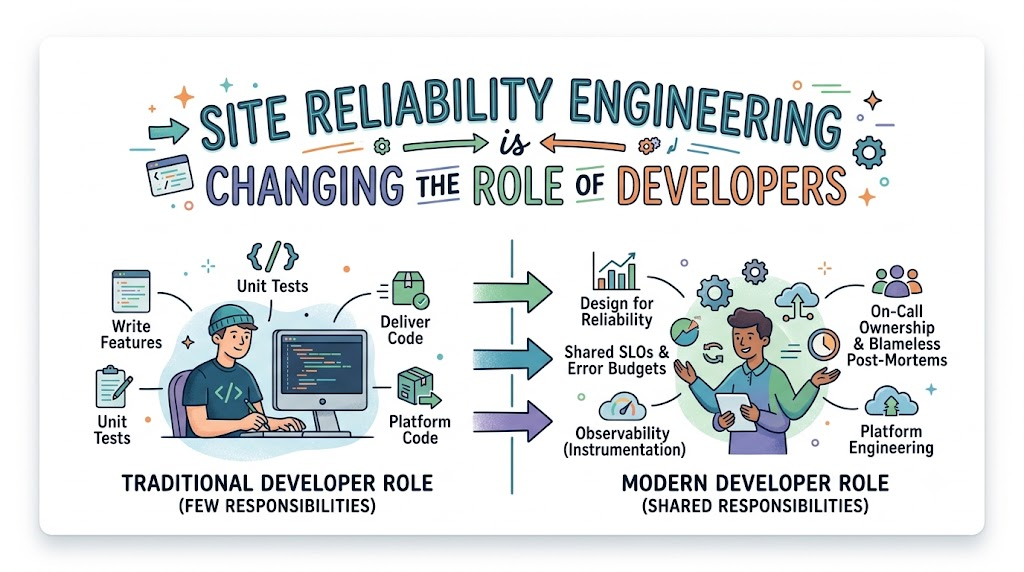
Historically, software development operated behind a stark line of demarcation: developers wrote application code, pushed it to a staging repository, and “threw it over the wall” to operations teams tasked with running and supporting it in production. When systems crashed, finger-pointing inevitably followed. Developers blamed poor server hygiene; system administrators blamed brittle code written in an operational vacuum.
Site Reliability Engineering (SRE)—originated at Google and now widespread across engineering organizations—has systematically dissolved that wall.
By applying software engineering mindsets to operations problems, SRE does not merely introduce a new job title into IT departments. Instead, it redefines what it means to be a software developer. Today, writing code that satisfies functional business logic is only half the assignment; ensuring that the code is observable, resilient, maintainable, and cost-effective under real-world runtime conditions has become central to the developer’s day-to-day work.
1. The Death of “It Works on My Machine”
The traditional developer worldview ended where the container or binary was delivered. If a feature passed unit tests locally, the developer’s job was largely considered done.
SRE dismantles this boundary by replacing isolation with shared systemic accountability. When service failures occur, SRE relies on blameless post-mortems focused on systemic flaws rather than personal fault. This practice quickly reveals that application code and operational environments cannot be treated as separate universes.
Modern developers must design systems that anticipate infrastructure failures:
- Handling Transient Failures: Developers must write code with defensive mechanisms like exponential backoff, jittered retries, and circuit breakers rather than assuming downstream databases or microservices will respond instantaneously.
- Understanding System Limits: Understanding memory allocations, garbage collection pauses, and non-blocking I/O is no longer reserved for specialized systems programmers; it is critical knowledge for building reliable web applications and distributed APIs.
- Designing Graceful Degradation: Applications must know how to drop non-critical background jobs or serve stale cache hits when traffic spikes, protecting core business workflows over peripheral features.
When reliability becomes a non-negotiable architectural requirement, the code developers write becomes fundamentally more defensive and resilient.
2. Shared Operational Metrics: From User Stories to SLOs and Error Budgets
Before SRE practices gained widespread adoption, developers were measured primarily on feature velocity—story points completed, pull requests merged, and sprint deadlines met. Operations teams, meanwhile, were measured on uptime and stability. These opposing incentives created structural conflict: developers wanted to ship changes as fast as possible, while operators wanted to freeze deployments to prevent downtime.
SRE resolved this gridlock with mathematical guardrails: SLIs (Service Level Indicators), SLOs (Service Level Objectives), and Error Budgets.
+-------------------------------------------------------------+
|                      Total System Time                      |
+-------------------------------------------------------------+
|    Service Level Objective (SLO)     |     Error Budget     |
|         e.g., 99.9% Uptime           |     e.g., 0.1% Risk  |
|     (Target for Reliability)         |  (Allowance for Dev) |
+--------------------------------------|----------------------+
                                       |
    [ If Budget Remaining ]            |  [ If Budget Depleted ]
               |                       |              |
               v                       |              v
    Ship features rapidly              |  Halt new feature releases;
    Take calculated risks              |  Focus on debt & reliability
The Error Budget as a Development Currency
An error budget represents the allowable room for failure over a defined rolling window (e.g., a 0.1% downtime allowance for a 99.9% SLO).
This budget fundamentally shifts the conversation developers have with product managers:
- Freedom to Innovate: If an error budget is green and healthy, developers have explicit organizational permission to deploy rapidly, experiment with new features, and take technical risks.
- Automatic Prioritization of Technical Debt: When an unexpected outage or performance regression burns through the error budget, feature releases pause automatically. The engineering team’s focus shifts directly to stability, automated testing, bug remediation, and infrastructure hardening.
Because developers share ownership of the error budget, they are no longer incentivized to treat refactoring and stability work as afterthoughts. Reliability transforms into an explicit product feature with measurable consequences.
3. Observability Built into the Code, Not Added Later
Decades ago, monitoring was an afterthought implemented by system administrators setting threshold alerts on CPU, disk space, and network interface cards.
In distributed cloud architectures, server-level monitoring is inadequate. A service might report 10% CPU usage while 50% of incoming customer requests fail silently inside a third-party payment gateway integration.
SRE emphasizes Observability—the ability to infer internal system states purely by examining external outputs. Because internal state is generated by application code, observability is directly in the hands of developers.
                    +------------------------------------+
                    |       The Telemetry Triad          |
                    +------------------------------------+
                     /                 |                \
                    /                  |                 \
                   v                   v                  v
            +-------------+     +-------------+    +-------------+
            |   Metrics   |     |    Logs     |    |   Traces    |
            | Aggregates  |     | Contextual  |    | End-to-End  |
            |  over time  |     | event data  |    | spans across|
            | (SLI math)  |     |  (JSON/key) |    |  services   |
            +-------------+     +-------------+    +-------------+
Modern developers must instrument their code from the outset using open standards such as OpenTelemetry:
- Metrics: Developers export fine-grained business and operational counters, gauges, and histograms (e.g., processing latency per tenant, cart-checkout failure rates).
- Structured Logging: Unstructured string logs (
print("error occurred")) are replaced by structured key-value payloads containing request IDs, tenant identifiers, and stack contexts, making logs searchable and parseable by log aggregation pipelines. - Distributed Tracing: Developers propagate context headers through incoming and outgoing requests so that a single user action can be tracked across dozens of decoupled microservices and database calls.
Rather than waiting for QA or operations to spot regressions, modern developers run traces against their local and staging branches to inspect query latency and network hops before opening a pull request.
4. “You Build It, You Run It”: The Evolution of On-Call
Perhaps the most visceral change SRE brings to developers is the operational feedback loop created by on-call rotations.
In traditional teams, software engineers wrote code and went home at 5 PM. If a memory leak crashed the server at 3 AM, an operations technician was paged. That technician often lacked access to the source code, leading to blunt remediations like restarting services or rebooting servers repeatedly until the morning shift arrived.
When SRE principles take root, developers join on-call rotations for the services they build.
+-----------------------------------------------------------------+
|                   The Feedback Loop of Ownership                |
+-----------------------------------------------------------------+
|                                                                 |
|   1. Developer authors service and alerting rules               |
|                                                                 |
|   2. Developer joins on-call rotation for the service           |
|                                                                 |
|   3. System alerts fire during runtime failure                  |
|                                                                 |
|   4. Developer directly experiences the pain of noisy alerts    |
|      and fragile design                                         |
|                                                                 |
|   5. High incentive to fix root causes and automate toil        |
|                                                                 |
+-----------------------------------------------------------------+
Direct operational responsibility yields immediate positive effects on software design:
- Elimination of Alert Fatigue: A developer who gets woken up at 2 AM for a flaky, non-actionable alert will fix or delete that alert the following morning.
- Higher Quality Runbooks: If an incident demands manual troubleshooting steps, developers quickly author thorough, clear runbooks and automate remediation scripts to avoid manual interventions.
- Empathy for the Runtime Environment: Seeing code execute under unpredictable real-world traffic teaches engineers lessons that unit tests never could.
Crucially, SRE protects developers from becoming full-time firefighters by capping toil—repetitive, manual, operational work—at 50% of total working hours. The remainder of an engineer’s time must be reserved for software engineering projects that eliminate toil at the root.
5. Shift-Left Reliability and Platform Engineering
The integration of SRE principles does not mean developers must manually configure every load balancer, DNS record, or backup policy. Doing so would overwhelm developers with cognitive load, slowing innovation to a crawl.
Instead, SRE has spurred the rise of Platform Engineering and Internal Developer Platforms (IDPs). SREs and platform teams operate as product teams whose customers are the internal software developers. They create self-service infrastructure, automated deployment pipelines, and standardized architecture templates.
| Traditional Ops Model | Modern SRE & Platform Model |
|---|---|
| Submit a ticket to request a database or VM. | Self-service provisioning via CLI, API, or GitOps manifest. |
| Custom, ad-hoc server configurations. | Golden paths with built-in logging, metrics, and autoscaling. |
| Manual, high-risk production deployments. | Automated canary and blue-green deployments with health checks. |
| Post-deployment discovery of vulnerabilities. | CI/CD automated gates enforcing security, linting, and SLO tests. |
This self-service model allows developers to “shift left”—integrating security, load testing, and reliability verifications early in the software delivery pipeline rather than discovering issues during production rollout.
6. How Developers Can Thrive in an SRE-Driven World
For developers accustomed to purely writing feature code, the transition to an SRE-influenced culture can feel daunting. However, embracing this evolution opens significant career opportunities, elevating an engineer from a simple code contributor to an architect of distributed systems.
To succeed in an SRE-driven engineering organization, developers should focus on four foundational competencies:
1. Master Systems Fundamentals
Frameworks and languages change rapidly, but systems fundamentals remain stable. Gain a working understanding of:
- The Linux networking stack, memory management, and file systems.
- Concurrency primitives, thread pools, and asynchronous programming models.
- Network topologies, DNS propagation, TLS termination, and HTTP/gRPC protocol semantics.
2. Treat Infrastructure as Software
Avoid manually configuring environments through cloud provider web consoles. Embrace Infrastructure as Code (IaC) tools and container definitions. Treat configuration files with the same rigor as application code—subjecting them to code review, static analysis, unit testing, and version control.
3. Learn to Read Telemetry Like Code
Make dashboard exploration a standard habit. After deploying a pull request, inspect live latency percentiles (p50, p95, p99) and error distributions. Learning to interpret telemetry data helps you catch edge cases and micro-regressions long before they trigger customer escalations.
4. Champion Blameless Culture
When a system breaks, resist the urge to focus on individual human actions. Humans are inherently prone to mistakes. Focus instead on the systemic conditions that made the failure possible:
- Why did CI/CD allow the bad configuration to reach production?
- Why did testing fail to simulate that traffic pattern?
- Why did the alert take 30 minutes to trigger instead of 30 seconds?
By focusing on systemic defenses, developers build organizational resilience alongside technical reliability.
The New Definition of Engineering Excellence
Site Reliability Engineering is not an isolated specialty operating in a silo; it is an organizational philosophy that has fundamentally changed what it means to be a software developer.
The modern developer is no longer just a builder of features. They are an architect of resilient digital ecosystems. By sharing responsibility for production reliability, aligning development velocity with error budgets, building observability directly into software, and participating in operational feedback loops, developers build systems that are robust by design.
In this new paradigm, true software craftsmanship is not measured solely by whether your code compiles and passes local tests. It is measured by how gracefully your code behaves in production, how predictably it scales under pressure, and how quickly your team can recover when unexpected failures inevitably arise.