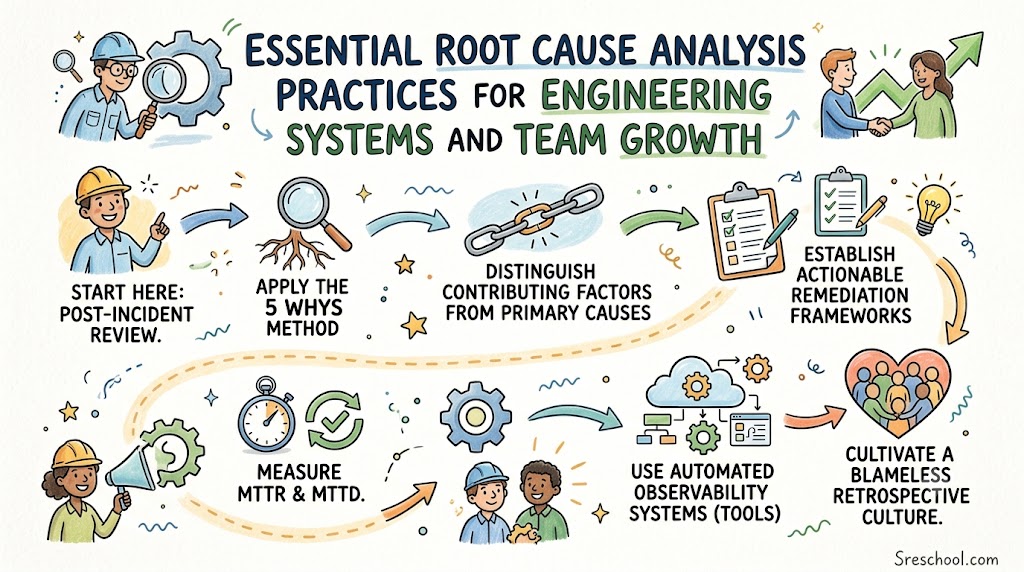
Site Reliability Engineering relies on structured post-incident reviews to convert unexpected infrastructure failures into valuable technical improvements. When complex systems fail, engineering teams must look beyond superficial symptoms to uncover the underlying vulnerabilities in code and architecture. This analytical process ensures that your organization learns from every service disruption while systematically building longer-term resilience.
Implementing a rigorous incident review framework helps your business maintain high service availability while protecting customer trust. By adopting these foundational engineering strategies, technical teams can systematically eliminate recurring failure modes and optimize system performance. You can master these modern operational methodologies by exploring the educational tracks provided by Sreschool.
Systemic resilience requires continuous architectural evaluation, clear communication channels, and disciplined operational habits. Consequently, organizations that prioritize thorough post-mortem investigations drastically lower their recurring failure rates. Thus, engineering teams gain greater confidence in their deployment pipelines while continually strengthening their overall production infrastructure.
Defining Root Cause Analysis in Systems Engineering
Root Cause Analysis represents a structured engineering discipline designed to identify the foundational vulnerabilities that trigger system outages. Rather than settling for quick fixes, engineers dig deep into infrastructure metrics, application logs, and code changes to trace execution paths. This investigative approach ensures that teams solve the underlying defect rather than repeatedly treating surface-level operational symptoms.
Establishing a clear analytical methodology allows engineering departments to categorize technical defects systematically and evaluate overall system reliability. Consequently, you can track structural weaknesses over time, isolating patterns that lead to performance degradation or service outages. This visibility enables technology leaders to allocate resources effectively toward critical security and infrastructure enhancements.
Furthermore, these post-incident workflows transform how modern software developers view production operational stability and failure modes. Instead of viewing outages as isolated accidents, engineers treat every system defect as a valuable learning opportunity. Therefore, software development and operations teams collaborate closely on architectural improvements, ensuring that safety mechanisms exist across all application layers.
Ultimately, this systematic focus prioritizes permanent infrastructure stability over temporary, manual operational patches. By addressing systemic design flaws, organizations prevent repeating identical outages when user traffic spikes unexpectedly. Thus, your business establishes a dependable technical foundation capable of scaling safely while sustaining high performance.
Key Operational Concepts You Must Know
The Five Whys Method for Infrastructure Vulnerabilities
The Five Whys technique is an iterative interrogative framework designed to explore the cause-and-effect relationships underlying a specific problem. By repeatedly asking why a failure occurred, engineers peel away layers of surface symptoms to reveal the true operational flaw. For example, a simple server crash might ultimately trace back to missing automated test coverage in deployment pipelines.
+-------------------------------------------------------+
|                The Five Whys Approach                 |
|  1. Why did the service fail? (Database overload)     |
|  2. Why was it overloaded? (Unindexed query ran)      |
|  3. Why was the query unindexed? (Missed in review)   |
|  4. Why was it missed? (No automated linting tool)    |
|  5. Why no linting tool? (Process not prioritized)    |
+-------------------------------------------------------+
Applying this structured questioning prevents teams from stopping their investigation at obvious human errors or superficial software bugs. Consequently, your engineers focus on fixing brittle processes, missing automation guardrails, and architectural weaknesses. This systematic approach ensures that resolved incidents result in lasting platform stability improvements across your engineering organization.
Distinguishing Contributing Factors from Primary Causes
In complex distributed architectures, outages rarely stem from a single, isolated technical error or individual failure point. Instead, multiple contributing factors—such as unexpected traffic bursts, latent software bugs, and misconfigured caching layers—converge to disrupt services. Distinguishing between these contributing factors and primary causes helps engineers understand the full scope of a production outage.
| Factor Category | Operational Definition | System Example |
|---|---|---|
| Primary Cause | The fundamental flaw that directly triggered the main failure | A missing database index causing query queue lockups |
| Contributing Factor | Secondary conditions that accelerated or worsened the incident | High user traffic combined with low alert thresholds |
| Trigger Event | The immediate action that initiated the failure sequence | A routine configuration change deployed during peak hours |
Separating these elements prevents teams from focusing narrowly on a single code defect while ignoring broader environmental vulnerabilities. Furthermore, it ensures that post-incident action items address all contributing factors, creating multiple safety nets across your platform.
Establishing Actionable Remediation Frameworks
Identifying root causes is only valuable if your engineering organization translates those insights into tangible, tracked engineering work. Every post-incident review must generate specific remediation tasks with assigned engineering owners, clear implementation deadlines, and defined success criteria. This structured follow-through prevents critical safety improvements from getting buried under routine product feature requests.
Additionally, organizations should track these remediation tasks in primary development backlogs alongside standard software features. If critical security or stability fixes remain unaddressed, engineering leadership must step in to reprioritize technical tasks immediately. This discipline keeps your infrastructure healthy and reduces the risk of repeated outages.
Measuring Mean Time to Detect and Recover
Key performance metrics like Mean Time to Detect and Mean Time to Recover provide quantifiable data regarding operational efficiency. Tracking these indicators across multiple incident lifecycles highlights whether your monitoring systems and incident response workflows are actually improving. Lower detection times indicate effective automated alerting, while faster recovery times reflect well-rehearsed mitigation playbooks.
[ Incident Start ] ---> [ Detection (MTTD) ] ---> [ Mitigation (MTTR) ] ---> [ Resolution ]
Consistently analyzing these metrics helps reliability leaders identify bottlenecks within their triage and response procedures. If recovery times remain high, your team may need better observability tooling or clearer emergency escalation procedures. Consequently, measuring these operational baselines guides smart investments in automated tooling and team training programs.
Platform Implementation vs. Culture — What’s the Real Difference?
Implementing Automated Observability Systems
Building a robust observability platform requires deploying centralized logging, automated metric aggregation, and distributed tracing across cloud environments. These technical tools collect real-time data, giving engineers immediate visibility into system health during active production outages. However, deploying sophisticated monitoring platforms alone will not automatically guarantee thorough post-incident learning.
Without proper analytical processes, raw telemetry data can overwhelm engineers with confusing charts and endless log streams. Modern tooling provides the raw information, but engineering teams must supply the critical thinking needed to interpret complex failures. Therefore, technical platforms serve as an essential data foundation, but they must be paired with structured analytical processes.
Cultivating Blameless Retrospective Cultures
A successful post-incident review process relies on a blameless culture that prioritizes psychological safety and transparent communication. In a blameless environment, engineers accept that human operators make mistakes due to poorly designed tools, unclear instructions, or missing guardrails. This perspective encourages transparency, prompting responders to share accurate details without fearing personal reprimands or public embarrassment.
+-------------------------------------------------------+
|             Blameless Review Culture                  |
|  - Treats human error as a symptom, not a cause       |
|  - Focuses on fixing brittle engineering systems      |
|  - Encourages honest, transparent reporting           |
+-------------------------------------------------------+
                           ^
                           | (Opposing Mindsets)
                           v
+-------------------------------------------------------+
|              Blame-Heavy Environment                  |
|  - Punishes individual engineers for mistakes         |
|  - Drives failure details underground                 |
|  - Leaves underlying system bugs unpatched            |
+-------------------------------------------------------+
When organizations punish individuals for outages, engineers become defensive and hide critical details during investigations. Conversely, combining powerful monitoring tools with a supportive blameless culture enables true operational resilience. Cultivating this open environment ensures that your engineering organization transforms every production failure into an opportunity for team growth.
Real-World Use Cases of Modern Operations
Diagnosing Cascading Failures in Microservices
A major digital publishing company experienced widespread service degradation when an upstream authentication service developed extreme latency under normal load. Because downstream services lacked proper timeout controls, pending network requests accumulated quickly, exhausting connection pools across the entire microservice ecosystem. This cascading failure brought down user-facing web applications and mobile platforms simultaneously.
During the post-incident review, the engineering team used distributed tracing to map request paths and pinpoint the initial connection bottleneck. They discovered that a missing database cache update forced the authentication service to execute heavy disk reads for every incoming request. By implementing circuit breakers and response caching, they insulated the platform against future upstream dependencies.
Uncovering Hidden Technical Debt in CI/CD Pipelines
A cloud analytics provider suffered an unexpected platform outage when a routine deployment script accidentally deleted active configuration parameters. The initial incident investigation pointed toward an operator error during a manual deployment step executed during off-peak hours. However, a detailed root cause analysis revealed deeper structural flaws in the team’s software delivery pipeline.
[ Operator Trigger ] ---> [ Manual Configuration Step ] ---> [ Script Error ] ---> [ Service Outage ]
                                                                 |
                                                                 v
                                                 (Lacked CI/CD Testing Guardrails)
The review uncovered that the deployment pipeline lacked automated validation checks to verify configuration files before applying changes to production. Furthermore, the team relied heavily on manual deployment steps due to legacy technical debt in their build scripts. Addressing these foundational automation flaws eliminated human error variables and streamlined their overall deployment workflows.
Common Mistakes in Operations Engineering
Stopping Investigations at Human Error
A frequent mistake in operations engineering is ending an incident investigation as soon as a human mistake is identified. Attribute an outage to “operator error” or “fatigue” ignores the system design flaws that allowed the mistake to occur. Systems should be built to withstand misconfigurations, typos, and improper commands without failing completely.
To avoid this pitfall, teams must ask why the system permitted a single human mistake to cause widespread downtime. Implementing strict permission boundaries, automated testing, and confirmation prompts ensures that individual errors cannot crash production. This approach builds resilient architectures that protect engineers and maintain service stability.
Failing to Share Post-Mortem Findings Across Teams
Failing to distribute post-incident reports across the broader engineering organization ensures that other teams will eventually repeat similar mistakes. When incident insights remain isolated within a single product group, systemic vulnerabilities persist unaddressed in other software components. Knowledge sharing is essential for building a strong, organization-wide culture of reliability and operational excellence.
Engineering leadership should establish open repositories for post-mortem documentation and host regular cross-team incident review meetings. Sharing lessons learned helps every software developer write safer code and design more reliable system architectures. Dedicating time to collective learning elevates technical standards across your entire engineering organization.
How to Become an Operations Expert — Career Roadmap
Mastering Observability Tools and Data Analysis
Building a successful career in reliability engineering requires mastering observability platforms, data visualization tools, and telemetry standards. You must learn how to construct meaningful metrics dashboards, configure intelligent alerting rules, and analyze distributed traces. Additionally, developing strong data analysis skills allows you to spot performance degradation trends before they trigger outages.
- Telemetry Standards: Learn how to instrument application code using open standards like OpenTelemetry for metrics and tracing.
- Dashboard Design: Build intuitive, clear dashboards that highlight core service health indicators during active incidents.
- Log Aggregation: Master advanced querying techniques to isolate relevant error logs across high-volume log storage backends.
Focusing on these core technical skills gives you the ability to diagnose complex distributed systems issues rapidly. Observability expertise allows you to trace system failures back to their true root causes with high accuracy.
Designing Resilient Architectures and Automated Guardrails
As you progress in your engineering career, you must shift your focus toward designing fault-tolerant architectures and self-healing systems. You will learn to implement design patterns like circuit breakers, rate limiters, graceful degradation, and automated rollback strategies. Mastering these techniques enables you to build cloud platforms that handle hardware and software failures automatically.
- Fault-Tolerant Design: Implement circuit breakers, bulkheads, and retries with exponential backoff across microservices.
- Infrastructure as Code: Use declarative configuration management tools to build, test, and update identical environments safely.
- Chaos Engineering: Conduct controlled fault-injection experiments to validate system resilience under real-world failure conditions.
Developing expertise in resilient architectural patterns positions you as a trusted technical leader within your engineering organization. Consequently, you can design scalable, self-healing platforms that maintain stability during unexpected operational disruptions.
FAQ Section
- What is the main goal of a post-incident review in Site Reliability Engineering?The primary goal is to identify systemic vulnerabilities, understand why a failure occurred, and implement preventative measures to stop similar outages. It focuses on improving software systems and operational processes rather than assigning personal blame to individual engineers.
- How soon after an incident should a team conduct a post-mortem review?Teams should conduct the post-mortem review within 24 to 48 hours while the incident details remain fresh in responders’ minds. Prompt reviews ensure accurate timeline reconstruction and allow teams to create actionable remediation tasks quickly.
- What makes an incident report truly blameless?A blameless report focuses entirely on system design flaws, missing automation, and process gaps rather than human error. It assumes that engineers acted in good faith based on the information and tools available to them at the time.
- How should teams prioritize remediation items from a post-incident review?Remediation items should be logged directly in main development backlogs and prioritized based on their potential impact and implementation effort. Critical safety fixes must take precedence over non-urgent feature updates to maintain system stability.
- Can small engineering teams benefit from formal root cause analysis workflows?Yes, small teams benefit significantly by establishing disciplined incident review habits early in their operational journey. Preventing repeat outages saves valuable engineering time, allowing small teams to focus more energy on building new features.
Final Summary
Root Cause Analysis plays a central role in post-incident reviews, allowing SRE teams to convert production outages into lasting system improvements. By utilizing frameworks like the Five Whys, distinguishing contributing factors, and setting actionable remediation tasks, organizations build truly resilient platforms. Balancing technical observability tools with a supportive, blameless culture keeps your engineering teams engaged, proactive, and focused on operational excellence.
As cloud architectures become more complex, disciplined incident review processes serve as your best defense against recurring service failures. Embracing these core practices helps your organization transform operational disruptions into valuable architectural insights that drive long-term stability. Ultimately, prioritizing systematic learning allows your business to innovate rapidly while delivering a dependable experience for all users.