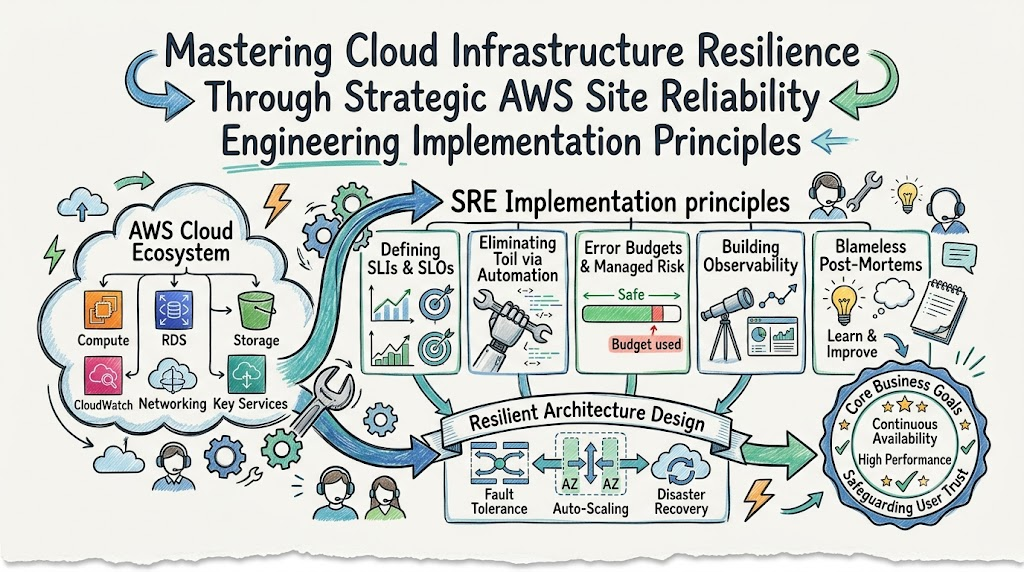
Modern enterprise cloud architectures demand continuous availability and high performance to support growing digital operations effectively. When businesses expand their digital footprint on Amazon Web Services, engineering teams must implement structured operational frameworks to keep workloads resilient. Site Reliability Engineering bridges the gap between software development and systems management by treating infrastructure reliability as a software problem.
Adopting these disciplined engineering methodologies empowers your organization to release new platform capabilities quickly without risking system stability. By combining automated provisioning with real-time operational monitoring, technical teams can prevent outages and maintain customer confidence during major traffic events. You can elevate your technical skills and master these cloud engineering strategies directly through Sreschool.
Reliable cloud architectures require automated recovery patterns, continuous telemetry tracking, and well-designed deployment pipelines. Consequently, organizations that apply systematic engineering practices to their cloud environments reduce service disruptions and improve team productivity. Ultimately, establishing these foundational principles enables your business to build scalable cloud systems that withstand sudden disruptions.
Architectural Foundations for Building Resilient AWS Environments
Building fault-tolerant architectures on Amazon Web Services begins by eliminating all single points of failure across your cloud topology. Engineers should distribute workloads across multiple Availability Zones within a region to ensure uninterrupted service if a physical data center fails. Consequently, your applications maintain high availability and continue serving customer requests without manual intervention.
+-------------------------------------------------------------+
|                     AWS Global Transit Gateway              |
+-------------------------------------------------------------+
               |                               |
               v                               v
+-----------------------------+ +-----------------------------+
|    Availability Zone A      | |    Availability Zone B      |
|  - Auto Scaling Group (EC2) | |  - Auto Scaling Group (EC2) |
|  - ECS / EKS Pod Replicas   | |  - ECS / EKS Pod Replicas   |
|  - Multi-AZ Aurora Primary  | |  - Multi-AZ Aurora Replica  |
+-----------------------------+ +-----------------------------+
Furthermore, managing cloud infrastructure through code templates enables teams to define and provision cloud environments reliably. Using declarative definitions ensures that testing, staging, and production environments remain identical across every operational stage. Therefore, your engineering squads can deploy changes rapidly while eliminating configuration errors and infrastructure drift.
In addition, modern cloud environments require self-healing mechanisms that detect and replace unhealthy compute instances automatically. Cloud orchestration systems perform frequent health checks and automatically restart failing containers or instances before users notice performance degradation. This automated remediation minimizes manual toil and allows engineers to focus on architectural enhancements.
Finally, decoupling stateless compute layers from managed database services allows your applications to scale resources dynamically during traffic spikes. Stateless workloads can expand rapidly behind load balancers without compromising data consistency or session storage. Thus, your distributed architecture remains flexible, cost-effective, and fully capable of handling unpredictable user demand.
Key Operational Concepts You Must Know
Defining AWS Service Level Indicators and Metric Signals
Service Level Indicators serve as the fundamental quantitative metrics that measure the performance and availability of your cloud workloads. On AWS, teams track metrics like CloudWatch request latencies, error percentages, transaction throughput, and compute resource utilization. Tracking these signals provides an accurate, real-time assessment of your distributed platform’s health.
When these core metrics exceed acceptable thresholds, automated alarms notify on-call engineers immediately before issues disrupt user journeys. Consequently, keeping a close watch on these operational indicators helps your organization maintain high software quality standards. Therefore, baseline operational data forms the cornerstone of every proactive reliability initiative.
Managing Error Budgets Across Cloud Services
An error budget represents the exact margin of allowable unreliability that your application can experience over a designated timeframe. For instance, establishing a 99.9% uptime target provides a 0.1% budget for planned updates, experimentation, and unexpected failures. This quantifiable buffer encourages software developers to deliver new features rapidly as long as the system operates within budget limits.
+---------------------------------------------------------------+
|                    CloudWatch Error Budget                    |
|  [ ■■■■■■■■■■■■■■■■■■■■■■■■■■■□□□□□ ] (75% Remaining)         |
+---------------------------------------------------------------+
  - Safe Operating Zone: Normal deployments and canary tests.
  - Budget Depleted: Release freeze; focus on stability tasks.
However, if unexpected outages exhaust this allocated error budget, engineering teams must pause all feature releases immediately. During this temporary freeze, developers focus entirely on fixing underlying bugs and strengthening system stability. Consequently, error budgets balance development velocity with production reliability through clear, objective criteria.
Leveraging Auto Scaling and Elastic Capacity Management
Elastic scaling allows cloud applications to adjust computing resources dynamically based on real-time application load. By analyzing metrics like CPU saturation, memory usage, and incoming request counts, target tracking policies provision extra capacity on demand. This automated adjustment prevents service slowdowns and ensures consistent application responsiveness.
| Auto Scaling Mechanism | Operational Trigger | Architectural Advantage |
|---|---|---|
| Dynamic Scaling | CPU, Memory, or Network thresholds | Scales resources in real time to meet sudden traffic demand. |
| Predictive Scaling | Historical machine learning models | Provisions capacity ahead of anticipated traffic cycles. |
| Target Tracking | Custom CloudWatch metrics | Keeps performance metrics aligned with specified targets. |
Applying these diverse scaling strategies avoids resource exhaustion while preventing expensive over-provisioning of cloud infrastructure. Furthermore, regular capacity reviews help teams forecast long-term resource needs, ensuring smooth operations during major product launches.
Implementing Canary Deployments with Traffic Shifting
Deploying application updates using canary releases significantly minimizes the blast radius of software bugs and configuration mistakes. Instead of updating the entire production fleet at once, you route a small percentage of user traffic to the new version using weighted routing. This gradual rollout allows engineers to verify performance metrics safely before completing the deployment.
[ Incoming Traffic ]
        |
        +--- (90% Live Traffic) ----> [ Stable Version Fleet ]
        |
        +--- (10% Canary Traffic) ---> [ Canary Version Fleet ]
                                              |
                                     (CloudWatch Alarm)
                                              v
                                   [ Automated Rollback ]
If monitoring systems detect elevated error rates in the canary environment, deployment pipelines initiate an automated rollback immediately. This automated recovery removes the need for manual troubleshooting during an outage, restoring normal operations within seconds. Consequently, teams can release code with high confidence, knowing built-in safeguards protect the production environment.
Platform Implementation vs. Culture — What’s the Real Difference?
Technical Implementation Across AWS Services
Building a resilient cloud platform requires configuring managed container services, infrastructure templates, secret managers, and network security policies. These technical tools provide the automation engine that runs enterprise applications and manages dynamic cloud workloads efficiently. However, simply deploying these services does not automatically ensure operational success.
+---------------------------------------------------------------+
|             Cloud Platform Layer (The Infrastructure)         |
|  - CloudWatch, Auto Scaling, Systems Manager, CloudFormation  |
+---------------------------------------------------------------+
                               |
                               | Governed & Maintained By
                               v
+---------------------------------------------------------------+
|             Engineering Culture Layer (The Mindset)           |
|  - Blameless reviews, Continuous learning, Shared ownership   |
+---------------------------------------------------------------+
Without disciplined engineering practices, your cloud environment can quickly become a complex web of unmaintained scripts and misconfigured resources. Technical tooling provides the foundation, but skilled engineers are essential to design resilient workflows and manage production risks. Therefore, cloud platforms act as operational enablers rather than complete solutions for system reliability.
Fostering Psychological Safety and Blameless Retrospectives
A strong engineering culture recognizes that complex cloud systems will occasionally fail despite rigorous testing and planning. In a blameless culture, teams view production incidents as system design flaws rather than the fault of individual engineers. This supportive atmosphere encourages team members to share incident details openly without fear of negative consequences.
When organizations eliminate blame, they uncover the real root causes of outages, such as unclear documentation or missing automated guardrails. Consequently, teams can implement permanent architectural improvements that prevent similar system failures in the future. Building this collaborative environment turns operational incidents into valuable learning opportunities that strengthen the entire team.
Real-World Use Cases of Modern Operations
Global Traffic Routing and High-Availability Multi-Region Failover
A major digital retail company experienced revenue losses whenever regional network disruptions degraded checkout services during peak sales. To solve this problem, the engineering team built an active-active multi-region cloud deployment using latency-based routing and database replication. If a primary region encounters performance issues, traffic routing policies automatically direct users to the healthy secondary region.
[ Global User Traffic ] ---> [ Route 53 Health Checks ]
                                    |
            +-----------------------+-----------------------+
            | (Primary Route)                               | (Failover Route)
            v                                               v
[ Region A: Active Workload ]                   [ Region B: Standby Workload ]
            |                                               |
            +-------- (Global Database Replication) --------+
Furthermore, the team regularly conducts automated disaster recovery drills to verify data synchronization speeds and validate failover mechanisms. As a result, the retail platform maintains uninterrupted service availability during unexpected cloud infrastructure outages. This implementation demonstrates how geo-distributed architectures protect mission-critical business transactions.
Automated Event-Driven Incident Remediation
A financial analytics organization faced significant operational toil because on-call engineers spent hours manually resolving recurring server disk saturation alerts. To eliminate this repetitive work, the team created an automated remediation pipeline using event triggers and serverless execution functions. When storage utilization crosses safe thresholds, the system automatically expands storage volumes without human intervention.
[ Disk Threshold Alert ] ---> [ EventBridge Rule ] ---> [ Lambda Function ] ---> [ Storage Expanded ]
Additionally, the automated pipeline logs every corrective action in a central audit repository for compliance tracking and post-incident review. Consequently, on-call engineers no longer need to perform routine manual fixes, which frees them to focus on high-impact reliability projects. This case illustrates how event-driven automation eliminates operational toil and improves overall system resilience.
Common Mistakes in Operations Engineering
Over-Reliance on Manual Console Changes
A common mistake in cloud operations occurs when engineers make manual changes through the cloud management console during production emergencies. While this quick workaround resolves the immediate problem, it creates configuration drift between your live infrastructure and your code repositories. Consequently, future automated deployments may overwrite these manual fixes, causing the outage to reoccur unexpectedly.
To avoid this problem, teams must enforce infrastructure-as-code practices strictly, requiring all changes to go through approved code review pipelines. Every modification must be committed to version control and applied using automated deployment tools. This approach ensures that your declared templates always match your running production environment accurately.
Setting Static Alert Thresholds and Generating Alert Fatigue
Many operations teams configure static alert thresholds that trigger high-priority pages for minor, self-correcting metric spikes. When on-call engineers receive dozens of non-actionable notifications throughout the night, they develop alert fatigue. Consequently, responders may overlook genuine production warnings, which increases the time needed to resolve critical outages.
+---------------------------------------------------------------+
|                    Alert Fatigue Progression                  |
|  [ Static Alerts ] ---> [ Noisy Pages ] ---> [ Responder Fatigue ] |
|                                                    |          |
|                                                    v          |
|                                         [ Missed Critical Outage ]
+---------------------------------------------------------------+
Teams should regularly review their alerting systems and implement anomaly detection to identify meaningful deviations from baseline performance. Moving non-critical alerts to asynchronous communication channels ensures that on-call pages represent actionable incidents that require immediate human intervention. This practice keeps engineering teams focused and ready to respond effectively during real emergencies.
How to Become an Operations Expert — Career Roadmap
Mastering Core Cloud Services and Automation Tooling
Building a successful career in cloud reliability begins with a solid foundation in core compute, networking, and storage services. You must understand virtual network configurations, subnetting strategies, routing tables, and security group policies to design robust architectures. Additionally, mastering automation tools like Terraform and programming languages like Python allows you to manage cloud resources programmatically.
- Networking Architecture: Master virtual private clouds, transit gateways, network access control lists, and DNS management.
- Compute Platforms: Understand virtual machine scaling, container management, and serverless execution environments.
- Infrastructure Automation: Write modular, reusable code templates to provision and maintain multi-tier cloud environments.
Developing these fundamental technical competencies gives you the skills needed to design reliable cloud platforms. Automation eliminates repetitive manual work, enabling you to build scalable environments that support growing business requirements.
Advancing to Distributed Systems Architecture and Chaos Engineering
As you progress toward senior reliability engineering roles, you should broaden your expertise into distributed tracing and controlled failure testing. You will design architectures that handle network latency, database replication lags, and node failures gracefully. Furthermore, conducting proactive chaos experiments helps you uncover hidden vulnerabilities before they cause unexpected production downtime.
- Distributed Observability: Implement tracing frameworks, log aggregation pipelines, and comprehensive metric dashboards.
- Chaos Engineering: Inject simulated network latency and compute failures to validate system self-healing mechanisms.
- Disaster Recovery Planning: Design multi-region failover strategies with low recovery point and recovery time objectives.
Mastering these advanced concepts allows you to build enterprise-scale cloud platforms that remain resilient under heavy load. Consequently, your strategic technical guidance will help engineering teams deliver dependable, high-performing software systems.
FAQ Section
- What is the difference between Service Level Objectives and Service Level Agreements on AWS?A Service Level Objective is an internal reliability target that guides development and operations priorities. A Service Level Agreement is a formal external commitment made to customers that includes specific financial or service remedies if missed.
- How does AWS Systems Manager assist Site Reliability Engineers in daily operations?Systems Manager provides a centralized toolset for automating operational tasks, managing configurations, running commands across instances, and applying security patches without opening manual bastion connections.
- Why are error budgets useful for software delivery teams?Error budgets provide an objective, data-driven framework that balances feature development velocity with production stability, establishing clear rules for when deployments must pause to address reliability.
- What role does AWS Fault Injection Simulator play in resilience engineering?Fault Injection Simulator enables teams to conduct controlled chaos engineering experiments by injecting real-world faults into workloads, helping uncover architectural weaknesses before they cause production outages.
- How do blameless post-incident reviews improve cloud infrastructure reliability?Blameless reviews focus on systemic vulnerabilities and process gaps rather than individual human mistakes, encouraging transparency and leading to lasting architectural fixes that prevent repeat incidents.
Final Summary
Implementing effective Site Reliability Engineering practices on AWS requires a thoughtful blend of resilient architecture, automated operations, and a strong engineering culture. By tracking objective Service Level Indicators, enforcing error budgets, and using infrastructure as code, teams can build platforms that handle fluctuating demand smoothly. Combining these technical tools with blameless retrospectives ensures your engineering organization learns continuously from production incidents.
As cloud environments grow in complexity, prioritizing automation and system simplicity remains your best defense against extended operational downtime. Investing in robust observability, self-healing automation, and proactive failure testing helps you transform complex cloud infrastructure into a resilient, high-performing platform. Ultimately, adopting these core engineering principles allows your business to innovate with confidence while delivering a dependable experience to all users.