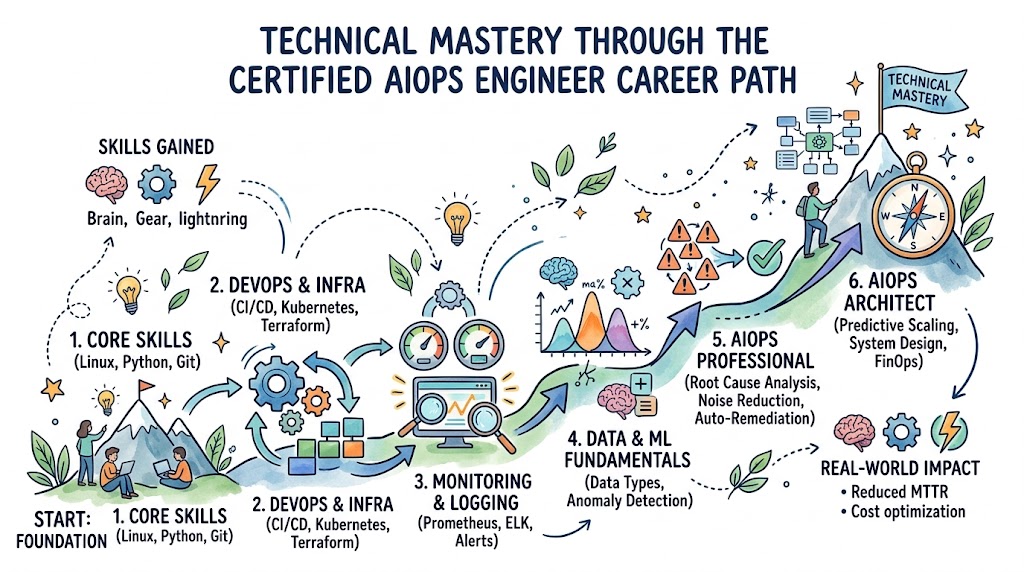
The modern IT landscape produces vast telemetry streams that overwhelm standard monitoring systems and manual workflows. Consequently, the Certified AIOps Engineer program offers a vital bridge between traditional site reliability and artificial intelligence. This comprehensive guide targets professionals who want to master intelligent observability, automated remediation, and predictive maintenance. By embedding machine learning into the operational lifecycle, you move from reactive troubleshooting to proactive system governance. We present this roadmap to help you navigate the AIOpsSchool ecosystem and advance your technical career with confidence.
Defining the Certified AIOps Engineer Role
The Certified AIOps Engineer represents a fundamental shift in managing distributed, cloud-native environments. Organizations created this designation because manual intervention cannot scale alongside microservices and ephemeral infrastructure. This program prioritizes the practical application of algorithmic analysis to operational data over abstract data science theory. You learn to build self-healing frameworks and intelligent alerting systems that meet enterprise demands for continuous availability.
Ideal Candidates for this Certification
This path serves DevOps practitioners, SREs, and platform engineers who seek to enhance their technical repertoire with machine learning. Cloud architects and security specialists also find immense value here, as pattern recognition drives both performance tuning and threat detection. It provides a clear advantage for engineering managers who oversee the shift toward automated operations in global markets. Whether you possess years of experience or are just starting, this certification delivers the depth required to lead AI-driven projects.
Strategic Value of AIOps Expertise
Enterprise environments grow more complex every day, making automated operational intelligence a necessity rather than a luxury. Earning this credential keeps your skills relevant even when specific cloud providers or CI/CD tools undergo significant changes. It yields a high return on investment by marking you as a specialist in a high-growth, niche technical field. Companies actively recruit individuals who can lower Mean Time to Repair (MTTR) by utilizing intelligent automation instead of manual effort.
Structural Details of the Program
The official portal delivers all training modules, while the AIOpsSchool platform hosts the certification exams for a consistent experience. This program uses a rigorous assessment model that pairs conceptual knowledge with hands-on lab challenges to verify your actual skills. Industry veterans maintain the curriculum to ensure it reflects current production hurdles and emerging automation patterns. Structurally, the certification tracks the entire lifecycle of telemetry, from data ingestion to automated incident response.
Available Tracks and Professional Levels
The curriculum follows a tiered progression that begins with foundational concepts regarding data science in an IT context. Professional levels transition into technical implementations, where you handle specific integration patterns and algorithmic models. Advanced levels cater to architects who design end-to-end intelligent ecosystems across diverse multi-cloud footprints. These tracks enable you to specialize in SRE-focused AIOps or FinOps-driven optimization based on your specific professional trajectory.
Complete Certified AIOps Engineer Certification Table
| Track | Level | Who it’s for | Prerequisites | Skills Covered | Recommended Order |
| Operations | Foundation | Junior Engineers | Linux Basics | Data Ingestion | 1 |
| Engineering | Professional | SREs / DevOps | Python Basics | Log Clustering | 2 |
| Architecture | Advanced | Tech Leads | System Design | Predictive Models | 3 |
| Optimization | Professional | Platform Teams | Cloud Billing | Cost Analytics | 2 |
Detailed Guide for Each Certified AIOps Engineer Certification
Certified AIOps Engineer – Foundation
What it is
This introductory level confirms your grasp of how artificial intelligence transforms traditional IT operational workflows. It validates your ability to distinguish between rules-based monitoring and modern algorithmic observability.
Who should take it
Aspiring cloud engineers and recent university graduates should start here to establish a strong technical foundation. It also helps managers understand the core terminology and strategic benefits of AIOps.
Skills you’ll gain
- Distinguishing telemetry data types
- Implementing basic anomaly detection
- Applying noise reduction techniques
- Recognizing high-impact AIOps use cases
Real-world projects you should be able to do
- Setup a centralized logging dashboard for a small cluster
- Detect and eliminate redundant alerts in a test environment
Preparation plan
- 7–14 days: Focus on the AIOps manifest and core vocabulary.
- 30 days: Complete all foundational labs and case studies.
- 60 days: Launch a pilot monitoring project using open-source tools.
Common mistakes
- Overlooking the necessity of high-quality data
- Treating standard automation as true AI-driven operations
Best next certification after this
- Same-track: Certified AIOps Professional
- Cross-track: SRE Foundation
- Leadership: AIOps Management Strategy
Certified AIOps Engineer – Professional
What it is
This certification proves your ability to deploy and manage AIOps tools within live production environments. It focuses on successfully integrating machine learning libraries into established DevOps toolchains.
Who should take it
Senior SREs and DevOps leads who manage high-uptime systems should pursue this level. You need a functional understanding of Python or similar scripting languages to succeed.
Skills you’ll gain
- Applying unsupervised learning to system logs
- Constructing automated remediation workflows
- Linking AI tools with enterprise ITSM platforms
- Developing predictive infrastructure scaling policies
Real-world projects you should be able to do
- Create a root cause analysis engine using clustering
- Implement a circuit breaker based on latency forecasts
Preparation plan
- 7–14 days: Refresh your knowledge of Python ML libraries.
- 30 days: Master API integrations and real-time data pipelines.
- 60 days: Build a full-stack automated incident response system.
Common mistakes
- Applying overly complex models to simple logic problems
- Failing to incorporate feedback from human operators
Best next certification after this
- Same-track: Certified AIOps Architect
- Cross-track: MLOps Professional
- Leadership: Principal Engineering Track
Choose Your Learning Path
DevOps Path
This path integrates intelligent feedback loops directly into your continuous delivery pipelines. You learn to use AI to forecast deployment risks and trigger automated rollbacks before users experience downtime. It ensures that your operational agility matches your development speed.
DevSecOps Path
Focusing on security, this track teaches you to use AI for behavioral anomaly detection and automated policy enforcement. You learn to identify potential breaches by spotting subtle deviations in system activity. It merges traditional defense with proactive, intelligent monitoring.
SRE Path
The SRE track prioritizes service level management and the reduction of manual toil through algorithmic assistance. You use predictive analytics to anticipate outages and manage error budgets more effectively. This path is essential for maintaining global-scale availability.
AIOps Path
As the core specialization, this track covers the entire data lifecycle from collection to actionable insight. You learn to build the specific infrastructure required to host and run AI models in an IT environment. It creates true specialists in automated operations.
MLOps Path
MLOps professionals ensure the reliability of the machine learning models themselves. You learn to track model drift, automate retraining cycles, and verify that your AI remains accurate over time. It sits at the intersection of data science and systems engineering.
DataOps Path
Quality data acts as the fuel for AIOps, and this path focuses on the reliability of those data pipelines. You learn to manage data governance and ensure that telemetry remains clean and timely. It is vital for teams handling massive datasets.
FinOps Path
Applying AIOps to cloud economics helps organizations optimize their infrastructure spend automatically. You learn to use predictive modeling to forecast costs and identify waste without manual auditing. It ensures that scaling remains financially sustainable.
Role → Recommended Certified AIOps Engineer Certifications
| Role | Recommended Certifications |
| DevOps Engineer | AIOps Foundation, Professional |
| SRE | AIOps Professional, Advanced |
| Platform Engineer | AIOps Foundation, DataOps |
| Cloud Engineer | AIOps Professional, FinOps |
| Security Engineer | DevSecOps, AIOps Foundation |
| Data Engineer | DataOps, AIOps Professional |
| FinOps Practitioner | FinOps, AIOps Foundation |
| Engineering Manager | AIOps Foundation, Leadership |
Next Certifications to Take After Certified AIOps Engineer
Same Track Progression
Advancing to the Architect level represents the natural next step after completing the professional tier. You will focus on designing large-scale AIOps strategies that function across multiple business units. This involves high-level orchestration and setting long-term governance standards for automation.
Cross-Track Expansion
Gaining expertise in MLOps or DataOps provides a more holistic understanding of the automated ecosystem. Knowing how to manage the models and the data pipelines makes you a much more versatile engineer. This expansion suits those aiming for roles in comprehensive platform engineering teams.
Leadership & Management Track
If you prefer strategic oversight, the leadership track emphasizes ROI and organizational implementation. You learn to build technical teams, evaluate vendor solutions, and drive the cultural shift toward AI. This path prepares you for executive roles like Head of Infrastructure.
Training & Certification Support Providers for Certified AIOps Engineer
DevOpsSchool
This provider delivers intensive bootcamps that focus on hands-on skills for working professionals. Their instructors emphasize practical labs that mirror the challenges found in the official certification exams.
Cotocus
Specializing in cloud-native consulting, this group provides deep technical training on infrastructure automation. Their courses stay updated with the latest industry trends to ensure students learn relevant skills.
Scmgalaxy
As a community-led platform, they offer a massive repository of tutorials and certification study guides. Engineers often use their resources to understand how AIOps integrates with existing configuration management tools.
BestDevOps
This site offers high-quality video modules and structured learning paths for various technical tracks. They design their content to help busy engineers master complex topics in a manageable timeframe.
devsecopsschool.com
Focusing exclusively on the security aspect of engineering, they provide specialized training in automated defense. They offer the context needed to apply AIOps principles within a secure software lifecycle.
sreschool.com
This school concentrates on the core principles of reliability and system uptime. Their programs are essential for anyone pursuing the SRE-specific tracks within the AIOps certification hierarchy.
aiopsschool.com
As the primary certification host, they offer the most direct and thorough learning materials available. Their resources represent the industry standard for anyone seeking the Certified AIOps Engineer credential.
dataopsschool.com
They address the data management challenges inherent in modern IT operations. Their training ensures that your AI models receive the high-quality data they need to function correctly.
finopsschool.com
Dedicated to cloud financial management, this provider teaches you to control infrastructure costs. Their curriculum aligns perfectly with the AIOps FinOps specialization for cost-conscious organizations.
Frequently Asked Questions
1. Does the Certified AIOps Engineer exam present a high level of difficulty?
The foundation level remains accessible, but the professional and advanced tiers require deep knowledge of Linux and automation scripting.
2. How many hours should I dedicate to preparing for the professional level?
Successful candidates typically spend 30 to 60 days practicing in labs and reviewing the core curriculum.
3. What prerequisites should I meet before starting the foundation course?
No formal prerequisites exist, though a basic grasp of cloud services and the development lifecycle helps significantly.
4. Can this certification actually improve my career prospects?
Yes, specialists in AIOps often secure higher salaries and senior positions in SRE and platform engineering teams.
5. Must I master advanced mathematics to succeed in AIOps?
You only need to understand the logic and application of machine learning, not the complex underlying calculus.
6. Does the industry recognize this certification on a global scale?
Major technology firms in India, Europe, and North America recognize this program for its adherence to international standards.
7. When does the certification credential expire?
Most credentials stay valid for two to three years, after which you should pursue a higher level or recertify.
8. Is an online proctoring option available for the exam?
Yes, you can take the assessment through a secure digital platform from any location with internet access.
9. Will the course teach me how to use specific vendor tools?
The program focuses on vendor-neutral principles, though you will use various open-source tools during your lab work.
10. Do I need to write code during the certification process?
Basic scripting in Python or a similar language is essential, particularly at the professional level where you automate tasks.
11. How does AIOps differ from standard automation?
Standard automation follows static rules, whereas AIOps uses dynamic machine learning to adapt to changing system behaviors.
12. Is it better to complete SRE training before starting AIOps?
While not strictly required, an SRE background provides excellent context for the problems that AIOps aims to solve.
FAQs on Certified AIOps Engineer
1. Which specific algorithms will I study during the course?
You will focus on log clustering, regression for capacity forecasting, and classification for automated incident routing.
2. Does this training support engineers moving to Kubernetes?
Yes, because AIOps is often the only way to manage the high volume of telemetry that cloud-native environments produce.
3. Can I join a professional network after passing the exam?
Certified individuals gain access to exclusive community forums for networking and sharing production-grade best practices.
4. Does the program provide access to live laboratory environments?
The curriculum includes extensive sandbox labs where you apply AI models to real-world operational datasets.
5. Will this help my team achieve a lower MTTR?
The training specifically targets the reduction of Mean Time to Repair by teaching you to automate root cause analysis.
6. Is the professional level useful for non-technical managers?
Technical managers benefit by learning the requirements and limitations of AI, which improves their strategic planning.
7. Does the curriculum address multi-cloud infrastructure?
The lessons cover strategies for managing operations across AWS, Google Cloud, and Microsoft Azure simultaneously.
8. What style of questions should I expect on the exam?
The assessment features a mix of conceptual multiple-choice questions and performance-based tasks in a live environment.
Final Thoughts: Is Certified AIOps Engineer Worth It?
Infrastructure management moves toward total automation with every passing year, making intelligent systems a standard requirement. Your value as a professional increases when you demonstrate the ability to manage this complexity through algorithmic assistance rather than manual toil. This certification offers a structured and recognized path to validate your expertise and stand out in a competitive field. It requires a significant investment of time, but the shift from reactive firefighter to proactive engineer defines a modern technical career. If you want to remain at the forefront of cloud operations, starting this journey today is a highly logical move.
This roadmap for becoming an AIOps engineer is fantastic and makes the career path feel much more achievable today.