Introduction
Aspiring professionals seeking to master the intersection of artificial intelligence and operations should consider becoming a Certified AIOps Engineer to stay competitive. This comprehensive guide serves engineers and managers who navigate the complex landscape of cloud-native environments and platform engineering. Modern infrastructure generates massive telemetry data that manual intervention can no longer manage effectively. Consequently, professionals must learn to leverage machine learning for incident response and predictive maintenance. This guide assists you in making informed career decisions by mapping these advanced skills to high-impact industry roles. By understanding this path at AIOpsSchool, you position yourself at the forefront of the next operational revolution.
What is the Certified AIOps Engineer?
The Certified AIOps Engineer designation represents a specialized mastery over automated IT operations using artificial intelligence and machine learning. This program exists because traditional monitoring reached its scaling limit years ago. Instead of focusing on theoretical models, the certification emphasizes real-world, production-focused learning. It aligns with modern engineering workflows by teaching participants how to integrate algorithmic insights into existing CI/CD pipelines. This ensures that enterprise practices move from reactive firefighting to proactive, self-healing system management.
Who Should Pursue Certified AIOps Engineer?
Systems engineers, Site Reliability Engineers (SREs), and cloud architects benefit most from this certification as they handle large-scale deployments. Security professionals and data engineers also find immense value in learning how to identify anomalies within massive datasets. The curriculum accommodates beginners who want a future-proof start and experienced leads looking to modernize their technical stack. Global enterprises and the rapidly growing tech sector in India both demand these skills to manage digital transformation. Managers who oversee technical teams should also pursue this to better understand the capabilities of automated operations.
Why Certified AIOps Engineer is Valuable and Beyond
The demand for AIOps skills continues to climb as enterprise adoption of hybrid cloud environments becomes the standard. This certification provides long-term career longevity because it focuses on logic and data patterns rather than specific, fleeting tools. Professionals stay relevant by mastering the underlying principles of algorithmic observation that persist even as software vendors change. Furthermore, the return on time investment is significant since it reduces the operational “toil” that often leads to burnout. Investing in this knowledge prepares you for a future where automated intelligence is a core requirement for any senior technical role.
Certified AIOps Engineer Certification Overview
The program is delivered via the official portal and hosted on the primary website. It utilizes a rigorous assessment approach that combines theoretical knowledge with practical, lab-based examinations. The structure focuses on ownership of the operational lifecycle, ensuring that candidates understand both the “why” and the “how” of machine learning in production. Certification levels are categorized to help candidates progress naturally from fundamental concepts to advanced architectural design. This structured approach ensures that every certified professional possesses a consistent and verifiable skill set.
Certified AIOps Engineer Certification Tracks & Levels
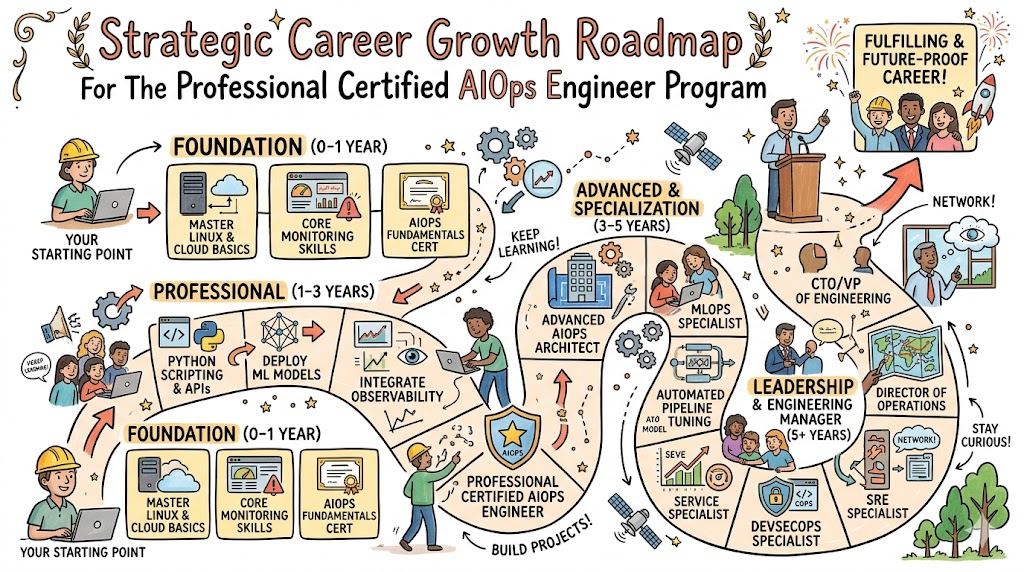
The certification offers foundation, professional, and advanced levels to accommodate various stages of professional growth. Foundation levels introduce the core concepts of data ingestion and basic anomaly detection for those new to the field. Professional tracks dive deeper into specialization areas like SRE-focused automation or FinOps-driven cost optimization using AI. Advanced levels are designed for architects who must design end-to-end self-healing systems for global enterprises. These levels align perfectly with career progression, moving from individual contributor tasks to high-level strategic planning.
Complete Certified AIOps Engineer Certification Table
| Track | Level | Who it’s for | Prerequisites | Skills Covered | Recommended Order |
| Operations | Foundation | Associate Engineers | Basic Linux/Cloud | Data Ingestion, Monitoring | First |
| Engineering | Professional | SREs / DevOps | 2+ Years Experience | ML Models, Automation | Second |
| Architecture | Advanced | Principal Leads | Professional Cert | System Design, AI Strategy | Third |
| Specialized | Expert | Data/MLOps Engineers | Advanced Cert | Neural Networks, Scaling | Fourth |
Detailed Guide for Each Certified AIOps Engineer Certification
Certified AIOps Engineer – Foundation Level
What it is
This certification validates a fundamental understanding of how artificial intelligence integrates with standard IT operations. It confirms the candidate knows how to navigate modern monitoring tools and basic data structures.
Who should take it
Junior DevOps engineers and recent graduates should take this to build a solid base in automated operations. It is also suitable for traditional sysadmins transitioning to cloud-native roles.
Skills you’ll gain
- Understanding of telemetry data types
- Basic configuration of AI-driven alerts
- Navigation of centralized logging systems
- Fundamental knowledge of incident lifecycles
Real-world projects you should be able to do
- Set up a basic monitoring dashboard with automated thresholds
- Configure log aggregation for a microservices application
Preparation plan
- 7-14 Days: Focus on terminology and the core pillars of observability.
- 30 Days: Complete all fundamental lab exercises and practice exam questions.
- 60 Days: Review real-world case studies of AIOps implementation in small startups.
Common mistakes
- Ignoring the importance of clean data ingestion
- Over-relying on default tool settings without understanding the logic
Best next certification after this
- Same-track option: Professional AIOps Engineer
- Cross-track option: Cloud Associate Certification
- Leadership option: Technical Team Lead Foundation
Certified AIOps Engineer – Professional Level
What it is
This level validates the ability to implement and manage machine learning models within a production environment. It focuses on reducing MTTR (Mean Time To Repair) through intelligent automation.
Who should take it
Mid-level SREs and DevOps professionals with a few years of experience should pursue this level. It is ideal for those responsible for maintaining high-availability systems.
Skills you’ll gain
- Implementation of predictive scaling algorithms
- Advanced root cause analysis using ML
- Integration of AIOps tools with CI/CD pipelines
- Management of noise reduction in alerting systems
Real-world projects you should be able to do
- Build an automated incident response workflow that triggers on specific anomalies
- Develop a predictive model to forecast infrastructure capacity needs
Preparation plan
- 7-14 Days: Deep dive into specific ML algorithms used for pattern recognition.
- 30 Days: Build and break complex lab environments to test recovery scripts.
- 60 Days: Conduct a full audit of a simulated enterprise environment for AIOps readiness.
Common mistakes
- Failing to account for model drift over time
- Neglecting the cultural shift required for automated operations
Best next certification after this
- Same-track option: Advanced AIOps Architect
- Cross-track option: MLOps Professional
- Leadership option: Engineering Manager Track
Choose Your Learning Path
DevOps Path
Engineers on this path focus on integrating AI into the software delivery lifecycle to improve velocity and quality. You will learn to use predictive analytics to identify potential deployment failures before they occur in production. This path emphasizes the creation of “smart” pipelines that adjust testing rigor based on historical data patterns. Mastering these skills allows DevOps professionals to move beyond simple script writing into intelligent system orchestration.
DevSecOps Path
This path prioritizes the application of AI to security operations and vulnerability management. Professionals learn to distinguish between normal user behavior and sophisticated cyber threats using high-speed data analysis. By automating the identification of security gaps, you can ensure that compliance is maintained without slowing down development. This specialization is critical for those working in highly regulated industries like finance or healthcare.
SRE Path
The SRE path focuses heavily on system reliability, uptime, and the reduction of operational toil. You will master the use of AI to automate complex troubleshooting steps that previously required manual intervention. By focusing on Service Level Objectives (SLOs), you learn to use machine learning to trigger corrective actions before users experience downtime. This path is essential for managing the massive scale of modern global web services.
AIOps Path
This core path is dedicated to the holistic management of IT environments through algorithmic intelligence. You will study the entire data pipeline from ingestion to actionable insight, ensuring that every piece of telemetry is utilized effectively. This track prepares you to build the “brain” of the IT infrastructure, centralizing intelligence across various domains. It is the definitive route for those wanting to become pure AIOps specialists.
MLOps Path
Focusing on the lifecycle of machine learning models, this path ensures that AI assets remain accurate and performant. You will learn how to deploy, monitor, and retrain models within a production environment to prevent performance degradation. This is vital for organizations that rely on AI for their core business products rather than just internal operations. It bridges the gap between data science and traditional systems engineering.
DataOps Path
DataOps professionals focus on the quality and flow of data that powers AI systems. You will learn to build resilient data pipelines that can handle the massive volume and velocity required for real-time AI analysis. This path ensures that the “fuel” for AIOps is clean, consistent, and delivered without latency. It is an excellent choice for those with a background in database management or data engineering.
FinOps Path
This path applies AI to cloud financial management and cost optimization. You will learn to use predictive modeling to forecast cloud spending and identify wasteful resource allocation automatically. By integrating AI with financial metrics, you help organizations maximize the value of every dollar spent on cloud infrastructure. This is a high-demand skill as companies look to rein in spiraling cloud costs.
Role → Recommended Certified AIOps Engineer Certifications
| Role | Recommended Certifications |
| DevOps Engineer | Foundation + Professional |
| SRE | Professional + Advanced |
| Platform Engineer | Professional + Advanced |
| Cloud Engineer | Foundation + Professional |
| Security Engineer | Professional (Security Focus) |
| Data Engineer | Professional (DataOps Focus) |
| FinOps Practitioner | Professional (FinOps Focus) |
| Engineering Manager | Foundation + Leadership Track |
Next Certifications to Take After Certified AIOps Engineer
Same Track Progression
Deep specialization involves moving toward the Advanced or Expert levels of the AIOps hierarchy. This path focuses on mastering complex neural networks and large-scale architectural patterns that govern entire data centers. You become the go-to expert for designing self-healing systems that require zero manual intervention. This progression often leads to roles like Principal AIOps Architect or Distinguished Engineer.
Cross-Track Expansion
Skill broadening allows you to take your AIOps knowledge into adjacent fields like MLOps or specialized Cloud Security. By understanding how AI interacts with different domains, you become a versatile asset capable of leading multi-disciplinary teams. This path is perfect for those who enjoy variety and want to understand the entire technical ecosystem. It provides a safety net against market shifts in any single specific technology.
Leadership & Management Track
Transitioning to leadership involves moving away from hands-on configuration toward strategic decision-making and team building. Your technical background in AIOps will allow you to set realistic goals and choose the right tools for your organization. Leaders with AI expertise are highly valued because they can bridge the gap between business objectives and technical feasibility. This track leads to roles such as Director of Engineering or Chief Technology Officer.
Training & Certification Support Providers for Certified AIOps Engineer
DevOpsSchool
This provider offers extensive hands-on labs and real-world project scenarios to help students master the complexities of modern automation. They focus on providing a deep dive into tool integration and cultural practices required for successful DevOps implementation. Their instructors are industry veterans who bring practical insights into the classroom setting.
Cotocus
This organization specializes in cloud-native technologies and provides specialized training for high-scale infrastructure management. They offer tailored programs that focus on the specific needs of modern enterprises transitioning to microservices architectures. Their curriculum is updated frequently to reflect the latest changes in the cloud ecosystem.
Scmgalaxy
As a community-driven platform, this provider offers a wealth of resources, including tutorials, forums, and specialized certification paths. They emphasize the importance of configuration management and source control as the foundation for any automated system. Their approach is highly practical, focusing on solving everyday engineering challenges.
BestDevOps
This portal provides comprehensive guides and structured learning paths for professionals at all stages of their careers. They focus on delivering high-quality content that balances theoretical concepts with practical application. Their certification support is designed to ensure that candidates are fully prepared for rigorous technical assessments.
devsecopsschool.com
This institution focuses exclusively on the intersection of security and operations within the modern delivery pipeline. They provide deep insights into how AI can be used to automate threat detection and compliance monitoring. Their programs are essential for engineers looking to specialize in secure software development lifecycles.
sreschool.com
This provider focuses on the principles of site reliability engineering and system availability. They teach students how to use data-driven insights to manage large-scale systems and reduce operational noise. Their training is highly valued by organizations that prioritize uptime and performance.
aiopsschool.com
As a primary destination for artificial intelligence in operations, this site offers specialized tracks for every level of expertise. They provide the core curriculum for the AIOps certification and host a variety of advanced learning modules. Their focus is on creating the next generation of intelligent systems engineers.
dataopsschool.com
This school focuses on the critical data pipelines that power modern automated systems. They teach the skills necessary to manage the flow, quality, and governance of data across the enterprise. Their training is vital for anyone looking to ensure that AI models have the high-quality data they require.
finopsschool.com
This organization provides specialized training in cloud financial management and cost optimization using advanced analytics. They help professionals understand how to align cloud spending with business value using automated tools. Their certification is a must-have for those looking to manage large cloud budgets effectively.
Frequently Asked Questions (General)
- How difficult is the certification exam for a professional engineer?
The exam is moderately difficult as it requires a mix of theoretical knowledge and hands-on lab experience to pass.
- How much time should I dedicate to studying for the foundation level?
Most professionals find that spending approximately five to ten hours a week for a month is sufficient for preparation.
- Are there any mandatory prerequisites before I can take the professional exam?
While not always mandatory, having at least two years of experience in cloud or DevOps roles is highly recommended.
- What is the return on investment for this specific certification track?
Certified engineers often see significant salary increases and receive more interest from top-tier global technology companies.
- In what sequence should I take the different certification levels?
It is best to follow the natural progression from Foundation to Professional and then finally to the Advanced level.
- Does the certification focus on a specific vendor or is it tool-agnostic?
The program focuses on core principles and logic, making the skills applicable across various vendors and open-source tools.
- How often do I need to renew my certification to stay current?
Certifications typically require renewal or continuing education every two to three years to account for technological advancements.
- Can a manager with a non-technical background pass the foundation exam?
Yes, with dedicated study, a manager can pass to gain a better strategic understanding of the technical landscape.
- What kind of lab environments are provided during the training phase?
Training providers usually offer cloud-based sandboxes where you can practice configurations without risking production systems.
- Is the certification recognized by major tech companies in India and abroad?
Yes, the certification is widely recognized as a benchmark for high-level competency in automated operations and AI.
- Are there community groups available for certified professionals to network?
Most providers host alumni groups and forums where you can share knowledge and find job opportunities.
- Does the exam include multiple-choice questions or practical tasks?
The assessment is a hybrid format, featuring both multiple-choice questions and live tasks in a lab environment.
FAQs on Certified AIOps Engineer
- How do I start my journey as a Certified AIOps Engineer today?You should begin by reviewing the foundation curriculum on the official portal and assessing your current knowledge of monitoring tools. Starting with basic data ingestion concepts will provide the necessary base for more complex machine learning topics later in the program.
- Does this certification cover both supervised and unsupervised machine learning?Yes, the curriculum covers various machine learning models relevant to operations, including anomaly detection and pattern matching. You will learn when to apply different algorithms based on the specific operational challenge you are trying to solve in production.
- Can I use these skills in a traditional on-premises data center?While the focus is on cloud-native environments, the logic of AIOps applies to any system that generates telemetry and logs. You can adapt these automated troubleshooting and predictive maintenance techniques to manage legacy hardware effectively within your organization.
- What programming languages are most useful for this certification track?Python is the most beneficial language due to its extensive libraries for data science and automation scripts. Familiarity with Bash and YAML is also essential for managing configurations and pipeline integrations within the AIOps ecosystem.
- How does AIOps differ from standard DevOps or SRE roles?AIOps specifically integrates artificial intelligence to handle the scale and complexity that traditional manual or scripted methods cannot manage. It acts as an enhancement to DevOps and SRE practices by providing deeper, automated insights into system behavior.
- Is there a focus on cost optimization within the curriculum?Yes, the professional and advanced levels include modules on using AI to identify wasteful resource usage and forecast spending. This ensures that engineers can contribute to the financial health of the organization while maintaining high performance.
- What are the common tools taught during the certification process?The training covers a variety of industry-standard tools for logging, monitoring, and machine learning integration. You will gain experience with platforms that handle massive data streams and provide algorithmic analysis for incident management and resolution.
- Are there any group discounts for enterprise engineering teams?Most training providers offer corporate packages for teams looking to upskill their entire workforce at once. You should contact the support team of your chosen provider to discuss tailored training schedules and bulk pricing options.
Final Thoughts: Is Certified AIOps Engineer Worth It?
If you are looking to advance your career in high-scale infrastructure, this certification is a vital investment. The transition from manual operations to AI-driven systems is not just a trend but a necessity for modern business survival. By mastering these skills, you move from being a technician who reacts to problems to an engineer who designs intelligent, self-correcting systems. The professional growth and market demand for this expertise far outweigh the time spent in study. Focus on the practical applications and remain curious about how data can improve system reliability. This path will undoubtedly place you among the elite tier of modern engineering professionals.
I really love how this roadmap simplifies the AIOps engineer path, making strategic career growth feel much more achievable.