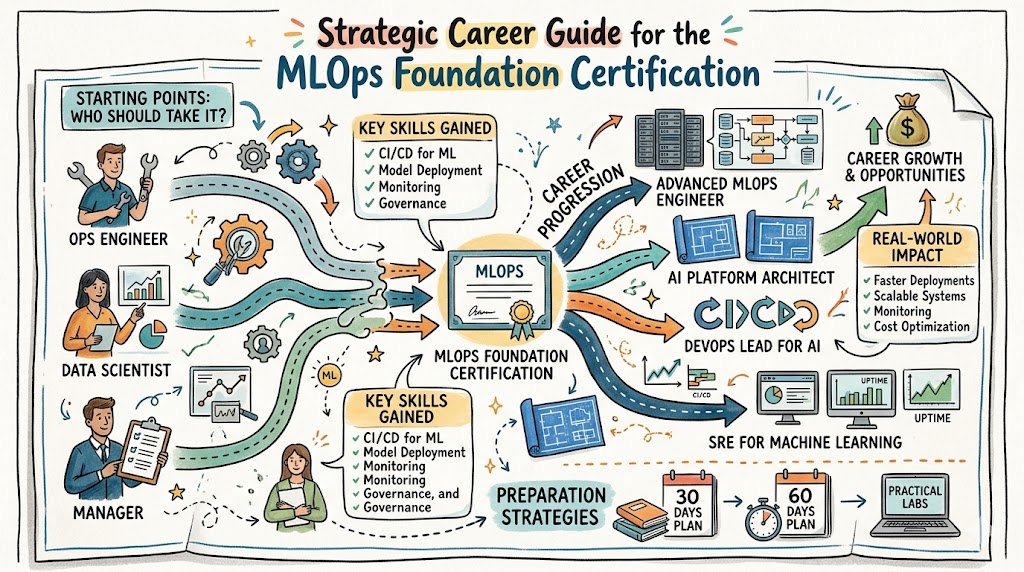
The MLOps Foundation Certification serves as a critical bridge between data science and production engineering. This guide helps software engineers, SREs, and platform experts understand how to transition from managing static code to managing dynamic machine learning lifecycles. By following this roadmap, professionals can make informed decisions about their career trajectory in the evolving landscape of AI-driven operations hosted by AIOpsSchool.
What is the MLOps Foundation Certification?
This certification represents a shift from theoretical data science toward robust, production-grade engineering. It exists to standardize the deployment, monitoring, and management of machine learning models within enterprise environments. Unlike academic courses, it emphasizes the operational side of the lifecycle, focusing on how models behave when they meet real-world data at scale.
The program aligns perfectly with modern engineering workflows by introducing CI/CD principles to the world of data. It ensures that engineers treat models as software artifacts that require versioning, automated testing, and continuous monitoring. This practical focus prepares professionals to handle the unique challenges of “hidden technical debt” often found in machine learning systems.
Who Should Pursue MLOps Foundation Certification?
Cloud professionals, SREs, and DevOps engineers who want to stay relevant in an AI-first world will find this path highly beneficial. It is equally important for data engineers who need to understand how their pipelines feed into production models and for security roles focusing on model integrity. Beginners gain a structured entry point, while experienced engineers learn to adapt their existing skills to the nuances of ML systems.
Furthermore, engineering managers and technical leaders should pursue this to understand the resource requirements and team structures needed for successful AI projects. The certification holds significant weight for the global market and the rapidly expanding tech hubs in India. It bridges the communication gap between pure data scientists and the operations teams responsible for uptime.
Why MLOps Foundation Certification is Valuable and Beyond
The demand for professionals who can operationalize AI is growing faster than the supply of qualified talent. As enterprises move past the experimental phase of machine learning, they require engineers who can ensure these models are reliable, scalable, and cost-effective. This certification provides longevity by teaching principles that apply regardless of whether you use open-source tools or proprietary cloud platforms.
Investing time in this domain offers a high return on career growth because it positions you at the intersection of two high-growth fields. Companies are increasingly adopting automated machine learning pipelines to maintain a competitive edge. Mastering these operations ensures you remain a vital asset to any organization looking to scale its intelligence capabilities without increasing manual overhead.
MLOps Foundation Certification Overview
The program is delivered via the official course page and is hosted on the primary website. It uses a structured assessment approach to validate that candidates understand the full spectrum of the ML lifecycle. The certification is designed to be practical, moving away from multiple-choice memorization toward demonstrating an understanding of system design and operational excellence.
Ownership of the learning process remains with the student, supported by a curriculum that covers data ingestion, model training, deployment strategies, and monitoring. The structure ensures that even those without a heavy math background can succeed by focusing on the “Ops” part of the equation. It builds a foundation that is necessary before moving into more specialized or advanced architectural roles.
MLOps Foundation Certification Tracks & Levels
The certification journey begins at the foundation level, establishing a common language for all team members. From there, professionals can move into professional levels that dive deeper into automation and infrastructure as code for machine learning. Advanced levels focus on large-scale architectural patterns and the orchestration of complex multi-model environments.
Specialization tracks allow learners to align their studies with their current roles, such as focusing on the security aspects or the financial optimization of ML clusters. This tiered approach ensures that career progression is measurable and logical. By advancing through these levels, an engineer can transition from a contributor to a lead architect within the ML space.
Complete MLOps Foundation Certification Table
| Track | Level | Who it’s for | Prerequisites | Skills Covered | Recommended Order |
| Core Ops | Foundation | Beginners/DevOps | Basic Linux/Git | ML Lifecycle, CI/CD | First |
| Engineering | Professional | SREs/Cloud Eng | Foundation Cert | Model Scaling, Drift | Second |
| Architecture | Advanced | Tech Leads/Architects | Professional Cert | Orchestration, Governance | Third |
| Security | Specialist | Security Engineers | Foundation Cert | Model Robustness, IAM | Optional |
| Data | Specialist | Data Engineers | Basic SQL/Python | Feature Stores, Pipelines | Optional |
Detailed Guide for Each MLOps Foundation Certification
MLOps Foundation Certification – Foundation Level
What it is
This certification validates a professional’s understanding of the basic concepts of machine learning operations and the collaboration between data scientists and engineers. It confirms that the holder knows the terminology and the components of a standard ML pipeline.
Who should take it
This is ideal for DevOps engineers, junior data scientists, and system administrators who are new to machine learning. It also serves as an excellent starting point for project managers who oversee technical AI teams.
Skills you’ll gain
- Understanding the ML experiment tracking process.
- Familiarity with model versioning and data lineage.
- Basic knowledge of containerization for ML models.
- Insights into continuous integration for model code.
Real-world projects you should be able to do
- Set up a basic automated pipeline for model retraining.
- Containerize a simple Python-based ML model for deployment.
- Configure an experiment tracking server to log model metrics.
Preparation plan
For a 7-14 day strategy, focus on high-level architecture and vocabulary. A 30-day plan should include hands-on labs with basic automation tools. Those taking 60 days should dive into the nuances of data pipelines and basic cloud services.
Common mistakes
Many candidates focus too much on the math behind the algorithms instead of the infrastructure surrounding them. Another common error is ignoring the importance of data versioning compared to code versioning.
Best next certification after this
- Same-track option: MLOps Professional Certification.
- Cross-track option: DataOps Foundation.
- Leadership option: Technical Product Manager for AI.
Choose Your Learning Path
DevOps Path
Professionals on this path should focus on integrating ML workloads into existing Jenkins or GitLab pipelines. The goal is to treat the model as just another piece of software that needs testing and deployment. You will learn to manage the underlying infrastructure that supports high-frequency model updates. This path bridges the gap between software delivery and data science.
DevSecOps Path
This journey emphasizes the security of the model supply chain and the protection of sensitive training data. You will explore how to scan containers for vulnerabilities and ensure that the model inference endpoints are resilient against attacks. It involves implementing policy as code to govern how models access enterprise data. Security is paramount when AI systems handle customer information.
SRE Path
The SRE path focuses on the reliability, latency, and performance of machine learning models in production. You will learn to set up Service Level Objectives for model inference and implement automated rollbacks when performance degrades. It involves deep dives into monitoring “model drift” and resource utilization of GPU clusters. Reliability ensures that AI remains a tool rather than a liability.
AIOps Path
This path teaches engineers how to use artificial intelligence to improve traditional IT operations. You will learn to build systems that predict outages or automate root cause analysis using machine learning. It is about applying the very models you manage to the infrastructure you run. This creates a self-healing environment that reduces manual intervention for the operations team.
MLOps Path
The MLOps path is the core journey of automating the entire machine learning lifecycle from data prep to monitoring. You will focus on building feature stores and automated retraining triggers that keep models accurate over time. It requires a balance of software engineering rigor and data science understanding. This is the primary path for anyone wanting to be a dedicated MLOps engineer.
DataOps Path
DataOps professionals focus on the “Data” part of the pipeline, ensuring high-quality data flows seamlessly into ML models. You will learn about data versioning, automated quality checks, and building scalable data lakes. It ensures that the model is only as good as the data it consumes. This path is essential for maintaining the integrity of the entire machine learning ecosystem.
FinOps Path
This path is dedicated to managing the high costs associated with training and running large-scale machine learning models. You will learn to optimize cloud spending, choose the right instances for GPU workloads, and track ROI for AI projects. It involves creating a culture of cost-awareness within data science teams. Effective FinOps prevents AI initiatives from becoming financial burdens on the organization.
Role → Recommended MLOps Foundation Certification Certifications
| Role | Recommended Certifications |
| DevOps Engineer | MLOps Foundation + Professional |
| SRE | MLOps Foundation + SRE School Specialist |
| Platform Engineer | MLOps Foundation + Cloud Architecture |
| Cloud Engineer | MLOps Foundation + FinOps Foundation |
| Security Engineer | MLOps Foundation + DevSecOps Specialist |
| Data Engineer | MLOps Foundation + DataOps Foundation |
| FinOps Practitioner | MLOps Foundation + FinOps Professional |
| Engineering Manager | MLOps Foundation + AI Governance |
Next Certifications to Take After MLOps Foundation Certification
Same Track Progression
Once the foundation is secure, the logical step is to pursue professional-level certifications that focus on advanced automation and enterprise scaling. This involves mastering specific toolsets like Kubernetes for ML and advanced pipeline orchestration. Deep specialization ensures you can handle the most complex production environments.
Cross-Track Expansion
Broadening your skills into DataOps or DevSecOps provides a more holistic view of the ecosystem. Understanding how data quality impacts model performance or how security vulnerabilities can compromise AI makes you a more versatile engineer. This cross-pollination of skills is highly valued by modern tech companies.
Leadership & Management Track
For those moving toward leadership, certifications in AI Ethics, Governance, and Strategy are key. This transition shifts the focus from building the systems to managing the teams and policies that govern them. It prepares you for roles like VP of Engineering or Head of AI Operations.
Training & Certification Support Providers for MLOps Foundation Certification
DevOpsSchool
This provider offers comprehensive training programs that cover the entire DevOps spectrum, including specialized tracks for machine learning operations. They focus on hands-on labs and real-world scenarios to ensure students can apply what they learn in enterprise settings. Their curriculum is updated frequently to reflect the latest industry trends and toolsets.
Cotocus
This organization provides high-quality consulting and training services focused on modern IT infrastructure and cloud-native technologies. They emphasize practical implementation over theoretical knowledge, making them a preferred choice for working professionals. Their instructors are often active practitioners who bring current industry insights into the classroom.
Scmgalaxy
As a community-driven platform, this provider offers extensive resources and training for software configuration management and DevOps. They have a vast library of tutorials and guides that support learners throughout their certification journey. Their focus is on building a strong community of experts who share knowledge and best practices.
BestDevOps
This platform specializes in providing curated learning paths for engineers looking to master DevOps and its related disciplines. They offer structured courses that guide students from foundational concepts to advanced architectural patterns. Their goal is to simplify the learning process and provide clear paths to career advancement.
devsecopsschool.com
This dedicated portal focuses on the intersection of security and operations, providing training on how to secure modern software pipelines. They offer specialized courses that cover security automation, policy as code, and model security. Their programs are essential for engineers who need to ensure compliance and protection in AI systems.
sreschool.com
Focused on site reliability engineering, this site provides deep dives into maintaining high availability and performance for complex systems. Their training includes specific modules on monitoring and scaling machine learning workloads. They help engineers build the skills necessary to keep production environments running smoothly under heavy loads.
aiopsschool.com
This is the primary hub for AIOps and machine learning operations training, offering the official certification paths mentioned in this guide. They provide a comprehensive ecosystem of learning materials, including labs, documentation, and expert-led sessions. Their focus is strictly on the future of AI-driven operations and infrastructure.
dataopsschool.com
This provider focuses on the data engineering and operations side of the house, ensuring that the foundation of AI is solid. Their training covers everything from data pipeline automation to data quality management at scale. They provide the necessary skills to manage the massive datasets required for modern machine learning.
finopsforce.com
Focused on the financial management of cloud and AI resources, this provider helps organizations control their spending. Their courses teach engineers and managers how to balance performance with cost-efficiency. They are a critical resource for anyone managing expensive GPU clusters or large-scale cloud deployments.
Frequently Asked Questions (General)
- How difficult is the foundation level exam?
The exam is moderate, focusing on conceptual understanding and logical workflows rather than complex coding. - How much time is needed for preparation?
Most working professionals can prepare sufficiently within 30 days by dedicating a few hours each weekend. - Are there any hard prerequisites?
There are no formal prerequisites, but a basic understanding of Linux and Git is highly recommended. - What is the ROI of this certification?
Professionals often see a significant salary bump and better job opportunities in AI-driven companies. - Should I learn Data Science before MLOps?
No, you only need to understand the ML lifecycle, not necessarily how to build complex models from scratch. - Does this certification expire?
Most certifications in this field require renewal every two to three years to stay current with technology. - Is it recognized globally?
Yes, the skills validated are universal across the tech industry in India, the US, and Europe. - Can I take the exam online?
Yes, the certification process is designed to be accessible remotely for professionals worldwide. - What tools are covered?
The focus is on principles, but you will encounter tools like Docker, Kubernetes, and various ML tracking platforms. - How does this differ from a standard DevOps cert?
It specifically addresses the challenges of non-deterministic code and data-dependent deployments found in ML. - Is there a community for support?
Yes, providers like Scmgalaxy and AIOpsSchool have active communities for student interaction. - Can a manager benefit from this?
Absolutely, it provides the technical context needed to make better hiring and resource allocation decisions.
FAQs on MLOps Foundation Certification
- How does MLOps Foundation Certification handle model drift?
The certification teaches you to implement monitoring systems that detect when model accuracy drops due to changing data. - What role does automation play here?
Automation is central, focusing on triggered retraining and automated deployment of validated models to production. - Are cloud-specific tools required?
While cloud platforms are discussed, the certification focuses on cloud-agnostic principles that apply anywhere. - Does it cover LLM operations?
Yes, the principles of MLOps are foundational to managing Large Language Models and Generative AI at scale. - Is Python knowledge necessary?
A basic ability to read Python is helpful as most ML tooling and scripts are written in it. - How does it address data privacy?
The curriculum includes sections on secure data handling and compliance within the machine learning pipeline. - What is the focus on Kubernetes?
Kubernetes is treated as the primary orchestration layer for scaling model inference and training jobs. - Does it include version control for data?
Yes, understanding how to version datasets alongside code is a core component of the foundation level.
Final Thoughts: Is MLOps Foundation Certification Worth It?
If you are looking to future-proof your career in infrastructure or software engineering, the answer is a clear yes. The industry is moving toward a state where every application will have an intelligent component, and someone must manage that complexity. This certification provides the mental framework and technical vocabulary to be that person.
It is not about chasing a trend; it is about adopting the next evolution of engineering discipline. By moving from traditional DevOps to MLOps, you are expanding your toolkit to handle the most valuable assets of a modern company: its data and its intelligence. This path is practical, demanding, and highly rewarding for those willing to learn.
This guide makes it so simple to understand how this certification can actually help boost my career path.