Introduction
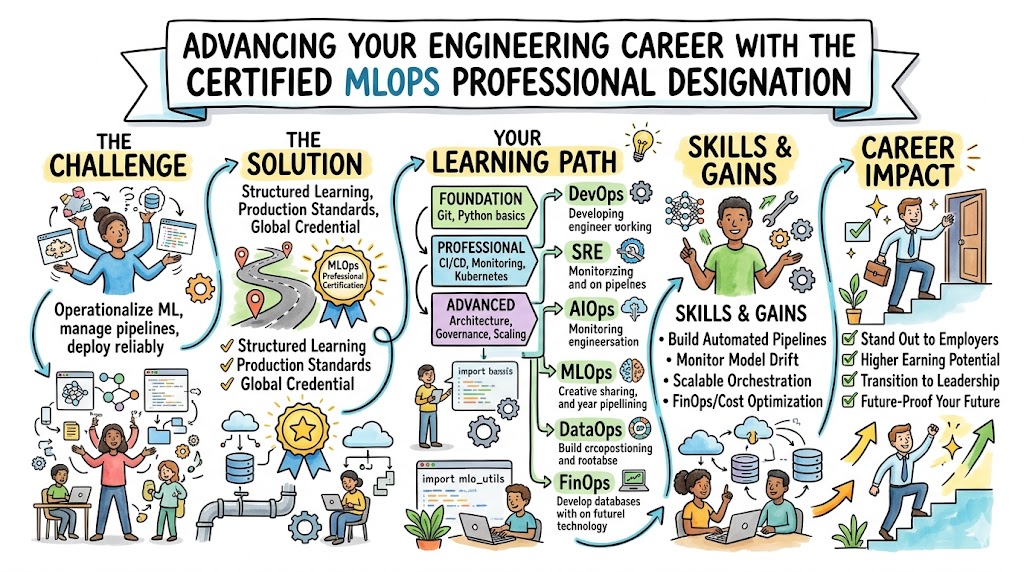
As machine learning moves from experimental notebooks to production environments, the demand for structured operations has skyrocketed. The Certified MLOps Professional program bridges the gap between data science and traditional DevOps by introducing rigorous engineering standards. This guide serves engineers, architects, and managers who navigate the complexities of cloud-native deployments and automated model lifecycles. By exploring this path, professionals can transition from manual workflows to scalable platform engineering. Modern organizations now prioritize candidates who understand the intersection of AIOpsSchool principles and continuous delivery. Decisions regarding career shifts require clear data, and this comprehensive analysis provides the technical foundation needed to evaluate the long-term impact of this credential on your professional trajectory.
What is the Certified MLOps Professional?
The Certified MLOps Professional designation establishes a specialized standard for engineers managing machine learning lifecycles in production. It solves the critical “last mile” problem where AI projects often fail due to insufficient operational discipline. This program prioritizes production-ready workflows over abstract theoretical algorithms. It synchronizes with modern engineering workflows by emphasizing strict versioning, constant monitoring, and automated testing for both code and data. Engineers learn to treat models as first-class citizens within the software development lifecycle to ensure predictable and repeatable deployments.
Who Should Pursue Certified MLOps Professional?
Software engineers, SREs, and cloud architects tasked with supporting data science teams benefit most from this certification. Systems administrators and platform engineers across India and global technology hubs find it essential as companies migrate legacy AI systems to cloud environments. While beginners with solid Linux and Python skills use this to enter a high-growth niche, experienced managers gain the necessary technical vocabulary to lead multidisciplinary teams. Data engineers also gain immense value by understanding the operational requirements of the models they support.
Why Certified MLOps Professional is Valuable Today
Massive enterprise adoption of automated AI systems drives the sustained demand for this certification. While specific tools change, the core principles of MLOps remain constant, allowing professionals to stay relevant throughout technological shifts. This credential offers an excellent return on time because it addresses the acute skill shortage in the current labor market. Organizations now move away from manual model handovers toward fully automated pipelines, making these skills mandatory for future-proof engineering roles. Mastering these operations shields your career path from the volatility often found in pure research positions.
Certified MLOps Professional Certification Overview
Candidates access the program through the official course materials hosted on the AIOpsSchool platform. The curriculum utilizes a multi-level assessment approach that combines rigorous practical labs with objective evaluations to confirm technical competency. The structure supports working professionals through a self-paced yet demanding journey across the pillars of model operations. Industry practitioners maintain the certification ownership and update the curriculum to reflect the latest cloud-native trends and security standards. This practical focus empowers certified individuals to contribute immediately to enterprise-level architecture discussions.
Certified MLOps Professional Certification Tracks & Levels
The certification features foundation, professional, and advanced levels to match various career maturity stages. The foundation level introduces fundamental pipeline concepts, while the professional track explores deep CI/CD for ML and automated monitoring. Advanced levels concentrate on complex architectural patterns, multi-cloud deployments, and orchestration strategies. Specialized tracks allow professionals to focus on DevOps-heavy roles or SRE-focused stability management. These levels provide a transparent roadmap for career progression from individual contributor to lead architect.
Complete Certified MLOps Professional Certification Table
| Track | Level | Who it’s for | Prerequisites | Skills Covered | Recommended Order |
| Core Operations | Foundation | Junior Engineers | Basic Python | Version Control, ML Basics | First |
| Engineering | Professional | SRE / DevOps | Cloud Knowledge | CI/CD, Containerization | Second |
| Architecture | Advanced | Tech Leads | 5+ Years Exp | Scaling, Governance | Third |
| Security | Specialist | Security Lead | Network Basics | Model Auditing, Compliance | Optional |
| Data | Specialist | Data Engineers | SQL / Big Data | Data Lineage, Feature Stores | Optional |
Detailed Guide for Each Certified MLOps Professional Certification
Certified MLOps Professional – Foundation
What it is
This certification validates a candidate’s grasp of the basic machine learning model lifecycle. It confirms that the individual knows how to migrate a model from a local environment to basic cloud services.
Who should take it
Junior developers or traditional DevOps engineers new to the data science domain should start here. It serves as the primary entry point for those pivoting into AI operations.
Skills you’ll gain
- Identifying ML pipeline stages
- Executing basic Git workflows for data science
- Setting up cloud environments for ML
- Tracking models effectively
Real-world projects you should be able to do
- Automate simple model training scripts
- Deploy pre-trained models as REST APIs
- Track experiment metrics using fundamental tools
Preparation plan
- 7-14 Days: Review core definitions and distinguish between DevOps and MLOps.
- 30 Days: Complete fundamental labs and practice basic containerization.
- 60 Days: Build three end-to-end sample pipelines independently.
Common mistakes
- Focusing excessively on mathematics instead of deployment.
- Neglecting the necessity of data versioning.
Best next certification after this
- Same-track: Certified MLOps Professional – Associate
- Cross-track: Cloud Practitioner
- Leadership: Team Lead Fundamentals
Certified MLOps Professional – Professional
What it is
This level confirms the capacity to build and manage production-grade automated pipelines. It emphasizes reliability, scalability, and the seamless integration of automated testing into the ML lifecycle.
Who should take it
Mid-level SREs, DevOps engineers, and data professionals with at least two years of experience should pursue this. It targets those responsible for maintaining uptime in ML systems.
Skills you’ll gain
- Managing advanced Kubernetes orchestration for ML
- Implementing automated CI/CD for model training
- Executing performance monitoring and drift detection
- Handling scalable feature store management
Real-world projects you should be able to do
- Build automated retraining pipelines triggered by data drift.
- Manage multi-node GPU clusters for distributed training.
- Implement A/B testing for live models in production.
Preparation plan
- 7-14 Days: Review advanced Kubernetes and container networking concepts.
- 30 Days: Practice implementing automated monitoring and alerting systems.
- 60 Days: Design and execute a migration of ML workloads to the cloud.
Common mistakes
- Overlooking cost optimization within GPU environments.
- Failing to implement robust security and access controls.
Best next certification after this
- Same-track: Certified MLOps Professional – Advanced
- Cross-track: DevSecOps Specialist
- Leadership: Engineering Manager Program
Choose Your Learning Path
DevOps Path
The DevOps path centers on integrating machine learning into existing software delivery pipelines. Professionals choose this route to treat models with the same engineering rigor as traditional applications. Key areas include automated testing, deployment strategies, and infrastructure as code tailored for machine learning. This path suits those who want to build the underlying machinery powering AI products. It bridges the gap between software development and model deployment effectively.
DevSecOps Path
The DevSecOps path highlights the security of the model lifecycle and sensitive data protection. Engineers on this track learn to scan models for vulnerabilities and ensure data privacy compliance throughout the pipeline. It involves implementing automated security checks and managing identity access for model environments. This path remains critical for industries like finance and healthcare where data integrity is paramount. It ensures that MLOps velocity never compromises system security.
SRE Path
The SRE path focuses on the reliability and observability of machine learning models in production. Professionals define SLIs and SLOs specifically for ML services, such as latency and prediction accuracy. This route covers handling model drift and performing automated rollbacks when performance degrades. It offers a highly technical path dedicated to maintaining the uptime of intelligence systems. SREs ensure that ML systems remain resilient to data changes and traffic spikes.
AIOps Path
The AIOps path teaches professionals to use machine learning for improving traditional IT operations. This involves analyzing logs, metrics, and traces with AI to predict system failures before they occur. It differs from MLOps because it applies AI to the infrastructure itself rather than just deploying models. Engineers in this track build self-healing systems and automated incident response tools. It represents the pinnacle of modern, intelligent infrastructure management.
MLOps Path
The MLOps path serves as the core journey for those managing the model lifecycle from ingestion to decommissioning. It covers the specific challenges of versioning large datasets and tracking experiments across distributed teams. Professionals build feature stores and model registries that act as a single source of truth. This path creates a collaborative environment between data scientists and engineers. It optimizes workflows for maximum experiment velocity and deployment stability.
DataOps Path
The DataOps path focuses on automated, policy-driven management of data feeding the ML models. Engineers build robust data pipelines that ensure high quality and low latency for training and inference. This track emphasizes data lineage, cataloging, and automated cleaning processes. It provides the foundation for successful MLOps because model quality depends entirely on data quality. DataOps practitioners ensure the fuel for the ML engine remains ready.
FinOps Path
The FinOps path addresses the economic aspects of running machine learning workloads, which often incur high costs. Professionals monitor cloud spending, optimize GPU usage, and implement cost-allocation tags for ML projects. This track ensures that AI initiatives remain profitable and within budget for the enterprise. It involves collaborating with finance teams to forecast spending based on model complexity. This ensures the long-term sustainability of AI projects in large organizations.
Role → Recommended Certified MLOps Professional Certifications
| Role | Recommended Certifications |
| DevOps Engineer | Certified MLOps Professional – Core |
| SRE | Certified MLOps Professional – Reliability Specialist |
| Platform Engineer | Certified MLOps Professional – Infrastructure Track |
| Cloud Engineer | Certified MLOps Professional – Cloud Native Track |
| Security Engineer | Certified MLOps Professional – Security Track |
| Data Engineer | Certified MLOps Professional – DataOps Track |
| FinOps Practitioner | Certified MLOps Professional – Cost Management |
| Engineering Manager | Certified MLOps Professional – Leadership Track |
Next Certifications to Take After Certified MLOps Professional
Same Track Progression
Mastering the professional level naturally leads to architectural or principal levels. This involves designing complex, multi-tenant platforms that support hundreds of models simultaneously. Deep specialization in specific cloud providers or hardware like TPUs also marks this progression. This path ensures you remain the top technical authority in your specific niche.
Cross-Track Expansion
Broadening your skills into DevSecOps or FinOps provides a holistic view of the engineering landscape. Professionals who understand both model deployment and security provide immense value to any organization. Cross-training allows you to bridge different departments and act as a technical lead across broader infrastructure initiatives. It transforms you into a “T-shaped” professional with significant depth and breadth.
Leadership & Management Track
Those moving away from hands-on coding should explore the leadership track for strategy and team building. This involves managing the product lifecycle and aligning technical capabilities with business goals. Leadership training helps you transition into roles like VP of Engineering or Head of Infrastructure. It concentrates on the people and process aspects of the MLOps framework.
Training & Certification Support Providers for Certified MLOps Professional
DevOpsSchool
This provider offers extensive resources for integrating MLOps into traditional software delivery. They focus on practical labs and real-world scenarios that help engineers transition from legacy systems to modern pipelines.
Cotocus
A technical training organization specializing in niche cloud technologies and automation. They provide deep-dive sessions into container orchestration and infrastructure as code, which are vital components of MLOps strategy.
Scmgalaxy
This community-driven platform provides extensive knowledge on configuration management and version control. Their expertise in SCM remains invaluable for candidates because MLOps relies heavily on versioning code and data.
BestDevOps
Focusing on modern engineering best practices, this provider offers structured courses emphasizing efficiency and automation. They help professionals understand the nuances of building high-performance teams and scalable systems.
devsecopsschool.com
This platform serves as the primary resource for integrating security into the automation lifecycle. They provide specialized training on model security, data privacy, and automated compliance checks.
sreschool.com
Dedicated to SRE principles, this provider teaches engineers to maintain system stability. Their courses cover monitoring, alerting, and incident management specifically for complex, distributed ML environments.
aiopsschool.com
The official hosting platform for the Certified MLOps Professional program provides the most direct and relevant training material. They offer the curriculum, practice exams, and lab environments required to pass.
dataopsschool.com
This provider concentrates on the data-centric side of the operations equation. They teach students how to build reliable data pipelines and manage the massive datasets required for machine learning.
finopsschool.com
This provider offers critical training on financial management in technology as cloud costs rise. They teach engineers to track and optimize costs associated with training and deploying models.
Frequently Asked Questions (General)
1. How difficult is it to achieve this certification?
The difficulty level targets professionals and requires a practical mix of coding skills and systems knowledge.
2. What is the typical time commitment for preparation?
Working professionals usually spend one to three months preparing, depending on their existing experience with cloud tools.
3. Are there any mandatory prerequisites before I can start?
While no strict blockers exist, you should possess a solid grasp of Linux, Python, and basic Git workflows.
4. What is the return on investment for this credential?
Certified individuals often secure significant salary increases and gain access to specialized, higher-level roles in the tech industry.
5. Do I need to be a data scientist to pass?
No, this engineering-focused certification requires you to manage models rather than build the underlying mathematical algorithms.
6. In what order should I take the levels?
Start with the Foundation level to build a strong base before moving to Professional and Advanced tracks.
7. Is this certification recognized by major cloud providers?
Yes, the platform-agnostic skills remain highly valued by teams working on AWS, Azure, and Google Cloud Platform.
8. How long does the certification remain valid?
The certification typically remains valid for two to three years before requiring a renewal or advanced assessment.
9. Can this help me get a job in India?
Absolutely, India has a massive demand for MLOps engineers as global firms move their AI centers to the region.
10. Is there a focus on specific tools like Jenkins or GitLab?
The program emphasizes CI/CD principles while using popular tools to demonstrate how to apply those principles in practice.
11. Are the exams hands-on or multiple-choice?
Assessments include a combination of both to test theoretical knowledge and practical application skills.
12. What happens if I fail the exam?
Most providers allow retakes after a waiting period, during which you can review the specific areas where you struggled.
FAQs on Certified MLOps Professional
1. What specifically makes MLOps different from standard DevOps?
MLOps handles the versioning of data and models, and it requires monitoring for drift in model accuracy over time.
2. Does this certification cover generative AI operations?
Yes, the curriculum includes the principles of scaling and deploying large language models as a key part of the program.
3. How does this program handle multi-cloud strategies?
The training highlights cloud-agnostic tools like Kubernetes, allowing you to manage model workloads across different cloud providers seamlessly.
4. Is there a focus on local government compliance?
While the core remains technical, the security and data tracks cover general principles of GDPR and other data privacy laws.
5. Will I learn about feature stores?
Yes, feature stores represent a critical component of the professional level, focusing on managing reusable data for model training.
6. How much coding is involved in the exam?
Expect to write Python scripts and YAML configurations for CI/CD pipelines and infrastructure deployment during the assessment.
7. Is real-time inference covered?
The curriculum includes both batch processing and real-time inference strategies to ensure a well-rounded operational understanding.
8. Does it cover hardware acceleration?
Advanced tracks touch upon managing specialized hardware like GPUs and TPUs for high-performance training tasks.
Final Thoughts: Is Certified MLOps Professional Worth It?
Choosing this certification serves as a strategic move for any engineer aiming to stay relevant in an AI-driven market. It elevates you beyond the saturated market of general DevOps into a specialized niche with higher barriers to entry. The value comes from the disciplined approach to engineering you develop through the curriculum. If you want to work on cutting-edge technology while maintaining a stable career, this path offers a clear choice. Focus on the labs, master the automation, and let the results speak for themselves.
This post really simplifies the path to becoming an expert and helps me plan my next career move perfectly.