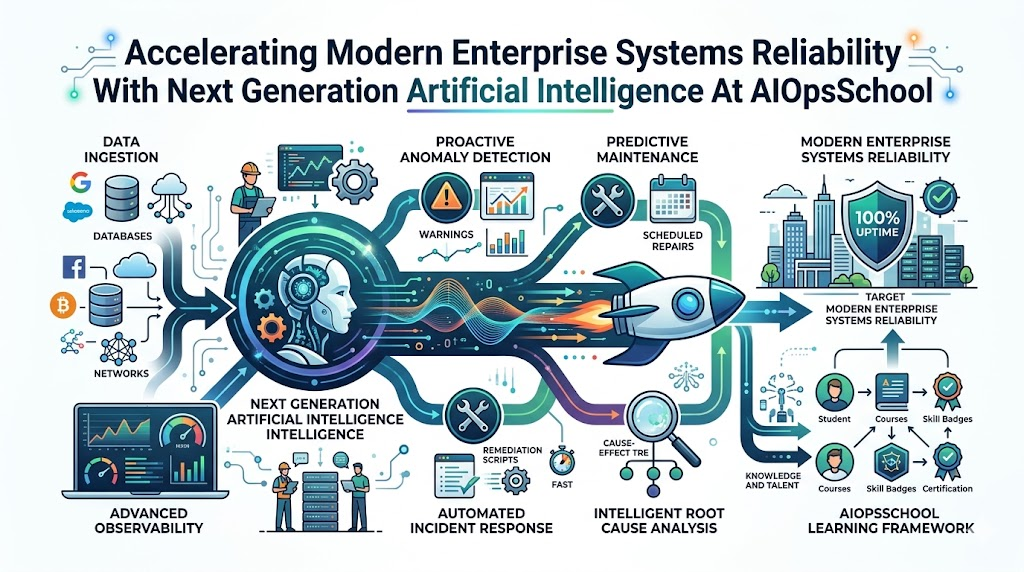
Modern IT infrastructures face an unprecedented level of operational complexity. Engineering teams constantly battle an overwhelming deluge of system alerts, distributed microservices, and multi-cloud environments. Consequently, traditional monitoring paradigms fail to keep pace, leaving engineers exhausted by persistent alert fatigue and prolonged system outages. To resolve these massive operational challenges, companies rapidly shift toward machine learning-driven automation. Therefore, professionals must seek comprehensive AIOps Training to remain competitive and lead infrastructure transformation initiatives. Through specialized learning platforms like AiOpsSchool, systems engineers acquire the exact technical expertise required to navigate this modern landscape.
Furthermore, digital transformation accelerates the velocity of data generation within enterprise environments. Traditional operations rely heavily on human intervention to sift through logs, trace metrics, and diagnose failures. However, this manual approach inevitably introduces critical delays, driving up the cost of downtime. Organizations consequently require automated intelligence that acts instantly upon system telemetry. Embracing advanced analytical paradigms allows teams to shift from reactive firefighting to predictive systems management. Ultimately, mastering these methodologies bridges the gap between infrastructure chaos and seamless operational resilience.
What Is AIOps?
Artificial Intelligence for IT Operations, commonly known as AIOps, combines big data, machine learning, and advanced analytics to enhance automated infrastructure management. So, What is AIOps in practical terms? It represents a paradigm shift where software algorithms continuously analyze your operational ecosystem instead of relying on manual oversight. The primary objective centers on ingestion of massive data volumes from disparate sources, identifying complex patterns, and executing automated resolutions.
In addition, this methodology replaces static, rule-based thresholds with dynamic, evolving algorithmic models. Standard monitoring tools merely flag a metric when it crosses an arbitrary line, which regularly triggers false positives. Conversely, an intelligent platform understands context, historical baselines, and cross-system dependencies. As a result, operations teams receive highly accurate, actionable insights rather than distracting background noise. This structural shift empowers modern engineering departments to optimize overall system reliability with minimal human overhead.
Key Operational Concepts You Must Know
To successfully implement AIOps in IT operations, engineers must first master the fundamental architectural building blocks that govern automated environments. The entire ecosystem relies on a continuous loop of data ingestion, contextual analysis, and intelligent remediation.
First, observability provides the foundation for all analytical intelligence. Unlike simple monitoring, observability enables teams to infer the internal states of a system based entirely on its external outputs. This practice depends directly on telemetry data, which comprises logs, metrics, and traces. Logs offer a chronological record of discrete system events; metrics supply numerical measurements of resource utilization over time; and traces map the end-to-end journey of an individual request through distributed microservices.
Second, event correlation acts as the analytical engine of modern operations. This process groups thousands of isolated network alerts, error logs, and system notifications into a unified, coherent incident. By automatically binding related telemetry together, engineers instantly see the full blast radius of an issue without manually digging through separate dashboards.
Third, separating an operational baseline from an anomaly determines whether an automation platform triggers an action. Traditional tools use rigid thresholds, whereas intelligent systems continuously calculate a fluid baseline of normal behavior. Therefore, if a database experience a sudden CPU spike at 3:00 AM when traffic is typically non-existent, the system identifies this deviation as an anomaly, even if the total utilization remains below a traditional 80% threshold.
Finally, automated remediation closes the operational loop. Once the analytical layer identifies a verified incident and isolates its origin, the remediation engine automatically deploys a targeted script, scales a cluster, or restarts a failing container. This sequence eliminates human delays entirely, accelerating the recovery process.
AIOps for Beginners
Stepping into advanced infrastructure automation can seem intimidating, but starting early offers monumental career benefits. Navigating AIOps for beginners becomes significantly easier when you realize that the entire industry is currently re-aligning around automated data science.
- Exponential Data Expansion: Contemporary applications generate terabytes of telemetry data every single day, making manual human triaging entirely impossible. Learning automation today ensures you remain capable of handling large-scale corporate infrastructures.
- Industry Shift Toward Proactive Operations: Modern enterprises actively move away from reactive engineering models to cut costs. Professionals who understand predictive analysis immediately become invaluable assets to corporate technical leadership.
- Substantial Career Differentiation: Traditional system administration roles face declining market demand due to widespread automation. By acquiring machine learning operations skills early, you elevate your career trajectory ahead of the broader engineering pool.
AIOps vs DevOps vs MLOps
Understanding the distinctions between modern technical disciplines clarifies how they complement one another within an enterprise ecosystem. While they share a common goal of accelerating software delivery and stability, their primary focus areas differ extensively.
The following table highlights the unique focus and core questions answered by each respective methodology:
| Concept | Primary Focus | Core Question It Answers |
|---|---|---|
| AIOps | Automating and optimizing IT operations using machine learning and telemetry data. | How do we use data science to automatically detect, isolate, and remediate system incidents? |
| DevOps | Bridging the structural gap between software development and infrastructure operations teams. | How do we safely accelerate the continuous integration and continuous deployment of application updates? |
| MLOps | Standardizing the deployment, monitoring, and management of machine learning models in production. | How do we reliably scale, track, and maintain machine learning pipelines within an enterprise environment? |
Platform Implementation vs. Culture — What’s the Real Difference?
Many organizations mistakenly view advanced automation as a simple software installation process. They assume that purchasing a commercial platform instantly fixes their internal operational deficiencies. However, true long-term success requires a balance between platform implementation and a deep cultural shift. Without establishing proper cross-team habits and absolute trust in automated systems, even the most expensive platform becomes expensive shelfware.
To gain long-term value from AIOps Training, engineers must learn to transform organizational habits alongside infrastructure code. Teams must transition away from isolated data silos and embrace collaborative, transparent workflows. Furthermore, engineers must develop a mindset that embraces algorithmic decision-making, gradually transferring operational control from manual checklists to automated policies. This cultural transition directly impacts how successfully an organization applies AIOps in IT operations.
The comparison table below outlines the core differences between a pure platform implementation and a comprehensive operational culture shift:
| Operational Dimension | Platform Implementation (The Tooling Layer) | Culture Shift (The Behavioral Layer) |
|---|---|---|
| Primary Definition | Deploying software agents, configuring APIs, and establishing data ingestion pipelines. | Modifying engineering habits, eliminating operational silos, and building trust in algorithms. |
| Core Activity | Integrating telemetry feeds with platforms like Datadog, Dynatrace, or Splunk. | Redefining team incident response workflows to prioritize machine-generated insights over human intuition. |
| Primary Metric | Number of connected data sources, ingestion rates, and system uptime configurations. | Reduction in organizational alert fatigue, increased collaboration, and automated action adoption rates. |
| Handling Failures | Adjusting data parsing algorithms or upgrading software platform licenses. | Conducting blameless post-mortems to refine automated remediation scripts and trust thresholds. |
Core AIOps Use Cases
Implementing intelligent analytics across corporate systems unlocks distinct operational efficiencies. The following numbered list details the essential AIOps use cases that modern engineering teams deploy to maintain high-availability systems:
- Intelligent Anomaly Detection: Machine learning algorithms continuously analyze multi-variable telemetry streams to flag deviations from dynamically calculated operational baselines, warning teams of impending degradation before it affects users.
- Automated Event Correlation: The platform ingests thousands of noisy, unstructured infrastructure alerts, instantly grouping them into a single, cohesive incident based on shared timestamps, topology, and historical patterns.
- Advanced AIOps Root Cause Analysis: Instead of forcing engineers to manually comb through logs during an active outage, the system automatically isolates the precise code deployment, database query, or network failure that triggered the event.
- Predictive Capacity Planning: By analyzing long-term historical resource utilization trends, the system projects future consumption patterns, allowing teams to purchase cloud resources or adjust infrastructure scaling rules weeks in advance.
- Automated Incident Remediation: When a verified anomaly occurs, the platform safely triggers an automated workflow, such as executing a self-healing script, spinning up container replicas, or rolling back a bad deployment.
- Continuous Optimization of AIOps in IT Operations: The environment constantly evaluates its own analytical accuracy, refining its internal algorithmic models over time to maximize detection precision and minimize operational overhead.
Real-World Use Cases of Modern Operations
Global enterprises across various industry sectors leverage these automated capabilities to preserve revenue and ensure seamless digital experiences. For instance, a global e-commerce enterprise experienced a sudden checkout latency spike during a high-traffic holiday sale. Their analytical platform immediately correlated the microservice slowdown with a specific database lock, completing an accurate AIOps root cause analysis and executing an automated connection pool reset within ninety seconds.
Similarly, a major retail banking institution deployed intelligent anomaly detection to monitor transaction processing networks. The system instantly flagged a subtle, multi-vector security anomaly across distributed edge API gateways that traditional static firewalls completely missed. Consequently, this early algorithmic warning allowed the bank to block malicious traffic before any data exfiltration occurred, protecting sensitive customer financial records.
Finally, a fast-growing Software-as-a-Service (SaaS) provider utilized predictive capacity planning to manage volatile infrastructure demands. By continuously evaluating historical resource trends, the platform accurately forecasted a massive storage constraint across their Kubernetes clusters three weeks before the physical threshold was reached. This foresight enabled the engineering team to seamlessly provision additional cloud block storage during regular business hours, avoiding an emergency middle-of-the-night scale-up. Through these practical AIOps use cases, companies successfully preserve system availability and optimize their operational expenditure.
AIOps Tools You Should Know
To effectively execute automated workflows, operations professionals must familiarize themselves with an array of specialized software platforms. Utilizing an educational AIOps Tutorial provides the structured guidance needed to master these complex enterprise technologies.
Monitoring and Observability Platforms
- Dynatrace: Provides full-stack observability with an integrated AI engine named Davis to automatically deliver root cause answers.
- Datadog: Combines infrastructure monitoring, application performance tracking, and log management with advanced algorithmic alert analysis.
- ScienceLogic: Delivers comprehensive IT operations management by mapping complex IT dependencies and automating incident workflows.
- New Relic: Offers an applied intelligence engine that reduces alert noise, correlates events, and isolates system anomalies quickly.
Event Correlation and ITSM Tools
- BigPanda: Specializes in centralized event correlation, transforming fragmented alerts from various tools into clear, actionable incidents.
- Moogsoft: Processes massive volumes of unstructured IT alert data, applying noise-reduction algorithms to streamline incident response.
- PagerDuty: Enhances modern incident response by integrating machine learning triage capabilities directly into engineering on-call schedules.
Open-Source Stacks and Cloud Services
- Elastic Stack (ELK with Machine Learning): Provides customizable anomaly detection features built directly over highly scalable log aggregation clusters.
- Amazon DevOps Guru: Uses specialized machine learning models trained on years of AWS operational data to identify cloud resource anomalies.
- Google Cloud MLOps & Operations Suite: Supplies powerful integrated tools to monitor cloud-native workloads while maintaining reliable algorithmic pipelines.
Common Mistakes in Operations Engineering
Transitioning to automated AIOps in IT operations introduces distinct technical challenges that can hinder progress if managed improperly. Engineering teams frequently commit predictable architectural blunders during early implementation phases.
First, teams often struggle with over-alerting because they fail to properly configure noise reduction algorithms. The fix requires configuring strict deduplication rules immediately during initial data ingestion. Second, many engineers treat an automation platform as a “set and forget” utility, assuming it requires no ongoing maintenance. The lesson here is that machine learning models must be regularly retrained against evolving production environments.
Third, organizations regularly skip data quality and normalization steps, feeding unstructured, messy logs directly into analytical engines. To resolve this, teams must enforce structured logging standards across all internal software application codebases. Fourth, teams often automate complex remediations too early, before building baseline trust in their system’s analytical accuracy. The fix is to run automation in “advisor mode” first, requiring manual human approval before execution until the system proves its reliability. Finally, a widespread lack of cross-team buy-in isolates the platform within a single department. The lesson is that leadership must actively educate both developers and operations engineers on shared automation benefits to ensure collaborative success.
AIOps for SRE
Site Reliability Engineering (SRE) focuses on maintaining highly scalable, reliable software systems through rigorous engineering practices. Integrating AIOps for SRE provides these teams with the precise analytical capabilities required to manage modern, complex distributed architectures.
+-----------------------------------------------------------------------+
|                        Telemetry Data Ingestion                       |
|                      (Logs, Metrics, Traces, APIs)                    |
+-----------------------------------------------------------------------+
                                    |
                                    v
+-----------------------------------------------------------------------+
|                          AIOps Engine                                 |
|         (Dynamic Baselines, Noise Reduction, Event Correlation)       |
+-----------------------------------------------------------------------+
                                    |
                                    v
+-----------------------------------+-----------------------------------+
|                                                                       |
v                                                                       v
+-----------------------------------+   +-------------------------------+
|     SRE Metric Optimization       |   |   Automated Root Cause        |
|  - Drastically Reduces MTTD       |   |   - Isolates Failure Origin   |
|  - Accelerates MTTR               |   |   - Protects Enterprise SLOs  |
+-----------------------------------+   +-------------------------------+
                                    |
                                    v
+-----------------------------------------------------------------------+
|                          Automated Remediation                        |
|                     (Self-Healing Infrastructure)                     |
+-----------------------------------------------------------------------+
By leveraging machine learning, SREs drastically reduce Mean Time to Detection (MTTD) by identifying anomalous behaviors long before traditional static alerts trip. Similarly, Mean Time to Resolution (MTTR) drops significantly because the system automates the preliminary forensic investigation, pointing engineers directly to the broken component. Ultimately, this intelligent automation protects critical Service Level Objectives (SLOs), ensuring applications consistently meet defined user performance expectations.
Seeing AIOps in Action
To understand how these concepts function in production, let us examine a detailed scenario within a complex corporate banking infrastructure.
The Problem
During a high-volume Friday afternoon, a critical consumer banking service began dropping user connection requests. Simultaneously, the central database container started experiencing severe memory saturation, which triggered over four hundred isolated alerts across separate infrastructure monitoring tools. On-call engineers faced immediate alert fatigue, making it impossible to determine whether the network, the application code, or the underlying cloud storage hardware was causing the active service degradation.
The Algorithmic Resolution Process
Instead of leaving engineers to manually parse through separate dashboards, the automated operations platform managed the entire incident response workflow through a series of intelligent steps:
- Ingestion and Noise Reduction: The system ingested all four hundred incoming alerts and suppressed 95% of the repetitive notifications, keeping the engineering workspace completely clear of distracting noise.
- Topology-Based Event Correlation: The engine instantly grouped the remaining unique alerts into a single, centralized incident ticket, identifying that the network glitches and container errors were physically connected.
- AIOps Root Cause Analysis: The analytical layer analyzed recent system changes and isolated a misconfigured database connection pool limit that a developer had deployed ten minutes prior to the failure.
- Automated Remediation Execution: The platform safely triggered a pre-approved infrastructure script that dynamically expanded the database connection pool limits and gracefully restarted the affected application containers.
The Measurable Result
The entire identification, correlation, and remediation sequence finished in less than three minutes. Without these automated capabilities, a manual investigation across separate teams would typically take over two hours. Consequently, the organization prevented an extended service outage, protected millions of dollars in transaction revenue, and preserved critical customer trust.
How to Become an Operations Expert — Career Roadmap
Building a successful career in advanced operations engineering requires a structured, deliberate approach to skill acquisition. Professionals must systematically transition from traditional infrastructure administration to automated, data-driven systems management. Utilizing a comprehensive AIOps Course accelerates this progression by providing hands-on experience with production-grade architectures.
- Master Systems Foundations and Monitoring: Acquire deep knowledge of Linux administration, containerization via Docker, and fundamental cloud networking principles. Learn to configure traditional monitoring tools to collect standard infrastructure metrics and application logs.
- Develop Deep Observability Expertise: Learn to instrument complex applications using open-source observability frameworks like OpenTelemetry. Master the process of aggregating and analyzing complex telemetry distributions across multi-cloud environments.
- Commit to Specialized Education: Enroll in a structured program to learn advanced operational algorithms, event correlation techniques, and automated pipeline design. This foundational learning clarifies how to properly apply data science to infrastructure management.
- Acquire a Formal Professional Credential: Successfully pass a recognized industry exam to earn an official AIOps Certification. This credential establishes your technical validation and highlights your expertise to corporate recruiters.
- Specialize within Modern Enterprise Roles: Apply your validation to secure advanced positions in Site Reliability Engineering, Cloud Platform Architecture, or specialized DevOps infrastructure management.
Frequently Asked Questions
- What is the core benefit of earning an AIOps Certification?An official certification validates your technical proficiency in machine learning operations and automated infrastructure management. It demonstrates to prospective global employers that you possess the advanced architectural skills needed to eliminate alert noise and minimize system downtime.
- How does an AIOps Foundation Certification differ from advanced tool training?The foundation credential establishes deep conceptual knowledge regarding telemetry data ingestion, dynamic baseline calculations, and algorithmic event correlation. Tool training focusing only on specific interfaces, whereas foundational validation ensures you can architect automated solutions across any enterprise platform.
- Can an experienced DevOps engineer easily transition into an AIOps Course?Yes, experienced DevOps professionals possess an excellent foundation in continuous integration pipelines and infrastructure as code. Enrolling in a specialized course allows them to easily layer advanced data science, automated remediation, and predictive analytics over their existing skills.
- Does modern automation completely replace traditional monitoring tools?No, advanced automation does not replace traditional monitoring tools; rather, it sits on top of them. It ingests the raw metrics, logs, and traces collected by those standard monitoring utilities and applies machine learning algorithms to correlate the data.
- How does automated root cause analysis save company revenue?It eliminates the lengthy manual triaging process typically performed by large engineering teams during active system outages. By pinpointing the exact origin of a failure within seconds, it drastically reduces system downtime and prevents costly transaction failures.
- Are open-source tools covered within a modern automated operations program?Yes, comprehensive training programs regularly incorporate prominent open-source technologies like the Elastic Stack and OpenTelemetry. Mastery of these open-source frameworks allows engineers to build highly scalable observability layers without vendor lock-in.
- What programming languages are most useful for automated systems engineering?Python remains the primary language due to its extensive ecosystem of data science and machine learning libraries. Additionally, possessing strong scripting skills in Go and Bash helps engineers build and modify automated infrastructure remediation workflows.
Why Get an AIOps Certification?
Acquiring a formal credential represents a pivotal step in an operations engineer’s professional development. As organizations aggressively automate their infrastructure departments, standard system administration skills lose market value. Securing an AIOps Certification provides unambiguous validation of your capability to manage high-velocity, data-driven production environments. This structured educational milestone ensures you understand both the underlying machine learning algorithms and the practical engineering pipelines required to implement them successfully.
Furthermore, holding an AIOps Foundation Certification provides significant professional leverage during salary negotiations and internal promotion reviews. Corporate technical executives actively seek certified specialists who can confidently lead multi-million-dollar digital transformation initiatives. This validation proves you can design resilient systems that reduce operational overhead, eliminate alert fatigue, and protect critical business continuity. Ultimately, certification transforms you from a traditional reactive infrastructure engineer into a highly sought-after proactive operations expert.
Where to Learn AIOps
Navigating the transition toward intelligent automation requires access to high-quality, structured educational materials. AiOpsSchool provides an industry-leading training platform designed explicitly to guide engineers through this complex technical evolution. The comprehensive curriculum bridges the gap between theoretical data science and practical, everyday infrastructure engineering.
Students at the academy gain deep insights through a variety of targeted educational paths:
- AIOps Training: Deep-dive operational programs focused on designing automated, resilient production architectures.
- AIOps Course: Hands-on, practical engineering modules that cover full-stack observability instrumentation and telemetry ingestion.
- AIOps Certification: Formal validation tracks designed to prepare professionals for recognized enterprise industry credentials.
- AIOps Tutorial: Accessible, step-by-step technical guides focused on configuring individual monitoring and event correlation platforms.
Final Thoughts
The continuous expansion of cloud-native architectures makes transition to intelligent automation an absolute necessity for modern enterprises. Traditional manual systems operations can no longer sustain the velocity and scale required by contemporary digital platforms. Consequently, engineering professionals must proactively upgrade their skills to remain relevant within this shifting technical landscape. Investing time into comprehensive AIOps Training allows you to master the automated workflows that are actively reshaping corporate IT departments globally.
Furthermore, securing an official AIOps Certification solidifies your market position as a forward-thinking technical leader. It demonstrates your readiness to architect self-healing systems, eliminate operational inefficiencies, and drive corporate engineering excellence. As you prepare to take the next major step in your career journey, exploring the specialized learning pathways at AiOpsSchool.com will provide you with the exact technical skills, real-world lab experience, and professional validation required to thrive in the future of operations engineering.
A key operational gap is trust calibration for AI-driven decisions. In enterprise reliability work, teams need clear rules for when AIOps can recommend actions versus execute them automatically, along with auditability, rollback controls, and evidence that the model still behaves correctly after major system changes.