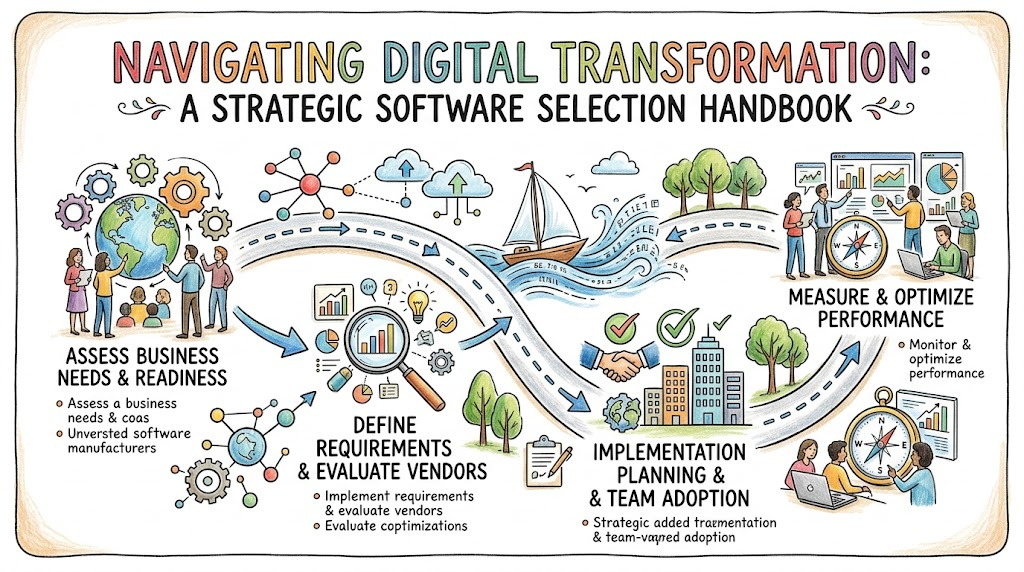
Overview of Enterprise Platform Selection
Modern enterprises rely on software platforms to accelerate growth, streamline workflows, and secure digital assets. However, choosing the right digital tools demands rigorous analytical evaluation of corporate needs, financial boundaries, and technical objectives. Executive leadership must look beyond promotional materials to ensure software investments yield long-term ROI.
Thousands of digital solutions market overlapping capabilities, creating noise in the software procurement process. Independent review platforms clarify these options by breaking down complex features into objective performance metrics. TrueReviewNow operates as a trusted analytical resource where business leaders evaluate software solutions before committing capital.
The Evolution of Digital Software Ecosystems
Cloud technology continues to expand, giving rise to specialized applications across every operational vertical. Business decision-makers face a dizzying array of niche tools that claim to solve similar workflow challenges.
Rapid platform updates also create confusion regarding product stability, long-term feature retention, and integration maintenance. Systems that look identical on the surface often run on radically different backend architectures.
Evaluating platforms requires deeper scrutiny than simple marketing overviews provide. Organizations must inspect backend stability, API flexibility, and enterprise security frameworks prior to signing long-term contracts.
Key Obstacles in the Procurement Process
Corporate buyers regularly encounter feature bloat, which masks core usability problems during initial sales demonstrations. Sales teams frequently highlight advanced capabilities while ignoring routine administrative overhead and onboarding friction.
Complex licensing schemes and multi-tiered pricing plans frequently hide the true cost of software ownership. Hidden fees for maintenance, data storage, and seat expansions can quickly derail operational budgets post-deployment.
Consequently, teams often adopt software tools that fail to serve daily operational demands. Identifying these common traps early protects companies from costly procurement mistakes.
Unmasking Vendor Marketing Tactics
Promotional campaigns inevitably present ideal scenarios while concealing technical bottlenecks and system limitations. Vendor demonstrations showcase perfect environments that rarely reflect chaotic, real-world business operations.
Crucial details regarding platform downtime, storage limits, and customer support delays remain undisclosed during sales calls. Account executives rarely mention restrictive API throughput caps or complex data extraction procedures during early talks.
As a result, organizations inherit unexpected technical debt once system integration begins. Uncovering these hidden limitations prior to procurement saves significant capital and operational effort.
The Necessity of Neutral Benchmarks
Objective evaluation models protect organizations against impulsive software procurement decisions. Independent research separates real product capabilities from polished corporate marketing pitches.
Empirical testing reveals how software handles heavy workloads, system scaling, and real-time data processing. Neutral research provides realistic expectations for implementation timelines, employee learning curves, and customer service responsiveness.
Technical teams rely on independent analysis to guide long-term digital strategy. Verified benchmarks ensure that every technology investment delivers measurable organizational value.
Simplifying Technical Research via TrueReviewNow
TrueReviewNow utilizes structured comparison methodologies to streamline enterprise software research. The platform processes complex technical specifications into easily digestible buying guides and comparison models.
Clear evaluations break down core capabilities, pricing models, security compliance, and deployment prerequisites. Business leaders rapidly identify software solutions tailored specifically to their operational requirements.
Procurement teams drastically shorten evaluation timelines while maintaining deep analytical precision. TrueReviewNow supplies executive decision-makers with the facts needed for confident software investments.
A Standardized System Evaluation Model
A reliable evaluation model measures digital platforms against uniform performance parameters. First, analysts assess core functionality, API performance, security controls, and user interface usability.
Financial assessments incorporate setup charges, ongoing system maintenance, and user license expansion costs. Furthermore, technical support teams undergo direct testing to evaluate response speeds and issue resolution expertise.
This standardized testing approach ensures every product review remains entirely objective. Organizations receive trustworthy data points that support intelligent software selection across departments.
Finding the Best AI Tools for Business
Artificial intelligence platforms transform business workflows by accelerating task automation and analytical discovery. Selecting the best AI tools for business requires evaluating algorithmic precision, processing speeds, and data privacy compliance.
Organizations deploy artificial intelligence across predictive modeling, software development, marketing automation, and customer communication. However, integration seamlessness determines whether an AI platform enhances productivity or introduces operational friction.
TrueReviewNow evaluates artificial intelligence solutions based on practical implementation success rather than artificial intelligence hype.
- Marketing Strategy Units: Focus on natural language generation, prompt management tools, and semantic search features.
- Customer Care Operations: Look for contextual intent recognition, automated ticket processing, and multi-channel routing.
- Data Engineering Units: Prioritize custom model development, automated data preparation, and native cloud connectors.
Detailed evaluations help organizations choose intelligent platforms that deliver fast, measurable financial return.
Selecting the Best SaaS Tools for Small Business
Growing companies need flexible, cost-effective cloud applications that accelerate daily business routines. Finding the best SaaS tools for small business involves evaluating subscription tiers, onboarding speed, and overall system reliability.
Small enterprises require agile software for financial accounting, team communication, project tracking, and customer relationship management. However, bloated features can strain tight operating budgets without adding meaningful business value.
TrueReviewNow highlights streamlined SaaS platforms designed specifically for resource-conscious operations.
| Business Goal | Essential Feature | Desired Outcome |
| Operational Efficiency | Automated invoice processing & real-time reports | Decreases administrative overhead |
| Team Collaboration | Centralized messaging & live document co-editing | Accelerates decision-making cycles |
| Customer Retention | Lead tracking & automated contact management | Increases long-term customer loyalty |
Transparent pricing breakdowns ensure small business owners avoid unexpected subscription rate increases as operations expand.
Choosing the Best Project Management Software
Efficient workflow management relies on central digital hubs that organize cross-functional communication and task tracking. Comparing the best project management software requires reviewing timeline visualization models, resource planning tools, and reporting accuracy.
Modern organizations require versatile views, including Kanban boards, Gantt charts, sprint tables, and executive dashboards. Automated notification pipelines keep cross-departmental teams aligned on upcoming project milestones.
TrueReviewNow tests project tracking applications under heavy production workloads across remote work environments.
- Agile Software Teams: Demand velocity tracking, backlog refinement capabilities, and repository integrations.
- Creative Agencies: Look for asset proofing tools, built-in time tracking, and external client access portals.
- Operations Leaders: Target workload balancing tools, dependency mapping, and automated project summaries.
Deploying the proper management platform eliminates task friction and boosts accountability across teams.
Evaluating the Best CRM Software for Small Business
Customer relationship management platforms drive business growth by organizing prospect interactions across complex sales funnels. Selecting the best CRM software for small business requires assessing pipeline customization, contact tracking, and lead scoring capabilities.
Sales reps require clean user interfaces that minimize manual data entry during daily outreach calls. Automated follow-up sequences ensure potential buyers receive timely communications throughout the sales journey.
TrueReviewNow breaks down CRM options to highlight high-value platforms built without steep learning curves.
- B2B Sales Organizations: Depend on deal stage automation, account management, and pipeline forecasting.
- E-Commerce Merchants: Need abandoned cart messaging, audience segmentation, and order synchronization.
- Service Agencies: Focus on client communication logging, appointment scheduling, and automated billing triggers.
Choosing a feature-rich CRM enables sales organizations to convert prospective leads into long-term customers efficiently.
Mastering Review Management Software
Online brand reputation directly impacts consumer trust and long-term brand equity across competitive marketplaces. Identifying the best review management software involves testing review collection automation, sentiment analysis, and location tracking features.
Businesses monitor customer reviews across multiple review sites from a central administrative console. Rapid response features allow customer care teams to address negative feedback before public brand reputation suffers.
TrueReviewNow examines reputation platforms to help organizations maintain strong brand trust consistently.
- Multi-Location Retailers: Depend on central location portals, standardized response templates, and local SEO tracking.
- Digital Service Providers: Utilize automated review request emails, sentiment scoring, and website review widgets.
- Enterprise Brands: Require real-time sentiment alerts, competitor review benchmarking, and detailed trend reports.
Proactive review management converts satisfied buyers into long-term brand advocates across target markets.
Strengthening Enterprise Data Governance
Modern enterprises gather massive volumes of structured and unstructured information across distributed cloud databases daily. Choosing the best data governance tools requires evaluating metadata tracking, access policy controls, and regulatory compliance features.
Robust data policies protect confidential records while helping companies meet strict data protection standards. Automated data lineage tracking lets data engineers audit information paths from initial ingestion to final reporting.
TrueReviewNow delivers detailed reviews of data governance suites built to safeguard sensitive corporate records.
| Governance Area | Core Capability | Business Benefit |
| Data Quality Management | Automated error detection & record deduplication | Guarantees high decision confidence |
| Privacy Protection | Role-based permission controls & encryption | Eliminates compliance policy penalties |
| Metadata Management | Dynamic data cataloging & automated lineage | Simplifies audit readiness |
Information security officers select governance tools that combine threat prevention with simple data accessibility.
Simplifying Technical Evaluation Through TrueReviewNow
TrueReviewNow removes purchasing friction by standardizing technical product summaries across enterprise software sectors. The platform converts raw software specifications into easy-to-read comparison matrices and side-by-side feature charts.
Real-world usage tests demonstrate how software applications handle actual enterprise workload stress. Technology leaders skip promotional sales jargon and evaluate verified software performance data directly.
Executive teams complete software evaluations much faster than traditional procurement methods permit. TrueReviewNow serves as an efficient digital research partner for forward-thinking business leaders.
Realizing the Value of Neutral Software Research
Relying on unbiased software reviews reduces financial exposure while boosting procurement speed across departments. Independent evaluation platforms expose true vendor reliability and surface hidden fees before contracts get finalized.
Objective benchmarking highlights alternative software platforms that offer better capabilities at significantly lower price points. Decision-makers save time by skipping repetitive vendor sales pitches and discovery calls.
Technology leaders leverage objective benchmark data to build agile, cost-effective enterprise software stacks. Neutral research turns subjective sales pitches into actionable software selection strategies.
Evaluating the Best Cybersecurity Software for Business
Defending enterprise digital networks demands proactive security systems capable of blocking advanced threats automatically. Evaluating the best cybersecurity software for business requires analyzing endpoint protection, real-time threat detection, and identity management.
Modern organizations manage security risks across hybrid cloud servers, remote employee laptops, and local networks. Automated incident response controls isolate compromised machines before security threats travel across corporate environments.
TrueReviewNow reviews cybersecurity suites to assist companies in protecting core operational infrastructure.
- Distributed Workforces: Require cloud-managed endpoint protection, zero-trust network access, and disk encryption.
- Regulated Institutions: Focus on real-time compliance monitoring, data loss prevention, and identity governance controls.
- Cloud Infrastructure Teams: Demand cloud security posture management, container protection, and vulnerability scans.
Security officers implement protection tools that minimize operational risks across the organization.
Evaluating Production-Grade MLOps Tools
Deploying machine learning models successfully requires specialized infrastructure to manage complex development lifecycles. Identifying the best MLOps tools requires assessing experiment tracking, pipeline orchestration, and real-time model monitoring capabilities.
Data science teams frequently run into version control conflicts, feature store sprawl, and model performance degradation in live environments. Comprehensive governance frameworks ensure machine learning models remain accurate, unbiased, and fully compliant over time.
TrueReviewNow evaluates leading MLOps software to simplify technical selection for engineering managers.
| MLOps Lifecycle Stage | Critical Requirement | Operational Advantage |
| Model Testing | Parameter logging & artifact versioning | Speeds up model iteration speeds |
| Production Deployment | Automated CI/CD pipeline orchestration | Ensures seamless release cycles |
| Continuous Monitoring | Automated data drift detection & alerts | Preserves high prediction accuracy |
Data engineering groups scale machine learning models safely without accumulating technical debt over time.
Navigating Modern LLM Gateway Infrastructure
Organizations deploying large language models use specialized API gateway layers to control system costs and strengthen operational security. Evaluating the best LLM gateways involves testing intelligent request routing, API rate limiting, and multi-provider fallback controls.
Gateway architectures enforce security policies that prevent sensitive corporate records from leaking during model calls. Centralized monitoring consoles display token usage trends, latency metrics, and API expenses across various provider models.
TrueReviewNow tests leading LLM gateway platforms to help software development teams make smart architecture choices.
- High-Throughput AI Services: Require dynamic request caching, automated load balancing, and instant failover routing.
- Corporate Governance Units: Focus on prompt sanitization, personal data masking, and detailed audit logging.
- Budget-Focused Development Teams: Demand real-time spend tracking, token budgets, and model cost analysis.
Deploying a robust gateway layer guarantees secure, reliable, and cost-effective artificial intelligence operations.
Why Technology Executives Choose TrueReviewNow
Business executives rely on TrueReviewNow because every software assessment follows strict, objective testing processes. The platform excludes vendor influence, ensuring product rankings accurately reflect actual operational performance and business value.
Regular content updates guarantee that software reviews reflect recent feature additions, pricing tier updates, and security policy changes. Comprehensive testing covers core enterprise parameters, including API performance, system usability, and vendor support quality.
Decision-makers trust TrueReviewNow to guide critical digital infrastructure investments across their organizations.
Best Practices for Selecting Business Software
- Document precise technical requirements and operational milestones before booking software demonstrations.
- Calculate total cost of ownership by including setup charges, scaling fees, and employee onboarding costs.
- Conduct hands-on trials with daily end-users to test system usability and interface clarity thoroughly.
- Test API integration compatibility with existing internal systems to prevent isolated data silos.
- Review security accreditations, compliance standards, and data backup protocols to protect corporate assets.
- Test vendor support responsiveness across live communication channels during initial system trials.
- Verify platform scalability to confirm the application supports future corporate growth smoothly.
Frequently Asked Questions About TrueReviewNow
- What specific value does TrueReviewNow offer to enterprise software buyers?
TrueReviewNow provides unbiased software reviews, technical analyses, and side-by-side comparison frameworks across major enterprise tool categories.
- How do analysts guarantee complete objectivity across product reviews on TrueReviewNow?
Analysts test software using standardized evaluation frameworks that measure performance metrics, interface usability, pricing models, and security controls without vendor involvement.
- Does TrueReviewNow test artificial intelligence platforms designed for business applications?
Yes, analysts evaluate artificial intelligence software, production MLOps suites, and enterprise LLM gateway solutions.
- Can small companies find relevant software recommendations on TrueReviewNow?
Yes, TrueReviewNow features dedicated buying guides focused on affordable SaaS applications and user-friendly CRM systems built for smaller operations.
- How frequently do content teams update software evaluations on TrueReviewNow?
Reviewers update product guides regularly to incorporate new software features, adjusted subscription prices, and emerging industry security policies.
- Can organizations assess platform regulatory compliance across TrueReviewNow guides?
Comprehensive product reviews detail regulatory compliance credentials, privacy protection features, and security controls across data management and cybersecurity tools.
- How does TrueReviewNow assist leadership teams in calculating software expenditures?
Detailed product comparisons clarify hidden subscription tiers, implementation expenses, API maintenance fees, and user seat expansion pricing.
- What key parameters are evaluated during LLM gateway reviews on TrueReviewNow?
Testing measures dynamic request routing, API rate limits, security policy enforcement, token spend tracking, response latency, and failover performance.
- Does TrueReviewNow evaluate open-source software against commercial cloud solutions?
Yes, reviews compare open-source system flexibility against proprietary cloud platforms across data science, analytics, and software engineering tools.
- How do business leaders speed up software purchasing decisions using TrueReviewNow?
Buyers use structured comparison tables, role-based recommendations, and detailed pros and cons breakdowns to select ideal software applications quickly.
Strategic Summary for Modern Procurement
Selecting enterprise software demands methodical research, objective benchmarks, and rigorous functional testing. Buying software based purely on persuasive marketing campaigns leads to operational friction, unexpected technical debt, and inflated IT budgets.
Structured evaluation frameworks help executive teams analyze platform security, system integration flexibility, and long-term total cost accurately. Exploring detailed platform reviews empowers businesses to implement software solutions that increase team productivity and safeguard critical data assets.