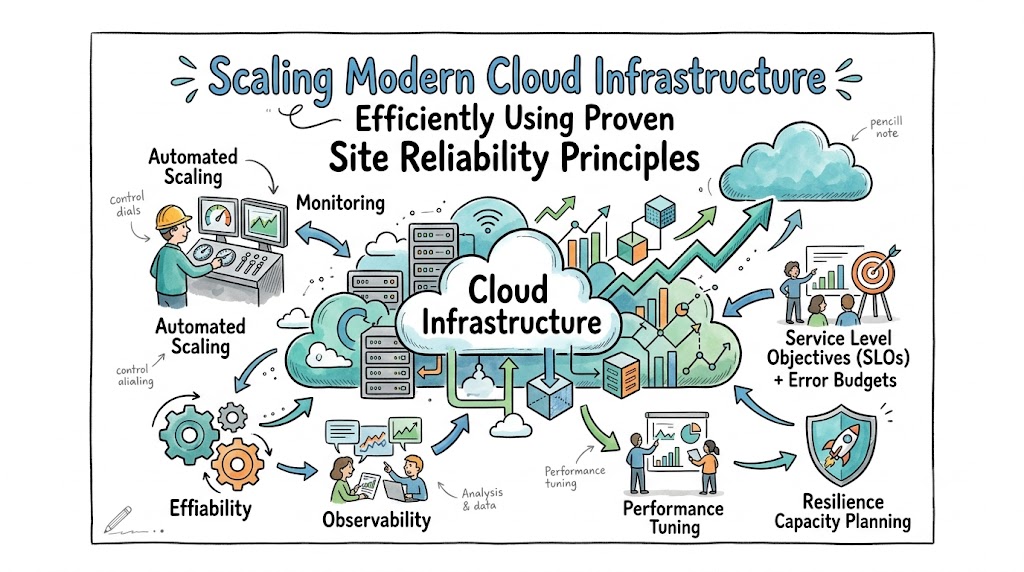
Scaling modern cloud applications presents continuous operational challenges for engineering teams managing high-volume user traffic. Without proper structural patterns, rapid growth often degrades application performance and leads to unexpected system outages. Adopting Site Reliability Engineering methodologies provides a systematic framework to maintain high availability while expanding your digital services.
Implementing these structured practices helps your organization scale its technical assets while safeguarding overall system stability. By combining software automation with robust operational guardrails, engineering departments can comfortably manage complex deployments. You can learn to master these essential architecture and delivery strategies through Sreschool.
Managing large-scale systems requires continuous observation, automated provisioning, and a clear architectural strategy. Consequently, organizations that adopt structured operational patterns can comfortably expand their cloud resource capacity. Thus, your engineering team can safely accelerate deployment speed while protecting the core user experience.
Defining Modern Site Reliability Practices
Site Reliability Engineering treats operational problems as software engineering challenges to build highly scalable environments. Instead of relying on manual server management, engineers design automated software platforms that manage cloud infrastructure. This strategic pivot ensures that your systems scale predictably as user demands grow over time.
Establishing objective metrics forms the foundation of this operational discipline, allowing teams to balance rapid deployment with stability. Consequently, you can measure resource consumption accurately, identifying infrastructure bottlenecks long before they cause service disruptions. This visibility helps your organization make intelligent decisions regarding capacity expansion and code optimization.
Furthermore, these unified workflows change how software developers and systems engineers interact during the deployment lifecycle. Rather than working in isolated silos, teams share joint responsibility for system health and operational performance. Therefore, every engineer understands application limits, which prevents catastrophic capacity failures and improves cross-functional velocity.
Ultimately, this technical discipline prioritizes long-term architecture health over short-term hotfixes, establishing a predictable lifecycle for cloud software. By managing infrastructure through version-controlled code, teams can replicate entire environments rapidly and consistently. Thus, your organization establishes a resilient digital foundation capable of supporting heavy traffic spikes.
Essential Structural Components of Cloud Lifecycles
+-------------------------------------------------------------+
|               Capacity Planning & Provisioning              |
+-------------------------------------------------------------+
                               |
                               v
+-------------------------------------------------------------+
|                 Automated Resource Scaling                  |
+-------------------------------------------------------------+
                               |
                               v
+-------------------------------------------------------------+
|               Performance Monitoring & Triage               |
+-------------------------------------------------------------+
                               |
                               v
+-------------------------------------------------------------+
|            Continuous Architectural Optimization            |
+-------------------------------------------------------------+
The cloud lifecycle consists of four distinct operational phases: planning, automated scaling, continuous triage, and optimization. During the capacity planning phase, engineers analyze historic traffic patterns to estimate future compute and storage requirements. Accurate forecasting prevents resource starvation during traffic surges while avoiding unnecessary infrastructure costs.
Once resources are provisioned, the automated scaling phase dynamically adjusts system capacity based on real-time user traffic. Automated auto-scaling groups and container orchestrators launch extra application instances whenever resource utilization spikes. Meanwhile, workload managers downscale idle instances during off-peak hours to maintain budget efficiency.
Next, the performance triage phase continuously monitors cluster health to catch latency spikes and resource exhaustion. When system metrics exceed safe operating limits, automated self-healing mechanisms restart failing containers or reroute network traffic. Because manual intervention is slow, automated remediation acts as the primary defense against widespread outages.
Finally, the continuous optimization phase evaluates system performance data to identify hidden inefficiencies in your architecture. Engineers refine container resource limits, optimize database queries, and tweak caching policies based on real usage patterns. This iterative loop ensures that your cloud infrastructure evolves alongside expanding business requirements.
Key Operational Concepts You Must Know
Understanding Service Level Objectives and Slippage
Service Level Objectives represent target performance thresholds that define the acceptable boundary of your cloud application’s health. For example, an objective might dictate that 99.5% of database queries must complete in under 50 milliseconds. When server performance drops below this standard, your system experiences slippage, indicating potential service degradation.
Tracking this slippage requires real-time telemetry, precise alerting mechanisms, and clear operational escalation paths across engineering teams. If slippage occurs frequently, developers must pause new feature rollouts and focus exclusively on infrastructure stabilization. Consequently, these metrics act as an automatic governor, balancing rapid software delivery with system stability.
Calculating and Managing Your Error Budget
An error budget represents the allowable margin of risk or downtime your application can experience over a given period. If your targeted availability level is set at 99.9%, your team has a 0.1% buffer reserved for deployments and bugs. This explicit framework gives developers a clear, quantifiable margin to innovate quickly and take calculated engineering risks.
However, completely burning through this budget triggers an immediate change in priorities, diverting engineering resources to technical debt remediation. This strict policy ensures that infrastructure stability remains a mandatory product requirement rather than a secondary priority. Therefore, managing error budgets effectively prevents long-term architectural decay while maintaining high availability.
Establishing Clear Severity Levels and Triage Frameworks
Classifying cloud incidents through explicit severity tiers helps on-call engineers organize their technical response during unexpected outages. A standard framework categorizes operational issues into levels ranging from minor background errors to catastrophic system failures. This clear structure eliminates confusion during high-pressure scenarios, allowing engineers to address critical failures systematically.
| Incident Level | Operational Impact | Immediate Required Action |
|---|---|---|
| Sev-1 (Critical) | Core service completely unavailable | Mobilize incident response team; apply immediate load shed or fallback. |
| Sev-2 (Major) | Significant feature failure or high latency | Alert service owners; re-route traffic or launch standby clusters. |
| Sev-3 (Minor) | Minor component failing without user impact | Log issue in product backlog; address during normal development cycles. |
Applying this structured approach systematically ensures that your technical staff responds with appropriate urgency to every event. Furthermore, it sets transparent expectations for business stakeholders, preventing unnecessary disruptions while engineers work on critical fixes.
Designing On-Call Rotations and Escalation Paths
Building sustainable on-call shifts protects your technical team from burnout while ensuring round-the-clock infrastructure coverage. Shifts should be distributed fairly across qualified engineers, supported by comprehensive runbooks and secondary backup engineers. This balanced approach ensures that on-call engineers are well-rested, prepared, and ready to respond to alerts.
Additionally, formal escalation paths must be established for situations where primary responders cannot resolve an incident quickly. If an operational failure remains unmitigated after twenty minutes, the system automatically alerts senior software architects. This mechanism prevents individual engineers from struggling alone while service downtime continues to escalate.
Platform Implementation vs. Culture — What’s the Real Difference?
Deploying the Technical Tooling Infrastructure
Building a scalable cloud environment requires implementing automated provisioning systems, container orchestrators, and real-time observability stacks. These technical tools collect continuous metric data, allowing systems to auto-scale and heal without manual human intervention. However, simply purchasing modern cloud software will not automatically guarantee a resilient infrastructure.
Without proper configuration, automated systems can misfire, causing cascading service failures across your cloud network. Software tools supply the underlying execution layer, but human engineering expertise is required to configure safe operating parameters. Therefore, technical platforms form an essential foundation, but they cannot replace sound engineering judgment.
Cultivating a Blameless Engineering Environment
A strong operational culture relies on psychological safety, ensuring engineers can analyze infrastructure failures without fear of blame. In a blameless culture, organizations treat human mistakes as symptoms of underlying system flaws rather than root causes. This encouraging environment prompts developers to share operational insights that help strengthen the overall infrastructure.
+-------------------------------------------------------+
|                 Blameless Culture                     |
|  - Focuses on systemic improvements                   |
|  - Encourages open incident reporting                 |
|  - Promotes psychological safety                      |
+-------------------------------------------------------+
                           ^
                           | (Divergent Approaches)
                           v
+-------------------------------------------------------+
|                  Blameful Culture                     |
|  - Punishes individual human mistakes                 |
|  - Encourages hiding system bugs                      |
|  - Results in fragile, slow deployments               |
+-------------------------------------------------------+
When management punishes mistakes, staff tend to hide configuration defects, leading to repeated production outages later. Conversely, pairing modern platforms with a blameless mindset enables organizations to build robust digital services. Cultivating this collaborative culture ensures that every infrastructure failure leads to permanent technical improvements.
Real-World Use Cases of Modern Operations
Migrating Monolithic Architecture to Scalable Cloud Clusters
A growing financial platform experienced frequent service crashes because their monolithic backend could not handle unpredictable user surges. To resolve this bottleneck, the engineering team refactored the application into independent, auto-scaling microservices running on managed Kubernetes. This structural decoupling ensured that heavy load on reporting tools never impacted the core payment gateway.
Additionally, they configured automated horizontal pod autoscalers to provision extra compute capacity whenever CPU load exceeded 70%. Consequently, their infrastructure handled massive end-of-month transaction surges without experiencing any service degradation. This migration highlights how decoupling software components enables seamless scaling under heavy operational loads.
Preventing System Collapses During Global Sales Events
During a major global shopping event, a fast-growing retail platform faced unprecedented web traffic that threatened database performance. The sudden rush of incoming requests saturated database connection pools, causing connection timeouts throughout the application layer. This compounding bottleneck created a cascading failure that threatened total service disruption across all regions.
[ Massive Traffic ] ---> [ Connection Pool Saturation ] ---> [ Connection Timeouts ]
                                ^                                    |
                                |                                    v
                                +---- [ Cascading Outage Loop ] <----+
Fortunately, the operational team quickly activated dynamic rate-limiting controls and enabled database read-replicas to distribute load. They temporarily disabled non-essential frontend widgets, freeing up system capacity for critical checkout transactions. By reviewing this event afterward, they implemented automated connection pooling layers that permanently eliminated this capacity limit.
Common Mistakes in Operations Engineering
Over-Reliance on Manual Provisioning and Uncontrolled Drift
A frequent mistake in cloud engineering is manually modifying cloud server configurations during active troubleshooting sessions. These untracked manual edits create configuration drift, making it impossible to replicate environments reliably using automated scripts. Consequently, future automated deployments often fail unexpectedly due to hidden differences between staging and production.
To prevent this issue, teams must enforce strict infrastructure-as-code practices, applying all environment changes exclusively through version-controlled pipelines. Disabling direct manual SSH or API access to production servers preserves environment consistency over time. This strict discipline guarantees that all infrastructure states remain fully reproducible and auditable.
Ignoring Telemetry Data and Misconfiguring Operational Alerts
Failing to fine-tune alerting thresholds leads to alert fatigue, flooding engineers with non-actionable notifications throughout the day. When on-call engineers receive constant false alarms, they inevitably become desensitized and may miss genuine critical warnings. Alerts should trigger only when immediate human action is required to save customer experience.
Teams should regularly review alert configurations and move non-urgent warnings to asynchronous communication channels like chat dashboards. Ensuring every alert is actionable keeps on-call engineers alert, focused, and ready to respond. This practice ensures swift responses when genuine infrastructure emergencies occur in production.
How to Become an Operations Expert — Career Roadmap
Mastering Foundational Systems and Infrastructure Scripting
Building a successful career in infrastructure engineering starts with mastering operating system internals, networking protocols, and system architecture. Understanding memory management, file systems, and network routing helps you diagnose complex infrastructure performance bottlenecks. Additionally, learning scripting languages like Python or Go allows you to automate routine server management tasks.
- Linux Fundamentals: Master kernel resource controls, process management, and storage subsystem performance tuning.
- Networking Protocols: Learn TCP/IP behavior, HTTP/3 request lifecycles, load balancing algorithms, and DNS routing.
- Automation Engineering: Build robust scripts to programmatically provision, update, and manage distributed cloud instances.
Focusing on these foundational skills equips you to troubleshoot complex multi-tier cloud environments effectively. Automation reduces manual workload, eliminating human error while enabling your cloud architecture to scale predictably.
Advanced Cloud Orchestration and Infrastructure Management
As you progress, you must master container orchestration platforms like Kubernetes alongside infrastructure management tools like Terraform. These standards allow you to define global multi-cloud infrastructure using version-controlled configuration files. Understanding these abstractions helps you design self-healing architectures that scale dynamically based on real-time demands.
- Container Orchestration: Learn pod scheduling algorithms, cluster networking topologies, and automated ingress controllers.
- Infrastructure as Code: Write declarative modules to deploy multi-region server clusters safely and repeatably.
- Observability Engineering: Implement distributed tracing and centralized logging to track request paths across microservices.
Developing expertise in orchestration frameworks allows you to manage thousands of application instances with minimal effort. Consequently, you can build resilient cloud infrastructure capable of surviving hardware failures smoothly.
FAQ Section
- How does Site Reliability Engineering differ from traditional cloud administration?Traditional administration relies heavily on manual server setup and reactive maintenance when hardware fails. In contrast, this modern engineering discipline applies software automation to build self-healing infrastructure that scales dynamically.
- When should a growing company begin implementing automated infrastructure scaling?Companies should implement automated scaling as soon as manual capacity expansion creates deployment delays or inconsistent application performance. Early automation prevents technical debt and establishes a flexible foundation for future business growth.
- What is the most critical metric to monitor when scaling cloud workloads?While CPU and memory utilization are important, customer-facing metrics like request latency and error rates provide the most accurate signal of system health. Monitoring end-user experience helps you scale infrastructure based on real operational needs.
- How do error budgets prevent conflicts between developers and operations teams?Error budgets provide an objective, data-driven agreement on acceptable risk between product velocity and system stability. When the budget is healthy, developers release features rapidly; when exhausted, efforts shift entirely to stability.
- Why is infrastructure as code essential for scaling cloud services?Infrastructure as code allows teams to define entire server environments using version-controlled text files, ensuring consistency. This practice enables rapid, error-free replication of complex environments across multiple global cloud regions.
Final Summary
Scaling cloud infrastructure efficiently requires combining automated provisioning, continuous observability, and disciplined engineering practices. By defining clear service metrics, managing error budgets, and using structured triage levels, teams can handle capacity expansion safely. Balancing powerful technical platforms with a blameless engineering culture keeps your technical teams focused, productive, and resilient.
As digital applications grow in complexity, investing in self-healing architectures and infrastructure automation serves as your best protection against downtime. Adopting these operational practices transforms sudden traffic surges into manageable, routine events for your engineering team. Ultimately, mastering these cloud principles enables your business to scale rapidly while delivering an exceptional user experience.