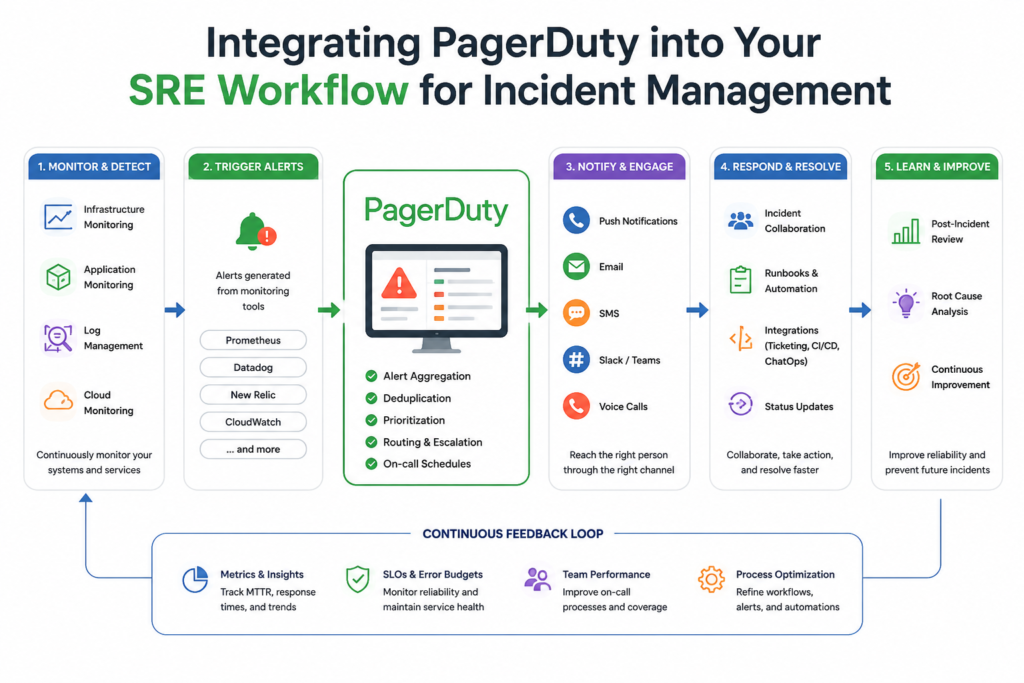
Modern organizations depend on highly available digital services to support customers, employees, and business operations. Whether it is an e-commerce platform, banking application, SaaS product, healthcare system, or cloud-native application, downtime can result in lost revenue, damaged reputation, and frustrated users. As systems become more distributed and complex, organizations need a structured approach to maintaining reliability and responding to incidents efficiently.
This is where Site Reliability Engineering (SRE) plays a critical role. SRE combines software engineering principles with operational practices to build reliable, scalable, and resilient systems. One of the most important responsibilities within an SRE environment is incident management. Teams must detect problems quickly, notify the right people, coordinate responses, and restore services with minimal disruption. Organizations looking to strengthen these capabilities often learn operational best practices through Sreschool, which emphasizes practical approaches to reliability engineering and incident response management.
PagerDuty has become one of the most widely adopted incident management platforms in modern operations. It helps teams automate alert routing, manage on-call schedules, coordinate incident response, and improve operational visibility. When integrated properly into an SRE workflow, PagerDuty transforms incident management from a reactive process into a structured and efficient operational practice. Understanding how to integrate PagerDuty effectively requires knowledge of operational principles, team collaboration, automation strategies, and continuous improvement techniques.
Understanding PagerDuty and Its Role in SRE
PagerDuty serves as a central platform for incident response and operational coordination. It connects monitoring systems with human responders and ensures that critical alerts receive immediate attention. Instead of relying on emails, manual phone calls, or fragmented communication channels, organizations can automate the notification process and establish clear ownership for incidents.
In an SRE environment, reliability depends on rapid detection and resolution of issues. Monitoring platforms generate alerts when applications, databases, networks, or infrastructure components experience abnormal behavior. PagerDuty receives these alerts and routes them to the appropriate engineers based on predefined rules and escalation policies. This automation eliminates delays and helps teams respond faster during critical situations.
PagerDuty also improves collaboration across technical and business teams. Engineers can coordinate responses, share updates, assign responsibilities, and track incident progress from a single platform. This centralized approach reduces confusion and allows teams to focus on resolving issues instead of managing communication challenges.
Another significant advantage is visibility. Organizations gain insights into response times, escalation effectiveness, incident trends, and operational performance metrics. These insights support continuous improvement and help teams identify opportunities to strengthen reliability practices.
Why Incident Management Matters in Modern Operations
Incidents are inevitable in complex technology environments. Hardware failures, software bugs, deployment errors, cloud outages, network disruptions, and security events can all impact service availability. Organizations cannot eliminate every potential failure, but they can prepare for them through effective incident management.
A structured incident management process reduces downtime and minimizes business impact. Teams know who should respond, what actions to take, and how to communicate with stakeholders. This clarity enables faster decision-making during stressful situations and prevents confusion from slowing response efforts.
Incident management also supports customer trust. Users are more likely to remain loyal when organizations respond quickly and communicate transparently during service disruptions. Reliable incident response demonstrates operational maturity and reinforces confidence in the organization’s services.
Furthermore, incident management creates valuable learning opportunities. Every incident reveals information about system weaknesses, monitoring gaps, operational processes, and team readiness. Organizations that analyze incidents thoroughly can improve reliability and reduce future risks.
PagerDuty enhances this process by providing automation, accountability, and visibility throughout the incident lifecycle.
Building an SRE Workflow Around PagerDuty
Successful PagerDuty integration begins with understanding the broader SRE workflow. The platform should support operational objectives rather than function as an isolated tool. Organizations must design workflows that align with service ownership, escalation structures, monitoring strategies, and business priorities.
The first step involves identifying critical services. Teams should understand which applications and systems have the highest impact on customers and business operations. Critical services typically require stricter monitoring, faster response times, and more robust escalation procedures.
Service ownership must also be clearly defined. Every service should have a designated team responsible for responding to incidents and maintaining reliability. Clear ownership prevents confusion during emergencies and ensures accountability throughout the response process.
Organizations should establish severity levels that classify incidents based on business impact. Critical outages may require immediate executive involvement, while lower-priority issues can follow standard response procedures. Severity classifications help teams allocate resources appropriately and avoid unnecessary escalations.
Communication processes represent another important component. Teams need documented procedures for internal collaboration, stakeholder updates, and customer communication. PagerDuty supports these workflows by centralizing incident information and facilitating coordination among responders.
Integrating Monitoring Systems with PagerDuty
Monitoring systems provide the data that drives incident response activities. Without effective monitoring, organizations cannot detect issues quickly enough to minimize impact. PagerDuty relies on monitoring platforms to generate alerts when abnormal conditions occur.
Most modern environments use multiple monitoring solutions. Infrastructure monitoring tracks servers, networks, and cloud resources. Application monitoring measures performance and user experience. Log analytics identify patterns and errors. Observability platforms provide deeper insights into system behavior.
When integrating monitoring tools with PagerDuty, organizations should focus on actionable alerts. Excessive alert generation creates alert fatigue, which can cause engineers to ignore notifications or overlook critical issues. Every alert should represent a meaningful condition that requires human attention.
Alert enrichment improves response effectiveness. Engineers need context to troubleshoot problems efficiently. Alerts should include relevant metrics, error details, affected services, dashboards, runbooks, and diagnostic information. Providing this context reduces investigation time and accelerates resolution efforts.
Organizations should continuously refine alerting strategies to eliminate noise and improve signal quality. Better alerts lead to faster responses, lower stress levels, and improved operational outcomes.
Designing Effective Escalation Policies
Escalation policies determine how incidents progress when initial responders do not acknowledge alerts. Well-designed escalation structures ensure that incidents receive attention even if primary responders are unavailable.
Most organizations begin by notifying the primary on-call engineer. If the alert remains unacknowledged within a defined timeframe, PagerDuty automatically escalates the incident to secondary responders. Additional escalation levels may include team leads, service owners, managers, or specialized response teams.
Escalation policies should reflect organizational structure and operational requirements. Critical services may require aggressive escalation timelines, while lower-priority systems can tolerate longer response windows. Teams should balance responsiveness with sustainability to avoid overwhelming engineers with excessive notifications.
Regular testing is essential. Incident simulations help verify that escalation workflows function correctly and reach the intended recipients. Continuous evaluation allows organizations to identify gaps and improve response effectiveness over time.
Creating Sustainable On-Call Programs
On-call management represents one of the most important aspects of incident response. Engineers must be available to address critical issues outside normal working hours, but organizations must also protect employee well-being.
PagerDuty simplifies on-call scheduling by automating rotations and ensuring clear coverage responsibilities. Engineers know when they are responsible for responding, which reduces uncertainty and improves accountability.
A sustainable on-call program distributes responsibilities fairly across team members. Organizations should avoid concentrating operational burdens on a small group of individuals. Balanced schedules reduce burnout and improve long-term team performance.
Training is equally important. Every on-call engineer should understand service architecture, troubleshooting procedures, monitoring tools, and incident response workflows. Well-prepared responders can diagnose and resolve issues more efficiently.
Organizations should regularly review on-call metrics to identify workload imbalances, coverage gaps, and staffing challenges. Continuous refinement helps maintain operational effectiveness while supporting employee satisfaction.
Key Operational Concepts You Must Know
Understanding operational concepts is essential for integrating PagerDuty into an SRE workflow successfully. These principles influence how teams design systems, respond to incidents, and measure reliability.
Service Level Objectives (SLOs)
SLOs define measurable reliability targets for services. They establish expectations for availability, latency, performance, and user experience. When services fall below these targets, PagerDuty alerts can trigger investigations and corrective actions. SLOs help organizations prioritize operational efforts and align technical activities with business goals.
Service Level Indicators (SLIs)
SLIs measure the actual performance of services. Common indicators include request success rates, response times, error percentages, and system availability. Monitoring these metrics provides visibility into service health and helps identify emerging issues before they become major incidents.
Error Budgets
Error budgets represent the acceptable amount of unreliability within a service. They help organizations balance innovation and stability. If teams consume excessive error budget, they may need to pause feature development and focus on reliability improvements.
Incident Severity
Severity levels classify incidents based on impact and urgency. Consistent severity definitions help teams allocate resources effectively and ensure appropriate escalation procedures.
Runbooks
Runbooks provide documented instructions for handling common incidents. Integrating runbooks with PagerDuty alerts enables responders to take consistent actions and reduces troubleshooting time.
Post-Incident Reviews
Post-incident reviews analyze what happened, why it happened, and how future occurrences can be prevented. These reviews support continuous learning and operational maturity.
Operational Metrics
Organizations commonly track:
- Mean Time to Detect (MTTD)
- Mean Time to Acknowledge (MTTA)
- Mean Time to Resolve (MTTR)
- Mean Time Between Failures (MTBF)
These metrics help evaluate incident response effectiveness and identify opportunities for improvement.
Platform Implementation vs. Culture — What’s the Real Difference?
Many organizations believe operational excellence comes primarily from technology investments. While tools like PagerDuty provide powerful capabilities, they do not automatically create reliable systems. The real difference lies in the relationship between platform implementation and organizational culture.
Platform implementation focuses on technical components. Teams configure monitoring systems, integrate PagerDuty, establish escalation policies, automate workflows, and develop observability capabilities. These investments create the foundation for effective incident management.
Culture focuses on people and behavior. High-performing organizations encourage ownership, accountability, collaboration, transparency, and continuous learning. Engineers take responsibility for service reliability and actively contribute to operational improvements.
An organization can deploy PagerDuty successfully from a technical perspective yet still struggle with incident response if teams avoid ownership or fail to communicate effectively. Conversely, a strong operational culture can compensate for limitations in tooling and processes.
The most successful organizations combine both elements. They invest in reliable platforms while cultivating a culture that values resilience, learning, and operational excellence. PagerDuty becomes significantly more effective when supported by teams that embrace these principles.
Real-World Use Cases of Modern Operations
Modern organizations use PagerDuty in various operational scenarios to improve reliability and response effectiveness.
E-Commerce Platforms
Online retailers depend on continuous availability to support customer purchases. A payment gateway failure or application outage can immediately affect revenue. PagerDuty enables rapid incident response by notifying responsible teams and coordinating recovery efforts before business impact escalates.
Financial Services
Banks and financial institutions operate under strict availability requirements. Transaction processing systems, online banking platforms, and fraud detection services require immediate attention when issues occur. PagerDuty helps ensure timely responses and supports regulatory compliance objectives.
Cloud-Native Applications
Organizations running microservices architectures often manage hundreds of interconnected components. PagerDuty helps coordinate responses across multiple service teams and improves visibility during complex incidents.
Healthcare Systems
Healthcare applications support patient care and operational workflows. Service disruptions can affect critical activities and require immediate remediation. PagerDuty facilitates rapid coordination among technical teams responsible for maintaining system availability.
SaaS Providers
Software providers rely on uptime to maintain customer satisfaction. PagerDuty helps manage incidents efficiently and enables transparent communication during service disruptions.
Common Mistakes in Operations Engineering
Many organizations encounter similar challenges when developing operational practices. Recognizing these mistakes can help teams avoid unnecessary disruptions and improve reliability.
Alert Fatigue
Excessive alert generation overwhelms engineers and reduces response effectiveness. Teams should prioritize meaningful alerts and eliminate unnecessary noise.
Poor Ownership Definition
Unclear service ownership creates confusion during incidents. Every system should have designated responders and documented responsibilities.
Lack of Automation
Manual processes increase response times and introduce human error. Automation improves consistency and enables faster incident resolution.
Ignoring Post-Incident Reviews
Organizations that skip incident reviews miss valuable learning opportunities. Continuous improvement depends on understanding failures and implementing corrective actions.
Weak Documentation
Outdated or incomplete documentation slows troubleshooting efforts. Teams should maintain accurate runbooks and operational procedures.
Inadequate Training
Responders need regular training and incident simulations to maintain readiness. Prepared teams perform better during real emergencies.
How to Become an Operations Expert — Career Roadmap
Building expertise in operations engineering requires technical knowledge, practical experience, and continuous learning. The following roadmap provides guidance for aspiring professionals.
Stage 1: Learn Core Infrastructure Concepts
Focus on operating systems, networking, cloud computing, databases, and system administration. Understanding infrastructure fundamentals creates a strong technical foundation.
Stage 2: Develop Monitoring Skills
Learn monitoring platforms, observability tools, logging systems, and performance analysis techniques. Understanding system behavior is critical for incident management.
Stage 3: Master Automation
Develop skills in scripting, infrastructure automation, configuration management, and deployment pipelines. Automation improves scalability and operational efficiency.
Stage 4: Study Reliability Engineering
Learn SRE principles, incident management practices, reliability metrics, and operational processes. These concepts form the foundation of modern operations.
Stage 5: Gain Incident Response Experience
Participate in on-call rotations, incident investigations, and post-incident reviews. Practical experience accelerates professional growth.
Stage 6: Build Communication Skills
Operations experts must communicate effectively during high-pressure situations. Strong communication improves collaboration and incident coordination.
Stage 7: Lead Operational Improvements
Experienced professionals contribute to architectural decisions, reliability initiatives, automation projects, and organizational improvements.
Recommended areas of focus include:
- Linux administration
- Cloud platforms
- Kubernetes
- Monitoring and observability
- Networking fundamentals
- Incident management
- Security principles
- Automation frameworks
- Infrastructure as Code
- Reliability engineering
FAQ Section
What is PagerDuty?
PagerDuty is an incident management platform that helps organizations detect, manage, and resolve operational issues through automated alerting and response workflows.
How does PagerDuty support SRE teams?
PagerDuty automates alert routing, manages on-call schedules, coordinates incident response, and provides operational visibility for reliability engineering teams.
Why is incident management important?
Incident management minimizes downtime, reduces business impact, improves customer satisfaction, and supports continuous operational improvement.
What is alert fatigue?
Alert fatigue occurs when engineers receive excessive notifications, causing important alerts to be overlooked or ignored.
What are escalation policies?
Escalation policies define how incidents progress when initial responders do not acknowledge alerts within specified timeframes.
What is an SLO?
A Service Level Objective is a measurable target that defines acceptable reliability levels for a service.
Why are post-incident reviews important?
Post-incident reviews help organizations understand failures, identify root causes, and implement improvements that prevent future incidents.
Can PagerDuty integrate with monitoring tools?
Yes. PagerDuty integrates with a wide range of monitoring, observability, logging, cloud, and collaboration platforms.
How does PagerDuty improve response times?
It automates notifications, escalation procedures, and incident coordination, ensuring that issues reach the appropriate responders quickly.
Is PagerDuty suitable for small teams?
Yes. Both small teams and large enterprises can use PagerDuty to improve incident response and operational reliability.
Final Summary
Integrating PagerDuty into an SRE workflow significantly strengthens incident management capabilities and improves operational reliability. Modern organizations operate increasingly complex systems that require rapid detection, efficient coordination, and structured response processes. PagerDuty provides the automation, visibility, and accountability necessary to manage incidents effectively while supporting broader reliability objectives.
Successful integration goes beyond technical configuration. Organizations must establish clear ownership, meaningful alerting strategies, sustainable on-call practices, effective escalation policies, and strong communication processes. At the same time, they must cultivate a culture of accountability, collaboration, and continuous improvement. Together, these elements create a resilient operational environment capable of responding to challenges quickly and effectively.
A practical gap in PagerDuty integrations is alert quality governance. If noisy alerts, duplicate incidents, and weak service ownership mappings are not cleaned up first, PagerDuty can escalate operational chaos faster instead of improving response speed and accountability.