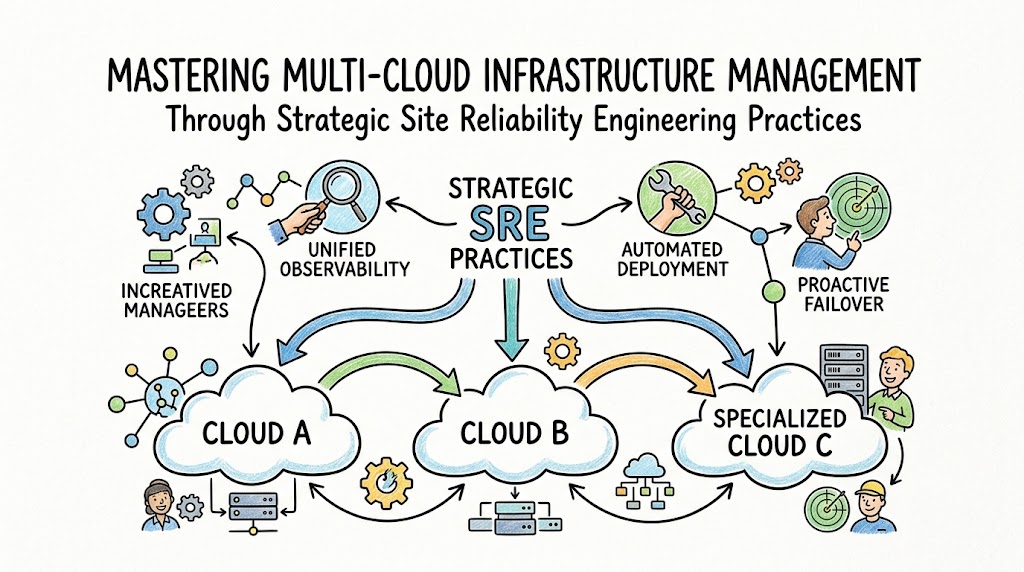
Managing multi-cloud environments requires a structured engineering approach to ensure seamless performance, cross-provider resilience, and consistent service availability. Modern enterprises increasingly distribute their workloads across multiple cloud platforms to prevent vendor lock-in, meet strict regional compliance mandates, and maximize system availability. However, running infrastructure across heterogeneous environments introduces immense complexity, network latency variations, and fragmented monitoring pipelines that traditional operations teams struggle to manage manually.
Site Reliability Engineering solves these architectural challenges by applying software engineering methodologies to multi-cloud infrastructure management. By creating unified observability frameworks, automated failover routines, and standardized deployment pipelines, reliability engineers streamline operations across diverse cloud ecosystems. Consequently, organizations can maintain high platform stability while deploying code rapidly across different cloud providers. You can master these advanced operational models by exploring the specialized learning resources available at Sreschool.
Building a resilient multi-cloud framework demands disciplined operational strategy, continuous testing, and automated configuration management. As a result, engineering teams that embrace standardized reliability patterns eliminate operational silos and lower mean time to recovery. Consequently, businesses achieve sustainable scalability, predictable operating costs, and reliable user experiences across every cloud region.
Key Operational Concepts You Must Know
Unified Service Level Objectives Across Heterogeneous Clouds
Defining consistent Service Level Objectives across multiple cloud providers ensures that your engineering teams evaluate performance using standardized benchmarks. Different cloud vendors offer varying native uptime guarantees, compute architectures, and storage latency metrics. Therefore, establishing vendor-neutral objectives prevents skewed operational priorities and maintains a unified definition of application health.
Managing these objectives across multiple clouds requires continuous data collection from distributed application endpoints. If a primary cloud provider experiences network degradation, your automated telemetry instantly identifies the performance drop against established limits. Consequently, your teams can trigger traffic rerouting mechanisms before end users encounter severe service disruptions.
Managing Distributed Error Budgets Across Cloud Platforms
An error budget represents the acceptable margin of unreliability your applications can experience within a given operational window. In a multi-cloud architecture, calculating error budgets across multiple hosting environments requires aggregating performance metrics into a central observability engine. This unified metric prevents single-provider outages from completely draining your overall system tolerance.
When a specific cloud region consumes its allocated error budget due to provider-side instability, team priorities shift immediately toward mitigation. Software engineers temporarily pause feature deployments in that environment to focus on infrastructure stabilization and traffic rebalancing. Therefore, managing error budgets across cloud platforms maintains system stability while empowering teams to innovate safely.
Abstracted Infrastructure as Code and Declarative Provisioning
Deploying infrastructure manually across different cloud console interfaces introduces configuration drift, security vulnerabilities, and human error. To overcome these inconsistencies, site reliability engineers utilize declarative Infrastructure as Code tools to define server configurations, networking rules, and security policies centrally. This abstraction layer allows teams to provision identical environments across diverse cloud platforms using unified code bases.
+-------------------------------------------------------------+
|               Unified Declarative Code Repo                 |
+-------------------------------------------------------------+
                               |
                               v
+-------------------------------------------------------------+
|             Cross-Cloud Provisioning Framework              |
+-------------------------------------------------------------+
               /               |               \
              v                v                v
     +-----------------+ +-----------+ +-----------------+
     | Primary Cloud A | | Cloud B   | | Specialized C   |
     +-----------------+ +-----------+ +-----------------+
Furthermore, version-controlling your cloud configurations ensures complete auditability and enables instant rollback capabilities during failed deployments. When a cloud region experiences a catastrophic hardware failure, automated provisioning scripts can recreate the entire infrastructure stack in an alternate cloud within minutes. Consequently, declarative automation turns complex multi-cloud provisioning into a predictable, repeatable engineering workflow.
Centralized Observability and Federated Telemetry Ingestion
Observability becomes significantly more complex when log files, performance metrics, and distributed traces are scattered across different vendor platforms. Site reliability teams solve this fragmentation by deploying federated collector agents that aggregate telemetry into a single analysis dashboard. This unified view gives engineers complete visibility into end-to-end request flows as they traverse multiple cloud networks.
| Telemetry Pillar | Multi-Cloud Challenge | SRE Technical Solution |
|---|---|---|
| Metrics Data | Incompatible vendor metrics formats | Open-standard telemetry collectors aggregating to central dashboards |
| System Logs | Isolated vendor log storage buckets | Standardized log shipping pipelines with unified schema tagging |
| Distributed Tracing | Network boundary context loss | Vendor-neutral trace propagation headers across cloud boundaries |
Standardizing your observability pipeline ensures that on-call engineers do not waste valuable time switching between multiple vendor control panels during active incidents. Consequently, unified telemetry speeds up root-cause analysis and empowers responders to resolve cross-cloud incidents swiftly.
Platform Implementation vs. Culture — What’s the Real Difference?
Building Modern Multi-Cloud Engineering Tooling
Implementing multi-cloud platforms requires integrating container orchestration tools, cross-cloud service meshes, and centralized secrets management systems. These powerful technical abstractions allow microservices to communicate securely across different cloud providers without exposing sensitive credentials. However, deploying technical software tools alone does not guarantee system resilience or prevent operational friction.
Without clear operational guardrails, complex multi-cloud toolsets can create excessive architectural overhead and confuse engineering teams. Software platforms provide the technical framework for multi-cloud deployment, but human expertise determines how effectively those tools operate during production crises. Therefore, technical tooling serves as an essential foundation, but it must align directly with clear operational strategies.
Fostering a Collaborative Cross-Cloud Mindset
A resilient multi-cloud strategy relies heavily on an organizational culture that values blameless learning, shared responsibility, and proactive risk management. Engineers must feel comfortable analyzing cross-cloud failures openly without fearing individual blame or corporate finger-pointing. This open environment encourages teams to share critical operational insights, ultimately strengthening system architecture across all cloud platforms.
+-------------------------------------------------------+
|             Multi-Cloud Shared Culture                |
|  - Collaborative cross-provider architecture           |
|  - Blameless post-incident evaluations                |
|  - Shared operational accountability                  |
+-------------------------------------------------------+
                           ^
                           | (Cultural Approach)
                           v
+-------------------------------------------------------+
|              Siloed Operations Culture                |
|  - Isolated vendor-specific engineering silos         |
|  - Finger-pointing during cross-cloud outages          |
|  - Defensive documentation and hidden errors          |
+-------------------------------------------------------+
When teams operate in isolated vendor silos, cross-cloud incident resolution stalls while departments debate whether the application code or cloud infrastructure caused the failure. Conversely, establishing a unified culture breaks down institutional barriers and aligns developers and operations engineers around common reliability goals. Consequently, combining robust technical platforms with a supportive culture ensures sustainable multi-cloud success.
Real-World Use Cases of Modern Operations
Active-Active Multi-Cloud Deployment for Enterprise Applications
A global financial services institution needed to guarantee continuous platform availability, even in the event of an entire cloud vendor experiencing a total regional blackout. To achieve this extreme level of resilience, the engineering team designed an active-active deployment architecture across two independent cloud providers. They utilized global traffic managers to route user requests dynamically based on real-time health checks and network latency.
                       [ Global Traffic Router ]
                                /     \
                               /       \
                              v         v
                     +---------------+ +---------------+
                     | Cloud Vendor A| | Cloud Vendor B|
                     | (Active Node) | | (Active Node) |
                     +---------------+ +---------------+
                              \         /
                               v       v
                     [ Synchronized Database Layer ]
Additionally, they implemented cross-cloud data replication protocols to ensure real-time state synchronization across both cloud environments. When a major service outage impacted one cloud vendor, automated health checks instantly detected the failure and redirected traffic seamlessly. Consequently, millions of active end users experienced zero downtime, demonstrating the power of active-active multi-cloud engineering.
Automated Multi-Cloud Disaster Recovery and Traffic Failover
A prominent digital media company experienced frequent latency spikes due to localized infrastructure bottlenecks within their primary cloud provider. To mitigate this business risk, the site reliability team implemented automated failover runbooks powered by continuous chaos engineering testing. They regularly simulated synthetic cloud failures during off-peak hours to validate their automated failover mechanisms.
During a subsequent real-world cloud disruption, the automated monitoring engine detected network packet loss and initiated the failover procedure automatically. The platform rerouted incoming API traffic to a secondary cloud environment within seconds, preserving system stability and performance. Post-incident analysis confirmed that proactive automation successfully protected corporate revenue and maintained customer trust.
Common Mistakes in Operations Engineering
Uncontrolled Multi-Cloud Architecture Complexity
A frequent mistake in multi-cloud engineering is adopting multiple cloud vendors without establishing standardized operational patterns first. Teams often deploy bespoke services across different platforms, creating an overly complex architecture that becomes nearly impossible to maintain. This uncontrolled fragmentation increases operational toil, security risks, and software maintenance costs significantly.
To avoid this pitfall, engineering organizations must establish strict architectural standards and limit custom vendor integrations. Standardizing container runtimes, deployment pipelines, and security configurations ensures that your workloads remain highly portable across clouds. Consequently, keeping your multi-cloud architecture lean reduces complexity and keeps operational overhead manageable.
Neglecting Egress Costs and Multi-Cloud Data Transfer Fees
Failing to account for cross-cloud data transfer fees can lead to massive budget overruns and unexpected monthly cloud expenses. Many organizations design distributed architectures that continuously stream huge volumes of raw data between different cloud platforms without considering bandwidth costs. These unoptimized network requests generate substantial vendor invoices that strain engineering resources.
Engineering teams should optimize multi-cloud data flows by caching data locally and aggregating analytical payloads before transmission. Additionally, leveraging private cloud interconnects reduces bandwidth costs while enhancing network security and lowering latency. Managing data transfer architecture proactively keeps cloud spending predictable while preserving multi-cloud flexibility.
How to Become an Operations Expert — Career Roadmap
Mastering Fundamental Networking and Cloud Architecture
Building a successful career in multi-cloud engineering requires a deep foundational mastery of network routing, security protocols, and cloud computing principles. You must understand how virtual private clouds, BGP routing, and TLS encryption operate across distributed global networks. Additionally, learning infrastructure-as-code languages like Terraform equips you to automate complex cross-cloud environments efficiently.
- Networking Mastery: Study cross-cloud IP routing, DNS load balancing, and private network peering configurations.
- Declarative Automation: Write clean, modular infrastructure code to provision resources consistently across multiple providers.
- Security Protocol Implementation: Configure unified identity access management, encryption keys, and security groups across cloud boundaries.
Focusing on these core competencies prepares you to architect resilient cloud systems capable of handling enterprise workloads. Automation skills eliminate manual provisioning tasks, enabling you to design scalable infrastructure pipelines.
Developing Advanced Reliability Engineering and Observability Expertise
As you advance in your career, you must focus on mastering distributed observability frameworks, chaos engineering methodologies, and automated remediation workflows. You should learn to instrument microservices using open-source tracing libraries to gain complete visibility into distributed request cycles. Furthermore, designing self-healing systems allows your applications to recover automatically from cloud infrastructure failures.
- Standardized Observability: Deploy OpenTelemetry collectors to unify log, metric, and trace ingestion across heterogeneous platforms.
- Resilience Testing: Conduct automated chaos experiments to identify hidden single points of failure before production outages occur.
- Automated Remediation: Build intelligent runbooks that execute self-healing scripts when monitoring systems detect infrastructure degradation.
Developing expertise in these advanced operational domains positions you as a leading reliability specialist in the cloud industry. Consequently, you will possess the strategic skills required to lead complex multi-cloud transformations for modern enterprises.
FAQ Section
- What is the primary benefit of deploying applications across a multi-cloud environment?A multi-cloud deployment prevents vendor lock-in, improves operational resilience against single-provider outages, and allows organizations to meet strict regional compliance rules.
- How do site reliability engineers manage configuration drift across different cloud platforms?Engineers utilize declarative Infrastructure as Code tools and version-controlled repositories to enforce identical server configurations, networking policies, and security guardrails across every cloud environment.
- Why are open observability standards critical for multi-cloud monitoring?Open observability standards like OpenTelemetry allow engineering teams to collect metrics, logs, and traces using a single, vendor-neutral framework without rewriting application instrumentation code.
- How does an error budget help manage multi-cloud operational risks?An error budget provides a clear, quantitative boundary for acceptable unreliability, helping teams balance feature deployment speed against infrastructure stabilization efforts across cloud platforms.
- What is the most effective way to control data transfer costs in multi-cloud architectures?Organizations reduce data transfer costs by caching data locally within each cloud region, minimizing cross-cloud data streaming, and utilizing private cloud interconnect agreements.
Final Summary
Managing multi-cloud environments through Site Reliability Engineering principles provides organizations with the ultimate foundation for application availability, scalable growth, and operational resilience. By establishing unified Service Level Objectives, managing error budgets centrally, and automating cross-cloud infrastructure code, teams master complex distributed architectures cleanly. Balancing these technical tools with a collaborative, blameless culture keeps engineering teams focused, efficient, and fully prepared to handle production challenges.
As modern cloud architecture continues to evolve, adopting standardized reliability practices serves as your strongest defense against provider-level disruptions. Investing in cross-cloud observability, automated failover mechanisms, and continuous resilience testing transforms unexpected cloud failures into manageable operational events. Ultimately, mastering multi-cloud engineering empowers your business to innovate rapidly while delivering an exceptionally stable experience to users worldwide.