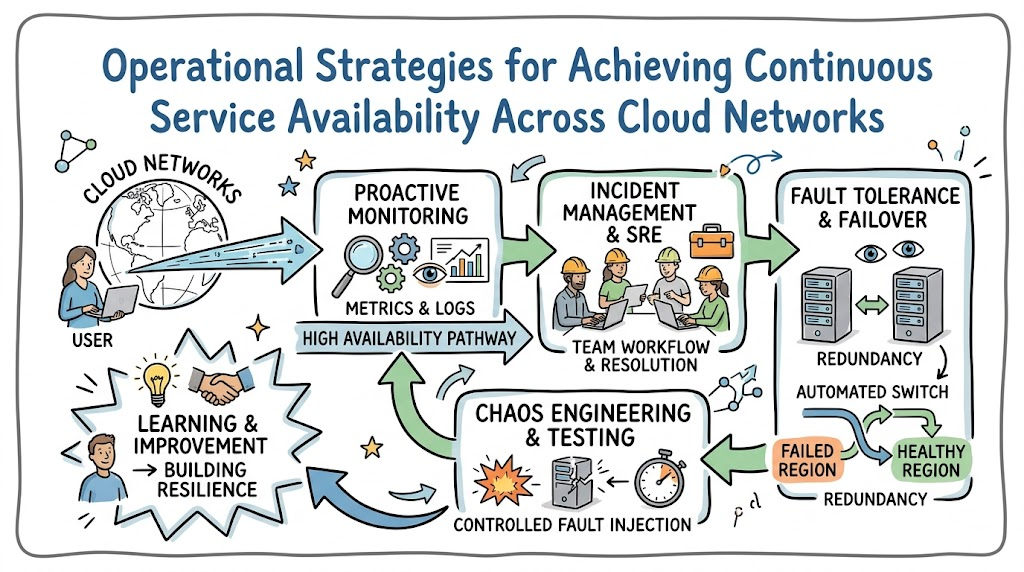
Site Reliability Engineering plays a vital role in keeping modern cloud applications available, resilient, and responsive under heavy production workloads. When complex microservices face unexpected traffic spikes or hardware failures, engineering organizations rely on automated recovery systems to keep services running without disruption. This methodology bridges the gap between fast feature deployments and reliable infrastructure management.
Building an effective operational foundation helps your organization protect core business services while continuously improving cloud performance. By adopting structured reliability principles, engineering teams can eliminate single points of failure across their deployment pipelines. You can master these modern operational methodologies and technical architectures by exploring the educational programs at Sreschool.
Ensuring continuous uptime requires real-time monitoring, proactive capacity management, and automated failover mechanisms across distributed networks. Consequently, organizations that implement these engineering practices significantly reduce system downtime and prevent widespread service outages. Therefore, your technical teams build deep operational confidence and maintain a seamless user experience.
Defining the Core Architecture of Cloud Availability
Modern cloud availability relies on designing distributed systems that can automatically detect, isolate, and recover from hardware and software failures. Instead of assuming cloud infrastructure is indestructible, engineers build applications with the understanding that individual component failures are inevitable. This shift in mindset forces teams to build redundant layers that keep application features accessible to users.
Establishing automated failover pathways forms the backbone of this architectural approach, allowing network traffic to reroute smoothly during outages. Consequently, when a specific cloud data center experiences power loss or network degradation, system traffic shifts instantly to healthy server clusters. This automatic redirection prevents user-visible errors and maintains consistent service execution across all regions.
[ User Request ] ---> [ Load Balancer ]
                             |
         +-------------------+-------------------+
         |                                       |
         v                                       v
[ Primary Cloud Region ]              [ Secondary Cloud Region ]
  (Active Execution)                   (Hot Standby Failover)
Furthermore, high availability requires decoupling software components into independent microservices to prevent failures from cascading through the platform. When one service experiences high latency or crashes, isolated circuit breakers prevent the issue from spreading to adjacent services. Therefore, critical user journeys remain intact even while background technical tasks undergo emergency maintenance.
Ultimately, achieving high uptime demands continuous testing, rigorous performance analysis, and automated scaling policies tailored to cloud infrastructure. By treating system operations as a software development discipline, organizations build scalable applications that recover effortlessly from unexpected disruptions. Thus, your business establishes a reliable digital presence capable of handling unpredictable global growth.
Key Operational Concepts You Must Know
Defining Availability Metrics Through the Nines Framework
Measuring system uptime using the framework of nines gives engineering teams a concrete standard for evaluating cloud service health. For example, achieving three nines of availability translates to roughly eight hours of total allowable downtime per year. Higher targets, such as four or five nines, require drastically tighter operational controls and full automation.
| Availability Target | Annual Allowable Downtime | Monthly Allowable Downtime |
|---|---|---|
| 99% (Two Nines) | 3.65 Days | 7.31 Hours |
| 99.9% (Three Nines) | 8.76 Hours | 43.8 Minutes |
| 99.99% (Four Nines) | 52.6 Minutes | 4.38 Minutes |
| 99.999% (Five Nines) | 5.26 Minutes | 26.3 Seconds |
Selecting the appropriate target requires balancing technical ambition with the operational costs needed to maintain that level of uptime. Every extra nine of reliability increases infrastructure complexity and requires advanced multi-region redundancy mechanisms. Consequently, teams must choose targets that protect user trust without burning through engineering budgets.
Designing Self-Healing Systems and Auto-Scaling Groups
Self-healing architecture uses automated monitoring agents to detect unhealthy instances and replace them without manual human intervention. When a cloud container stops responding to health checks, orchestration platforms automatically terminate the faulty pod and launch a fresh copy. This rapid replacement minimizes service degradation and keeps application capacity at optimal levels.
Complementing this self-healing process, auto-scaling policies dynamically expand or contract server capacity based on live network demand metrics. During sudden traffic surges, cloud systems automatically provision additional instances to distribute CPU load and manage incoming traffic. Thus, self-healing and auto-scaling work together to maintain consistent system responsiveness under fluctuating workloads.
Implementing Chaos Engineering and Fault Injection
Chaos engineering tests application resilience by purposefully introducing controlled infrastructure failures directly into active testing or production systems. Engineers simulate server crashes, network delays, and database disconnects to observe how the overall system copes with unexpected stress. These experiments reveal hidden architectural flaws before they cause real, unplanned outages for end users.
Executing these tests safely requires precise guardrails, explicit blast-radius limits, and instant abort triggers to protect the user experience. Once a failure point is exposed, engineering teams prioritize building automated fixes to harden the system against that specific failure scenario. Consequently, regular fault injection transforms hypothetical stability risks into proven, resilient architectural designs.
Managing Data Consistency Across Multi-Region Clouds
Maintaining data consistency across geographically distributed database clusters presents significant technical challenges for high-availability cloud applications. Synchronous replication guarantees data integrity across regions but introduces network latency that can slow down individual user requests. Conversely, asynchronous replication offers fast write speeds but introduces a brief window where data might become temporarily inconsistent.
+-------------------------------------------------------+
|                 Replication Modes                     |
+-------------------------------------------------------+
|  1. Synchronous: High consistency, added latency      |
|  2. Asynchronous: Fast writes, eventual consistency   |
+-------------------------------------------------------+
To resolve this tradeoff, engineers apply eventual consistency patterns and specialized distributed database engines designed for cloud environments. These storage systems ensure that data updates propagate across all nodes quickly without stalling active user transactions. Therefore, managing database replication strategy carefully keeps your global applications both highly available and reliable.
Platform Implementation vs. Culture — What’s the Real Difference?
Building the Technical Platform Stack
Setting up a modern platform stack involves orchestrating containerized applications, configuring global load balancers, and deploying automated deployment pipelines. These software tools provide the necessary computing framework to execute code, route traffic, and scale server resources effortlessly. However, relying solely on sophisticated infrastructure software will not automatically guarantee continuous service availability.
Without proper operational processes, complex infrastructure platforms can increase systemic risks and introduce hard-to-diagnose failure modes. Software platforms deliver raw technical capacity, but they require skilled engineers to establish appropriate operational logic and rules. Therefore, deployment platforms serve as the technical foundation, but human strategy determines ultimate system reliability.
Cultivating a Culture of Shared Ownership
A strong reliability culture shifts operational responsibility from a dedicated infrastructure team to every software developer in the organization. In this collaborative setup, developers write code with production stability in mind, designing features that handle network failures gracefully. This shared responsibility breaks down traditional team silos and encourages proactive collaboration across the software lifecycle.
+-------------------------------------------------------+
|                Shared Ownership Model                 |
|  - Developers write resilience-focused code           |
|  - Operations teams build self-service tooling        |
|  - Everyone shares accountability for uptime          |
+-------------------------------------------------------+
                           ^
                           | (Divergent Approaches)
                           v
+-------------------------------------------------------+
|                 Siloed Ownership Model                |
|  - Developers ship code without testing stability     |
|  - Operations teams struggle with manual fixes        |
|  - High friction and frequent production outages      |
+-------------------------------------------------------+
When development and operations teams share accountability for application health, software quality improves dramatically across the entire pipeline. Developers gain immediate visibility into how their code performs under live traffic, driving better architectural decisions. Combining powerful cloud tools with a culture of shared responsibility ensures that your cloud systems remain resilient.
Real-World Use Cases of Modern Operations
Mitigating Data Center Outages with Multi-Region Failover
A global streaming network experienced a catastrophic fiber-optic cable cut that completely severed access to one of its primary cloud regions. Thanks to a multi-region failover architecture, automated traffic management systems detected the regional outage within seconds. The network instantly redirected millions of concurrent stream requests to a healthy secondary data center nearby.
[ Fiber Cut Incident ] ---> [ Regional Outage Detected ] ---> [ Traffic Rerouted ]
                                                                     |
                                                                     v
                                                       (Zero Stream Interruption)
Because application state was continuously synchronized across regions, end users experienced zero buffering interruptions or service drops during the transition. The engineering team monitored the failover process using centralized dashboards, confirming that the secondary cluster handled the load seamlessly. This real-world recovery highlights how proper multi-region design prevents localized hardware failures from disrupting global business operations.
Preventing System Crash During High-Volume Flash Sales
A high-traffic retail engine faced extreme user surges during a synchronized flash sale, generating traffic volumes ten times higher than normal. Anticipating this traffic spike, the team pre-configured aggressive auto-scaling policies and deployed dynamic API rate-limiting rules. Additionally, they placed non-essential background processing tasks into asynchronous message queues to protect core checkout APIs.
When the flash sale launched, auto-scaling instances expanded system capacity smoothly while rate limiters shielded primary databases from query overloads. The core purchase pipeline remained completely available, processing thousands of transactions per second without crashing or slowing down. Analyzing this event afterward allowed the team to fine-tune their capacity models for future high-demand events.
Common Mistakes in Operations Engineering
Over-Complicating System Design for Minimal Uptime Gains
A common mistake in cloud engineering is designing unnecessarily complex architectures in pursuit of extreme availability targets that the business does not actually need. Adding excessive layers of abstraction, redundant microservices, and multi-cloud sync setups can make systems fragile and difficult to maintain. Every added component introduces a new potential failure point and increases operating costs significantly.
Engineers should keep systems as simple as possible while meeting the actual reliability expectations of their target audience. Focus on eliminating obvious single points of failure before introducing complex multi-cloud orchestration patterns. Keeping infrastructure designs clean and manageable makes troubleshooting straightforward and reduces unexpected outages caused by configuration errors.
Ignoring Load Test Scenarios and Capacity Constraints
Failing to test cloud systems under realistic load conditions often leads to unexpected crashes when real traffic spikes hit production environments. Synthetic unit tests cannot replicate complex production traffic patterns, race conditions, or database connection pool exhaustions. Without regular, full-scale load testing, hidden performance bottlenecks remain buried deep within your application code.
Teams should execute automated load tests within staging environments to measure exact system breaking points and identify scaling limits. Run realistic user scenarios to verify how databases, caches, and third-party APIs behave under peak traffic loads. Discovering operational boundaries through controlled testing prevents catastrophic failure modes during live, business-critical events.
How to Become an Operations Expert — Career Roadmap
Mastering Fundamental Infrastructure and Automation Skills
Building a successful career in reliability engineering requires a strong foundation in operating system internals, network protocols, and infrastructure scripting. You should understand how modern cloud operating systems allocate CPU, memory, and storage to diagnose complex performance bottlenecks. Furthermore, mastering declarative tools like Terraform or Ansible enables you to deploy and manage infrastructure through code.
- Systems Internals: Learn memory management, process thread scheduling, and disk I/O performance tuning.
- Cloud Networking: Master VPC configuration, subnet routing, security group rules, and DNS management.
- Infrastructure Automation: Write reusable, version-controlled code templates to build and update server resources reliably.
Developing these core technical skills allows you to build predictable operational environments that scale efficiently under pressure. Automation reduces manual errors and gives you more time to design resilient cloud architectures.
Advancing to Cloud Orchestration and Distributed Systems
As your skills mature, you must deepen your knowledge of container orchestration platforms, distributed storage systems, and advanced observability tools. Learning to run and scale Kubernetes clusters allows you to manage microservices cleanly across multi-tenant environments. Additionally, understanding distributed tracing frameworks enables you to track user requests across complex microservice architectures.
- Container Management: Master cluster scheduling, pod autoscaling rules, persistent volume drivers, and ingress routing.
- Telemetry and Tracing: Implement centralized metrics collection and end-to-end distributed tracing across microservices.
- Resilience Patterns: Design software circuit breakers, bulkheads, retry strategies, and rate-limiting rules.
Gaining expertise in these advanced orchestration concepts positions you to architect enterprise-grade cloud systems. Consequently, you can build self-healing platforms that maintain high availability while handling massive global workloads.
FAQ Section
- What is the primary difference between high availability and fault tolerance?High availability focuses on keeping a system operational with minimal downtime by using fast failover mechanisms when components fail. Fault tolerance goes a step further, ensuring that a system continues operating without any service degradation, usually through expensive hardware redundancy.
- How do circuit breakers prevent cascading failures in cloud microservices?Circuit breakers monitor downstream service health and automatically cut off requests to a failing service when error rates spike. This fast-failure approach stops application threads from piling up and prevents a single failing component from crashing the entire network.
- Why is disaster recovery planning still necessary if an application is highly available?High availability protects against routine component failures, while disaster recovery addresses catastrophic events like region-wide power loss or data corruption. Having a tested disaster recovery plan ensures you can recover critical business data even if an entire cloud provider fails.
- How does rate limiting protect cloud applications from unexpected traffic spikes?Rate limiting restricts the number of API requests a user or client can make within a specific timeframe. This boundary prevents bad actors, rogue bots, or bugged client apps from overwhelming application servers and crashing primary databases.
- Can an organization achieve five nines of availability using a single cloud region?Achieving five nines of availability within a single cloud region is nearly impossible because physical data centers face unavoidable localized hardware risks. Reaching that level of reliability requires multi-region setups with automated global traffic routing and real-time data replication.
Final Summary
Implementing Site Reliability Engineering principles is vital for building resilient cloud applications that deliver continuous uptime and protect user confidence. By defining clear availability targets, designing self-healing systems, and running chaos experiments, engineering teams can handle unexpected infrastructure failures with ease. Balancing technical deployment platforms with a culture of shared responsibility ensures that your systems remain stable, scalable, and secure.
As cloud architectures become more interconnected, investing in continuous monitoring, automated failovers, and robust load testing is your strongest defense against downtime. Adopting these operational strategies empowers your technical teams to transform unexpected system failures into opportunities for continuous improvement. Ultimately, prioritizing system reliability enables your business to scale rapidly while maintaining a smooth, uninterrupted user experience.