Introduction
Deep learning helps computers learn from large amounts of data. It powers many modern technologies, including voice assistants, image recognition, language translation, and generative AI.
However, building a deep learning model can be difficult. Developers must manage data, neural networks, training, computing resources, and model testing.
Deep learning frameworks make this work easier. They provide ready-made tools for creating neural networks, training models, and working with powerful hardware.
Some frameworks focus on flexible model development. Others simplify coding, support large training jobs, or provide ready-made AI models.
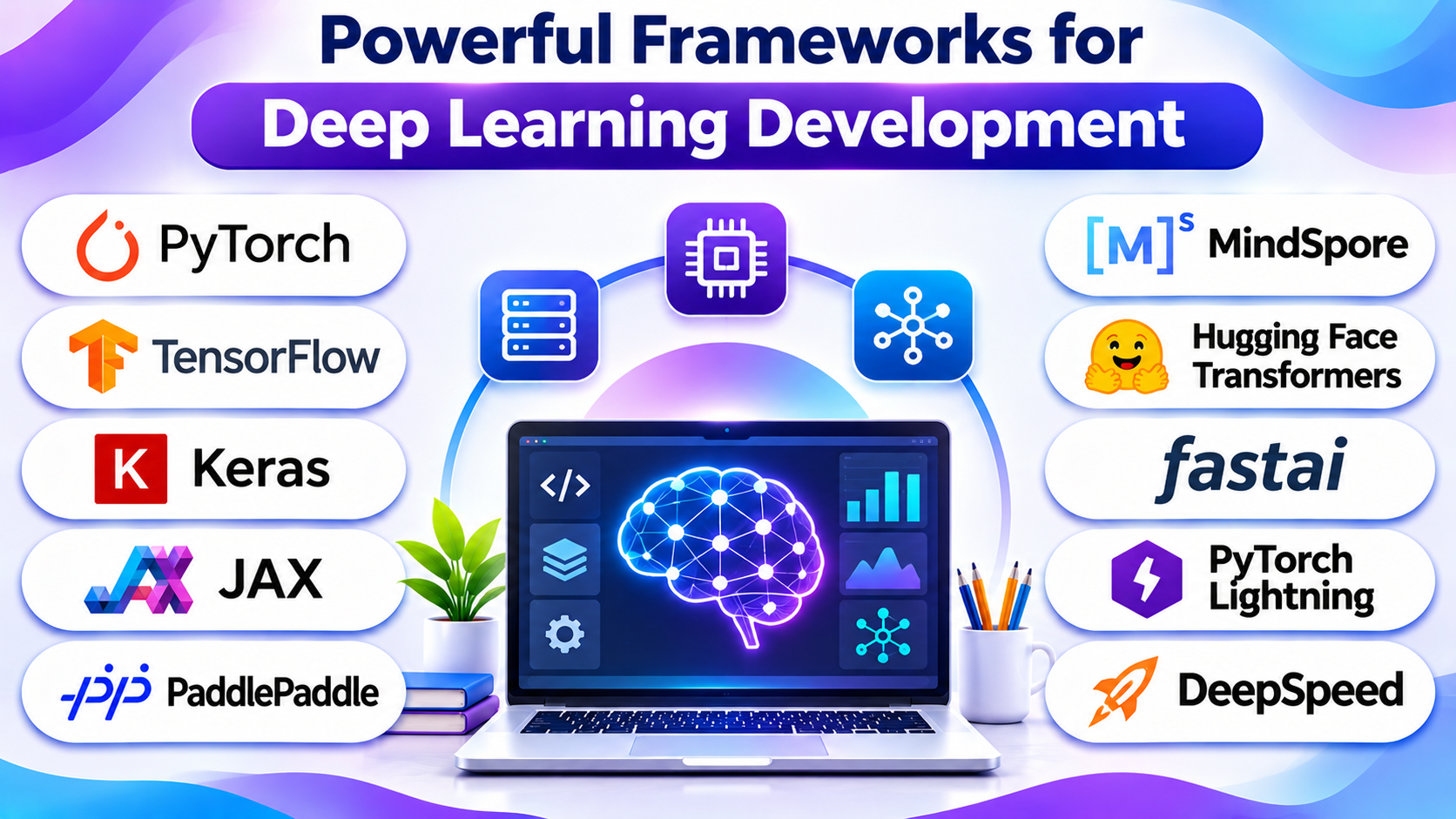
This guide explores ten important deep learning frameworks and libraries. You will learn about their features, Pros, Cons, and common uses. A comparison table and selection guide will help you choose the right tools.
Top 10 Deep Learning Frameworks
1. PyTorch
PyTorch is an open-source deep learning framework supported by the PyTorch Foundation. It helps developers build, train, and test neural networks.
PyTorch uses tensors to handle numerical data. Tensors work like arrays but also support operations needed for machine learning.
One of its main strengths is automatic differentiation. This feature calculates gradients during model training. Developers can use these gradients to update model weights.
PyTorch also supports dynamic computation graphs. This approach lets developers change model behavior while their code runs. It makes experiments and debugging easier.
The framework offers strong GPU support. It also has a large ecosystem for computer vision, natural language processing, and generative AI.
Many researchers and developers use PyTorch for both experiments and production projects.
Key Features
- Dynamic computation graphs.
- Automatic differentiation.
- GPU acceleration.
- Neural network building blocks.
- Support for custom model architectures.
- Distributed training options.
- Integration with popular AI libraries.
- Tools for model optimization and deployment.
Pros
- Offers flexible model development.
- Makes debugging easier with familiar Python workflows.
- Supports powerful GPU computing.
- Has a large developer community.
- Works with many AI libraries.
- Supports research and production projects.
Cons
- Beginners may need time to understand its concepts.
- Large projects need careful performance management.
- Some deployment tasks require extra tools.
- Distributed training can need advanced setup.
2. TensorFlow
TensorFlow is an open-source machine learning framework developed by Google. It supports the development, training, and deployment of deep learning models.
The framework provides tools for building neural networks and handling large datasets. Developers can use it for image recognition, language processing, forecasting, and other AI tasks.
TensorFlow supports automatic differentiation through GradientTape. It also offers tools for distributed training and model optimization.
Its wider ecosystem includes TensorFlow Serving and TensorFlow-related tools for mobile and edge deployment. These options help teams move trained models into real applications.
TensorFlow works well for organizations that need an established machine learning ecosystem. It supports both research and production workflows.
Key Features
- Neural network development.
- Automatic differentiation.
- CPU and GPU support.
- Distributed model training.
- Model optimization.
- TensorFlow Serving for deployment.
- Tools for mobile and edge applications.
- Integration with Python and other development tools.
Pros
- Provides a broad machine learning ecosystem.
- Supports large training workloads.
- Offers several deployment options.
- Includes tools for model optimization.
- Has extensive learning resources.
- Supports many deep learning applications.
Cons
- Some advanced workflows require technical knowledge.
- Its wider ecosystem can feel complex.
- Beginners may find certain concepts difficult.
- Some projects may need additional deployment configuration.
3. Keras
Keras is a high-level deep learning API. It helps developers create neural networks with clear and readable code.
Keras focuses on simplicity. Developers can build models with layers, connect them, and train them with a small amount of code.
Keras 3 supports multiple backends, including TensorFlow, PyTorch, and JAX. This gives developers more flexibility when choosing the computing engine behind their models.
The platform includes tools for model training, evaluation, and prediction. It also supports common neural network architectures.
Keras works well for beginners, researchers, and developers who want to build models quickly. It can also support larger projects when teams need a simpler model development interface.
Key Features
- High-level neural network API.
- Simple model-building interface.
- Support for multiple backends.
- Ready-made neural network layers.
- Model training and evaluation tools.
- Support for custom layers.
- Integration with Python.
- Tools for saving and loading models.
Pros
- Easy to learn and use.
- Reduces repetitive coding.
- Supports several computing backends.
- Helps build models quickly.
- Offers clear model development workflows.
- Works well for teaching and prototyping.
Cons
- Advanced customization may require backend knowledge.
- Some low-level operations need extra code.
- Users may need to understand the selected backend.
- Complex projects can require additional tools.
4. JAX
JAX is a numerical computing framework developed by Google. It helps developers perform fast mathematical operations and build advanced machine learning systems.
JAX combines a NumPy-like programming style with automatic differentiation and compilation. These features help developers create efficient numerical programs.
One important feature is just-in-time compilation. It can compile selected functions to improve performance on supported hardware.
JAX also supports automatic vectorization. This helps developers apply operations across batches of data without writing every step manually.
Many research teams use JAX for scientific computing and advanced deep learning experiments. It works with CPUs, GPUs, and supported accelerator environments.
JAX often works with additional libraries such as Flax and Optax for neural network development and optimization.
Key Features
- Automatic differentiation.
- Just-in-time compilation.
- NumPy-style programming.
- Automatic vectorization.
- GPU and TPU support.
- Parallel computing features.
- Integration with neural network libraries.
- Support for scientific machine learning.
Pros
- Offers powerful numerical computing features.
- Supports advanced model development.
- Helps optimize mathematical operations.
- Works with accelerators.
- Provides flexible program transformations.
- Suits research and scientific applications.
Cons
- Has a steeper learning curve.
- Functional programming concepts may confuse beginners.
- Neural network development often needs extra libraries.
- Hardware setup can require technical knowledge.
5. PaddlePaddle
PaddlePaddle is an open-source deep learning framework developed by Baidu. It provides tools for building, training, and deploying neural networks.
The framework supports many AI applications. These include computer vision, natural language processing, speech recognition, and industrial automation.
PaddlePaddle offers model development tools and ready-made components. Developers can use these resources to create AI applications without building every feature from scratch.
Its ecosystem includes PaddleOCR for optical character recognition and PaddleNLP for natural language processing.
PaddlePaddle is especially useful for teams working with its wider ecosystem. It supports research, business applications, and large-scale AI development.
Key Features
- Neural network development.
- GPU acceleration.
- Distributed training support.
- Computer vision tools.
- Natural language processing libraries.
- Model deployment options.
- Ready-made AI components.
- Support for industrial AI applications.
Pros
- Offers a broad deep learning ecosystem.
- Supports several AI application areas.
- Includes useful model libraries.
- Provides tools for distributed training.
- Supports production-focused development.
- Offers open-source resources.
Cons
- Its ecosystem may be less familiar to some developers.
- Learning resources can vary by language.
- Some projects may need specific environment setup.
- Integration choices may be narrower than larger ecosystems.
6. MindSpore
MindSpore is an open-source AI framework developed by Huawei. It helps developers create and train neural networks across supported hardware environments.
The framework supports automatic differentiation, model development, and distributed training. It aims to help teams build AI systems for different computing devices.
MindSpore provides tools for model construction and training. It also supports optimization features that help manage computing resources.
The framework can support computer vision, natural language processing, and other deep learning applications.
MindSpore suits developers who work with its supported hardware and software ecosystem. Teams should review compatibility before selecting it for a project.
Key Features
- Neural network development.
- Automatic differentiation.
- Distributed training.
- Model optimization.
- Support for supported AI accelerators.
- Computer vision capabilities.
- Natural language processing support.
- Tools for model deployment.
Pros
- Supports different AI development tasks.
- Provides distributed training features.
- Offers model optimization tools.
- Supports hardware-focused development.
- Provides an open-source ecosystem.
- Can support large AI workloads.
Cons
- Hardware compatibility needs careful review.
- The community is smaller than some major frameworks.
- Beginners may need extra learning resources.
- Some environments require specific setup steps.
7. Hugging Face Transformers
Hugging Face Transformers is a popular open-source library for working with pretrained AI models. It focuses on transformer-based architectures and supports several machine learning tasks.
Developers can use it for text generation, translation, summarization, image processing, audio tasks, and multimodal applications.
The library provides access to pretrained models and tools for fine-tuning. This helps developers adapt existing models instead of training every model from the beginning.
Transformers supports major deep learning backends, including PyTorch and TensorFlow. It also connects with a large model-sharing ecosystem.
It is especially useful for teams building natural language processing and generative AI applications. However, it is a model library rather than a complete replacement for a core deep learning framework.
Key Features
- Access to pretrained models.
- Transformer architecture support.
- Model fine-tuning tools.
- Natural language processing features.
- Support for vision and audio models.
- Integration with PyTorch and TensorFlow.
- Model sharing and loading.
- Tools for generative AI applications.
Pros
- Provides many ready-made models.
- Reduces model development time.
- Supports several AI tasks.
- Offers useful fine-tuning tools.
- Connects with a large open-source community.
- Helps developers test new AI applications.
Cons
- Large models can require powerful hardware.
- Some models need substantial memory.
- Users must review model licenses and usage terms.
- Advanced fine-tuning can be complex.
8. fastai
fastai is a high-level deep learning library built on PyTorch. It helps developers create useful models with less code.
The library provides practical tools for computer vision, natural language processing, tabular data, and other machine learning tasks.
fastai includes ready-made training methods and useful defaults. These features help users focus on solving problems instead of writing every training step.
The library also supports transfer learning. This approach lets developers adapt an existing model to a new task.
fastai is popular among learners, researchers, and developers who want to build deep learning models quickly. It works especially well for practical experiments and education.
Key Features
- High-level deep learning API.
- Built on PyTorch.
- Computer vision support.
- Natural language processing tools.
- Tabular data support.
- Transfer learning features.
- Model training utilities.
- Learning resources and tutorials.
Pros
- Makes deep learning easier to start.
- Reduces repetitive coding.
- Provides practical model-building tools.
- Supports several data types.
- Works with the PyTorch ecosystem.
- Helps users learn through practical projects.
Cons
- Advanced customization may require PyTorch knowledge.
- Some workflows rely on library conventions.
- It offers fewer low-level controls than core frameworks.
- Users may need extra tools for production deployment.
9. PyTorch Lightning
PyTorch Lightning is a framework that organizes and simplifies PyTorch training workflows. It helps developers write cleaner and more structured training code.
Traditional PyTorch projects often require developers to manage training loops, validation, logging, checkpoints, and hardware settings.
PyTorch Lightning provides a structured approach to these tasks. Developers can focus on model logic while the framework manages much of the training process.
It supports GPU training, distributed workloads, mixed precision, and experiment tracking integrations.
The framework is useful for teams that want to manage larger PyTorch projects. It can also help researchers create repeatable training workflows.
Key Features
- Structured PyTorch training.
- Training and validation workflows.
- GPU and multi-device support.
- Distributed training options.
- Checkpoint management.
- Logging integrations.
- Mixed-precision training.
- Reusable training code.
Pros
- Organizes complex training workflows.
- Reduces repetitive training code.
- Supports distributed training.
- Helps manage checkpoints.
- Improves project structure.
- Works with the PyTorch ecosystem.
Cons
- Requires basic PyTorch knowledge.
- Adds another layer to the development process.
- Some advanced customization needs extra work.
- Beginners may need time to understand its structure.
10. DeepSpeed
DeepSpeed is an open-source deep learning optimization library developed by Microsoft. It helps developers train large models with better use of computing resources.
Large neural networks can require huge amounts of memory. DeepSpeed provides techniques that help distribute model training across multiple GPUs and machines.
One of its important features is ZeRO, which reduces memory use by distributing training states across devices.
DeepSpeed also supports features for large language model training and optimization. Teams can use it with supported PyTorch workflows.
It is useful for organizations and research teams working with large models. However, it requires suitable hardware and advanced technical knowledge.
Key Features
- Distributed model training.
- ZeRO memory optimization.
- Multi-GPU support.
- Large model training tools.
- Mixed-precision training.
- Memory management features.
- Integration with PyTorch.
- Optimization for large AI workloads.
Pros
- Helps train very large models.
- Improves memory efficiency.
- Supports distributed computing.
- Offers useful optimization features.
- Works with PyTorch projects.
- Supports large language model workloads.
Cons
- Requires advanced technical knowledge.
- Distributed setup can be complex.
- Large workloads need suitable hardware.
- Troubleshooting can take time.
Comparison of the Top 10 Deep Learning Frameworks
| Framework or Library | Best For | Main Strength | Technical Level |
|---|---|---|---|
| PyTorch | General deep learning | Flexible model development | Intermediate |
| TensorFlow | Production AI systems | Broad development and deployment ecosystem | Intermediate |
| Keras | Simple model development | High-level, multi-backend API | Beginner to Intermediate |
| JAX | Scientific computing and research | Automatic differentiation and compilation | Advanced |
| PaddlePaddle | Industrial AI applications | Broad AI development ecosystem | Intermediate |
| MindSpore | Hardware-focused AI development | Distributed training and optimization | Intermediate to Advanced |
| Hugging Face Transformers | Pretrained transformer models | Model access and fine-tuning | Beginner to Advanced |
| fastai | Practical deep learning | High-level PyTorch tools | Beginner to Intermediate |
| PyTorch Lightning | Organized PyTorch training | Structured training workflows | Intermediate |
| DeepSpeed | Large-scale model training | Distributed training and memory optimization | Advanced |
Note: These tools do not all serve the same role. Some are core frameworks, while others provide higher-level APIs, model libraries, or training optimization.
Important Features to Look for in a Deep Learning Framework
1. Neural Network Support
The framework should provide the layers and operations needed to build neural networks. Check whether it supports the model types your project requires.
2. Automatic Differentiation
Automatic differentiation calculates gradients during training. This saves developers from calculating every gradient manually.
3. GPU and Accelerator Support
Deep learning models can need large amounts of computing power. Look for support for GPUs, TPUs, and other suitable accelerators.
4. Model Training Tools
A good framework should help manage training, validation, optimization, and checkpoints. These features make model development easier.
5. Pretrained Model Support
Pretrained models can reduce development time. Check whether the framework offers ready-made models or connects with model libraries.
6. Distributed Training
Large projects may need several GPUs or machines. Distributed training features help teams divide workloads across computing resources.
7. Model Evaluation
Developers need to test model quality before deployment. Look for tools that support validation, metrics, and error analysis.
8. Deployment Support
Check how easily you can move trained models into real applications. Some frameworks offer built-in tools, while others work with separate deployment services.
9. Community and Documentation
Good documentation helps developers solve problems faster. An active community can also provide tutorials, examples, and useful libraries.
10. Hardware Compatibility
Check whether the framework supports your operating system, processors, GPUs, and accelerators. Hardware compatibility can affect setup and performance.
Benefits of Using Deep Learning Frameworks
Faster Development
Frameworks provide ready-made neural network components. Developers can build models without writing every mathematical operation from scratch.
Easier Model Training
Automatic differentiation and optimization tools simplify training. These features help developers focus on model quality.
Better Hardware Use
Many frameworks support GPUs and other accelerators. This can help teams handle large training workloads.
Reusable Components
Developers can reuse layers, models, and training methods. This saves time across different projects.
Support for Advanced AI
Deep learning frameworks support many modern AI tasks. These include image recognition, speech processing, language understanding, and generative AI.
Improved Collaboration
Shared tools and common workflows help teams work together. Developers can review experiments and reuse model components.
Easier Experimentation
Teams can test different architectures and training settings. This helps them find suitable approaches for their data.
Scalable Model Development
Some frameworks support distributed training. This helps teams work with larger datasets and models.
Common Challenges of Deep Learning Frameworks
1. High Computing Costs
Large models can require powerful GPUs and large amounts of memory.
How to address it: Start with smaller models. Use suitable hardware and monitor computing costs.
2. Complex Model Design
Deep learning models can have many layers and parameters. Designing them without a clear plan can waste time.
How to address it: Start with a simple model. Add complexity only when testing shows a clear need.
3. Poor Data Quality
Models learn from training data. Incorrect or incomplete data can lead to poor results.
How to address it: Clean and review datasets before training. Check data quality during the project.
4. Long Training Times
Large datasets and complex models can take a long time to train.
How to address it: Use efficient data pipelines and suitable hardware. Test smaller training runs first.
5. Difficult Deployment
A model that works during development may not work well in a production system.
How to address it: Test deployment early. Check model compatibility, memory use, and response times.
6. Framework Learning Curves
Some frameworks require knowledge of mathematics, programming, and hardware.
How to address it: Choose beginner-friendly tools when possible. Use official tutorials and small practice projects.
7. Model Maintenance
Models can lose accuracy when real-world data changes.
How to address it: Monitor model performance. Review new data and retrain models when needed.
How to Choose the Right Deep Learning Framework
Step 1: Define Your Project Goal
Decide what you want to build. Common goals include image recognition, speech processing, language models, and predictive systems.
Step 2: Review Your Team’s Skills
Check your team’s programming and machine learning experience. Choose a framework that matches its current skills and learning goals.
Step 3: Identify Your Hardware
Review your available CPUs, GPUs, and accelerators. Make sure the framework supports your hardware.
Step 4: Check Model Requirements
Some projects need custom neural networks. Others need pretrained models or large language model support.
Choose tools that fit your model requirements.
Step 5: Review Training Features
Check support for automatic differentiation, optimization, validation, and checkpoints. These features can improve development workflows.
Step 6: Consider Project Size
Small experiments may work well with simple tools. Large projects may need distributed training and memory optimization.
Step 7: Review Deployment Needs
Think about where your model will run. It may need to work in a cloud service, mobile application, website, or local system.
Step 8: Check Documentation and Community
Review tutorials, examples, and support resources. Strong documentation can reduce development problems.
Step 9: Compare Development Costs
Consider hardware, cloud computing, storage, and maintenance costs. Open-source software may still require significant infrastructure spending.
Step 10: Run a Small Test Project
Build a simple model with your shortlisted tools. Compare development effort, compatibility, and model results before making a final choice.
Best Practices for Using Deep Learning Frameworks
- Start with a clear project goal.
- Use clean and relevant training data.
- Select a framework that matches your hardware.
- Begin with a simple neural network.
- Use pretrained models when they fit your needs.
- Track training experiments.
- Save model checkpoints.
- Test models with separate datasets.
- Monitor memory and computing use.
- Protect sensitive training data.
- Review model performance after deployment.
- Document important development decisions.
- Keep framework dependencies updated.
- Test model changes before production use.
- Monitor models for performance changes.
Frequently Asked Questions
1. What is a deep learning framework?
A deep learning framework provides tools for creating, training, and testing neural networks. It helps developers manage complex mathematical operations and computing tasks.
2. Which deep learning framework is best?
PyTorch is a strong choice for flexible development and research. TensorFlow supports broad production workflows. Keras helps beginners build models with simpler code. The best choice depends on your project.
3. Is PyTorch better than TensorFlow?
Neither framework is best for every project. PyTorch offers flexible development and a large research ecosystem. TensorFlow provides a broad set of production and deployment tools.
4. Is Keras suitable for beginners?
Yes. Keras provides a simple API for building and training neural networks. It helps beginners start without writing every low-level operation.
5. What is the difference between machine learning and deep learning?
Machine learning covers methods that help computers learn from data. Deep learning is a part of machine learning that uses multi-layer neural networks.
6. Do deep learning frameworks require Python?
Many popular frameworks support Python. Some also provide interfaces for other languages. Check language support before selecting a framework.
7. Can deep learning frameworks use GPUs?
Yes. Many frameworks support GPU acceleration. This helps speed up the mathematical operations used during model training.
8. What is automatic differentiation?
Automatic differentiation calculates derivatives through program operations. Deep learning frameworks use it to calculate gradients and update model weights during training.
9. What is distributed deep learning?
Distributed deep learning uses multiple GPUs or machines to train models. It helps teams manage large models and datasets.
10. What is the difference between PyTorch and PyTorch Lightning?
PyTorch is a core deep learning framework. PyTorch Lightning builds on PyTorch and organizes training workflows with reusable structures.
11. What is JAX used for?
JAX supports high-performance numerical computing and machine learning research. It offers automatic differentiation, vectorization, and compilation features.
12. What is Hugging Face Transformers used for?
Hugging Face Transformers provides access to pretrained transformer models. Developers use it for language, vision, audio, and multimodal AI tasks.
13. Are deep learning frameworks free?
Many popular frameworks are open source and free to use. However, training models may require paid cloud computing, storage, or hardware.
14. Can beginners build deep learning models?
Yes. Beginners can start with Keras or fastai. They can learn model design and training through small projects.
15. What hardware do deep learning projects need?
Small projects can run on regular computers. Larger models may need powerful GPUs, more memory, and distributed computing resources.
Final Thoughts
Deep learning frameworks make modern AI development more practical. They help developers build neural networks, train models, and solve complex problems.
PyTorch offers flexible model development. TensorFlow provides a broad development ecosystem. Keras makes neural network coding easier, while JAX supports advanced numerical computing.
PaddlePaddle and MindSpore offer additional development ecosystems. Hugging Face Transformers gives developers access to pretrained models. fastai helps users build practical models with less code.
PyTorch Lightning organizes training workflows, and DeepSpeed supports large-scale model training.
No single framework fits every project. Compare hardware support, learning needs, model requirements, deployment options, and costs before choosing.
Start with a small project and test your preferred tools. The right framework should help your team build reliable models and reach its AI goals.