Introduction
Modern applications often use many small services. These services work together to complete different tasks. They need a safe and reliable way to communicate.
Managing this communication can become difficult. Teams must handle traffic, security, failures, and monitoring. They also need to understand how services depend on each other.
A service mesh helps solve these problems. It adds a network layer between application services. This layer manages communication without requiring major changes to application code.
Service mesh platforms offer tools for traffic routing, encryption, access control, and monitoring. Some focus on Kubernetes. Others also support virtual machines and hybrid environments.
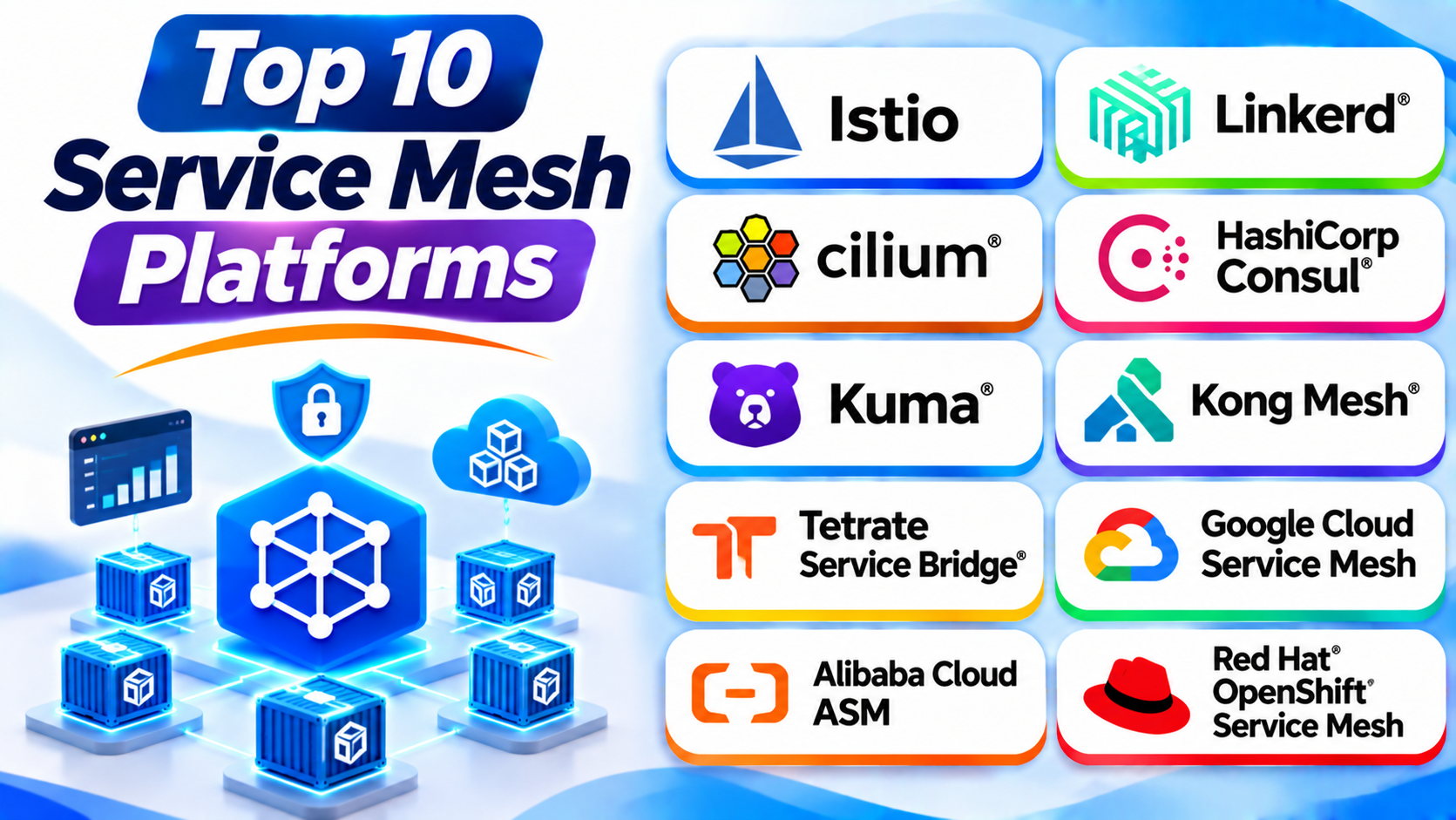
This guide explores ten popular service mesh platforms. It explains their features, Pros, Cons, and best uses. It also includes a comparison table and practical selection tips.
What Is a Service Mesh?
A service mesh is an infrastructure layer that manages communication between application services.
It helps services connect without adding all networking tasks to application code. It can also improve security and give teams better visibility.
A service mesh usually has two main parts.
Control Plane
The control plane manages the service mesh. It sends rules and settings to the network proxies.
Administrators use it to configure traffic, security, and service policies.
Data Plane
The data plane handles service-to-service traffic. It often uses proxies to manage communication between services.
These proxies can collect traffic data and apply network rules.
Sidecar and Sidecarless Models
Many service meshes use sidecar proxies. A sidecar proxy runs beside an application container.
Some platforms also support sidecarless designs. These approaches can use node-level proxies or kernel networking features.
Each model has different resource needs and capabilities.
How Does a Service Mesh Work?
A service mesh manages communication between services through a set of rules.
Here is a simple example:
- An application sends a request to another service.
- The service mesh intercepts the network traffic.
- A proxy or networking layer checks the traffic rules.
- The mesh applies security and routing settings.
- It sends the request to the correct service.
- It records useful traffic information.
- It can retry or redirect requests when configured.
For example, an online store may use separate services for products, payments, and orders. A service mesh can help secure communication between these services.
It can also route some traffic to a new application version. This helps teams test updates with less risk.
Main Features of Service Mesh Platforms
Traffic Management
Traffic management controls how requests move between services. It supports routing, load balancing, and traffic splitting.
Mutual TLS Security
Mutual TLS, or mTLS, encrypts communication and verifies both sides of a connection. It helps protect service-to-service traffic.
Service Discovery
Service discovery helps applications find available services. It also helps the mesh track service locations.
Observability
Observability gives teams information about service traffic. It can include metrics, logs, and distributed traces.
Retries and Timeouts
Retries allow a system to try a failed request again. Timeouts stop requests that take too long.
Traffic Policies
Traffic policies control which services can communicate. They can also limit access to selected services.
Fault Handling
Some platforms support circuit breaking and fault injection. These features help teams test and manage service failures.
Top 10 Service Mesh Platforms
The following platforms offer different approaches to service networking. Some are open-source projects. Others provide managed or enterprise service mesh solutions.
1. Istio
Istio is an open-source service mesh platform. It helps teams connect, secure, and monitor microservices.
It supports Kubernetes and can also connect services running on virtual machines. Teams can use it to manage communication across different environments.
Istio offers detailed traffic management features. These include routing rules, retries, timeouts, traffic splitting, and failover.
It also supports mutual TLS and identity-based access controls. This helps teams protect communication between services.
Istio provides two main data plane modes. The sidecar mode uses Envoy proxies beside application workloads. Ambient mode uses node-level proxies and optional Layer 7 waypoints.
Istio offers many features, but its setup can be complex. Teams need suitable Kubernetes and networking skills.
Key Features
- Open-source service mesh.
- Traffic routing and load balancing.
- Mutual TLS encryption.
- Identity-based authentication and authorization.
- Retries, timeouts, and failover.
- Canary and percentage-based traffic splitting.
- Metrics, logs, and distributed tracing.
- Sidecar and ambient data plane modes.
Pros
- Offers a broad feature set.
- Supports advanced traffic management.
- Provides strong service security.
- Works across Kubernetes and supported external workloads.
- Has a large ecosystem.
- Supports sidecar and ambient architectures.
Cons
- Can be difficult for beginners.
- Needs careful configuration.
- May use extra computing resources.
- Troubleshooting can require deep knowledge.
- Large deployments need strong operational planning.
Best For: Teams that need advanced traffic control, security, and observability.
2. Linkerd
Linkerd is an open-source service mesh built for Kubernetes. It focuses on simplicity, security, and performance.
The platform uses a lightweight proxy written in Rust. This design helps reduce the complexity of running a service mesh.
Linkerd automatically enables mutual TLS between meshed services. It also provides traffic metrics and service-level visibility.
Teams can use Linkerd to manage retries, timeouts, and load balancing. Its dashboard and command-line tools help administrators inspect service health.
Linkerd can suit teams that want core service mesh features without a large configuration system. However, teams should review its release channels and support options before production use.
Key Features
- Kubernetes-focused service mesh.
- Lightweight Rust-based proxy.
- Automatic mutual TLS.
- Traffic metrics and dashboards.
- Load balancing.
- Retries and timeouts.
- Service authorization policies.
- Distributed tracing support.
Pros
- Offers a simple operating model.
- Uses a lightweight proxy.
- Provides automatic mTLS.
- Makes service metrics easy to access.
- Supports common traffic controls.
- Fits Kubernetes environments well.
Cons
- Focuses mainly on Kubernetes.
- Offers fewer advanced controls than some alternatives.
- Complex multi-environment needs may require extra tools.
- Production support choices need review.
- Teams still need mesh troubleshooting skills.
Best For: Kubernetes teams that want a lightweight and simple service mesh.
3. Cilium Service Mesh
Cilium provides networking, security, and observability for Kubernetes. Its service mesh features build on its eBPF-based networking system.
eBPF allows programs to run inside the Linux kernel. Cilium uses this technology to manage network traffic efficiently.
Cilium can provide service connectivity and network security. It also supports application-aware features through Envoy.
Teams can use Cilium for network policies, load balancing, and service visibility. Its service mesh capabilities can help manage HTTP and gRPC traffic.
Cilium can be useful for teams that already use it as their Kubernetes networking layer. However, its architecture and eBPF concepts require technical knowledge.
Key Features
- eBPF-based networking.
- Kubernetes networking and security.
- Service mesh capabilities.
- Envoy integration for application-layer traffic.
- Network policies.
- Load balancing.
- Service observability.
- Support for encryption and identity-based security features.
Pros
- Combines networking and service mesh features.
- Uses efficient eBPF technology.
- Offers strong network visibility.
- Supports Kubernetes security policies.
- Can reduce the need for separate networking tools.
- Fits modern cloud-native environments.
Cons
- Requires Linux and networking knowledge.
- Advanced features need careful configuration.
- Best suited to compatible Kubernetes environments.
- Troubleshooting can require eBPF expertise.
- Teams must check feature support for their setup.
Best For: Kubernetes teams that want eBPF networking and service mesh features together.
4. HashiCorp Consul
HashiCorp Consul is a service networking platform. It provides service discovery and service mesh features.
Consul supports Kubernetes, virtual machines, and other workloads. This makes it useful for organizations with mixed infrastructure.
Its service mesh features help secure communication between services. It can use Envoy sidecar proxies to manage traffic.
Consul also provides service registration and health checks. Teams can use it to discover services across different environments.
The platform supports traffic management, access policies, and encrypted connections. It can help connect services across clouds and data centers.
However, Consul has several components and configuration choices. Teams should plan its architecture carefully.
Key Features
- Service discovery.
- Service-to-service encryption.
- Mutual TLS support.
- Envoy proxy integration.
- Service health checks.
- Traffic routing and splitting.
- Access control policies.
- Support for Kubernetes, VMs, and hybrid environments.
Pros
- Supports mixed infrastructure.
- Combines service discovery and service mesh.
- Helps secure service communication.
- Supports multi-cloud environments.
- Offers useful health checks.
- Works with several workload platforms.
Cons
- Can be complex to operate.
- Requires careful configuration.
- Enterprise features may add cost.
- Teams need networking knowledge.
- Large deployments need ongoing maintenance.
Best For: Organizations that connect services across Kubernetes, virtual machines, and hybrid environments.
5. Kuma
Kuma is an open-source service mesh platform maintained by Kong. It helps teams manage service communication across Kubernetes and virtual machines.
Kuma uses Envoy proxies as its data plane. It provides policies for traffic management, security, and observability.
The platform supports single-zone and multi-zone deployments. A zone can represent a Kubernetes cluster, data center, or other deployment environment.
Kuma can help organizations connect services across different regions and infrastructure types. It also supports multiple meshes under one control plane.
Its policy-based approach helps teams manage service behavior. However, multi-zone deployments require careful planning.
Key Features
- Open-source service mesh.
- Envoy-based data plane.
- Kubernetes and VM support.
- Single-zone and multi-zone deployments.
- Service-to-service security.
- Traffic routing policies.
- Observability integrations.
- Multiple mesh support.
Pros
- Supports Kubernetes and virtual machines.
- Offers multi-zone management.
- Uses Envoy proxies.
- Provides flexible traffic policies.
- Supports different infrastructure environments.
- Can manage multiple meshes.
Cons
- Requires service mesh knowledge.
- Multi-zone setups need planning.
- Envoy configuration may need expertise.
- Large environments can add operational work.
- Some enterprise needs may require Kong Mesh.
Best For: Teams that need an open-source mesh across Kubernetes and virtual machines.
6. Kong Mesh
Kong Mesh is an enterprise service mesh built on Kuma. It helps organizations connect, secure, and observe services across different environments.
The platform adds enterprise features to Kuma. These include additional security integrations, policy controls, and multi-zone management features.
Kong Mesh uses Envoy proxies to manage service traffic. Teams can apply policies for encryption, access, and communication.
It can help platform teams manage services across multiple clusters and locations. It also connects with Kong’s wider API and cloud-native ecosystem.
Kong Mesh suits organizations that need enterprise support and governance. However, its commercial model may not suit every team.
Key Features
- Enterprise service mesh based on Kuma.
- Multi-zone service management.
- Service-to-service encryption.
- Security policy management.
- Integration with external certificate authorities.
- Access control through supported policy systems.
- Observability and traffic management.
- Support for different infrastructure environments.
Pros
- Builds on the open-source Kuma project.
- Adds enterprise-focused features.
- Supports multi-zone environments.
- Offers security integrations.
- Helps standardize service policies.
- Fits organizations using Kong products.
Cons
- Commercial licensing may increase costs.
- Requires service mesh expertise.
- Adds enterprise management complexity.
- Teams should review feature differences from Kuma.
- Large deployments need careful design.
Best For: Enterprises that need supported service mesh management across multiple zones.
7. Tetrate Service Bridge
Tetrate Service Bridge, or TSB, is an enterprise platform for managing service mesh environments. It builds on Istio and Envoy technologies.
TSB helps teams manage service communication across clusters and environments. It provides a central management layer for platform operators.
Application teams can use TSB to configure traffic routing and access policies. Security teams can manage service identity and runtime security controls.
The platform also supports observability and multi-cluster operations. It can help organizations connect services running on Kubernetes and virtual machines.
TSB can simplify large Istio environments. However, it adds another management layer and may need enterprise support planning.
Key Features
- Centralized service mesh management.
- Istio-based service networking.
- Multi-cluster and multi-environment support.
- Traffic routing and rate limiting.
- Service security policies.
- Global observability.
- VM-to-Kubernetes connectivity.
- Enterprise management workflows.
Pros
- Helps manage large Istio deployments.
- Provides centralized governance.
- Supports hybrid service communication.
- Offers enterprise security controls.
- Supports traffic management.
- Helps platform teams manage multiple clusters.
Cons
- Commercial platform with licensing costs.
- Adds another layer to the architecture.
- Requires Istio knowledge.
- Setup can take time.
- May be too much for small teams.
Best For: Enterprises that need centralized management and governance for Istio-based service meshes.
8. Google Cloud Service Mesh
Google Cloud Service Mesh is Google’s managed service mesh solution. It uses Istio and Envoy technologies to manage service communication.
The platform helps teams secure, observe, and control traffic between services. It supports Kubernetes workloads and selected virtual machine environments.
Google manages important control plane operations for managed deployments. This can reduce the work required from platform teams.
Cloud Service Mesh provides traffic routing, service security, and observability. It also supports hybrid and multi-cloud scenarios.
Teams using Google Cloud may find it easier to connect with their existing infrastructure. However, users should review supported APIs and deployment modes before choosing it.
Key Features
- Managed service mesh capabilities.
- Istio and Envoy technology.
- Traffic management.
- Mutual TLS and service security.
- Service observability.
- Support for GKE workloads.
- Support for selected VM and hybrid environments.
- Google-managed control plane options.
Pros
- Reduces control plane maintenance.
- Fits well with Google Cloud.
- Uses established Istio and Envoy technologies.
- Supports service security.
- Provides traffic visibility.
- Supports selected hybrid environments.
Cons
- Requires Google Cloud knowledge.
- Some features depend on deployment mode.
- Cloud service costs need review.
- Teams have less control over managed components.
- Supported platform choices may affect portability.
Best For: Organizations that want managed service mesh capabilities on Google Cloud.
9. Alibaba Cloud Service Mesh (ASM)
Alibaba Cloud Service Mesh, or ASM, is a managed service mesh platform built around Istio. It helps teams manage service communication on Kubernetes.
ASM supports traffic routing, mutual authentication, and service observability. It also provides policy controls and security features.
The platform offers sidecar and ambient data plane modes. Its managed control plane can reduce the work needed to operate Istio components.
ASM supports Alibaba Cloud Kubernetes environments and selected external Kubernetes clusters. It also provides multi-cluster capabilities for supported configurations.
This platform can suit organizations that already use Alibaba Cloud. Teams should review edition and mode support before deployment.
Key Features
- Managed Istio-compatible service mesh.
- Managed control plane.
- Sidecar and ambient modes.
- Mutual TLS and identity-based authorization.
- Traffic routing and splitting.
- Retries and fault injection.
- Service metrics, logs, and tracing.
- Multi-cluster support for supported modes.
Pros
- Reduces Istio control plane maintenance.
- Offers familiar Istio compatibility.
- Supports traffic and security policies.
- Provides observability features.
- Offers sidecar and ambient options.
- Fits Alibaba Cloud environments.
Cons
- Best suited to Alibaba Cloud users.
- Some features depend on edition and mode.
- Requires Kubernetes knowledge.
- Managed service costs need review.
- Teams should check regional availability.
Best For: Organizations that use Alibaba Cloud and want a managed Istio-based service mesh.
10. Red Hat OpenShift Service Mesh
Red Hat OpenShift Service Mesh helps organizations manage connectivity, security, and observability for microservices.
It builds on the Istio project and integrates with Red Hat OpenShift. It provides a central control point for service communication.
The platform supports service discovery, load balancing, and service-to-service authentication. It also offers monitoring and traffic management features.
Teams can use it for canary releases and access control. Its integration with OpenShift can help organizations manage application networking within their existing platform.
OpenShift Service Mesh is useful for organizations that already use Red Hat products. However, it may not be the simplest choice for teams outside the OpenShift ecosystem.
Key Features
- Istio-based service mesh.
- Integration with Red Hat OpenShift.
- Service discovery and load balancing.
- Service-to-service authentication.
- Traffic management.
- Access control policies.
- Metrics and monitoring.
- Support for canary releases.
Pros
- Fits well with OpenShift environments.
- Uses established Istio technology.
- Provides centralized service management.
- Supports security and observability.
- Helps manage microservice traffic.
- Offers enterprise support options.
Cons
- Best suited to OpenShift environments.
- Requires Kubernetes and Istio knowledge.
- Adds platform complexity.
- Resource needs require planning.
- May be costly for smaller teams.
Best For: Organizations that run Red Hat OpenShift and need integrated service mesh capabilities.
Service Mesh Platforms Comparison Table
| Platform | Main Technology | Deployment Focus | Best For |
|---|---|---|---|
| Istio | Envoy and Istio | Kubernetes, VMs, hybrid | Advanced traffic and security |
| Linkerd | Rust-based proxy | Kubernetes | Lightweight service mesh |
| Cilium Service Mesh | eBPF and Envoy | Kubernetes | Integrated networking and mesh |
| HashiCorp Consul | Consul and Envoy | Kubernetes, VMs, hybrid | Service discovery and secure networking |
| Kuma | Envoy | Kubernetes and VMs | Open-source multi-zone mesh |
| Kong Mesh | Kuma and Envoy | Enterprise multi-zone | Enterprise service governance |
| Tetrate Service Bridge | Istio and Envoy | Multi-cluster and hybrid | Centralized Istio management |
| Google Cloud Service Mesh | Istio and Envoy | Google Cloud and supported hybrid | Managed service mesh |
| Alibaba Cloud ASM | Istio | Alibaba Cloud and supported Kubernetes | Managed Istio-based networking |
| Red Hat OpenShift Service Mesh | Istio and Envoy | OpenShift | OpenShift microservices |
Service Mesh vs. API Gateway
Service meshes and API gateways both manage network traffic. However, they solve different problems.
Service Mesh
A service mesh mainly manages communication between internal application services. It provides service identity, encryption, traffic policies, and internal observability.
API Gateway
An API gateway manages traffic entering or leaving an application system. It can handle authentication, API routing, rate limits, and external client access.
Can They Work Together?
Yes. Many systems use both tools.
An API gateway manages external API requests. A service mesh manages communication between internal services.
This approach can provide better control over the full application network.
How to Choose the Right Service Mesh Platform
The best service mesh depends on your application architecture and team skills. Review these points before making a decision.
1. Understand Your Main Problem
Start by identifying your biggest challenge. You may need better security, traffic routing, or monitoring.
Do not install a service mesh only because it is popular. Choose one that solves a real problem.
2. Review Your Infrastructure
Some platforms focus on Kubernetes. Others also support virtual machines and hybrid systems.
Choose a tool that fits your current environment. Also consider future infrastructure changes.
3. Check the Data Plane Model
Review whether the platform uses sidecars, ambient networking, eBPF, or another design.
Each model has different resource and operational needs.
4. Compare Security Features
Check mTLS, service identity, authorization policies, and certificate management.
Make sure the platform supports your security requirements.
5. Review Traffic Management
Look for traffic splitting, retries, timeouts, and failover.
These features can help teams release updates and improve application reliability.
6. Check Observability Tools
Review the available metrics, logs, and distributed tracing features.
Also check integration with your current monitoring tools.
7. Understand Operational Complexity
A service mesh adds another infrastructure layer. Your team must install, update, monitor, and troubleshoot it.
Choose a platform that your team can operate well.
8. Compare Total Costs
Open-source software may not have a license fee. However, it still needs infrastructure and engineering time.
Commercial platforms may add support and enterprise features. Compare the full cost before choosing one.
9. Test with a Small Workload
Start with a small application. Test security, routing, monitoring, and failure handling.
This helps your team understand the platform before a wider rollout.
Common Uses of Service Mesh Platforms
Microservices Security
A service mesh can encrypt communication between application services. It can also control which services can connect.
Canary Deployments
Teams can send a small share of traffic to a new application version. They can check the results before increasing traffic.
Traffic Management
Service meshes can route requests based on rules. They can also support retries and timeouts.
Multi-Cluster Communication
Organizations may run services across several clusters. A service mesh can help connect these environments.
Service Monitoring
A mesh can collect metrics and traces from service communication. This helps teams understand performance and failures.
Hybrid Infrastructure
Some businesses run applications on Kubernetes and virtual machines. Certain service meshes can connect both environments.
Benefits of Service Mesh Platforms
Better Service Security
mTLS can encrypt service-to-service communication. Identity-based rules can also control access.
Improved Traffic Control
Teams can route traffic without changing application code. They can also test new versions through controlled traffic splits.
Better Visibility
Metrics and traces help teams understand service behavior. This makes troubleshooting easier.
More Reliable Communication
Retries, timeouts, and failover rules can help applications handle network problems.
Less Networking Code
A service mesh moves many networking tasks outside application code. Developers can focus more on business features.
Consistent Policies
Teams can apply common security and traffic rules across services. This can help large application environments.
Challenges of Using a Service Mesh
Added Complexity
A service mesh introduces more infrastructure. Teams must understand its control plane and data plane.
Resource Usage
Proxies and networking components need CPU and memory. Large deployments should measure this overhead.
Troubleshooting
Problems can involve applications, proxies, certificates, and network rules. Teams need clear monitoring and diagnostic tools.
Learning Requirements
Service mesh platforms need networking and Kubernetes knowledge. Teams should plan training before production use.
Configuration Errors
Incorrect traffic or security rules can interrupt communication. Teams should test changes before applying them widely.
Cost and Maintenance
Even open-source platforms need ongoing maintenance. Commercial support and managed services may add extra costs.
Best Practices for Service Mesh Management
- Start with a clear business or technical need.
- Test the mesh with a small application first.
- Use mTLS for suitable service communication.
- Apply clear service identity and access policies.
- Monitor proxy and application resource use.
- Set suitable retry and timeout rules.
- Test traffic changes before production releases.
- Keep mesh components updated.
- Use trusted certificates and manage them carefully.
- Document traffic and security policies.
- Review mesh costs and resource use regularly.
- Plan upgrades and recovery steps.
Frequently Asked Questions
1. What is a service mesh platform?
A service mesh platform manages communication between application services. It can provide traffic routing, security, and monitoring.
2. What is the most popular service mesh platform?
Istio is a widely used service mesh platform. It offers advanced traffic management, security, and observability features.
3. Is Kubernetes a service mesh?
No. Kubernetes manages containerized workloads. A service mesh manages communication between application services running on those workloads.
4. What is the difference between Istio and Linkerd?
Istio offers a broad set of traffic and policy features. Linkerd focuses on a simpler and lighter Kubernetes service mesh.
5. What is mutual TLS in a service mesh?
Mutual TLS verifies both sides of a connection. It also encrypts communication between services.
6. Does a service mesh improve application performance?
A service mesh can improve traffic control and reliability. However, proxies and networking components also use resources.
Teams should test the effect on their own workloads.
7. Do small applications need a service mesh?
Not always. Small applications with few services may not need one.
A service mesh becomes more useful when teams need internal encryption, detailed traffic policies, or service-level visibility.
8. What is the difference between a sidecar and ambient mesh?
A sidecar mesh runs a proxy beside each application workload. An ambient mesh uses shared node-level components and optional Layer 7 proxies.
9. Can a service mesh work across multiple clusters?
Yes. Several platforms support multi-cluster service communication.
Examples include Istio, Kuma, Consul, and enterprise service mesh platforms.
10. How do I choose the best service mesh?
Review your infrastructure, security needs, traffic requirements, and team skills.
Then test a suitable platform with a real application before using it across your environment.
Final Thoughts
Service mesh platforms help teams manage communication between microservices. They support security, traffic control, and better visibility.
Istio offers a broad feature set. Linkerd focuses on simplicity. Cilium combines eBPF networking with service mesh features. Consul supports mixed environments.
Kuma provides open-source multi-zone management. Kong Mesh adds enterprise features. Tetrate Service Bridge supports large Istio environments. Google Cloud Service Mesh and Alibaba Cloud ASM offer managed options. Red Hat OpenShift Service Mesh fits OpenShift users.
No single platform suits every application. Your choice should match your architecture, security needs, and team skills.
Start with one clear problem. Test a suitable platform. Then expand when your team is ready.