Introduction
Spatial computing is changing how people interact with digital content. It connects digital objects, apps, and information with the physical world. People can use these experiences through phones, tablets, smart glasses, and headsets.
Think about walking through a virtual building before construction begins. You could inspect its rooms, move furniture, and study the layout. You could also view digital instructions while repairing a real machine. These examples show how spatial computing can help people work and learn.
Developers need special tools to create these experiences. These tools help software understand space, track movement, display 3D objects, and respond to user actions. Some focus on augmented reality. Others support virtual reality, mixed reality, or large 3D environments.
Spatial computing also includes more than AR and VR. It can connect digital models with real places and objects. It can support shared 3D scenes, location-based experiences, and digital twins.
Choosing the right toolkit depends on the project. A mobile AR app has different needs from a headset-based training system. A factory simulation may need strong 3D data tools. A browser-based experience may need web technologies instead.
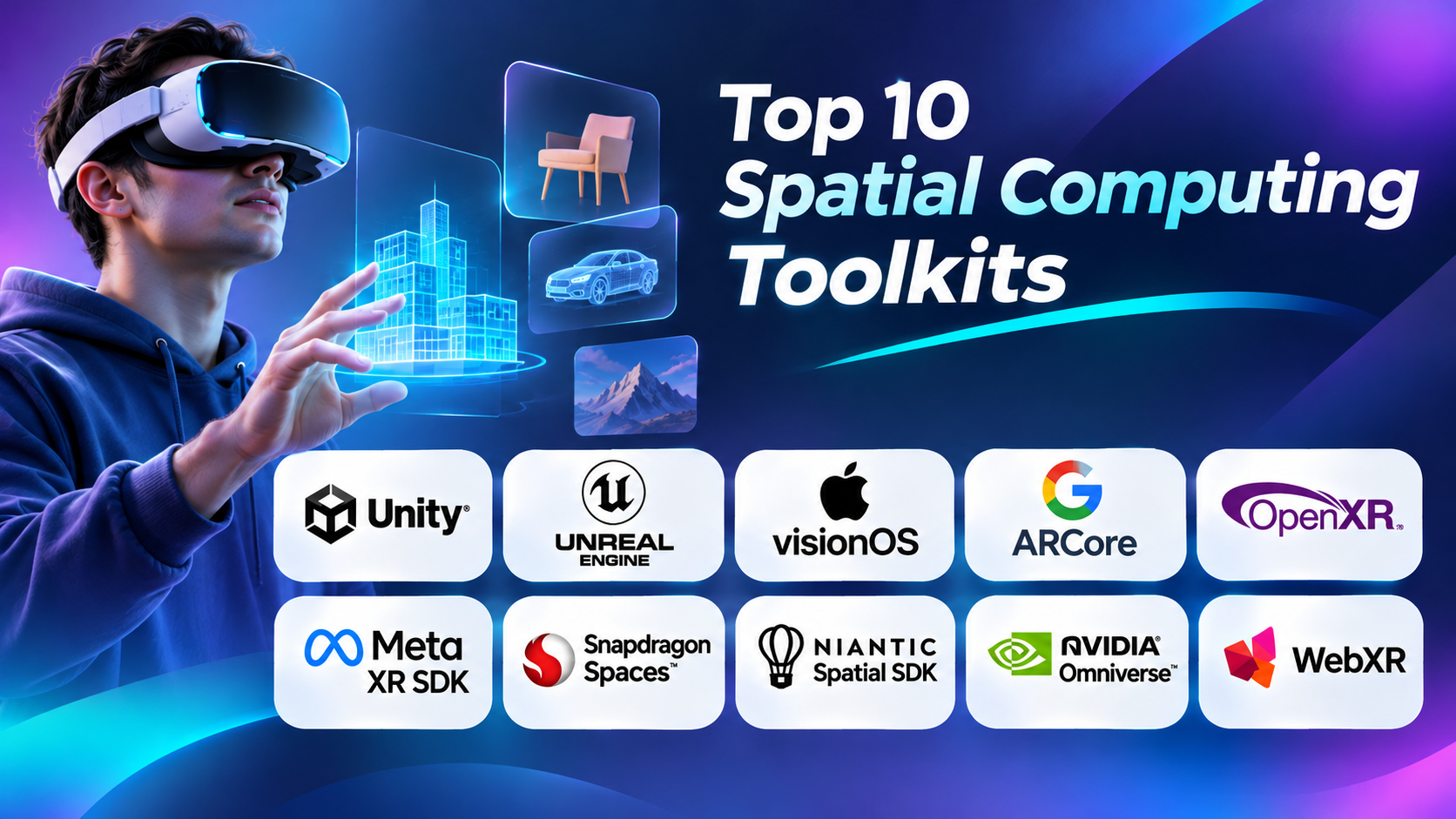
This guide explores ten useful spatial computing toolkits. It explains what each one does, where it fits, and what developers should consider before choosing it.
1. Unity XR Development Toolkit
Unity is a popular development platform for building interactive 2D and 3D applications. Its XR tools help developers create augmented reality, virtual reality, and mixed reality experiences. The platform supports projects for mobile devices, computers, and compatible headsets.
Unity offers several tools that work together. AR Foundation helps developers build AR features across supported devices. It provides common functions for tasks such as surface detection, object tracking, and spatial mapping. Developers can use these features without building every device-specific function from the beginning.
The XR Interaction Toolkit focuses on user actions. It helps developers add object grabbing, selection, movement, and controller input. For example, a developer can create a virtual room where users pick up objects and move them around. The toolkit also supports visual feedback and basic interface controls.
Unity uses C# for scripting. Developers use it to control object movement, app behavior, menus, and interactions. The Unity Editor also offers a visual workspace for building scenes. Teams can add 3D models, lights, sound, animation, and other assets.
Another useful part of Unity is its package system. Developers can add only the XR tools they need. This helps them keep projects focused. However, they must check package versions and device support before combining different tools.
Unity can also support specialized device features through platform-specific packages. This matters when an app needs hand tracking, passthrough, or other headset functions. Developers should test these features on the actual target hardware.
Key features
- AR Foundation for supported AR workflows.
- XR Interaction Toolkit for object and interface interaction.
- Support for VR, AR, and mixed reality projects.
- C# scripting and visual scene editing.
- Tools for animation, physics, sound, and 3D content.
- Package support for different XR devices.
Pros
- Supports many types of spatial computing projects.
- Offers a large collection of development resources.
- Provides tools for both AR and VR interactions.
- Allows teams to add features through packages.
- Works well for interactive apps, games, and training tools.
Cons
- Beginners may need time to learn the editor and C#.
- Package versions must work together.
- Device-specific features may need extra setup.
- Developers must test performance on each target device.
Unity is a strong option for teams that want a flexible development environment. It suits mobile AR apps, VR training, interactive product displays, and mixed reality projects.
2. Unreal Engine
Unreal Engine is a real-time 3D development platform known for its detailed graphics tools. Developers use it to create games, simulations, virtual environments, and immersive experiences. Its XR development features support projects for augmented reality, virtual reality, and mixed reality devices.
One of Unreal Engine’s main strengths is visual quality. It provides tools for lighting, materials, shadows, textures, and complex 3D scenes. These features help developers create realistic digital environments.
For spatial computing, visual quality is only one part of the work. Users also need to interact with objects naturally. Unreal Engine supports different input methods, including motion controllers and other device-supported tracking features. Developers can build virtual menus, interactive objects, and room-scale experiences.
Blueprint Visual Scripting is another important feature. It lets developers create application logic through connected visual blocks. This can help designers and artists build interactions without writing every line of code. Developers can also use C++ when they need more control or custom systems.
Unreal Engine supports OpenXR for compatible head-mounted devices. This helps developers use a common XR interface across supported systems. However, OpenXR does not make every device feature identical. Some advanced functions still depend on the headset and its extensions.
The engine also provides tools for testing and improving performance. This matters because immersive apps must respond quickly to user movement. Slow frame rates or poor control response can make an experience uncomfortable.
Unreal Engine can require more development resources than a simple AR toolkit. Detailed scenes may also need powerful hardware. Teams should plan the visual quality around the device that will run the final application.
Key features
- Real-time 3D rendering and scene tools.
- Blueprint Visual Scripting.
- C++ support for custom development.
- OpenXR support for compatible headsets.
- Tools for lighting, materials, physics, and animation.
- XR input and interface development features.
- Performance testing and profiling tools.
Pros
- Creates detailed and realistic 3D environments.
- Offers visual scripting and traditional programming.
- Supports many types of immersive projects.
- Provides strong tools for complex scenes.
- Works well for simulations and high-quality VR experiences.
Cons
- Beginners may face a steep learning curve.
- Detailed scenes can require powerful hardware.
- Developers must manage performance carefully.
- Some device features need platform-specific setup.
Unreal Engine suits projects where visual detail and realistic environments matter. It is useful for virtual training, architecture experiences, product visualization, and advanced simulations.
3. Apple visionOS Development Tools
Apple’s visionOS development tools help developers build spatial apps for Apple Vision Pro. The platform lets users interact with digital content while staying aware of their surroundings. Developers can also create fully immersive scenes that replace much of the visible physical environment.
Apple provides several frameworks for this work. SwiftUI helps developers build app interfaces. RealityKit handles 3D content, rendering, animation, and interaction. ARKit provides access to information about the user’s surroundings and spatial features.
These tools work together to create apps that feel connected to the user’s space. For example, an app can show a floating window beside a real desk. It can also place a 3D model in the room or open a fully immersive environment.
RealityKit is important for developers who work with 3D content. It supports models, animations, spatial audio, and physics-based behavior. Developers can create scenes in code and respond to user input.
Apple also provides Reality Composer Pro for preparing and organizing 3D content. It helps teams work with scenes, materials, and other assets for spatial apps. This can make it easier to manage content before adding it to an application.
A major difference in visionOS development is the way users interact with apps. People can use their eyes, hands, and voice. Developers must design interfaces that feel natural in this setting. A traditional phone interface may not work well when placed in a large 3D space.
The platform also has a clear device focus. Developers who choose these tools mainly target Apple’s spatial computing ecosystem. Teams that need broad headset support may need another toolkit or a cross-platform engine.
Key features
- SwiftUI for spatial app interfaces.
- RealityKit for 3D rendering and interaction.
- ARKit for spatial understanding.
- Reality Composer Pro for 3D content workflows.
- Support for spatial audio and animation.
- Hand, eye, and voice-based interaction options.
- Shared experiences through supported Apple frameworks.
Pros
- Designed for Apple’s spatial computing platform.
- Provides connected tools for apps and 3D content.
- Supports natural input methods.
- Offers a clear path for building native spatial apps.
- Works well with Apple’s development ecosystem.
Cons
- Focuses on Apple Vision Pro.
- Developers need to learn Apple’s frameworks.
- Teams may need to adapt existing app interfaces.
- Testing requires access to suitable hardware or development tools.
Apple’s visionOS tools are a good fit for developers who want to build native spatial apps for Vision Pro. They suit productivity tools, learning apps, 3D presentations, and immersive media experiences.
4. Google ARCore
Google ARCore is a platform for building augmented reality experiences on supported devices. It helps apps understand the physical world through a device’s camera and sensors. Developers can use it to place digital content in real spaces.
ARCore includes motion tracking. This helps an app understand how a phone moves through an environment. The app can then keep virtual objects in the right position as the user moves.
Environmental understanding is another important feature. ARCore can detect surfaces such as floors and tables. Developers can use this information to place virtual furniture, products, or other objects in a scene.
The Depth API adds more detail about the space around the user. It helps apps estimate how far objects are from the camera. This can support more realistic effects, such as making a real object appear in front of a virtual object.
ARCore also offers light estimation. This helps an app adjust virtual objects to match the lighting in the real environment. A digital object can look more natural when its brightness and color fit the room.
The Geospatial API supports location-based AR experiences. Developers can attach digital content to real-world locations. This can help build outdoor guides, location-based games, and public information experiences.
ARCore works with Android development tools and supported development engines. However, not every Android phone supports every ARCore feature. Developers must check the supported device list and test their apps on the phones they plan to serve.
Key features
- Motion tracking.
- Detection of real-world surfaces.
- Depth understanding.
- Light estimation.
- Geospatial features for location-based AR.
- Persistent cloud anchors for shared AR content.
- Support for compatible Android devices and development tools.
Pros
- Useful for Android AR applications.
- Offers several tools for understanding physical spaces.
- Supports location-based experiences.
- Helps place virtual objects in real environments.
- Can work with supported development engines.
Cons
- Device support varies.
- Some features need compatible hardware and software.
- Developers must test tracking in different environments.
- It focuses on AR rather than full VR development.
ARCore is a strong choice for Android-focused AR projects. It works well for shopping apps, education, navigation, product previews, and location-based experiences.
5. OpenXR
OpenXR is an open standard for connecting applications with XR devices. It provides a shared way for software to communicate with supported headsets and other XR hardware.
Without a common standard, developers may need different systems for different devices. This can increase development work. OpenXR helps reduce that problem by providing a common set of APIs.
An API is a set of rules that lets software systems communicate. OpenXR defines how an application can access supported XR features. These include headset tracking, input devices, and other parts of an immersive experience.
OpenXR is not a full game engine or visual design tool. It does not provide the same scene editor as Unity or Unreal Engine. Instead, it works as a connection layer between an application and an XR runtime.
A runtime is the software that manages communication with the XR device. The application uses OpenXR functions to request supported features. The runtime then handles the connection with the hardware.
This design can help developers build applications for more than one headset. However, cross-device support still needs testing. Different devices may support different extensions and features. A developer may need extra code to use special hardware functions.
OpenXR works with engines such as Unity and Unreal Engine. Developers can use these engines to create content while OpenXR helps connect it to supported devices.
Key features
- Open standard for XR application development.
- Common APIs for supported XR devices.
- Access to headset and input information.
- Support for device-specific extensions.
- Integration with major development engines.
- A shared foundation for compatible XR applications.
Pros
- Helps reduce device-specific development work.
- Supports a broad XR ecosystem.
- Offers a common API structure.
- Works with major 3D engines.
- Helps teams plan for multiple compatible devices.
Cons
- It is not a complete development engine.
- Device features can differ.
- Some advanced functions need extensions.
- Developers still need to test each target device.
OpenXR is useful for teams that want to build XR apps across compatible hardware. It is especially valuable when device flexibility matters more than using one headset’s special features.
6. Meta XR SDK
Meta XR SDK provides development tools for building experiences for Meta’s VR and mixed reality devices. Developers commonly use it with Unity. The SDK includes features for input, interaction, spatial audio, and mixed reality.
The Meta XR Core SDK provides the basic tools needed to start a project. It includes the Meta XR Rig, project setup tools, sample assets, and input features. Developers can use these parts as a starting point for a headset application.
The Interaction SDK helps developers create natural user actions. It supports interactions such as grabbing, pointing, touching, and moving objects. It also offers tools for hand-based interaction.
Mixed reality features help apps connect digital content with the real room. Supported tools include passthrough, depth information, and spatial anchors. Passthrough lets users see the physical environment through the headset’s cameras.
The Mixed Reality Utility Kit can help developers work with room information. For example, an app may place digital objects on floors or attach content to walls. These features can support room design, learning, and interactive entertainment.
Meta also offers tools for social and connected experiences. Developers can add features such as voice chat, achievements, matchmaking, and in-app purchases through the relevant SDK components.
The main trade-off is platform focus. Meta XR SDK offers access to Meta-specific features. However, some components depend on Meta device extensions and may not work on other headsets. Developers who need broader support should plan their project around OpenXR and add Meta features only where needed.
Key features
- Meta XR Core SDK.
- Interaction tools for hands and controllers.
- Passthrough and mixed reality support.
- Spatial anchors and scene features.
- Spatial audio tools.
- Social and multiplayer services.
- Development and testing tools for Meta devices.
Pros
- Provides tools designed for Meta devices.
- Supports hand and controller interaction.
- Helps build mixed reality experiences.
- Offers tools for social and connected apps.
- Includes sample content and development helpers.
Cons
- Many features focus on Meta hardware.
- Some SDK components do not support other devices.
- Developers must manage SDK packages and updates.
- Advanced projects need careful device testing.
Meta XR SDK is a useful choice for teams building apps for Meta Quest devices. It suits VR games, mixed reality tools, social apps, and interactive training systems.
7. Qualcomm Snapdragon Spaces
Qualcomm Snapdragon Spaces is an XR development platform for supported devices. It provides tools for building experiences that connect compatible phones and XR glasses. Developers can use its SDK with Unity and Unreal Engine.
The platform focuses on spatial experiences for wearable devices. It offers features that help apps understand the user’s position and surroundings. This can support digital content that stays in place as the user moves.
Positional tracking is one of its main capabilities. It helps the system estimate the device’s position and direction in 3D space. This allows virtual content to stay aligned with the user’s view.
Snapdragon Spaces also provides spatial anchors. Anchors help apps keep digital objects linked to positions in the environment. Developers can use them to create experiences where content appears in a set location.
The platform includes hand tracking options through its development packages. This can help users interact with virtual objects without relying only on controllers.
Developers can choose Unity or Unreal Engine for their projects. The SDK packages include tools, services, and sample applications. This gives teams a starting point for building and testing supported experiences.
Hardware support is an important point. Snapdragon Spaces works with compatible devices. Developers should check the supported hardware list before planning a project. They should also test tracking in the lighting and room conditions expected during use.
Key features
- SDK support for Unity and Unreal Engine.
- Positional tracking.
- Local spatial anchors.
- Hand tracking packages.
- Tools for compatible XR glasses and devices.
- Sample applications and development services.
- Support for spatial AR experiences.
Pros
- Focuses on wearable XR experiences.
- Supports major 3D development engines.
- Provides spatial tracking tools.
- Offers sample projects for developers.
- Helps connect compatible phones and XR glasses.
Cons
- Hardware support is limited to compatible devices.
- Some features may depend on environment conditions.
- Developers need to check SDK and engine requirements.
- It may not suit projects targeting every headset.
Snapdragon Spaces is worth considering for teams building apps for supported XR glasses. It can suit hands-free guidance, workplace tools, and wearable mixed reality experiences.
8. Niantic Spatial SDK
Niantic Spatial SDK provides tools for building AR experiences that connect digital content with real places. It is designed for developers who want virtual objects and effects to relate to the physical world.
One of its key areas is localization. Localization helps an app understand where it is within a real environment. This can help digital content appear in the right place when users return to a location.
This approach can support shared and location-based AR experiences. For example, developers may create digital content that appears at a particular place. Users can explore that content through a supported AR application.
The SDK also includes AR effects and developer tools. These features help teams create visual experiences that respond to the user’s surroundings. Developers can use the available tools and sample projects to understand how the platform works.
Niantic’s spatial technology has a different focus from a general-purpose 3D engine. It concentrates on connecting digital experiences with real-world locations. Developers may still use Unity as part of the application workflow.
Teams should review the current SDK documentation before starting a project. They should also check account migration requirements and service availability. Niantic has changed parts of its developer platform, so older tutorials may refer to tools or services that no longer operate in the same way.
Key features
- Localization for real-world experiences.
- AR effects and spatial features.
- Unity SDK support.
- Developer tools and sample projects.
- Tools for connecting digital content with physical locations.
Pros
- Focuses on real-world AR experiences.
- Supports location-aware digital content.
- Provides Unity development resources.
- Offers sample projects for learning.
- Can support place-based interactive applications.
Cons
- It is more specialized than a full 3D engine.
- Developers need to review current service requirements.
- Location accuracy can depend on the environment.
- Some workflows may require additional development tools.
Niantic Spatial SDK suits developers who want to build AR experiences connected to real places. It may be useful for location-based entertainment, digital guides, and interactive public spaces.
9. NVIDIA Omniverse and OpenUSD
NVIDIA Omniverse is a development platform for building 3D applications, simulations, and digital twin workflows. It uses OpenUSD as a key foundation for sharing and working with complex 3D scenes.
OpenUSD stands for Universal Scene Description. It provides a way to describe and exchange 3D scenes and their parts. Different tools can use this format to work with shared 3D content.
This matters when teams use many different design and simulation applications. A project may contain models, materials, lights, cameras, and scene information from several sources. OpenUSD helps organize this information in a shared structure.
Omniverse provides SDKs, APIs, libraries, and services for developers. The Kit SDK helps teams build custom applications using Python or C++. It includes tools for rendering, physics, user interfaces, and extensions.
The platform can support digital twins. A digital twin is a digital model that represents a real object, place, or system. Teams can use these models to study layouts, test workflows, and understand how a system may behave.
Omniverse also supports simulation workflows. For example, a company may create a digital model of a factory. Developers can use it to study equipment placement, movement, and production processes.
This toolkit is different from a headset-focused AR SDK. It focuses more on 3D data, simulation, and connected digital environments. Teams building direct headset experiences may need to combine it with another XR platform.
Hardware and infrastructure needs also matter. High-quality rendering and large simulations can require powerful computing resources. Teams should plan their data storage, rendering, and deployment needs before building a large project.
Key features
- OpenUSD-based 3D data workflows.
- Kit SDK for custom application development.
- Python and C++ development support.
- Rendering and physics tools.
- APIs and libraries for 3D applications.
- Collaboration across compatible 3D tools.
- Support for digital twins and simulation workflows.
Pros
- Helps manage complex 3D scenes.
- Supports connected workflows across tools.
- Offers APIs and SDKs for custom applications.
- Useful for digital twins and simulation.
- Supports detailed 3D data and rendering workflows.
Cons
- It is not a simple mobile AR toolkit.
- Developers need to understand 3D data workflows.
- Large projects may need strong computing resources.
- Some deployments require extra infrastructure planning.
NVIDIA Omniverse is a strong option for industrial spatial computing. It suits digital twins, factory planning, robotics simulation, and large 3D collaboration projects.
10. WebXR
WebXR is a web technology that helps developers create augmented and virtual reality experiences in supported browsers. It connects web applications with compatible XR devices.
One major benefit is browser-based access. Users may be able to open an experience through a website instead of installing a separate native application. This can make sharing and testing easier.
WebXR provides APIs for managing immersive sessions. It helps a web app find supported XR devices, receive movement information, and display 3D content. It also supports input from compatible controllers.
Developers can use WebXR with web graphics technologies such as WebGL. These tools help create and render 3D scenes. A web developer can build a virtual showroom, interactive learning space, or simple AR experience.
WebXR supports both VR and AR session types. A VR session can place users inside a fully digital scene. An AR session can show digital content over the physical world on compatible devices.
However, browser support is an important limitation. WebXR does not work in every browser or on every device. Some features also depend on secure website connections and device permissions.
Developers should check browser compatibility before choosing WebXR for a production project. They should also test how the experience works on different headsets and mobile devices.
WebXR may not provide the same level of device-specific control as a native SDK. Advanced features may need extra APIs or platform tools. Even so, it can be a useful option when easy access through the web matters.
Key features
- Browser-based AR and VR experiences.
- APIs for immersive XR sessions.
- Head and device movement tracking.
- Support for compatible XR controllers.
- Integration with web graphics technologies.
- Access through supported web browsers.
- Tools for interactive 3D web applications.
Pros
- Users can access experiences through supported browsers.
- Works with common web development workflows.
- Supports both AR and VR session types.
- Useful for demos and interactive web content.
- Can reduce the need for native app installation.
Cons
- Browser and device support varies.
- Some features remain limited or experimental.
- Advanced projects may need extra web development work.
- Performance depends on the browser and device.
WebXR is a useful choice for teams that want to deliver spatial experiences through websites. It suits virtual showrooms, browser-based learning, product demos, and lightweight immersive applications.
Comparison Table: Top 10 Spatial Computing Toolkits
| Tool | Main Purpose | Best For | Key Strength |
|---|---|---|---|
| Unity XR Development Toolkit | Build AR, VR, and mixed reality apps | Game developers and app creators | Flexible tools and wide device support |
| Unreal Engine | Create realistic 3D worlds and experiences | High-quality visuals and simulations | Powerful graphics |
| Apple visionOS Development Tools | Build apps for Apple Vision Pro | Apple spatial app developers | Deep Apple device support |
| Google ARCore | Add digital objects to real-world views | Android AR app developers | Real-world tracking |
| OpenXR | Connect apps with XR devices | Cross-platform XR development | Common industry standard |
| Meta XR SDK | Build apps for Meta Quest devices | VR and mixed reality developers | Meta device features |
| Qualcomm Snapdragon Spaces | Build AR and spatial apps | AR glasses and compatible devices | Hardware-focused AR support |
| Niantic Spatial SDK | Create real-world spatial experiences | Location-based AR projects | Real-world mapping |
| NVIDIA Omniverse and OpenUSD | Build and connect 3D worlds | Industrial design and digital twins | 3D collaboration and simulation |
| WebXR | Run AR and VR experiences in web browsers | Web developers | Browser-based access |
How to Choose the Right Spatial Computing Toolkit
Each toolkit serves a different purpose. Some focus on mobile AR. Others support headsets, wearable devices, or large 3D simulations. Your project needs should guide the choice.
Start with your target device
First, decide where people will use your application.
- For Android AR apps, consider Google ARCore.
- For Apple Vision Pro apps, consider Apple’s visionOS tools.
- For Meta Quest projects, consider Meta XR SDK.
- For compatible XR glasses, review Snapdragon Spaces.
- For browser-based experiences, consider WebXR.
Device support should come before advanced features. A toolkit cannot help if it does not support your target hardware.
Match the toolkit to your project
A product preview app may need surface detection and object placement. A VR training app may need hand tracking and realistic 3D scenes. A factory digital twin may need large 3D data and simulation tools.
Choose tools that support the main task. Avoid adding complex systems that your project does not need.
Check development skills
Some toolkits need strong programming skills. Unity uses C#. Unreal Engine supports C++ and visual scripting. Apple’s tools use Swift and its development frameworks. WebXR requires web development knowledge.
Choose a platform that matches your team’s skills. Also consider how much time your team can spend learning new tools.
Test device performance
Spatial apps must respond quickly to movement. Poor tracking or slow visuals can harm the user experience.
Test your project on the actual target device. Check frame rates, tracking quality, battery use, heat, and comfort. Also test in the rooms and lighting conditions where people will use the app.
Review long-term support
A spatial computing project may need updates for a long time. Check the toolkit’s documentation, supported devices, release activity, and developer community.
Also review licensing, service costs, data needs, and platform limits. These details can affect the total cost of a project.
Frequently Asked Questions About Spatial Computing Toolkits
1. What is a spatial computing toolkit?
A spatial computing toolkit helps developers build apps that understand real-world spaces. It can connect digital objects with physical places. These tools support AR, VR, and mixed reality experiences.
2. Which spatial computing toolkit is best for beginners?
Unity is a good choice for many beginners. It offers useful learning resources and flexible development tools. Developers can use it to build AR and VR apps.
3. What is the difference between AR, VR, and mixed reality?
AR adds digital objects to the real world. VR places users inside a fully digital space. Mixed reality connects digital objects with the real world.
4. Is Unreal Engine good for spatial computing?
Yes. Unreal Engine offers strong 3D graphics and visual tools. Developers can use it for realistic simulations, VR apps, and interactive environments.
5. What is the purpose of OpenXR?
OpenXR helps developers build XR apps for different devices. It offers a shared way to connect software with supported headsets and platforms. This can reduce the need for separate device-specific code.
6. Can I build spatial computing apps for Apple Vision Pro?
Yes. Apple provides visionOS development tools for this work. Developers can use SwiftUI and RealityKit to create apps for Apple Vision Pro.
7. What does Google ARCore do?
Google ARCore helps Android apps understand and use real-world spaces. It supports features such as motion tracking, surface detection, and placing digital objects in a real scene.
8. Can spatial computing work in a web browser?
Yes. WebXR supports AR and VR experiences through compatible web browsers and devices. It can help users access immersive content without installing a separate app.
9. What is the role of NVIDIA Omniverse in spatial computing?
NVIDIA Omniverse helps teams create and connect detailed 3D environments. It supports design work, simulations, and digital twins. A digital twin is a virtual model of a real object or place.
10. How should I choose the right spatial computing toolkit?
Start with your project goals and target devices. Then check the toolkit’s features, cost, learning resources, and device support. Also, test a small project before making your final choice.
Final Thoughts
Spatial computing gives developers new ways to connect digital content with the real world. But each project needs a different set of tools. A mobile AR app does not need the same platform as a factory digital twin or a headset-based training system.
Unity and Unreal Engine offer flexible environments for building interactive 3D experiences. Apple visionOS tools support native apps for Vision Pro. ARCore helps developers create Android AR applications. OpenXR can reduce device-specific work across compatible headsets.
Meta XR SDK and Snapdragon Spaces focus on supported wearable devices. Niantic Spatial SDK supports AR experiences linked to real places. NVIDIA Omniverse helps teams build connected 3D applications and simulations. WebXR offers a path for browser-based immersive content.
Before choosing a toolkit, define your users, devices, and main features. Build a small test project and try it on the target hardware. Check performance, tracking, ease of use, and long-term support.
The best spatial computing toolkit is the one that fits your real project needs. A clear plan and careful testing will help you build an experience that people can use with confidence.